
World Online Ranking of Best Neuroscientists – 2024 Report

Co-Founder and Chief Data Scientist
Research.com published the third edition of its best scientists in neuroscience ranking on May 8, 2024. This report is designed for researchers, university leaders, students, policymakers, and industry teams who need a clearer view of influential neuroscience experts, institutions, and research hubs. Instead of treating the ranking as a simple leaderboard, this guide explains what the 2024 results show, how the ranking was built, where leading neuroscientists are concentrated, and how readers can use the data for collaboration, graduate study, hiring, or career planning.
The ranking is especially useful in a field where neuroscience now intersects with medicine, psychology, artificial intelligence, genetics, data science, and digital health. Readers will learn which countries and institutions had the strongest representation in the 2024 report, how D-index results compare across leading scholars, and what practical questions to ask before using rankings to evaluate programs, experts, or research opportunities.
Quick answer: What does the 2024 neuroscience ranking show?
The 2024 Research.com neuroscience ranking highlights highly cited and influential scientists whose published work is primarily connected to neuroscience. The United States has the largest presence in the report, with 536 ranked scientists. University College London leads institutions with 31 ranked scientists, and Solomon H. Snyder from the Johns Hopkins University School of Medicine ranks first globally with a D-index of 274.
| 2024 ranking measure | Result reported by Research.com | Why it matters |
| Publication date | May 8, 2024 | Marks the release of the third edition of the neuroscience scientist ranking. |
| Profiles examined | Over 8,000 profiles | Shows the scale of the review before the final ranking was produced. |
| Data sources used | Bibliometric databases and other sources, including OpenAlex and CrossRef | Provides the research foundation for evaluating scholar profiles. |
| Minimum D-index considered | At least 30 | Sets a baseline for inclusion in the ranking process. |
| Top scientist globally | Solomon H. Snyder, Johns Hopkins University School of Medicine, D-index of 274 | Identifies the highest-ranked scholar in the 2024 neuroscience report. |
| Leading institution | University College London, with 31 scientists | Shows the institution with the strongest representation in the 2024 ranking. |
How the Research.com neuroscience ranking was developed
To build the 2024 neuroscience report, Research.com reviewed over 8,000 scientist profiles from bibliometric databases and additional sources, including OpenAlex and CrossRef. The evaluation considered multiple indicators, including the share of a scholar’s contributions within neuroscience and notable honors or achievements connected to the researcher’s work.
For a scientist to be considered, Research.com set the D-index score requirement at at least 30. The scientist’s published research also needed to focus primarily on neuroscience topics. This matters because a broad citation record alone is not enough; the ranking is intended to reflect impact within the neuroscience field rather than general academic visibility across unrelated disciplines.
How to use this neuroscience ranking responsibly
A scientist ranking can help identify influential experts, but it should not be the only factor used to choose collaborators, graduate advisors, institutions, or research directions. Rankings are strongest when used as a starting point for deeper evaluation: reading a scientist’s recent publications, checking lab activity, reviewing mentorship history, and confirming whether the scholar’s work aligns with your specific neuroscience question.
| If your goal is... | Use the ranking to... | Also check before making a decision |
| Find a research collaborator | Identify scientists with strong field-specific influence. | Recent publications, active projects, coauthor networks, and openness to collaboration. |
| Choose a graduate research environment | See which institutions have several highly ranked neuroscience scholars. | Lab fit, funding availability, advising style, placement outcomes, and program requirements. |
| Track national research strength | Compare country-level concentration of ranked scientists. | Research funding systems, institutional partnerships, and the specific subfield you care about. |
| Evaluate institutional expertise | Review which universities and research organizations have multiple ranked scientists. | Whether those scientists are in your target area, such as cognitive neuroscience, neuroimaging, neurodegeneration, or computational neuroscience. |
| Plan a career in neuroscience | Study where leading scientists publish, collaborate, and build research programs. | Training requirements, technical skills, research experience, and alternative career paths outside academia. |
Latest discoveries in neuroscience research
Recent neuroscience research continues to show how closely brain activity, perception, behavior, and social interaction are connected. One study discussed by Neuroscience News examines a possible connection between facial features and our perception of personality or potential disorders. The research explores whether facial details may shape unconscious judgments about personality traits or mental health risk, a question with possible relevance for social bias, workplace decisions, and everyday interpersonal judgment.
Another emerging area concerns how digital communication affects neural activity. Research summarized by Neuroscience News on the impact of video conferencing tools on the brain suggests that online interaction may suppress neural activity more than in-person conversation. The finding is important because video communication has become routine in education, healthcare, research, and professional collaboration, yet its effects on attention, social connection, and mental well-being are still being studied.
Key findings from the 3rd edition of the best neuroscientists ranking
- The United States has the largest number of scientists in the 2024 report, with 536 ranked scientists, three fewer than the previous year.
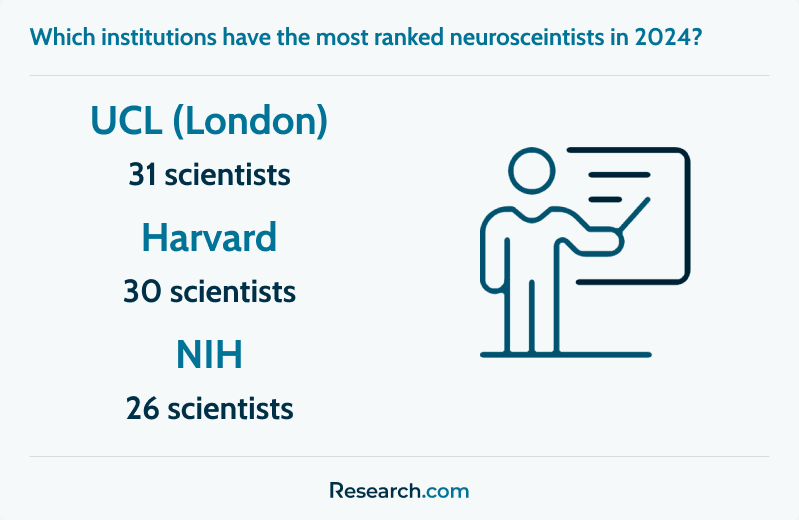
- University College London ranks first among leading neuroscience institutions in 2024, with 31 scientists included in the ranking.
- American universities account for 70% of the top 10 institutions represented in the neuroscience ranking.
- Solomon H. Snyder of the Johns Hopkins University School of Medicine is the highest-ranked neuroscience scientist, with a D-index of 274.
- The average D-index for the top 1% of scientists is 246.6, compared with 111.31 for all scientists included in the ranking.
The complete 2024 list is available here:
Countries with the highest number of leading neuroscientists
The United States remains the most represented country in the 2024 neuroscience ranking, with 536 scientists. That total is down by three scientists from 539 in the prior year.
The United Kingdom ranks second with 112 scientists, an increase of four from the previous year. Germany, Canada, and Italy hold the third, fourth, and fifth positions, respectively, matching their order from last year’s list. Germany has 83 ranked neuroscientists, Canada has 47, and Italy has 33. Germany added five ranked scientists in 2024.
The rest of the top 10 includes France with 30 scientists, the Netherlands with 24, Sweden with 20, Switzerland with 17, and Australia with 16.
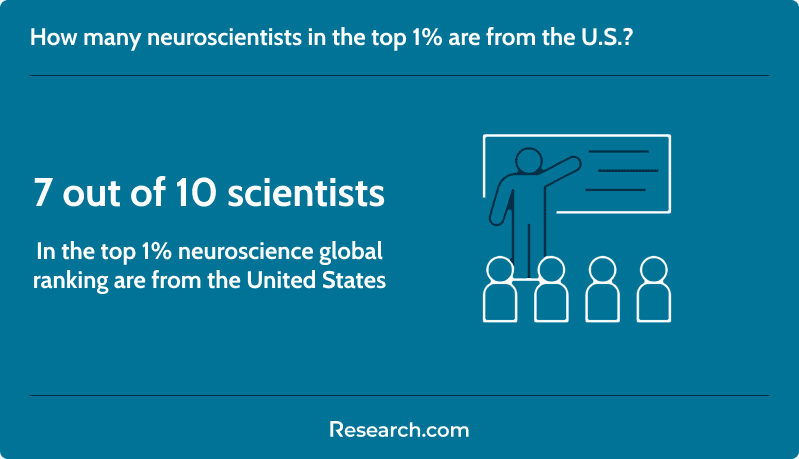
Seven of the 10 scientists in the top 1% are affiliated with institutions in the United States.
The country assigned to a scientist reflects the location of the scholar’s affiliated research institution, not the scientist’s nationality.
| Country | Number of ranked neuroscientists in 2024 | Context from the report |
| United States | 536 | Largest national representation; three fewer scientists than the previous year. |
| United Kingdom | 112 | Second overall; four more scientists than the previous year. |
| Germany | 83 | Third overall; gained five ranked scientists in 2024. |
| Canada | 47 | Fourth overall. |
| Italy | 33 | Fifth overall. |
| France | 30 | Among the remaining top 10 countries. |
| Netherlands | 24 | Among the remaining top 10 countries. |
| Sweden | 20 | Among the remaining top 10 countries. |
| Switzerland | 17 | Among the remaining top 10 countries. |
| Australia | 16 | Among the remaining top 10 countries. |
Institutions with the highest number of leading neuroscientists
University College London holds the top institutional position in the 2024 report, with 31 ranked scientists. Harvard University follows with 30 scientists, and the National Institutes of Health ranks third with 26 scientists.
The University of Oxford is fourth with 22 scientists, while Yale University is fifth with 21 scientists. Stanford University moved down from the 5th spot to the 6th spot, with 20 scientists.
The University of California-San Diego remains in the 7th spot with 19 scientists. The University of California-Los Angeles moved to the 8th spot with 18 scientists, and the University of Cambridge moved from its previous 8th spot to the 9th spot in 2024 with 17 scientists.
American universities and institutions make up 70% of the top 10 leading institutions in the 2024 ranking. The remaining 30% are represented by universities in the U.K.: University College London, the University of Oxford, and the University of Cambridge.
| Institution | 2024 position or status reported | Number of ranked scientists |
| University College London | 1st | 31 |
| Harvard University | 2nd | 30 |
| National Institutes of Health | 3rd | 26 |
| University of Oxford | 4th | 22 |
| Yale University | 5th | 21 |
| Stanford University | 6th | 20 |
| University of California-San Diego | 7th | 19 |
| University of California-Los Angeles | 8th | 18 |
| University of Cambridge | 9th | 17 |
Can neuroscience research expertise open doors to diverse career opportunities?
Yes. Neuroscience training can support careers in academia, healthcare research, biotechnology, pharmaceuticals, neurotechnology, data science, cognitive science, user research, behavioral analytics, and public policy. The strongest candidates usually combine scientific reasoning with technical skills such as statistics, experimental design, data interpretation, programming, imaging analysis, or clinical research methods.
Career flexibility depends on the level of training and the type of experience a person builds. A student focused mainly on wet-lab neuroscience may need different preparation than someone pursuing computational neuroscience, neuropsychology, or neurotechnology. Learners comparing broader academic pathways can also review related options such as the easiest major in college, but neuroscience itself is typically best suited to students who are comfortable with biology, psychology, quantitative reasoning, and sustained research work.
| Career direction | How neuroscience training can help | What to build in addition |
| Academic or laboratory research | Provides grounding in brain systems, experimental methods, and scholarly publication. | Mentored research, grant-writing exposure, publication experience, and advanced methods training. |
| Healthcare and clinical research | Supports work connected to neurological, psychiatric, cognitive, or behavioral conditions. | Clinical research protocols, ethics training, patient-facing experience, and relevant regulatory knowledge. |
| Technology and neurotechnology | Connects brain science with product development, sensors, imaging tools, and human-computer interaction. | Programming, signal processing, data science, and interdisciplinary teamwork. |
| Data science and analytics | Develops experience with complex datasets, measurement uncertainty, and hypothesis testing. | Statistical modeling, machine learning, reproducible workflows, and domain-specific communication skills. |
| Policy, ethics, or science communication | Helps translate brain research for public health, education, law, or technology governance. | Writing, stakeholder communication, ethics, and evidence evaluation. |
Strengthening neuroscience research through digital collaboration and online learning
Digital platforms have changed how neuroscience teams share data, coordinate projects, and work across institutions. This is especially important in neuroscience because many research questions require large datasets, specialized equipment, diverse populations, and expertise from multiple fields.
One major advantage is the ability to combine datasets across research groups. When researchers share anonymized brain imaging data, genetic data, behavioral observations, and related measures, they may be able to identify patterns that smaller single-site studies could miss. The National Institute of Mental Health also highlights the value of collaborative research in advancing scientific understanding.
Neuroscience increasingly benefits from teams that include neurologists, psychologists, geneticists, computer scientists, statisticians, engineers, and clinicians. For example, neurologists may work with computer scientists to improve brain imaging methods, while psychologists and geneticists may study biological contributors to mental health. Online universities and digital research platforms can support this collaboration, but they cannot replace every hands-on laboratory, clinical, or equipment-based requirement.
What factors should be considered when choosing an accredited online neuroscience program?
Students considering online neuroscience programs should start with accreditation, curriculum design, faculty expertise, and access to research or lab-related experiences. Neuroscience is not only a content-heavy field; it also requires methodological training. A strong program should explain clearly how students will learn research design, statistics, data analysis, ethics, and any required lab or practical components.
Program format matters as well. Some online programs may work well for students seeking foundational neuroscience knowledge, pre-professional preparation, or interdisciplinary training. Others may not be sufficient for students who need extensive in-person lab training, supervised clinical preparation, or direct access to specialized equipment. Students comparing nonprofit options can review nonprofit online colleges as part of their broader school search.
| Program factor | What to verify | Why it matters for neuroscience students |
| Accreditation | Confirm that the institution is accredited by a recognized accrediting body. | Accreditation can affect credit transfer, graduate admissions, financial aid eligibility, and employer recognition. |
| Faculty expertise | Review faculty research areas, publications, and neuroscience-specific experience. | Faculty fit is especially important for students who want research mentorship. |
| Curriculum depth | Check coverage of neuroscience fundamentals, research methods, statistics, and data analysis. | A narrow curriculum may not prepare students for advanced study or research roles. |
| Lab or practical components | Ask how the program handles lab work, projects, simulations, or in-person requirements. | Some neuroscience skills are difficult to learn through lectures alone. |
| Research access | Look for thesis options, faculty-led projects, internships, or partnerships. | Research experience can be critical for graduate school and research careers. |
| Cost and flexibility | Compare tuition, fees, transfer credit policies, pacing, and scheduling. | The best program is not always the cheapest; it must also fit your academic and career goals. |
What challenges do online neuroscience programs face?
Online neuroscience programs must solve a difficult problem: they need to provide flexibility while still teaching a field that often depends on laboratory methods, experimental tools, collaborative research, and close faculty feedback. Programs that rely too heavily on recorded lectures may leave students underprepared for research-intensive or clinically adjacent pathways.
Students should also consider technology access, faculty responsiveness, academic advising, and whether the program updates its content as research practices change. If a student is unsure how to compare admissions requirements, program credibility, or long-term fit, guidance from a college admission consultant may help organize the decision process.
How can aspiring neuroscientists benefit from digital education?
Digital education can make neuroscience coursework more accessible for students who need flexible schedules, live far from research universities, or want to combine neuroscience with another discipline. Online formats can also expose students to virtual labs, remote collaboration tools, data analysis assignments, and expert lectures from institutions outside their local area.
The main advantage is access; the main risk is assuming that online convenience automatically equals research readiness. Aspiring neuroscientists should choose programs that provide meaningful projects, analytical training, mentorship, and clear pathways to graduate study or employment. Students beginning their search can compare accredited options through resources on top online colleges.
Do online neuroscience programs offer effective career support and networking opportunities?
Some accredited online neuroscience programs provide career advising, mentoring, internship guidance, alumni connections, employer events, and research networking opportunities. These services can be valuable, particularly for students who cannot easily access campus-based labs or professional networks.
However, students should not assume that every online program offers the same level of support. Before enrolling, ask whether career services are tailored to neuroscience, whether students can connect with faculty researchers, whether internships are available, and whether alumni have entered graduate programs, research positions, healthcare-related roles, or technology careers. For students comparing education paths with earnings potential in mind, Research.com also provides information on the highest paying online degrees.
Can additional certifications boost neuroscience career prospects?
Additional certifications can help when they build concrete skills that employers or research teams actually need. For neuroscience students and professionals, useful add-ons may include training in data analysis, programming, clinical research coordination, research ethics, biomedical tools, project management, or specialized software. The best choice depends on the target role.
A certificate should not be treated as a substitute for required degrees, supervised research, licensure, or clinical training. It works best as a focused credential that fills a skill gap. Students looking for shorter training options can compare short certificate programs that pay well, while still checking whether the content is relevant to neuroscience or an adjacent career.
Is financial aid accessible for online neuroscience programs?
Financial aid may be available for some online neuroscience programs, but eligibility depends on the institution, program type, accreditation status, enrollment level, and student circumstances. Prospective students should review grants, scholarships, institutional aid, employer tuition benefits, and federal aid options before committing.
The most important step is to confirm whether the school and program meet financial aid requirements. Students should also compare the total cost of attendance, not only tuition. Fees, technology costs, textbooks, required campus visits, lab materials, and lost work time can all affect affordability. To begin comparing lower-cost options, students can review online programs that accept FAFSA.
D-index ranking leaders, averages, and distribution
In Europe, Professor Karl J. Friston of University College London in the United Kingdom is the region’s leading neuroscience scientist. He is ranked third globally, with a D-index of 262.
In North America, Professor Solomon H. Snyder of the Johns Hopkins University School of Medicine in the United States leads the region. He is also the top-ranked neuroscience scientist worldwide, with a D-index of 274.
In Oceania, Professor John R. Hodges of the University of Sydney in Australia is the leading scientist in the region. He ranks 52nd in the report, with a D-index of 170.
In the Middle East, Professor Moussa B.H. Youdim of Technion - Israel Institute of Technology in Israel is the leading neuroscientist. Globally, he ranks 189, with a D-index of 131.
In Asia, Professor Mu-ming Poo of the Chinese Academy of Sciences leads the region. He is ranked 234 in the report, with a D-index of 125.
The average D-index for the top 1% of scientists is 246.6, compared with 111.31 for all scientists included in the ranking.
The average number of published articles for the top 1% of scientists in the ranking is 1258.9, compared with 475.31 for all scholars.
The average number of citations for the top 1% of scientists is 232,210.1, compared with 54,355.6 for all scholars.
| Region or group | Leading scientist or measure | Reported ranking detail |
| Europe | Karl J. Friston | Ranked third globally, with a D-index of 262. |
| North America | Solomon H. Snyder | Top-ranking scientist worldwide, with a D-index of 274. |
| Oceania | John R. Hodges | Ranks 52nd, with a D-index of 170. |
| Middle East | Moussa B.H. Youdim | Ranks 189 globally, with a D-index of 131. |
| Asia | Mu-ming Poo | Ranks 234, with a D-index of 125. |
| Top 1% of scientists | Average D-index | 246.6. |
| All ranked scientists | Average D-index | 111.31. |
You can review the ranking methodology in more detail here.
Common mistakes when using scientist rankings
- Using rankings as the only decision factor. A high-ranked scientist or institution may not be the best fit for every student, collaborator, or research project.
- Ignoring subfield match. Neuroscience covers many areas. A leader in one area may not work in the topic you need.
- Assuming affiliation equals nationality. In this report, the country attached to a scientist is based on the affiliated research institution, not nationality.
- Overlooking recent activity. A strong bibliometric record should be paired with a review of current publications, active grants, lab openings, and ongoing collaborations.
- Choosing a program only because it has famous faculty. Students should also check advising access, research opportunities, funding, curriculum, and graduation requirements.
- Assuming online neuroscience programs are interchangeable. Accreditation, lab access, research support, and career services vary widely by institution.
- Focusing only on tuition. Total cost, financial aid eligibility, transfer policies, required visits, and opportunity cost can change the real price of a program.
Questions to ask before choosing a neuroscience program or research opportunity
| Question | Why it matters |
| Is the institution properly accredited? | Accreditation can affect financial aid, transfer credit, graduate admissions, and employer acceptance. |
| Does the program match my target neuroscience subfield? | A strong general neuroscience curriculum may still lack depth in your area of interest. |
| Will I have access to research, labs, datasets, or faculty mentorship? | Research experience is often essential for graduate study and research-focused careers. |
| How does the program teach quantitative and technical skills? | Modern neuroscience increasingly depends on statistics, imaging tools, computational methods, and data interpretation. |
| What support exists for internships, graduate applications, or job placement? | Career support can make a major difference, especially in online or remote programs. |
| What is the full cost after aid, fees, and required materials? | Affordability should be measured by total cost, not advertised tuition alone. |
About Research.com
All research was coordinated by Imed Bouchrika, Ph.D., a computer scientist with an established history of collaborating on international research projects with academic partners. His role was to help ensure that the data remained unbiased, accurate, and up to date.
Research.com is a research portal for science and educational rankings. Its mission is to help professors, research fellows, and students advance their work and identify leading experts across scientific disciplines. Research.com also supports learners by providing information on colleges, academic opportunities, and career paths.
Key Insights
- The 2024 Research.com neuroscience ranking reviewed over 8,000 profiles and required scientists to have a D-index of at least 30, with published work primarily focused on neuroscience.
- The United States leads the ranking by country, with 536 scientists, while University College London leads institutions with 31 ranked scientists.
- Solomon H. Snyder of the Johns Hopkins University School of Medicine is the top-ranked neuroscience scientist globally, with a D-index of 274.
- Rankings are most useful when treated as a research tool, not a final decision. Readers should also evaluate subfield fit, recent publications, mentorship access, funding, and collaboration potential.
- Neuroscience careers increasingly reward interdisciplinary skills, especially in data analysis, research design, digital collaboration, computational methods, and communication across scientific fields.
- Students considering online neuroscience programs should verify accreditation, lab or practical learning options, faculty expertise, career support, and financial aid eligibility before enrolling.


