
World Online Ranking of Best Physics Scientists – 2024 Report

Co-Founder and Chief Data Scientist
The 2024 Research.com ranking of the best scientists in physics helps researchers, students, institutions, funders, and science-focused organizations identify influential scholars whose work has shaped modern physics. Released on May 24, 2024, this 3rd edition highlights leading experts across countries and institutions using bibliometric evidence from more than 4,600 scientific profiles reviewed through sources such as OpenAlex and CrossRef.
This guide explains what the ranking shows, how to interpret the results, which countries and institutions are most represented, and what the findings suggest for aspiring physics researchers. It also outlines practical academic and career considerations for students who want to build a serious research path in physics, from choosing the right program to understanding how funding, collaboration, policy, and emerging technologies affect research opportunities.
Quick answer: what does the 2024 physics scientists ranking show?
The 2024 Research.com physics ranking identifies the top 1,000 scientists in the field based on research impact indicators, including the scientist's D-index, published work, awards, and career achievements. To be considered, a scholar needed a D-index threshold of 40 when most of their publications were in physics.
| Ranking question | Direct answer from the 2024 report |
| Who leads the global physics ranking? | Michael A. Strauss from the University of Oklahoma, United States, ranks first with a D-index of 293. |
| Which country has the most ranked physics scientists? | The United States leads with 540 scholars, representing 54.0% of the top 1,000 list. |
| Which institution has the largest number of ranked physics scientists? | The California Institute of Technology is identified as the leading institution, with 41 scientists in the key findings and 42 scientists in the institution-level discussion. |
| What is the average D-index among the top 1%? | The top 1% has an average D-index of 238.7, compared with 136.93 for the full top 1,000 group. |
| Where can readers see the complete list? | The full ranking is available through the Research.com physics scientists ranking page. |
How Research.com evaluated leading physics scientists
For the 2024 edition, Research.com reviewed more than 4,600 scientific profiles from bibliometric databases including OpenAlex and CrossRef. The evaluation prioritized evidence of sustained research influence, including published papers, field-specific awards, and major career contributions in physics.
The D-index threshold for inclusion was set at 40 for scholars whose work was primarily published in physics. This threshold helps ensure that the ranking reflects substantial and field-relevant research activity rather than short-term visibility or isolated publication counts.
Readers should treat the ranking as a structured research-impact tool, not as the only measure of scientific excellence. A scientist’s placement can help identify influential scholars and institutions, but research quality, mentorship, collaboration fit, and subfield relevance remain important when evaluating academic opportunities.
Latest discoveries in physics research
One of the most important recent developments in astrophysics is the first evidence of a gravitational-wave background produced by collisions involving supermassive black holes. This finding gives researchers a new way to study how black holes merge over cosmic time and how those events relate to the formation and evolution of galaxies.
Observations from the James Webb Space Telescope have also reshaped key questions about the early universe. By detecting light from galaxies that formed just 300 million years after the Big Bang, JWST findings have raised new questions about galaxy formation and growth. The telescope’s evidence that early galaxies may have been brighter and more massive than earlier models predicted is forcing scientists to refine theories about cosmic structure, black holes, and the timeline of the universe.
The key findings for the 3rd edition of the best physics scientists ranking
- The United States has the largest presence in the 2024 report, with 540 scholars. That equals 54.0% of the physics scientists included in the top 1,000 ranking.
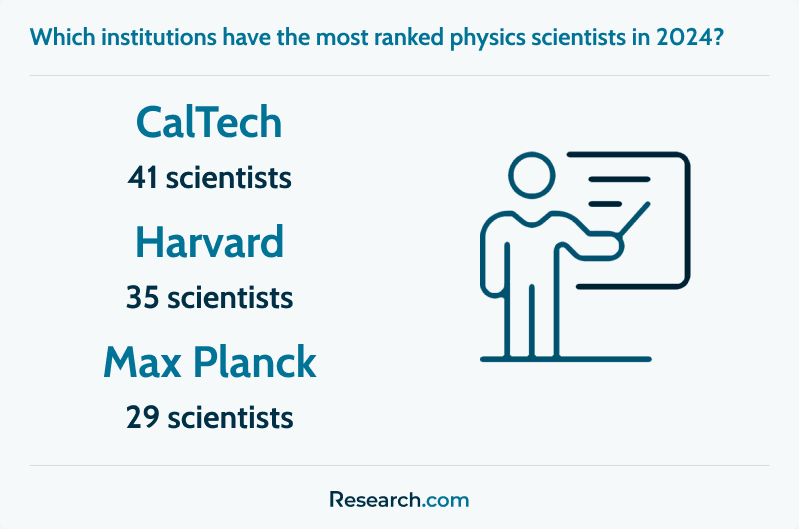
- The California Institute of Technology remains the leading university by number of ranked physics researchers, with 41 scientists listed in the 2024 key findings.
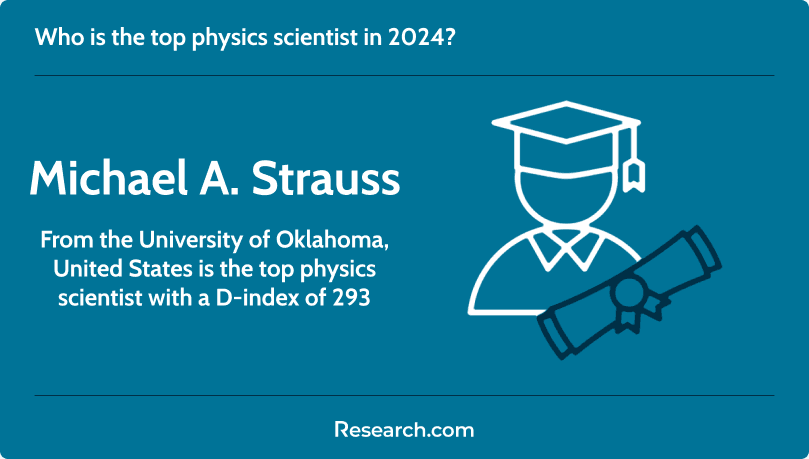
- Michael A. Strauss of the University of Oklahoma, United States, is the highest-ranked physics scientist, with a D-index of 293.
- The average D-index for the top 1% of ranked scientists is 238.7, while the average across the top 1,000 scientists is 136.93.
The complete 2024 list is available here:
View the full Best Physics Scientists Ranking
Countries with the highest number of leading physics scientists
The United States dominates the 2024 ranking with 540 researchers, accounting for 54.0% of the top 1,000 physics scientists. The U.K. remains in second place with three more scientists this year. Germany follows with 83 scientists, Italy has 45, and France reaches 40 after adding eight more scientists.
The rest of the top 10 countries are Canada with 23 scientists, Japan with 22, Australia with 20, Switzerland with 19, and the Netherlands with 16 scientists.
Among the top 1%, seven out of 10 scientists are affiliated with institutions in the United States. The other countries represented in the top 1% are Germany through the Max Planck Society and the United Kingdom through the University of Oxford and the University of Cambridge.
The country assigned to each scientist reflects the affiliated research institution recorded in MAG. It does not necessarily indicate the scientist’s nationality.
| Country or region | What the 2024 ranking shows | How readers should interpret it |
| United States | 540 scientists, or 54.0% of the top 1,000 | The U.S. has the strongest institutional concentration in this ranking, especially among the highest-impact researchers. |
| U.K. | Second place, with three more scientists this year | The U.K. remains a major physics research hub, especially through institutions represented in the top 1%. |
| Germany | 83 scientists | Germany’s strength is reflected in institutions such as the Max Planck Society. |
| Italy | 45 scientists | Italy has a notable presence among the top-ranked physics research countries. |
| France | 40 scientists, with eight more scientists | France continues to be represented among the leading countries for physics research output. |
Institutions with the highest number of leading scientists
In the 2024 report, the California Institute of Technology remains in first place with 42 scientists in the institution-level summary. Harvard University moves into the second position with 35 scientists, replacing the Max Planck Society. Max Planck takes the third position, while Stanford University rises from spot 6 in 2023 to the 4th spot this year, with 22 scientists.
The remaining institutions in the top 10 are Princeton University, National Institute for Astrophysics, University of California-Berkeley, MIT, University of Cambridge, and Fermilab.
Institutions in the United States account for 80% of the top 10 leading institutions. The remaining 20% are represented by Germany through the Max Planck Society and the U.K. through the University of Cambridge.
Among the top 10 scientists, seven are affiliated with U.S.-based universities and institutions. The other three are affiliated with the Max Planck Institute for Astrophysics in Germany, the University of Cambridge, and the University of Oxford in the U.K.
| Institution | 2024 ranking note | Why it matters for students and researchers |
| California Institute of Technology | Listed as the top institution, with 42 scientists in the institution section | Signals a very strong concentration of high-impact physics research and potential collaboration networks. |
| Harvard University | Second position with 35 scientists | Shows broad research strength and visibility in physics-related scholarship. |
| Max Planck Society | Third position | Highlights Germany’s role in advanced physics research through major research institutes. |
| Stanford University | Moved from spot 6 in 2023 to the 4th spot, with 22 scientists | Indicates a strong and rising institutional presence in the ranking. |
| Other top 10 institutions | Princeton University, National Institute for Astrophysics, University of California-Berkeley, MIT, University of Cambridge, and Fermilab | These institutions may be useful reference points for students exploring research environments, collaborators, or graduate study options. |
How to use the physics scientists ranking when making academic or research decisions
A ranking can help readers identify influential scientists and research centers, but it should not be used as a shortcut for choosing a graduate program, advisor, collaborator, or employer. Physics is highly specialized, and the best option depends on the reader’s subfield, research interests, funding needs, and career goals.
| If your goal is... | Use the ranking to... | Also verify... |
| Find a potential Ph.D. advisor | Identify researchers with strong publication influence in your area | Whether the scientist is accepting students, has funding, and offers the mentorship style you need |
| Compare graduate programs | See which institutions have clusters of highly ranked physics researchers | Program fit, lab access, assistantships, completion expectations, and placement outcomes |
| Build a collaboration list | Locate scientists and institutions with visible research impact | Recent publications, active grants, conference presence, and openness to collaboration |
| Assess institutional research strength | Review how many leading scientists are affiliated with an institution | Whether strength is broad across physics or concentrated in one subfield |
What are the optimal academic pathways for a successful career in physics research?
A strong physics research career usually starts with rigorous preparation in mathematics, classical mechanics, quantum mechanics, electromagnetism, statistical physics, laboratory methods, and computational analysis. Students who plan to pursue research should look beyond the name of a major and examine whether a program offers access to faculty research, advanced coursework, undergraduate research opportunities, and preparation for graduate study.
Interdisciplinary preparation is increasingly valuable. Data science, high-performance computing, engineering, materials science, astronomy, and applied mathematics can all strengthen a physics researcher’s toolkit. Students comparing majors may also review broader college-planning resources such as guides to accessible college majors, but they should be careful not to choose an “easy” path if it does not provide the quantitative foundation required for physics research.
| Academic stage | What to prioritize | Common mistake to avoid |
| Undergraduate study | Core physics, advanced mathematics, coding, lab experience, and faculty-led research | Choosing a program only because it is convenient without checking research access |
| Master’s preparation | Specialized coursework, thesis or research projects, and stronger technical depth | Assuming every master’s program is equally useful for Ph.D. admission |
| Ph.D. training | Advisor fit, funding, publications, collaboration opportunities, and dissertation direction | Selecting a famous department without confirming the right advisor and research group |
| Postdoctoral or early-career research | Publication strategy, grants, network building, and independent research identity | Relying only on institutional prestige instead of building a focused research profile |
Strengthening research through online universities
Physics research increasingly depends on collaboration across institutions, countries, and technical specialties. Online universities and digital learning platforms can support this ecosystem by expanding access to coursework, research tools, remote seminars, and interdisciplinary training, especially for students and professionals who cannot relocate immediately.
The gravitational-wave background discovery illustrates why large-scale coordination matters. It relied on collaboration among multiple observatories and research teams, combining data and analytical methods that would be difficult for a single institution to manage alone.
The James Webb Space Telescope offers another example of global scientific coordination. The JWST project team involved NASA, the European Space Agency, the Canadian Space Agency, and many research partners. This kind of distributed expertise shows how modern physics and astronomy often advance through coordinated networks rather than isolated laboratories.
For students, the practical lesson is clear: technical training matters, but so does the ability to work across teams, tools, datasets, and institutions. Online learning can help fill skill gaps, but it should complement—not replace—hands-on research experience when the goal is a research-intensive physics career.
How do research funding strategies drive breakthrough discoveries in physics research?
Breakthrough physics often requires long timelines, specialized equipment, advanced computing, and teams that span multiple disciplines. Funding strategies therefore shape which questions can be pursued, how quickly projects scale, and whether early-career researchers can participate in high-risk work.
Government grants, private investment, philanthropic support, and industry partnerships can each play a role. The strongest funding models often combine stable support for foundational research with flexible resources for exploratory projects that may not produce immediate applications. Researchers who want to broaden their career options can also examine education pathways tied to workforce flexibility, including resources on the fastest degree options with strong career potential, while recognizing that advanced physics research typically requires deep and sustained graduate-level preparation.
What is the role of accelerated doctoral programs in advancing physics research?
Accelerated doctoral pathways can help some students move more quickly from coursework into original research, especially when they already have strong preparation and a clear research direction. In physics, however, speed should not come at the expense of advisor fit, funding stability, laboratory access, or publication readiness.
Flexible doctoral models may be useful for students who need nontraditional scheduling or who already hold substantial graduate credits. Resources discussing the shortest doctoral program online can help readers understand accelerated structures, but aspiring physicists should verify whether any program provides the research depth, facilities, and mentorship needed for their subfield.
| Program feature | When it can help | What to check before enrolling |
| Accelerated timeline | You have strong prerequisites and a defined research interest | Whether the timeline allows enough time for publishable research |
| Online or hybrid coursework | You need flexibility for early-stage theory, math, or computational training | Whether research, lab, and dissertation requirements can realistically be completed |
| Competency-based structure | You can demonstrate mastery efficiently | Whether physics departments, labs, and employers recognize the credential |
| Transfer credit options | You already completed graduate-level physics or mathematics coursework | How many credits transfer and whether they shorten time to candidacy |
How does science policy influence research excellence?
Science policy affects physics research through funding priorities, grant rules, infrastructure investment, international collaboration frameworks, and support for early-career scientists. Well-designed policies can make it easier for researchers to pursue ambitious projects, share data, build facilities, and work across academia, government, and industry.
Policy expertise is also useful for scientists who want to move into leadership, funding agencies, advisory roles, or research administration. Programs such as a master’s in public policy online can help professionals understand how research priorities are set and how evidence-based policy can support long-term scientific progress.
How are emerging technologies shaping physics research?
Computational tools are changing how physics research is conducted. Advanced simulation software, large-scale data analysis, artificial intelligence, machine learning, digital repositories, and collaborative platforms now help researchers model complex systems, detect patterns, and manage datasets that would be difficult to evaluate manually.
These technologies are especially important in fields that generate massive observational or experimental data, including astrophysics, particle physics, condensed matter physics, and materials research. Students who want to stay competitive should build fluency in programming, statistics, data visualization, reproducible workflows, and responsible use of AI-assisted tools.
Accessible online education can help learners build some of these skills. For example, students comparing flexible options may review resources on accredited online colleges with no application fee, while still confirming that any chosen program has the rigor, accreditation, and research preparation needed for their long-term goals.
How do professional certification programs boost career opportunities in physics research?
Certifications do not replace a physics degree or research record, but they can strengthen a scientist’s employability in applied and interdisciplinary settings. Credentials in programming, data science, machine learning, project management, laboratory safety, cloud computing, or technical instrumentation can make a physics graduate more competitive for roles in industry, government labs, research operations, and scientific computing.
Students and professionals considering credentials should focus on skills that match their intended role rather than collecting certificates without a plan. Research.com’s guide to certificate programs connected to high paying certificate jobs can be useful for comparing career-oriented options, but physics researchers should prioritize credentials that complement their technical specialty.
How can affordable online education expand access to physics research opportunities?
Affordable online education can reduce barriers for students who need flexible scheduling, lower upfront costs, or access to prerequisite coursework before applying to research-focused programs. Online courses can be especially useful for strengthening mathematics, programming, statistics, scientific writing, and computational methods.
However, students should evaluate online options carefully. Research-intensive physics training often requires direct mentorship, lab participation, advanced instrumentation, or access to research groups. Online learning is most effective when it supports a broader plan that includes supervised research experience.
Cost-conscious students can compare institutions that participate in federal aid using resources such as Research.com’s guide to online schools that take FAFSA. Before enrolling, they should confirm accreditation, transfer policies, course rigor, and whether credits will support their intended academic pathway.
Common mistakes when using scientist rankings or choosing a physics research path
| Common mistake | Why it can hurt your decision | Better approach |
| Using rankings as the only decision factor | A highly ranked scientist or institution may not match your subfield, goals, or mentorship needs. | Use rankings as a starting point, then review recent publications, research groups, funding, and advisor availability. |
| Focusing only on institutional prestige | A prestigious university is not automatically the best fit for every physics specialization. | Compare laboratories, faculty fit, assistantships, placement outcomes, and collaboration opportunities. |
| Ignoring accreditation and academic quality | Credits or credentials from weak programs may not support graduate admission or career mobility. | Verify institutional accreditation and the program’s relevance to physics research preparation. |
| Choosing the fastest program without checking research depth | Accelerated options may not provide enough time for advanced research, publications, or dissertation development. | Prioritize research quality, advisor support, and funding stability over speed alone. |
| Assuming online study replaces lab or research experience | Many physics research careers require direct experimentation, instrumentation, or supervised projects. | Use online education to build skills, then seek research assistantships, internships, labs, or faculty projects. |
| Overlooking funding early | Graduate physics training can be difficult to sustain without assistantships, grants, or institutional support. | Ask programs about stipends, tuition coverage, research funding, teaching expectations, and summer support. |
D-index ranking-leaders, averages, and distribution
In North America, Professor Michael A. Strauss of the University of Oklahoma, United States, leads both the region and the global ranking. His D-index is 293.
In Europe, Professor Simon D. M. White of the Max Planck Institute for Astrophysics, Germany, is the top-ranked scientist in the region and places number four worldwide. His D-index is 231.
In Asia, Professor Xiang Zhang of the University of Hong Kong, China, ranks first regionally and number 82 globally with a D-index of 187.
In South America, Professor Maria-Teresa Dova of the National University of La Plata, Argentina, is the leading scientist. Professor Dova ranks 133 globally and has a D-index of 172.
In Oceania, Professor Joss Bland-Hawthorn of the University of Sydney, Australia, is ranked 1st in the region. He is also listed as no. 214 in the global ranking, with a D-index of 156.
| Metric | Top 1% of ranked scientists | Top 1,000 ranked scientists |
| Average D-index | 238.7 | 136.93 |
| Average number of published articles | 1,650.1 | 793.51 |
| Average number of citations | 333,665.9 | 98,132.58 |
The gap between the top 1% and the full top 1,000 group shows how concentrated research impact can be at the very highest level of physics scholarship. At the same time, D-index, publication counts, and citation totals should be interpreted alongside research area, publication norms, collaboration patterns, and career stage.
You can learn more about how Research.com creates its rankings by reviewing the Research.com methodology.
Questions to ask before choosing a physics research program or advisor
- Does the program have faculty actively publishing in the physics subfield I want to study?
- Are graduate students funded through assistantships, fellowships, grants, or other support?
- Will I have access to the laboratories, datasets, observatories, computing resources, or collaborations needed for my research?
- How often do students publish before graduation?
- What are the placement outcomes for graduates pursuing academia, national labs, industry, or policy roles?
- Is the advisor accepting new students, and what is their mentorship style?
- How does the program support interdisciplinary work in data science, engineering, astronomy, materials science, or applied mathematics?
- Can online or transfer coursework strengthen my preparation without weakening my research trajectory?
Key insights
- The 2024 Research.com physics ranking reviewed more than 4,600 scientific profiles and included scholars who met a D-index threshold of 40 when most of their publications were in physics.
- The United States has the strongest representation, with 540 scientists, or 54.0% of the top 1,000 ranking.
- Michael A. Strauss of the University of Oklahoma ranks first globally with a D-index of 293.
- The California Institute of Technology remains the leading institution in the report, with 41 scientists in the key findings and 42 scientists in the institution-level summary.
- Rankings are useful for identifying influential researchers and institutions, but students should also evaluate advisor fit, research facilities, funding, accreditation, and career outcomes.
- Modern physics research is increasingly shaped by global collaboration, large-scale data, AI-enabled analysis, advanced simulations, and interdisciplinary training.
- Online education, accelerated programs, and certifications can support a physics career, but they should be chosen carefully and aligned with serious research preparation.
About Research.com
All research was coordinated by Imed Bouchrika, Ph.D., a computer scientist with an established record of collaboration across international academic research projects. His role was to help ensure that the data used in this report remained unbiased, accurate, and up-to-date.
Research.com is a research portal for science and educational rankings. Its mission is to help professors, research fellows, and students advance their work and identify leading experts across scientific disciplines. Research.com also supports learners by helping them compare colleges, academic options, and career pathways.


