
World Online Ranking of Best Neuroscientists – 2025 Report

Co-Founder and Chief Data Scientist
On May 13, 2025, Research.com released the fourth edition of the world's best scientists in neuroscience. This report aims to spotlight the leading minds shaping neuroscience today. By recognizing their research and global influence, the ranking helps promote visibility for neuroscience experts.
We share these rankings to recognize researchers making key breakthroughs in neuroscience. This yearly list introduces top figures from labs, universities, and institutions worldwide. It also helps connect students, faculty, and organizations with the experts leading the way in brain science. By identifying the top performers in the field, this report encourages greater engagement and collaboration across borders and disciplines.
For the 2025 edition, experts reviewed data from over 9,000 scientist profiles. These came from trusted bibliometric sources. The rankings are based on a mix of performance indicators, including impact, productivity, and influence within neuroscience. These data points ensure the final list reflects real contributions and lasting scientific value.
To be considered for this list, a neuroscientist must meet certain conditions. Their D-index (discipline-specific H-index) must reach at least 20, especially if most of their published work falls within neuroscience. Selection also depends on how much of their work belongs to the field, their research awards, and overall career achievements. These requirements ensure that every scholar in the report truly stands out in their expertise.
Latest discoveries in neuroscience research
In 2025, scientists in Germany made a significant breakthrough in diagnosing Parkinson’s disease early. They developed a test that detects misfolded alpha-synuclein proteins in spinal fluid using an immuno-infrared sensor (iRS). This test showed 97% sensitivity and 92% specificity in distinguishing Parkinson’s and multiple system atrophy from other conditions. By identifying these protein changes early, doctors can diagnose the disease before severe brain damage occurs. This advancement could lead to earlier treatments and better patient outcomes.
Meanwhile, researchers in the United States have developed a promising vaccine targeting Alzheimer’s disease. The vaccine uses virus-like particles to stimulate the immune system against phosphorylated tau proteins linked to Alzheimer’s. In mice and non-human primates tests, the vaccine reduced harmful tau buildup and improved memory and motor functions without causing significant side effects. These findings suggest the vaccine could slow or prevent Alzheimer’s progression, offering hope for future human trials.
The key findings for the 4th edition of the best neuroscientists ranking
- The United States leads with 526 neuroscientists in the top 1,000, accounting for over half of the global total.
- University College London tops the institutional list with 31 scientists in the ranking.
- Harvard University holds the second-highest number of top neuroscientists, with 29 individuals.
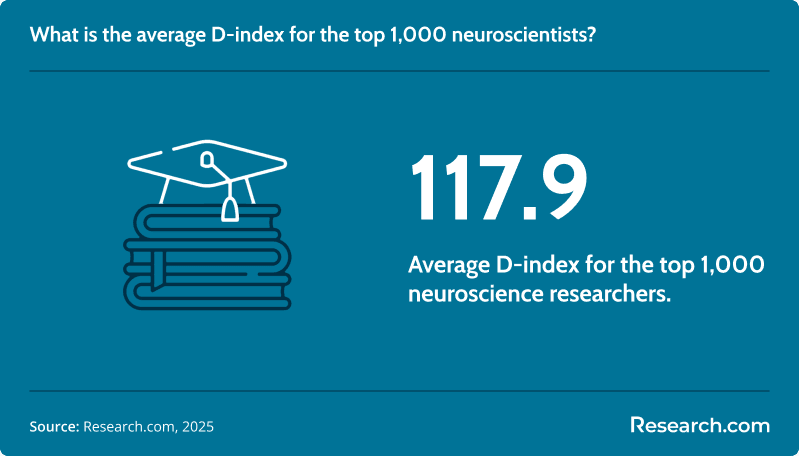
- The average D-index for the top 1% of neuroscientists is 256.7, more than double the overall average of 117.9.
- Professor Solomon H. Snyder from Johns Hopkins University ranks 1st globally with a D-index of 283.
- The lowest D-index of a scientist in the 2025 ranking is 30, setting the entry threshold for global recognition.
The full ranking for the 2025 list of the best neuroscientists can be found here:
Countries with the highest number of leading neuroscientists
The 2025 report shows the United States continues to lead in neuroscience, with 526 scientists in the top 1,000. While still the dominant force, this marks a slight drop from last year’s 536, continuing a downward trend from the 539 reported in 2023. The United Kingdom holds second place again, with 111 scientists, just one less than the 112 listed in the 2024 edition. Germany remains third with 81 neuroscientists, a minor drop from 83 in the previous year.
Canada and Italy keep their fourth and fifth positions with 52 and 31 scientists, respectively. Canada shows strong growth, adding five more top researchers compared to last year’s 47. Italy, on the other hand, saw a slight decline from 33 to 31. The Netherlands climbs ahead of France this year, with 30 scientists ranked, up from 24 in 2024. France, now in seventh place, has 28 neuroscientists on the list, down from 30.
Australia made a notable jump, rising to eighth place with 23 scientists, an increase from last year’s 16. Sweden dropped slightly to ninth with 19, compared to 20 in 2024. Switzerland is in tenth place with 17 scientists, the same as last year. These shifts show a growing international presence in neuroscience, with several countries strengthening their research impact.
Please note that the country associated with a scientist is based on their affiliated research institution according to MAG, not on their actual nationality.
Institutions with the highest number of leading neuroscientists
In the 2025 report, University College London (UCL) maintains its position at the top, with 31 neuroscientists in the global top 1,000, unchanged from last year. Harvard University follows closely with 29 scientists, dropping slightly from 30 in the 2024 edition. The National Institutes of Health (NIH) remains in third place but now lists 25 leading scientists, down from 26 previously.
The University of Oxford climbs slightly to fourth place with 23 scientists, up from 22 last year, strengthening its hold on the fourth spot. The University of California, San Diego (UC San Diego) moves significantly to fifth place with 21 scientists, an increase from 19 in 2024. Stanford University drops to sixth with 20 scientists, the same number as last year, losing its earlier lead due to UC San Diego’s gain.
Yale University slips to seventh with 18 scientists, down from 21. The University of Cambridge remains steady with 17 scientists. Still, it is now in eighth place with the University of California, San Francisco, which holds the same number. The University of California, Los Angeles (UCLA) rounds out the top ten with 16 neuroscientists, slightly decreasing from 18 in the previous report.
This year, American institutions account for 70% of the top 10. In comparison, the United Kingdom represents the remaining 30% with UCL, Oxford, and Cambridge. Canadian institutions, represented by the University of Toronto and McGill University, and the Mayo Clinic, a U.S. non-academic research center, also make notable appearances in the rankings.
Strengthening neuroscience research through online universities
Online universities are playing a growing role in supporting neuroscience education and research. As access to online learning expands, more students can study biology, biomedical sciences, and neuroscience-related fields from anywhere in the world. According to the latest data from the NCES, over 131,000 undergraduate degrees were awarded in biological and biomedical sciences. This shows a strong interest in subjects that form the foundation of neuroscience.
Online universities help meet this demand by offering flexible, affordable pathways to these degrees. Students who may not have access to top research institutions can still build a strong academic foundation through online programs. This creates a broader pool of future neuroscientists who can contribute to discoveries and help drive innovation in the field.
As online learning platforms grow more advanced, some even provide access to virtual labs, simulations, and collaborative research projects. These tools make it easier for students to gain practical experience and prepare for graduate-level studies or careers in neuroscience. With the continued rise of online universities, the academic pipeline into neuroscience is expanding, helping ensure that talent and opportunity are not limited by geography or financial barriers.
D-index ranking — leaders, averages, and distribution
In North America, Professor Solomon H. Snyder from Johns Hopkins University School of Medicine, United States, leads the region and ranks 1st globally with a D-index of 283, the highest in the world.
In Europe, Professor Karl J. Friston from University College London, United Kingdom, is the top neuroscientist and ranks 3rd globally with a D-index of 275.
In Oceania, Professor John R. Hodges from the University of Sydney, Australia, leads the region and ranks 51st globally with a D-index of 179.
In Asia, Professor Arthur F. Kramer from Northeastern University, China, ranks 139th globally and leads his region with a D-index of 148.
In South America, Professor Ivan Izquierdo from the Pontifical Catholic University of Rio Grande do Sul, Brazil, is the leading neuroscientist and ranks 577th globally with a D-index of 104.
In Africa, Professor Paul R. Manger from the University of the Witwatersrand, South Africa, ranks 3691st globally and is the continent’s top neuroscientist with a D-index of 58.
The average D-index for the top 1% of scientists in the top 1,000 is 256.7, while the overall average for all ranked neuroscientists is 117.9.
The average number of discipline publications for the top 1% is 1,328.0, compared to 502.86 for all scientists in the top 1,000.
On average, the top 1% of scientists have received 260,380.7 citations, while the overall average is 61,436.06 citations.
The lowest D-index among those who qualified for this year’s ranking is 30.
You can learn more about the methodology used to create this report here.
About Research.com
All research was coordinated by Imed Bouchrika, Ph.D., a computer scientist with a well-established record of collaboration on a number of international research projects with different partners from the academic community. His role was to make sure all data remained unbiased, accurate, and up-to-date.
Research.com is the number one research portal for science and educational rankings. Our mission is to make it easier for professors, research fellows, and students to progress with their research and find the top experts in a wide range of scientific disciplines. Research.com is also a leading educational platform that helps students find the best colleges, academic opportunities, and career paths.


