
World Online Ranking of Best Plant Science & Agronomy Scientists – 2025 Report

Co-Founder and Chief Data Scientist
On April 16, 2025, Research.com released its fourth annual ranking of the leading scientists in plant science and agronomy. This report aims to spotlight researchers whose work significantly advances the field through technological and scientific innovation.
With the 2025 edition, our goal is to support the scientific community by offering a comprehensive directory of top-tier experts in plant science and agronomy. This report is designed to assist fellow researchers, academic institutions, and global organizations in identifying and connecting with leading professionals in the discipline.
Our team evaluated nearly 4,000 scientists listed in databases such as Google Scholar and Microsoft Academic Graph. We assessed candidates using a range of metrics—including citation counts and academic honors—to determine their eligibility for the report. To qualify, researchers needed a D-index of at least 30, provided the majority of their work falls within the scope of plant science and agronomy.
Latest discoveries in plant science & agronomy research
Recent advancements in plant science and agronomy are significantly enhancing our understanding of plant biology and improving crop breeding techniques. At the University of California, Davis, researchers have developed a genetic tool that utilizes CRISPR-Cas9 to manipulate micro-RNAs, specifically targeting the AP2L2 genes. By inhibiting a particular micro-RNA that normally suppresses these genes, they achieved increased expression of AP2L2, resulting in shorter wheat and triticale plants without compromising grain quality or yield. This innovation allows breeders to efficiently produce grain varieties with tailored heights, optimizing them for diverse environmental conditions and reducing the time required for developing new varieties.
In a complementary development, scientists at Iowa State University have pioneered a single-cell proteomics (SCP) method to analyze proteins within individual plant cells. Overcoming challenges posed by plant cell walls, they employed enzymes to dissolve the walls and extract the protoplasts for detailed protein analysis. Applying this technique to Arabidopsis thaliana root cells, they quantified over 3,000 proteins and identified nearly 600 that varied in abundance between neighboring cell types. This granular insight into protein distribution enhances our comprehension of plant cell functions and interactions, laying the groundwork for precision breeding strategies aimed at improving crop resilience and productivity.
The key findings for the 4th edition of the best plant science and agronomy scientists ranking
- Scientists from the United States dominate the list with 260 scholars included in 2025. However, a sharp decrease of 17 scientists was noted compared to the previous year.
- The U.S. is followed by Australia (93 scientists), the United Kingdom (93), Germany (66), and China (62).
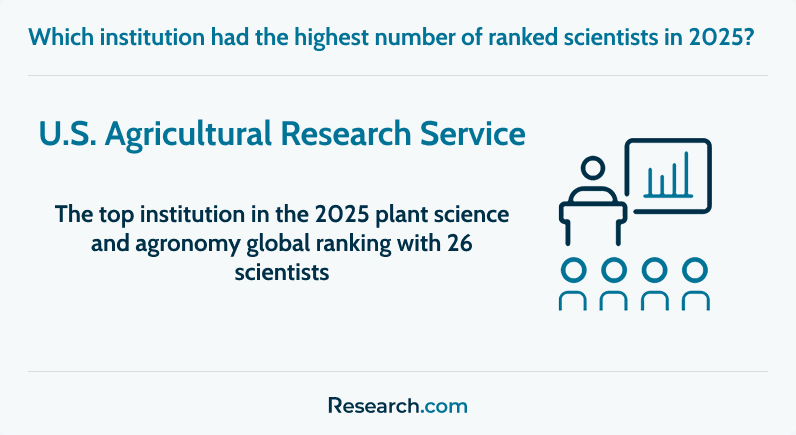
- In the 4th edition of our report, the U.S. Agricultural Research Service is once again the leader with 26 scientists, consistent with its total last year.
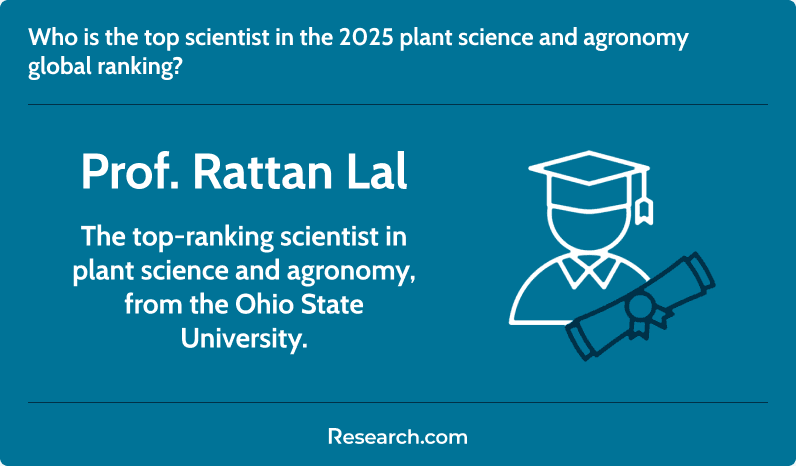
- The top-ranking scientist in plant science and agronomy is Rattan Lal from the Ohio State University in the United States.
- The average D-index for the top 1% of scientists is 151 against an average of 74 for all 1,000 scientists included in the ranking.
The full ranking for the 2025 list of best plant science and agronomy scientists can be found here:
WORLD'S BEST PLANT SCIENCE & AGRONOMY SCIENTISTS RANKING
Countries with the highest number of leading plant science & agronomy scientists
Scientists from the United States dominate the list with 260 scholars included in our 2025 report, 17 scientists less compared to 2024. This makes up 26% of the plant science agronomy scientists' ranking.
Australia ranks second with 93 scientists, followed by the United Kingdom with 93 scientists. While Australia's total remained the same, the UK saw a decrease of two scientists.
The other leading countries are Germany with 66 scientists, two scientists less than last year, China with 62, Canada with 48, Spain with 44, and France with 34.
The Netherlands (10th placer in 2024) climbed to the 9th rank with 25 scientists while Italy moved to the 10th spot with 25 scientists.
Please note that the country associated with a scientist is based on their affiliated research institution according to MAG, not on their actual nationality.
How do government policies and funding contribute to the progress of plant science and agronomy?
Government policies and funding play a crucial role in driving innovation and progress in plant science and agronomy. Strategic investments from public institutions support cutting-edge research, development of sustainable agricultural practices, and the improvement of crop yields and resilience. Policies that prioritize climate adaptation, food security, and technological advancement help guide research priorities and ensure alignment with national and global needs.
Government grants and funding programs provide essential resources for universities, research institutions, and collaborative projects, enabling scientists to explore novel solutions to agricultural challenges. These efforts not only advance scientific understanding but also promote the practical application of research to benefit farmers, ecosystems, and food systems worldwide.
Institutions with the highest number of leading scientists
The U.S. Agricultural Research Service continues to lead in 2025, with 26 ranked scientists, which is consistent with the previous year. In second place is the University of California, Davis, with 23 recognized scientists.
Rounding out the top five are the University of Western Australia with 18 scientists, INRAE (Institut national de recherche pour l'agriculture, l'alimentation et l'environnement) with 17 scientists, and the Swedish University of Agricultural Sciences moving one rank higher with 16 scientists.
From its 40% share in 2024, American universities make up only 20% of the top 10 institutions this year. The remaining institutions in the top 10 are located in Australia, France, Sweden, the Netherlands, China, Canada, UK, and Spain.
Among scientists in the top 1% of the rankings, only one is affiliated with a U.S.-based institution—Ohio State University. This institution is also home to the top-ranked scientist, Rattan Lal. Meanwhile, the UK, China, Australia, and Germany are represented by two scientists each in this elite group. One scientist representing Utrecht University from the Netherlands completes the top 1%.
Strengthening research among online universities
Online universities play a growing role in advancing plant science and agronomy research by expanding access to education, collaboration, and innovation. Through flexible, remote learning platforms, they make it possible for students and professionals around the world to engage with the latest scientific developments. Many programs offer virtual labs, data analysis tools, and research opportunities that mirror those in traditional settings, allowing learners to contribute to ongoing studies or initiate their own projects. Online universities foster global academic networks that encourage interdisciplinary collaboration, enabling researchers to exchange ideas and solutions to pressing agricultural challenges. This increased accessibility and connectivity help drive the evolution of plant science and agronomy in both academic and practical contexts.
How can plant science and agronomy scientists accelerate their career trajectory?
Plant science and agronomy scientists can accelerate their career trajectory by actively seeking advanced education, networking with industry leaders, and engaging in interdisciplinary collaborations. Pursuing specialized certifications, attending conferences, and participating in research-focused workshops helps them stay at the forefront of emerging technologies and techniques.
For those beginning their academic journey, enrolling in an online associates degree can provide a strong foundation in agricultural science and related disciplines. By publishing high-impact research and contributing to well-regarded scientific journals, scientists can establish themselves as thought leaders in the field. These efforts not only enhance their own expertise but also foster knowledge sharing and collaboration, leading to accelerated advancements in plant science and agronomy.
Building a robust professional network also opens doors to funding opportunities, mentorship, and collaborative projects that further propel research and innovation in sustainable agriculture, crop management, and environmental solutions.
What are the key challenges hindering innovation in plant science and agronomy?
Key challenges hindering innovation in plant science and agronomy include limited interdisciplinary collaboration, underrepresentation of diverse voices, gaps in research training, and insufficient support for early-career scientists. These obstacles can slow the pace of discovery and limit the application of new technologies in sustainable agriculture. The Center for the Improvement of Mentored Experiences in Research (CIMER) helps address these challenges by equipping mentors with tools to create inclusive, supportive, and collaborative research environments. By promoting effective mentorship practices, CIMER enhances researcher development, fosters diversity and equity, and strengthens the interdisciplinary networks crucial for innovation in plant science and agronomy. Even in military friendly colleges online, this mentorship system is being implemented to tap expert researchers.
D-index ranking-leaders, averages, and distribution
For North America, Professor Rattan Lal, from the Ohio State University is the top scientist. Professor Lal also ranks first in our 2025 report and has a D-index of 188.
For Europe, Professor Mark Stitt from the Max Planck Institute of Molecular Plant Physiology in Germany is ranked first in the region. He is second in the overall ranking with a D-index of 161.
For Oceania, Professor Mark W. Chase from Curtin University leads other scientists in the region. Professor Chase ranks sixth in our report and has a D-index of 141.
Meanwhile, in Asia, Professor Yong-Guan Zhu from the Chinese Academy of Sciences leads other scientists in the region. Professor Guan Zhu is the fifth scientist in our 2025 report with a D-index of 152.
Professor Michael J. Wingfield who is affiliated with the University of Pretoria, South Africa leads the region with a world ranking of 26. Professor Wingfield has a D-index of 121.
For the Middle East/North Africa (MENA) region, Professor Parvaiz Ahmad leads other top scientists. Professor Ahmad is affiliated with the King Saud University in Saudi Arabia and ranks 64th in our report with a D-index of 103.
Professor Klaus Winter from the Smithsonian Tropical Research Institute in Panama is the highest-ranking scientist from Latin America. Professor Winter ranks 137th in our report and has a D-index of 91.
The average D-index for the top 1% of scientists is 151 against an average of 74 for all 1,000 scientists included in the ranking.
The average number of published articles for the top 1% of scientists in the ranking is 712 against an average of 267 for all 1,000 scholars.
The average number of citations for the top 1% of scientists is 91,921 against an average of 22,765 for all 1,000 scholars.
You can learn more about the methodology used to create the ranking here.
About Research.com
All research was coordinated by Imed Bouchrika, Ph.D., a computer scientist with a well-established record of collaboration on a number of international research projects with different partners from the academic community. His role was to make sure all data remained unbiased, accurate, and up-to-date.
Research.com is the number one research portal for science and educational rankings. Our mission is to make it easier for professors, research fellows, and students to progress with their research and find the top experts in a wide range of scientific disciplines. Research.com is also a leading educational platform that helps students find the best colleges, academic opportunities, and career paths.


