
World Online Ranking of Best Political Scientists – 2024 Report

Co-Founder and Chief Data Scientist
Research.com published the third edition of its report on the best political scientists on May 6, 2024. This guide explains what the ranking shows, how it was built, which countries and institutions are most represented, and how readers can use the findings responsibly when evaluating political science research, academic influence, or future study options.
The report is designed for students, researchers, faculty members, policy professionals, and institutions that want a clearer view of influential scholarship in political science. It highlights researchers whose work has had a measurable impact in the field, while also showing where leading political science research is concentrated across universities, research institutes, and countries.
Rather than treating the ranking as a simple list of names, readers should use it as one source of evidence. Bibliometric indicators can help identify influential scholars and research hubs, but they should be considered alongside research specialization, publication quality, policy relevance, mentorship, institutional resources, and academic fit.
Quick Answer: What Does the 2024 Best Political Scientists Report Show?
The 2024 Research.com report identifies leading political science scholars based on bibliometric indicators, field-specific contribution, awards, and academic achievements. To be considered, scholars needed a D-index score of at least 40 and had to publish primarily in political science.
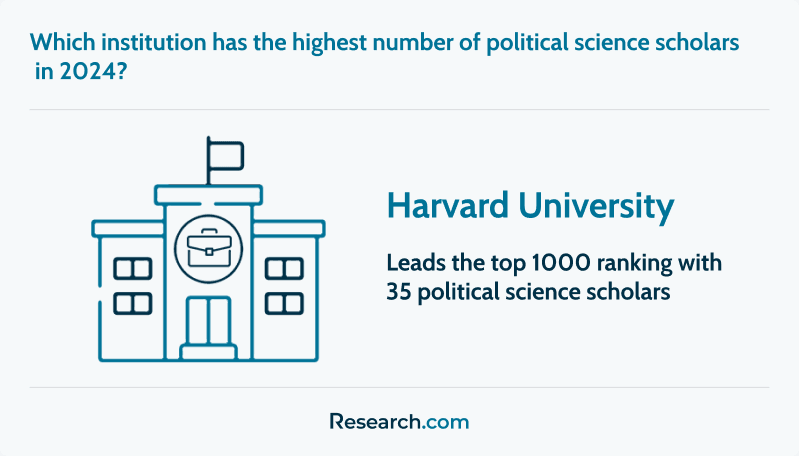
Research.com reviewed more than 1500 profiles from OpenAlex, CrossRef, and other bibliometric databases. The final ranking includes 1000 scholars. The United States has the largest representation, with 527 profiles in the report, while Harvard University leads institutions with 35 affiliated scholars.
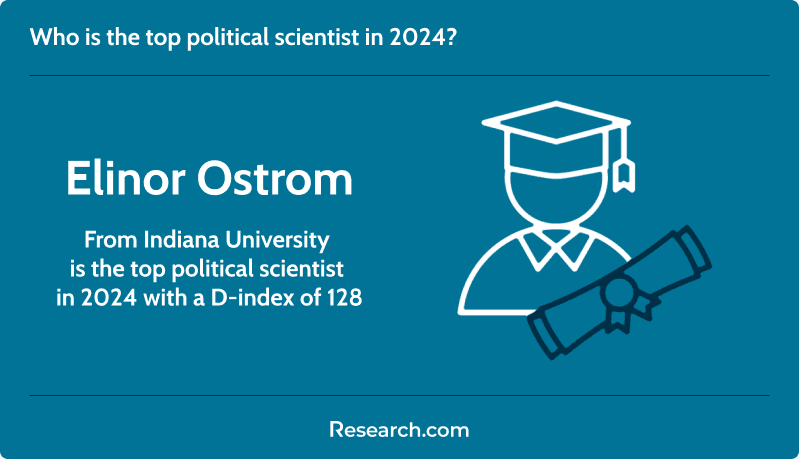
The top-ranked political scientist is Elinor Ostrom from Indiana University, United States, with a D-index of 128.
How to Use This Political Science Ranking
This ranking is most useful when readers want to identify influential researchers, compare institutional research strength, understand global patterns in political science scholarship, or locate experts in specific areas of study. It should not be used as the only measure of a scholar’s value or a university’s quality.
| Reader goal | How this report can help | What to check next |
| Find leading scholars | Use the ranking to identify highly cited and field-focused political science researchers. | Review each scholar’s recent publications, research themes, and collaborations. |
| Compare institutions | Look at universities with many ranked scholars to understand where research capacity is concentrated. | Check department strengths, graduate placement, faculty availability, and funding opportunities. |
| Choose a research direction | Study the work of ranked scholars to see which topics are shaping the field. | Compare subfields such as governance, political economy, comparative politics, international relations, and public policy. |
| Evaluate academic influence | Use D-index, publications, citations, and awards as indicators of scholarly visibility. | Balance metrics with research quality, methodological rigor, and real-world policy relevance. |
How the 2024 Political Science Ranking Was Created
For the 2024 report, Research.com analyzed more than 1500 profiles using OpenAlex, CrossRef, and other bibliometric databases. The evaluation considered several factors, including the share of each scholar’s work connected to political science, notable awards, and academic achievements.
Scholars included in the ranking had a D-index score of at least 40 and published primarily on political science topics. This field-specific requirement matters because it helps distinguish political science researchers from scholars whose citation records come mainly from other disciplines.
The country assigned to each scholar is based on the affiliated research institution recorded in MAG, not on the scholar’s nationality.
Latest Discoveries and Research Directions in Political Science
Political science research is increasingly focused on problems that cut across technology, security, governance, and public trust. One of the most important areas is the relationship between artificial intelligence and political authority. Researchers are examining the security implications of AI, including its possible role in autonomous weapons systems, cyber conflict, and strategic decision-making.
AI is changing the questions political scientists need to ask. Instead of analyzing only voters, parties, institutions, and states, researchers now also study how algorithmic systems may influence public administration, surveillance, military operations, information flows, and democratic accountability.
Another emerging discussion is “AI-tocracy,” a scenario in which intelligent systems hold substantial decision-making authority. Research on the potential risks and benefits of AI in shaping political landscapes explores how advanced technologies could affect domestic governance, international relations, conflict, and institutional design.
For students and early-career researchers, this trend means methodological range is becoming more important. Political scientists who understand institutions, data, ethics, security, and digital systems are better positioned to study how power operates in technology-mediated societies.
The Key Findings From the 3rd Edition of the Best Political Scientists Ranking
- The United States has the strongest representation in the 2024 report, with 527 scholar profiles included.
- Harvard University ranks first among institutions for political science research and has 35 affiliated scholars in the report.
- Seven out of the top 10 institutions in the ranking are American universities.
- Elinor Ostrom from Indiana University, United States, is the leading political science scholar in the report, with a D-index of 128.
- The average D-index for the top 1% of scientists is 103.4, compared with 39.89 for all 1000 scholars included in the ranking.
The complete 2024 ranking is available here:
View the best political scientists ranking
What the Ranking Means for Students, Researchers, and Institutions
For students, the ranking can help identify universities and faculty members with strong research visibility in political science. This is especially useful for applicants considering graduate study, research assistantships, thesis supervision, or doctoral programs.
For researchers, the report can point to potential collaborators, influential literature, and research communities with strong citation impact. It can also help scholars understand where their subfield sits within the broader discipline.
For universities and departments, the findings show how institutional research strength is distributed. A high number of ranked scholars may indicate a strong research environment, but students should still examine fit carefully. A department with fewer ranked scholars may be the better choice if it has the right advisor, funding package, methods training, or specialization.
How Political Science Research Influences Real-World Policy Decisions
Political science research can affect policy by testing assumptions, evaluating programs, explaining institutional behavior, and clarifying the trade-offs behind public decisions. Researchers use quantitative data, qualitative fieldwork, comparative analysis, historical evidence, experiments, surveys, and case studies to study how policies work in practice.
In government and public affairs, this evidence can inform legislation, public administration, election design, international negotiations, regulatory strategy, and democratic reform. The strongest policy research usually does more than describe a problem; it explains causes, evaluates alternatives, and identifies likely consequences.
Students preparing for policy-oriented work can build research skills through campus-based programs, research assistant roles, and flexible study pathways. Some learners also compare accredited online schools when they need a program structure that fits work, family, or geographic constraints.
Countries With the Highest Number of Leading Political Scientists
The United States accounts for the largest number of scholars in the 2024 report, with 527 listed profiles. It also accounts for 70% of the top 1% of scholars.
The United Kingdom ranks second, with 178 scholars, which is eight scholars fewer than in the previous year.
Australia, Germany, and Canada follow with 42, 39, and 35 scholars included in the report, respectively.
The remaining countries in the top 10 are the Netherlands (27), Switzerland (24), Italy (19), Denmark (15), and Norway (14), which replaced Sweden in the 10th spot.
The country associated with each scholar is based on the affiliated research institution listed in MAG and does not necessarily reflect the scholar’s nationality.
| Country | Number of scholars in the 2024 report | How to interpret the result |
| United States | 527 | The United States has the largest concentration of ranked political science scholars in this report. |
| United Kingdom | 178 | The United Kingdom remains the second-largest contributor, despite having eight scholars fewer than the previous year. |
| Australia | 42 | Australia is third in the country distribution. |
| Germany | 39 | Germany follows Australia in the country ranking. |
| Canada | 35 | Canada completes the top five countries represented in the report. |
| Netherlands | 27 | The Netherlands is among the leading European countries in the ranking. |
| Switzerland | 24 | Switzerland has a notable presence among leading political science scholars. |
| Italy | 19 | Italy is included among the top 10 countries represented. |
| Denmark | 15 | Denmark is part of the top 10 country group. |
| Norway | 14 | Norway replaced Sweden in the 10th spot. |
Institutions With the Highest Number of Leading Scholars
Harvard University is the leading institution in this year’s political science research report, with 35 affiliated scholars included.
The London School of Economics and Political Science ranks second with 25 scholars, followed by Stanford University, also with 25 scholars.
Columbia University and the University of Oxford are also in the top five, each with 22 scholars.
American universities and institutions make up 70% of the top 10 leading institutions. The remaining 30% are represented by universities in the U.K.—the London School of Economics and Political Science and the University of Oxford—and Australia through Australian National University.
| Institution | Number of affiliated scholars in the report | What prospective students should examine |
| Harvard University | 35 | Faculty availability, subfield coverage, graduate funding, and advisor fit. |
| London School of Economics and Political Science | 25 | Strength in political economy, policy analysis, international research networks, and supervision options. |
| Stanford University | 25 | Research methods training, interdisciplinary opportunities, and faculty alignment. |
| Columbia University | 22 | Urban policy access, international affairs connections, and department-level research support. |
| University of Oxford | 22 | Research specialization, faculty mentorship, and program structure. |
How Online Universities Can Support Political Science Research
Traditional research universities often provide established faculty networks, seminars, archives, and graduate research communities. Stanford University’s overview of established research communities, for example, shows how departments organize scholarship across major political science areas.
Online universities and digitally delivered programs can also support research development when they provide rigorous coursework, trained faculty, library access, data resources, and structured opportunities for collaboration. Their main advantage is flexibility: students and working professionals can often continue building research skills without relocating or leaving employment.
Digital research environments may also make it easier to use shared datasets, citation databases, and open-source research platforms. These tools can help political science students learn how to locate primary sources, analyze political data, and participate in collaborative projects.
However, not every online program is equally useful for research preparation. Students should look carefully at accreditation, faculty credentials, research methods requirements, library access, thesis or capstone options, and whether the program supports graduate school or policy career goals.
Are Accredited Online Programs Useful for Political Science Careers?
Accredited online programs can be useful when they offer credible instruction, strong methods training, and a curriculum aligned with a student’s career objective. They are often a practical option for working adults, military learners, caregivers, and students who cannot easily relocate.
For political science professionals, online study may support advancement in policy analysis, public administration, campaign work, civic technology, nonprofit leadership, legislative support, international affairs, or research operations. The value depends less on whether the program is online and more on whether it is accredited, rigorous, affordable, and relevant to the student’s goals.
Students comparing flexible programs may also review broader options such as online colleges, especially if they are weighing speed, cost, and career relevance across multiple fields.
How Accreditation and Cost Affect Online Political Science Education
Accreditation matters because it signals that an institution or program has been reviewed against recognized academic standards. For students, it can affect credit transfer, graduate admissions, employer acceptance, and access to financial aid. Before enrolling, students should confirm the school’s accreditation status through official sources and ask whether credits will transfer to the institutions or programs they may later pursue.
Cost should be evaluated beyond tuition alone. Application fees, technology fees, books, residency requirements, exam costs, and lost work time can change the total price of a program. Some students reduce upfront costs by considering colleges with no application fee online, but they should still compare total program cost and academic quality.
| Factor | Why it matters | Question to ask before enrolling |
| Accreditation | It can influence credit transfer, graduate school options, financial aid access, and employer recognition. | Is the institution currently accredited by a recognized accreditor? |
| Faculty expertise | Political science programs are stronger when instructors have relevant academic or professional experience. | Who teaches the core courses, and what are their research or policy backgrounds? |
| Research methods training | Methods courses are essential for graduate study, policy analysis, and evidence-based decision-making. | Does the curriculum include quantitative, qualitative, or mixed-methods research? |
| Total cost | Tuition is only one part of affordability. | What fees, books, software, travel, or residency costs are required? |
| Flexibility | Students balancing work or family obligations may need asynchronous or part-time options. | Are courses self-paced, scheduled, synchronous, asynchronous, or cohort-based? |
| Career support | Internships, advising, and alumni networks can improve the practical value of the degree. | Does the program help students find internships, research roles, or policy-related opportunities? |
Can Self-Paced Online Courses Expand Research Opportunities?
Self-paced online courses can help political science students and professionals build targeted skills without committing immediately to a full degree. They may be useful for learning statistics, research design, survey methods, data visualization, geographic information systems, public policy analysis, or software used in social science research.
The best use of self-paced learning is strategic. A course should fill a specific skill gap, support a current project, or prepare the learner for a degree, certificate, internship, or research role. Learners comparing flexible options can review programs through self paced online college resources, but they should verify course quality, assessment standards, and credit eligibility before enrolling.
Alternative Education Pathways for Political Science Professionals
A traditional political science degree is not the only way to build relevant expertise. Graduate certificates, professional certificates, short courses, policy fellowships, internships, and applied research projects can help professionals add skills in a focused area.
Alternative credentials may be especially useful for people who already have a degree and want to specialize in public policy, data analysis, international development, public administration, nonprofit management, campaign strategy, or security studies. An online graduate certificate can be one option for learners who want additional academic training without immediately pursuing a full graduate degree.
These pathways work best when they complement a clear career plan. A credential with no connection to a job target, research interest, or graduate school goal may add cost without improving outcomes.
Emerging Non-Academic Career Pathways for Political Science Experts
Political science training is valuable beyond the university setting. Graduates and researchers often use their skills in government agencies, international organizations, think tanks, advocacy groups, consulting firms, polling organizations, media analysis, risk advisory work, and legislative offices.
Common non-academic pathways include policy analysis, strategic communications, public affairs, political risk research, legislative consulting, survey research, campaign analytics, and program evaluation. These roles reward the ability to interpret evidence, write clearly, understand institutions, evaluate competing claims, and communicate uncertainty.
Students who are still choosing a degree path should avoid selecting a program only because it appears easy or fast. Resources discussing the easiest degree to get can be useful for understanding workload and program design, but political science learners should prioritize academic credibility, transferable skills, internships, and career alignment.
How Financial Aid Can Improve Access to Political Science Study
Financial aid can make political science education more accessible, particularly for students pursuing online or part-time study while working. Lower financial barriers may allow more students to participate in research training, complete internships, attend conferences, or continue into graduate study.
Students should compare aid eligibility, tuition, transfer credits, employer tuition benefits, scholarships, and program length before deciding where to enroll. Those focused on federal aid eligibility may want to review online colleges that accept FAFSA, while also confirming accreditation and total program cost.
Common Mistakes to Avoid When Using Rankings or Choosing a Program
| Common mistake | Why it can be a problem | Better approach |
| Relying only on a ranking | A ranking shows research influence, but it may not capture advising quality, funding, teaching, or fit. | Use rankings as a starting point, then examine faculty, curriculum, outcomes, and student support. |
| Assuming a famous institution is always the best choice | A prestigious university may not have the right supervisor or subfield strength for every student. | Prioritize the department and advisor that match your research interests. |
| Ignoring accreditation | Accreditation can affect credit transfer, financial aid, and employer or graduate school recognition. | Verify accreditation before applying or enrolling. |
| Looking only at tuition | Fees, books, travel, technology, and time away from work can change the real cost. | Calculate total program cost and compare available aid. |
| Assuming online programs are all the same | Online programs differ widely in rigor, faculty access, research support, and student outcomes. | Compare curriculum depth, methods training, advising, and career services. |
| Choosing a credential without a career goal | A certificate or degree may not pay off if it does not build marketable skills or support a clear next step. | Match each credential to a target role, research skill, or graduate pathway. |
Questions to Ask Before Studying Political Science or Choosing a Research Program
- Which political science subfield do I want to study, and which faculty members work in that area?
- Does the program provide strong training in research design, data analysis, writing, and policy evaluation?
- Are there opportunities for internships, assistantships, fieldwork, publication, or conference participation?
- How much will the full program cost after tuition, fees, books, technology, and other expenses?
- Is the institution accredited, and will credits transfer if I later pursue another degree?
- Does the program support my intended path: graduate school, government, nonprofit work, consulting, international affairs, or academia?
- If the program is online, how accessible are faculty, advisors, library resources, and research support?
D-Index Ranking Leaders, Averages, and Distribution
In North America, Professor Elinor Ostrom of Indiana University, United States, leads the region’s political science scholars. Professor Ostrom is also the top-ranked scholar worldwide, with a D-index of 128.
In Europe, Professor Bruno S. Frey of the University of Basel, Switzerland, is the leading scholar in the region. Professor Frey ranks third globally, with a D-index of 112.
In Oceania, Professor John S. Dryzek of the University of Canberra, Australia, leads political science scholars in the region. Professor Dryzek ranks 23rd in the report, with a D-index of 78.
In Africa, Professor Simplice A. Asongu of the African Governance and Development Institute, Cameroon, is the leading scholar. Professor Asongu is included in the report and ranks 109th, with a D-index of 62.
In Asia, Professor Richard M. Walker of the City University of Hong Kong, China, is the leading scholar. Professor Walker ranks 78th in the report, with a D-index of 61.
The average D-index for the top 1% of scholars is 103.4, compared with 39.89 for all scholars included in the ranking.
The average number of published articles for the top 1% of scholars in the ranking is 398.4, compared with 166.16 for all scholars.
The average number of citations for the top 1% of scientists is 87,107.4, compared with 14,064.18 for all scholars.
| Region | Leading scholar | Institution | Ranking detail |
| North America | Elinor Ostrom | Indiana University, United States | Top-ranked worldwide; D-index of 128 |
| Europe | Bruno S. Frey | University of Basel, Switzerland | Ranks third globally; D-index of 112 |
| Oceania | John S. Dryzek | University of Canberra, Australia | Ranks 23rd; D-index of 78 |
| Africa | Simplice A. Asongu | African Governance and Development Institute, Cameroon | Ranks 109th; D-index of 62 |
| Asia | Richard M. Walker | City University of Hong Kong, China | Ranks 78th; D-index of 61 |
Methodology and Editorial Oversight
More information about the methodology used for this report is available here.
All research was coordinated by Imed Bouchrika, Ph.D., a computer scientist with a well-established record of collaboration on a number of international research projects with different partners from the academic community. His role was to make sure all data remained unbiased, accurate, and up-to-date.
Research.com is the number one research portal for science and educational rankings. Its mission is to help professors, research fellows, and students advance their research and identify leading experts across scientific disciplines. Research.com also serves as an educational platform for students comparing colleges, academic opportunities, and career paths.
Key Insights
- The 2024 Research.com political science report is a field-specific ranking based on more than 1500 reviewed profiles, with scholars required to have a D-index score of at least 40 and a primary publication record in political science.
- The United States dominates the ranking with 527 scholars and 70% of the top 1% of scholars, showing the country’s strong institutional concentration in the field.
- Harvard University leads institutions with 35 affiliated scholars, while the London School of Economics and Political Science and Stanford University each have 25 scholars.
- Elinor Ostrom of Indiana University, United States, is the top-ranked political scientist worldwide, with a D-index of 128.
- Rankings are useful for identifying influential scholars and research hubs, but students should also consider advisor fit, subfield strength, funding, accreditation, research training, and career goals.
- AI, cyber conflict, algorithmic governance, and technology-mediated power are becoming increasingly important topics in political science research.
- Online and alternative education pathways can support political science careers when they are accredited, skill-focused, affordable, and aligned with a clear academic or professional objective.


