
2027 Best Online FNP Programs That Provide Preceptors

Co-Founder and Chief Data Scientist
Advancing your nursing career is a big decision, but the search for a qualified preceptor can feel like a second full-time job, adding immense stress and uncertainty. With demand for family nurse practitioners projected to grow 40%, any delay in your education means missing out on significant opportunities. The key to protecting your investment is choosing an online FNP program that provides preceptors, ensuring you graduate on time and career-ready.
This isn't just a list of schools. It's a strategic guide from career planning experts with over 10 years of experience, designed to give you the clarity you need to move forward with confidence.
What are the benefits of getting an online FNP program that provides preceptors?
- You gain access to a stable and growing career field, with opportunities as a primary care provider in clinics, hospitals, and urgent care centers.
- The financial return is significant, with family nurse practitioners earning an average annual salary of around $116,800.
- Choosing an online program with guaranteed preceptors gives you the flexibility to manage your studies alongside work and life, while removing the biggest obstacle to graduating on time.
What can I expect from an online FNP program that provides preceptors?
You can expect a demanding graduate-level curriculum that combines rigorous online coursework with essential in-person clinical training. These programs are designed for working professionals, but it's crucial to understand that online learning doesn't mean easier learning. The coursework in pathophysiology, pharmacology, and advanced health assessment requires significant discipline and dedicated study time.
The curriculum is structured to build your clinical decision-making skills, preparing you for autonomous practice. You'll complete hundreds of hours of hands-on clinicals, just as you would in an on-campus program. The key benefit of choosing an online FNP program that provides preceptors is that the school handles the complex logistics of securing those clinical placements for you.
Where can I work with a degree from an online FNP program that provides preceptors?
Graduates from an online FNP program work in a wide variety of primary care settings. Employers value accreditation and clinical skill, not the format of your degree, preparing you to join the 71% of FNPs who work directly in the healthcare industry.
Here are some of the most common environments where you can build your career:
- Primary Care Clinics: You will serve as the main healthcare provider for individuals and families, managing chronic conditions and providing preventive care.
- Urgent Care Centers: This fast-paced setting will have you diagnosing and treating acute illnesses and injuries that are not life-threatening.
- Hospital Outpatient Departments: You can manage patient care for specific specialties, such as cardiology or oncology, before or after hospitalization.
- Retail Health Clinics: Located in pharmacies and retail stores, you'll offer accessible and convenient care for common vaccinations and minor health issues.
- Community Health Centers: In this role, you will provide vital primary care services to diverse and often underserved patient populations.
How much can I make with a degree from an online FNP program that provides preceptors?
The average annual salary for a family nurse practitioner is around $116,800. However, your total compensation can vary based on several key factors.
Here is what influences your earning potential:
- Geographic Location: Your salary is heavily influenced by local demand, with FNPs in a high-paying state like California earning an average of over $145,000.
- Years of Experience: An experienced FNP with 10–19 years of practice earns an average of $120,000, showing clear growth from an entry-level position.
- Practice Setting: FNPs working in outpatient care centers can earn an average of $129,000, often higher than in smaller private practices.
- Advanced Education: Earning a Doctor of Nursing Practice (DNP) can qualify you for leadership roles and boost your average salary by an additional $5,000 to $10,000 per year.
- Certifications: Gaining additional certifications in high-demand areas can also increase your competitiveness and earning potential.
- List of the Best Online FNP Programs That Provide Preceptors for 2027 List of Programs
- How long does it take to complete an online FNP program that provides preceptors? Completion Time
- How does an online FNP program that provides preceptors compare to a traditional on-campus program? How does an online FNP program that provides preceptors compare to a traditional on-campus program?
- What is the average cost of an online FNP program that provides preceptors? Program Cost
- What are the financial aid options for students enrolling in an online FNP program that provides preceptors? Financial Aid
- What are the prerequisites for enrolling in an online FNP program that provides preceptors? What are the prerequisites for enrolling in an online FNP program that provides preceptors?
- What courses are typically included in an online FNP program that provides preceptors? What courses are typically included in an online FNP program that provides preceptors?
- What types of specializations are available in an online FNP program that provides preceptors? Specializations
- How to Choose the Best Online FNP Program That Provides Preceptors How to Choose the Best Online FNP Program That Provides Preceptors
- What career paths are available for graduates of online FNP programs that provide preceptors? Career Paths
- What is the job market for graduates of online FNP programs that provide preceptors? Job Market
Best Online FNP Programs That Provide Preceptors for 2027
Choosing an online family nurse practitioner program is not just about tuition, curriculum, or school reputation. For many registered nurses, the biggest practical barrier is finding approved clinical sites and qualified preceptors. Without reliable placement support, students can lose months trying to secure rotations, delay graduation, or struggle to meet certification and licensure requirements on time.
This guide is for BSN-prepared registered nurses comparing online FNP programs that offer meaningful clinical placement support. It explains which programs provide or assist with preceptors, how long these programs take, what they cost, what admissions requirements to expect, and how to judge whether a program is a good fit for your schedule, budget, state, and career goals.
Quick Answer: What Is the Best Online FNP Program That Provides Preceptors?
The best online FNP program that provides preceptors is the one that is accredited, approved for your state, transparent about clinical placement responsibilities, and aligned with your timeline and budget. Some schools arrange all practicum sites, while others provide placement assistance or structured support while still expecting students to participate in the search. Before enrolling, ask the program to explain exactly what “preceptor support” means in writing.
In general, strong online FNP programs should offer CCNE or ACEN accreditation, clear clinical hour requirements, faculty support, board certification preparation, and a documented process for helping students secure approved clinical experiences.
How do we rank schools?
Because graduate nursing education can be a major financial commitment, Research.com evaluates programs using transparent, decision-focused criteria. Our review considers publicly available institutional and program data from sources such as the IPEDS database, Peterson's database, the College Scorecard database, and The National Center for Education Statistics.
These data sources help support comparisons across tuition, institutional quality, student outcomes, and program characteristics. You can learn more about how Research.com evaluates schools on our methodology page.
Online FNP Programs That Provide Preceptor Support: Comparison Table
| School | Program | Program Length | Credits | Tuition or Cost | Accreditation | Clinical Placement Support |
| University of Texas at Arlington | MSN Family Nurse Practitioner Online | As few as 32–36 months | 46 | $30,084 | Commission on Collegiate Nursing Education (CCNE) | Students are encouraged to identify preceptors, but placement assistance is available. |
| Cleveland State University | MSN Family Nurse Practitioner Online Track | 2 years | 47 | $636.70 (in-state); $637.70 (out-of-state) | Commission on Collegiate Nursing Education (CCNE) | The university provides clinical placement services for required clinical hours. |
| Texas Woman’s University | MSN Family Nurse Practitioner Online | 2 years | 45 | $28,561.50 | Commission on Collegiate Nursing Education (CCNE) | Dedicated clinical placement services help secure sites and preceptors. |
| West Coast University | Master's in Family Nurse Practitioner Online | 20–32 months | 53 | $33,655 | Commission on Collegiate Nursing Education (CCNE) | Online coursework is paired with required in-person intensive weekends. |
| Southern New Hampshire University | MSN Family Nurse Practitioner Online | Approximately 2 years | 51 | $627 | Commission on Collegiate Nursing Education (CCNE) | The university supports students as they secure clinical preceptorships. |
| Carson-Newman University | MSN Family Nurse Practitioner Online | Approximately 2 years | 48 | Approximately $32,000 | Commission on Collegiate Nursing Education (CCNE) | Dedicated clinical placement support assists with sites and preceptors. |
| Simmons University | MSN Family Nurse Practitioner Online | Approximately 2 years | 47 | $59,925 | Commission on Collegiate Nursing Education (CCNE) | A clinical placement specialist helps identify local clinical sites and preceptors. |
| Georgia College and State University | MSN Family Nurse Practitioner Concentration Online | Approximately 3 years | 40 | $32,289 | Commission on Collegiate Nursing Education (CCNE) | The School of Nursing assists with preceptors and clinical rotations within Georgia. |
| Chamberlain University | MSN Family Nurse Practitioner | Approximately 2 years and 6 months | 33 | $24,255 | Commission on Collegiate Nursing Education (CCNE) | The Practicum Commitment® provides resources and guidance for site and preceptor selection. |
| University of Illinois Chicago | DNP Family Nurse Practitioner Focus Area | 2–4 years | 77 | $82,775 | Commission on Collegiate Nursing Education (CCNE) | Faculty arrange practicum sites and qualified preceptors for students. |
1. University of Texas at Arlington – MSN Family Nurse Practitioner Online
The University of Texas at Arlington offers an online MSN-FNP pathway for nurses preparing to deliver primary care to patients across the lifespan. The program emphasizes research, assessment, diagnosis, and clinical management. Students are advised to participate in identifying potential preceptors, but the school offers placement assistance so students can complete required clinical experiences.
- Program Length: As few as 32–36 months
- Required Credits to Graduate: 46
- Total Tuition: $30,084
- Accreditation: Commission on Collegiate Nursing Education (CCNE)
2. Cleveland State University – MSN Family Nurse Practitioner Online Track
Cleveland State University delivers an online FNP track built around community-based primary care for patients of all ages. Coursework is completed online, with one required on-site residency. A major advantage for students is the university’s clinical placement service, which helps arrange the clinical hours needed to progress through the program.
- Program Length: 2 years
- Required Credits to Graduate: 47
- Cost per Credit: $636.70 (in-state); $637.70 (out-of-state)
- Accreditation: Commission on Collegiate Nursing Education (CCNE)
3. Texas Woman’s University – MSN Family Nurse Practitioner Online
Texas Woman’s University prepares FNP students to combine advanced clinical judgment with patient-centered, holistic care. The program also develops leadership capacity for nurses moving into advanced practice roles. Its dedicated clinical placement services help students locate appropriate clinical sites and qualified preceptors.
- Program Length: 2 years
- Required Credits to Graduate: 45
- Total Tuition: $28,561.50
- Accreditation: Commission on Collegiate Nursing Education (CCNE)
4. West Coast University – Master's in Family Nurse Practitioner Online
West Coast University offers an online FNP program focused on evidence-based care for diverse patient populations, especially in ambulatory and primary care settings. Students complete most academic work online and attend two required on-site intensive weekends designed to strengthen hands-on clinical skills.
- Program Length: 20–32 months
- Required Credits to Graduate: 53
- Total Tuition: $33,655
- Accreditation: Commission on Collegiate Nursing Education (CCNE)
5. Southern New Hampshire University – MSN Family Nurse Practitioner Online
Southern New Hampshire University structures its online MSN-FNP program for working nurses who need flexibility. Courses are delivered asynchronously, and the curriculum includes a one-week campus immersion. The university offers support as students work to secure clinical preceptorships required for graduation.
- Program Length: Approximately 2 years
- Required Credits to Graduate: 51
- Cost per Credit: $627
- Accreditation: Commission on Collegiate Nursing Education (CCNE)
6. Carson-Newman University – MSN Family Nurse Practitioner Online
Carson-Newman University offers a part-time, faith-based online MSN-FNP program designed for registered nurses who plan to keep working while studying. Coursework is 100% online and does not require set login times. The school provides clinical placement support to help students identify approved sites and preceptors.
- Program Length: Approximately 2 years
- Required Credits to Graduate: 48
- Total Tuition: Approximately $32,000
- Accreditation: Commission on Collegiate Nursing Education (CCNE)
7. Simmons University – MSN Family Nurse Practitioner Online
Simmons University brings its Boston-based nursing education model to online learners through a digital FNP program. Students work with a clinical placement specialist who helps locate clinical sites and preceptors in their communities, which can be especially valuable for nurses studying far from campus.
- Program Length: Approximately 2 years
- Required Credits to Graduate: 47
- Total Tuition: $59,925
- Accreditation: Commission on Collegiate Nursing Education (CCNE)
8. Georgia College and State University – MSN Family Nurse Practitioner Concentration Online
Georgia College and State University offers an online FNP concentration for BSN-prepared nurses in Georgia. The program uses a largely online format with limited campus requirements. Clinical rotations must take place in Georgia, and the School of Nursing assists students with arranging preceptors and clinical placements.
- Program Length: Approximately 3 years
- Required Credits to Graduate: 40
- Total Tuition: $32,289
- Accreditation: Commission on Collegiate Nursing Education (CCNE)
9. Chamberlain University – MSN Family Nurse Practitioner
Chamberlain University offers an MSN-FNP program that connects classroom learning with clinical application through practicum experiences and an in-person immersion weekend. Its Practicum Commitment® gives students structured guidance and resources for identifying appropriate practicum sites and preceptors.
- Program Length: Approximately 2 years and 6 months
- Required Credits to Graduate: 33
- Total Tuition: $24,255
- Accreditation: Commission on Collegiate Nursing Education (CCNE)
10. University of Illinois Chicago – DNP Family Nurse Practitioner Focus Area
The University of Illinois Chicago offers a blended DNP pathway with an FNP focus area. The program prepares students for advanced primary care practice, with particular attention to underserved populations. Unlike programs that only advise students during the placement process, faculty arrange practicum sites and highly qualified preceptors for students.
- Program Length: 2–4 years
- Required Credits to Graduate: 77
- Total Tuition: $82,775
- Accreditation: Commission on Collegiate Nursing Education (CCNE)
How Long Does It Take to Complete an Online FNP Program That Provides Preceptors?
Most online FNP programs take two to three years to finish. Programs with reliable preceptor support may help students stay closer to the published timeline because clinical placement delays are less likely to derail progression. Students still need to complete substantial supervised clinical training, commonly between 550 and 660 clinical hours, but a school-managed or school-supported placement process can reduce uncertainty.
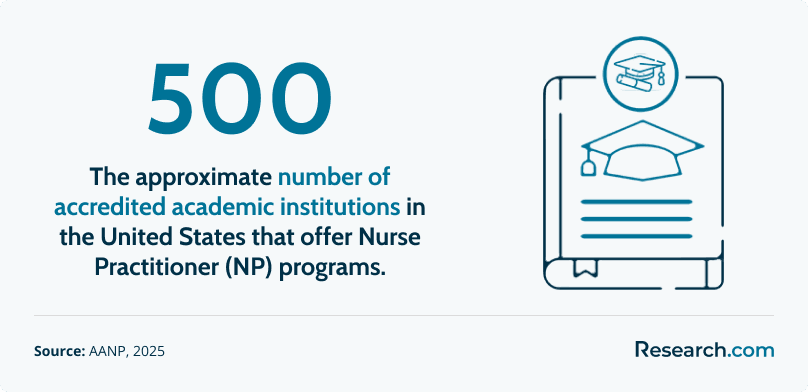
The broader nurse practitioner education market is large, with around 500 institutions in the U.S. offering nurse practitioner programs. Most follow a two-to-three-year structure because students need time to develop advanced assessment, diagnostic, prescribing, and primary care management skills. Nurses with strong time availability may also compare faster routes, including a 12 month FNP program, but accelerated formats require careful planning around work, family obligations, and clinical scheduling.
| Timeline Factor | How It Can Affect Graduation | What to Ask Before Enrolling |
| Clinical placement model | Programs that arrange or actively support placements can reduce delays. | Does the school guarantee placement, assist with placement, or only approve student-found sites? |
| Work schedule | Full-time RN work can make coursework and clinical availability harder to manage. | Can clinical hours be scheduled around shifts, or must they occur on fixed weekdays? |
| State authorization | Some schools may not accept students in every state or may limit clinical locations. | Is the program approved for my state of residence and clinical practice? |
| Program pace | Accelerated formats shorten time in school but increase weekly workload. | How many hours per week should students expect to commit? |
Online FNP Programs With Preceptors vs. Traditional On-Campus FNP Programs
Accredited online and campus-based FNP programs are expected to meet comparable academic and clinical standards. The major differences are not usually the scope of training or the board certification goal; they are delivery format, scheduling, access to faculty, campus requirements, and how clinical placements are coordinated.
Online FNP Degree Programs
Online FNP programs are usually the better fit for registered nurses who need to keep working or who do not live near a university with an FNP track. The strongest online options combine flexible coursework with structured clinical placement support. Some programs have developed networks of clinical partners, while others use placement specialists who coordinate with students to locate approved preceptors near where they live.
On-Campus FNP Degree Programs
Campus-based FNP programs can work well for students who prefer face-to-face interaction, set class times, and direct access to university facilities. These programs may have long-standing relationships with nearby clinics, hospitals, and healthcare systems. However, online programs with strong placement systems can now offer similar clinical support without requiring students to relocate or commute regularly.
| Program Format | Best For | Main Advantages | Possible Trade-Offs |
| Online FNP with preceptor support | Working RNs, rural nurses, and students who need schedule flexibility | Flexible coursework, local clinical options, and reduced placement burden | Requires self-discipline and careful verification of state authorization |
| On-campus FNP | Students near campus who prefer in-person learning | Face-to-face faculty access, structured schedule, and local networking | Less flexible for full-time workers and geographically limited |
| Hybrid or blended FNP | Students who want online coursework plus periodic in-person training | Combines flexibility with skills intensives or residencies | Travel costs and campus attendance requirements may add complexity |
Some nurses also compare FNP programs with broader advanced practice options, including psychiatric mental health preparation. If you are interested in both primary care and behavioral health, the best online dual FNP/PMHNP programs may help you compare integrated pathways that combine clinical placement planning with a wider scope of career preparation.
What Is the Average Cost of an Online FNP Program That Provides Preceptors?
The average total tuition for an online FNP program is approximately $38,500. Cost matters, but tuition alone does not show the full financial picture. Students should also account for fees, books, travel for immersions, certification exam costs, lost work hours, and the possibility of delayed graduation if clinical placements are not secured on time.
Graduate nursing students commonly use borrowing to pay for school; nearly 70% of graduate nursing students borrow money to finance their education. A program that provides stronger preceptor support may cost more upfront, but it can reduce the risk of paying for extra terms or postponing the move into an FNP role.
Return on investment should include more than base pay. Employers may use benefits, productivity incentives, or annual bonuses to attract and retain experienced FNPs. Those additional forms of compensation can improve the value of the degree over time, especially for graduates who move into high-demand primary care, urgent care, leadership, or telehealth roles.
Financial Aid Options for Online FNP Students
Most FNP students use more than one funding source. The best approach is to compare the total program cost, then ask each school’s financial aid office how students commonly pay for tuition, fees, and clinical-related expenses.
- Federal Student Loans: Federal loans are a common funding source for graduate nursing students and may offer repayment options that are more flexible than many private alternatives.
- Private Loans: Banks and credit unions may offer private education loans to cover remaining costs, but borrowers should compare interest rates, fees, repayment terms, and cosigner requirements carefully.
- Scholarships and Grants: Scholarships and grants do not need to be repaid. They may come from universities, nursing organizations, employers, foundations, and professional associations. Some universities offer over $7.1 million in scholarships to their students.
- Employer Tuition Assistance: Hospitals and healthcare systems may help registered nurses pay for graduate education, particularly when the degree supports workforce needs.
- Military and Veteran Benefits: Eligible service members and veterans may qualify for education funding through programs such as the GI Bill.
Nurses trying to reduce both cost and time in school may also compare accelerated psychiatric mental health pathways. For example, some of the best one-year online PMHNP programs offer streamlined coursework and financial aid guidance for students pursuing a different advanced practice specialty.
Prerequisites for Online FNP Programs That Provide Preceptors
Online FNP programs generally expect applicants to have a nursing foundation, an active RN license, and enough clinical experience to transition into advanced practice study. Admissions standards vary by school, but competitive applicants usually show strong academic preparation and professional readiness.
- Bachelor of Science in Nursing (BSN): A BSN from an accredited institution is the usual starting point. Data show that 76.6% of nurse practitioners major in nursing.
- Active Registered Nurse (RN) License: Applicants typically need a current, unencumbered RN license, often in the state where they will complete clinical hours.
- Clinical Experience: Many programs prefer or require one to two years of full-time RN experience, with acute care experience often viewed favorably.
- Minimum GPA: A cumulative undergraduate GPA of 3.0 or higher is commonly expected for competitive admission.
- Letters of Recommendation: Applicants are often asked for two to three academic or professional references who can speak to clinical ability, professionalism, and readiness for graduate study.
The BSN-to-FNP route is common, but it is not the only pathway. Nurses with prior graduate education may explore online MSN to FNP programs that build on previous master’s-level coursework while preparing students for FNP certification eligibility.
Common Courses in an Online FNP Program That Provides Preceptors
An FNP curriculum is designed to move registered nurses from bedside-focused care into advanced clinical reasoning, diagnosis, treatment planning, and long-term patient management. Because patient care appears as the most highlighted skill on over 30% of FNP resumes, coursework emphasizes practical decision-making across the lifespan.
- Advanced Pathophysiology: Students study disease processes and how altered physiology affects assessment, diagnosis, and treatment decisions.
- Advanced Pharmacology: This course prepares students to understand medication actions, prescribing considerations, therapeutic effects, safety risks, and patient education.
- Advanced Health Assessment: Students learn to conduct comprehensive histories, physical exams, diagnostic evaluations, and age-appropriate assessments.
- Primary Care of Adults: This course focuses on common acute and chronic conditions affecting adult patients in primary care settings.
- Primary Care of Children and Adolescents: Students learn to address pediatric and adolescent care needs, including wellness, development, prevention, and common illness management.
Students who start with an associate degree can also look at bridge options that lead toward graduate nursing study, including ADN to FNP pathways.
Specializations and Practice Areas for FNP Graduates
Family nurse practitioner education is already a specialization because it prepares nurses for primary care across the lifespan. Additional specialization often develops after graduation through employment setting, continuing education, mentorship, and employer-based training.
- Gerontology: FNPs may concentrate on older adult care in primary care offices, long-term care facilities, or community health settings.
- Pediatrics: Although FNPs are trained across age groups, some choose roles focused mainly on infants, children, and adolescents.
- Rural Health: FNPs can help expand access to primary care in rural and underserved communities.
- Women's Health: Some FNPs develop experience in reproductive health, preventive care, menopause management, and related services.
- Dermatology: FNPs may build additional expertise in evaluating and treating common skin concerns in primary care or specialty clinics.
FNP graduates may also move into specialty-adjacent roles after gaining experience. If you are asking, where can I work in cardiology as an FNP, possible settings include outpatient cardiology clinics, heart failure programs, cardiac rehabilitation, and inpatient cardiology teams, depending on employer expectations and state practice rules.
The FNP pathway remains the dominant nurse practitioner track. Data show that 61.7% of all students in NP master's programs are enrolled in the FNP track, reflecting its broad usefulness in primary care and related settings.
How to Choose the Best Online FNP Program That Provides Preceptors
The best online FNP program is not always the cheapest, fastest, or most recognizable. The right choice is the program that is accredited, authorized for your state, realistic for your schedule, transparent about clinical placement, and strong enough to prepare you for board certification and practice.
- Confirm accreditation first: Look for CCNE or ACEN accreditation. Accreditation affects educational quality, certification eligibility, employer confidence, and sometimes financial aid access.
- Clarify the clinical placement promise: Ask whether the school guarantees preceptors, assigns placements, helps with placement, or only approves preceptors students find themselves.
- Check certification outcomes: Programs that publish first-time board certification pass rates give applicants a clearer view of graduate readiness.
- Evaluate faculty access: Online students should have reliable access to faculty, clinical coordinators, and academic advisors.
- Compare total cost, not just tuition: Include program fees, travel, campus intensives, books, certification preparation, and unpaid clinical time.
- Verify state authorization: Make sure the program can enroll students in your state and approve clinical placements where you plan to practice.
| Question to Ask | Why It Matters |
| Will the school arrange my preceptor, or am I responsible for finding one? | The answer affects your workload, timeline, and risk of delayed clinical progression. |
| Is the program approved for my state? | State authorization and clinical approval rules can affect enrollment and licensure planning. |
| Are campus visits or intensives required? | Travel, lodging, and time away from work can add meaningful cost. |
| What happens if a clinical site falls through? | A strong program should have a backup process for placement disruptions. |
| What are recent board certification pass rates? | Pass rates can help you judge how well the program prepares graduates for certification. |
| What is included in tuition? | Some programs separate tuition from fees, technology costs, clinical costs, and materials. |
If you are not yet a registered nurse but want a direct route into advanced practice, you may need a different pathway. Some students from non-nursing backgrounds explore online direct entry DNP programs for non nurses, which are designed for career changers seeking entry into nursing and advanced practice preparation.
Common Mistakes to Avoid When Choosing an Online FNP Program
- Assuming “preceptor support” means guaranteed placement: Schools use different language. Get the placement policy in writing before enrolling.
- Looking only at tuition: A lower tuition program can become more expensive if placement delays, travel, fees, or extra terms are involved.
- Ignoring state rules: Online programs may not be authorized in every state, and clinical placements may be restricted by state regulations.
- Choosing speed over fit: A faster program is not always better if you cannot realistically manage coursework, clinical hours, and employment.
- Skipping accreditation checks: Accreditation is essential for quality assurance and may affect certification, licensure, and employer recognition.
- Relying only on rankings: Rankings are helpful starting points, but your final decision should also account for clinical support, cost, schedule, and state eligibility.
Career Paths for Graduates of Online FNP Programs That Provide Preceptors
Graduates of online FNP programs can pursue roles in primary care, urgent care, telehealth, community health, specialty clinics, and leadership. The best pathway depends on your state scope of practice, clinical background, employer needs, and long-term goals.
1. Primary Care Provider
FNPs in primary care often serve as the first point of contact for individuals and families. They assess symptoms, diagnose common conditions, manage chronic illness, order tests, prescribe medications when permitted, and emphasize prevention and patient education.
Median Salary: $116,800 per year.
2. Urgent Care Provider
Urgent care FNPs treat acute, non-life-threatening problems such as injuries, infections, minor procedures, and sudden illness. This setting requires fast assessment skills, efficient documentation, and the ability to manage high patient volume.
Median Salary: $120,000 per year.
3. Clinical Manager
Experienced FNPs may move into management roles overseeing clinical teams, workflows, quality measures, scheduling, budgets, and patient care standards. This path blends advanced clinical knowledge with operational leadership.
Median Salary: $106,193 per year.
4. Health Educator
FNPs can apply their clinical expertise to patient education, community health programs, workplace wellness, hospital education, or nonprofit initiatives. This role may involve developing materials, leading workshops, and improving health literacy.
Median Salary: $50,531 per year.
5. Telehealth Provider
Telehealth FNPs provide remote consultations, follow-up care, medication management, and patient education using digital platforms. This role can expand access for patients who face transportation, distance, or scheduling barriers.
Median Salary: $115,000 per year.
An FNP degree can also support long-term growth. An experienced FNP with 10–19 years of practice earns an average of $120,000, and some nurses later pursue doctoral study, leadership, or specialty roles. For a broader overview of advancement options, review this guide to FNP careers.
Job Market for Online FNP Program Graduates
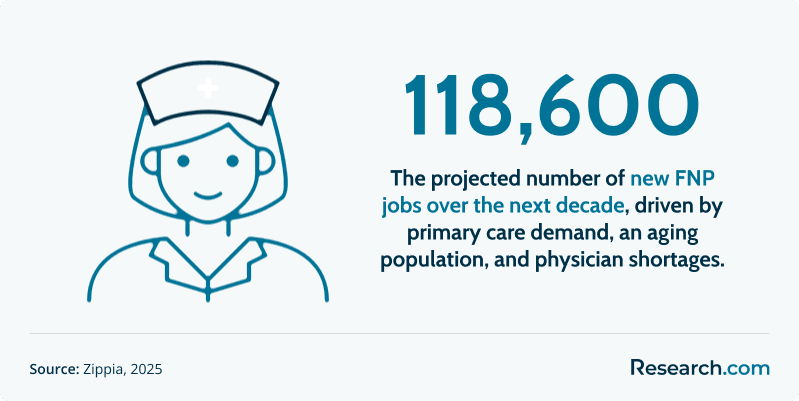
The employment outlook for family nurse practitioners is strong because FNPs help address primary care access needs, especially as the population ages and many communities face provider shortages. Demand is projected to create over 118,600 new jobs in the next decade, and over 211,000 FNPs are currently employed.
Job availability and pay vary by state, practice authority, employer type, and local healthcare demand. Some states, including New Hampshire, have a higher concentration of FNP jobs, while California and Louisiana are among states associated with some of the highest average salaries. Nurses aiming for leadership, academic, or advanced clinical roles may also compare doctoral options, including the shortest post master's DNP program.
Current Trends Affecting Online FNP Programs
- Clinical placement is a major decision factor: As online nursing programs expand, students are paying closer attention to whether schools actively arrange preceptors or simply provide guidance.
- Telehealth is changing primary care delivery: FNPs increasingly need comfort with virtual assessment, remote monitoring tools, digital documentation, and patient communication through online platforms.
- Employer expectations are rising: Many employers want FNPs who can practice independently, manage chronic conditions, use evidence-based guidelines, and work across interdisciplinary teams.
- State practice rules remain important: Scope of practice, prescribing authority, and supervision requirements differ by state, so students should choose programs that align with where they plan to work.
- Cost transparency matters more: Students are comparing total tuition, clinical costs, travel requirements, and financial aid before committing to a program.
What Graduates Say About Online FNP Programs With Preceptor Support
- : "I could not pause my nursing job or family responsibilities to return to campus full time. The online format let me study at night, complete requirements around my schedule, and move into a role with more independence and steadier hours. — Arianna"
- : "Living in a rural community made campus-based graduate study unrealistic. An online FNP program gave me a path to advanced practice without leaving home, and now I provide primary care to people in the same community where I grew up. — Winnie"
- : "I wanted a degree that made financial and professional sense. After graduation, my salary rose by nearly 40%, and I gained a level of stability and respect that changed my career outlook. — James"
Key Insights
- Preceptor support can affect your graduation timeline: Programs that arrange or actively support clinical placements may reduce the risk of delays.
- Accreditation is non-negotiable: Prioritize CCNE or ACEN-accredited programs before comparing cost, speed, or school reputation.
- Ask what “provides preceptors” really means: Some schools arrange placements, while others assist students who remain responsible for finding sites.
- Most online FNP programs take two to three years: Faster options exist, but they require strong time management and clinical availability.
- Cost should be evaluated beyond tuition: Include fees, travel, books, certification costs, clinical scheduling, and potential lost income from delayed graduation.
- The FNP pathway is broad and flexible: Graduates can work in primary care, urgent care, telehealth, health education, leadership, rural health, and specialty-adjacent settings.
- State rules matter: Always confirm that your chosen program can enroll students in your state and support clinical placements where you plan to practice.
References:
- American Association of Nurse Practitioners. Professional funding support: Scholarships. Retrieved from AANP.
- American Association of Nurse Practitioners. Planning your NP education. Retrieved from AANP.
- Emory University. Tuition, financial aid, and scholarships. Retrieved from Nursing Emory.
- National Organization of Nurse Practitioner Faculties. Nurse practitioner policy report. Retrieved from NONPF.
- National Library of Medicine. Family nurse practitioner workforce and challenges. Journal of Nursing Scholarship. Retrieved from PMC.
- Salary.com. Family nurse practitioner salary. Retrieved from Salary.com.
- Zippia. Family nurse practitioner demographics. Retrieved from Zippia.
- Zippia. Family nurse practitioner education. Retrieved from Zippia.
- Zippia. Family nurse practitioner trends. Retrieved from Zippia.
Other Things You Should Know About Online FNP Programs
To choose the best online FNP program in 2027, ensure the program is accredited, offers substantial support in securing preceptors, and has a robust curriculum. Check graduate success rates and reviews for insights into student experiences and job placement.
After completing an FNP program in 2027, candidates typically need to pass either the ANCC FNP Board Certification or the AANP FNP National Certification Examination. These exams verify that the graduate is prepared for the advanced practice role of a Family Nurse Practitioner.


