
2027 MBA or CFA: Explaining the Difference

Co-Founder and Chief Data Scientist
Deciding between pursuing a Master of Business Administration (MBA) degree program and earning a Chartered Financial Analyst® (CFA®) program can be challenging for professionals aiming to advance in business or finance. Both credentials carry global recognition but serve different purposes. Understanding their distinctions is key to choosing the credential that best supports long-term career goals.
To help you choose, I created this in-depth guide to the differences between an MBA and a CFA®. Explore application requirements, offered courses, program lengths, program costs, and career opportunities.
Key Things You Should Know about MBA and CFA Programs
- MBA programs cover a wide range of business areas, while CFA® programs specialize in finance, investment analysis, and portfolio management.
- MBAs usually take 1 to 2 years of structured coursework, while CFA® candidates study independently over several years to pass three examination levels.
- An MBA prepares graduates for leadership and management roles across industries. The CFA® is best suited for careers in investment banking, asset management, or financial analysis.
- What is an MBA? MBA Overview
- What is a CFA®? CFA Overview
- What is the main difference between an MBA and a CFA®? Differences
- What are the basic application requirements for MBA and CFA programs? Application Requirements
- What are the common courses covered in MBA and CFA programs? What are the common courses covered in MBA and CFA programs?
- How long does it take to complete MBA and CFA programs? Completion Time
- What is the average cost of MBA and CFA programs in the US? Program Cost
- What jobs can you get with an MBA degree? What jobs can you get with an MBA degree?
- What jobs can you get with a CFA credential? What jobs can you get with a CFA credential?
- Could an Accelerated Healthcare Administration Degree Enhance My Career? Could an Accelerated Healthcare Administration Degree Enhance My Career?
- Which program should I choose: MBA or CFA®? Which program should I choose: MBA or CFA®?
What is an MBA?
A Master of Business Administration (MBA) degree is a graduate-level program designed to prepare professionals for leadership and management roles in business. MBA programs, including online MBA programs, provide students with a broad foundation in key areas, such as finance, marketing, operations, strategy, and organizational behavior.
Students can choose MBA specializations to align with their professional interests and career goals. These include finance, accounting, management, marketing, and statistics.
An MBA emphasizes both technical and interpersonal skills. It combines analytical decision-making with communication, teamwork, and leadership development. Students often gain real-world experience through case studies, internships, and networking opportunities with industry professionals.
MBA programs are widely recognized and valued by employers across industries. The education and training that MBA programs offer and the credibility that they bring make them a versatile option for professionals seeking career advancement and higher earning potential. They can also help professionals transition into new fields.
What is a CFA®?
The Chartered Financial Analyst® (CFA) credential is a globally recognized professional designation awarded by the CFA Institute. It is considered one of the most prestigious certifications in the investment and finance industry. The CFA® program focuses on areas essential to the industry, such as investment analysis, portfolio management, economics, and ethical standards.
Just as some professionals may wonder what is an MD MPH when exploring dual medical and public health degrees, finance professionals often seek the CFA® to demonstrate advanced expertise and commitment. While highly challenging, the CFA designation enhances credibility, career opportunities, and global recognition, particularly for careers in investment banking, asset management, equity research, and financial analysis.
What is the main difference between an MBA and a CFA®?
The main difference between an MBA and a CFA® lies in their scope, focus, and career applications. An MBA is a graduate degree that provides a broad education in business management. It covers diverse business topics, such as leadership, marketing, finance, operations, and strategy. An MBA is ideal for individuals seeking leadership roles, career advancement, or career opportunities across diverse industries.
In contrast, the CFA credential is a specialized professional designation centered on investment management, financial analysis, and ethical standards in the finance industry. It is highly valued for roles in asset management, investment banking, and portfolio management.
Just as conversations around men in nursing highlight the value of representation and specialized expertise in healthcare, the CFA emphasizes deep technical knowledge for finance professionals. While the MBA emphasizes broad managerial and leadership skills, the CFA offers focused expertise in finance.
What are the basic application requirements for MBA and CFA programs?
Applying to an MBA program or pursuing the CFA® designation involves meeting a set of standard requirements. These requirements ensure that candidates are prepared for the academic rigor, professional expectations, and technical knowledge demanded by each path.
Just as students researching most in demand engineering degrees carefully evaluate prerequisites and program expectations, aspiring MBA and CFA candidates must understand the essential requirements for success. Below, I break down the basic application requirements for MBA programs and the CFA Program to help you understand what you’ll need before getting started.
MBA
Applying to an MBA program usually requires fulfilling several standard requirements that demonstrate academic readiness and professional potential. Common application requirements include the following:
- Earn a bachelor’s degree. Applicants must hold an accredited undergraduate degree in business or relevant fields. Professionals in other disciplines may also be qualified for MBA degree programs, given that they meet additional requirements.
- Submit standardized test scores. Some programs require Graduate Management Admission Test (GMAT) or Graduate Record Examination (GRE) scores to assess quantitative, verbal, and analytical skills. Notably, other programs offer test-optional admissions.
- Gain work experience. Applicants may also be required to have professional experience of 2 to 5 years to ensure that they can contribute practical insights to classroom discussions.
CFA®
To earn the CFA designation, candidates must go through the following qualification process:
- Pass three examination levels. CFA candidates must pass the required three-part examination, which includes the CFA Program Level I, Level II, and Level III.
- Complete relevant work experience. Professional experience may be earned before, during, or after the candidate’s participation in the CFA Program.
- Apply for a membership to the CFA Institute. Becoming a member of the CFA Institute allows you to use the CFA credential and provides you with access to exclusive membership benefits.
What are the common courses covered in MBA and CFA programs?
Both MBA and CFA programs prepare professionals with valuable knowledge, but their course content differs in scope and depth. MBA programs emphasize broad business education, while CFA courses specialize in finance and investment. Many of the most respected online MBA programs offer comprehensive curricula designed to equip students with skills applicable across industries. Explore some of the common courses each program offers below.
MBA
- Finance: A finance course in an MBA program provides an overview of financial management, corporate finance, and investment principles to help leaders make informed financial decisions.
- Marketing: This course covers strategies for understanding consumer behavior and building brand value. It can also teach how to create effective promotional campaigns.
- Organizational Behavior: An organizational-behavior course examines leadership, teamwork, and workplace dynamics to prepare students for managing people effectively.
CFA®
- Ethics and Professional Standards: This course focuses on integrity, ethical decision-making, and professionalism in financial services.
- Financial Reporting and Analysis: Financial reporting and analysis teaches how to interpret financial statements and assess company performance.
- Portfolio Management: This course explores asset allocation, risk management, and strategies to optimize investment returns for clients.
How long does it take to complete MBA and CFA programs?
The program lengths of an MBA and a CFA program differ significantly. An MBA program usually takes 1 to 2 years for full-time students. Part-time and executive MBA degree options may extend the timeline to 3 years at the minimum. Notably, students can choose accelerated MBA programs online to finish more quickly.
In contrast, the CFA® credential requires passing a three-part examination, which candidates often complete in 3 to 4 years while working full-time. However, it can take longer depending on examination results and study pace.
While an MBA offers a structured academic environment, the CFA demands focused self-study and discipline. Therefore, the duration is highly dependent on individual commitment and preparation.
What is the average cost of MBA and CFA programs in the US?
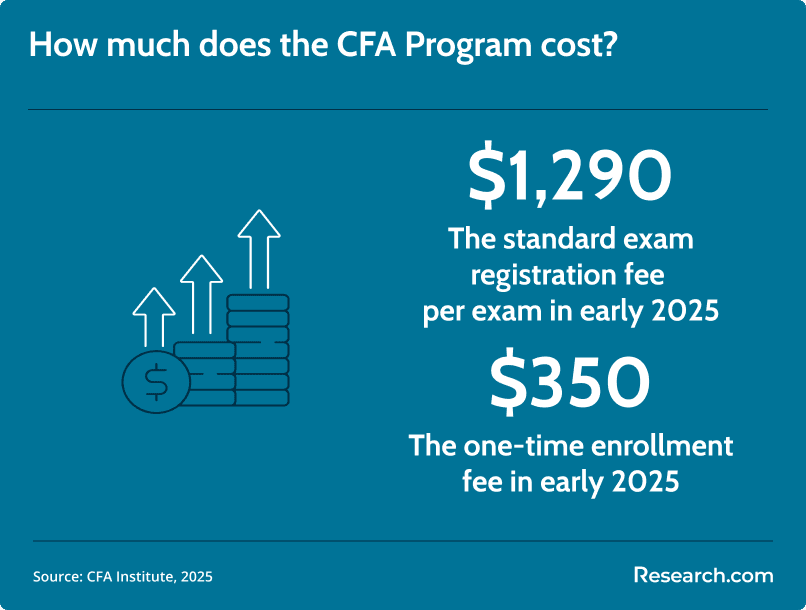
The cost of pursuing an MBA or a CFA® in the US varies significantly. For the CFA credential, the CFA Institute charged a standard exam registration fee of $1,290, an early exam registration fee of $990, and a one-time enrollment fee of $350 in early 2025. Considering that CFA candidates must pass three examination levels, the total cost can add up remarkably.
In contrast, tuition rates for MBA degree programs are higher and may vary, depending on the academic institution, institution type, and the student’s enrollment status. For instance, Arizona State University charged $605 per credit for its online MBA program in the academic year 2025–2026. The program requires students to complete 51 credit hours to graduate. Thus, tuition can amount to $30,855. Moreover, this total still does not include other fees, such as program fees and graduate student support fees.
What jobs can you get with an MBA degree?
Professionals with an MBA degree can qualify for a wide range of leadership and management positions. Some of the most common roles include the following:
- Marketing Managers: Marketing managers design and implement strategies to promote products or services, strengthen brand presence, and engage target audiences. An MBA equips them with strategic, analytical, and leadership skills essential for driving business growth.
- Human Resources (HR) Managers: HR managers handle employee recruitment, training, benefits, and workplace culture. With an MBA, professionals gain leadership and organizational skills that prepare them to align human capital strategies with business goals.
- Sales Managers: Sales managers lead sales teams, set revenue targets, and analyze performance metrics. An MBA equips them with leadership, financial insight, and strategic decision-making abilities. These skills enable them to boost profitability and market share.
The chart below provides a visualization of the 2024 median annual wages (US BLS, 2025) of occupations that MBA degree holders may be qualified for.
What jobs can you get with a CFA credential?
Earning a CFA credential opens doors to a variety of finance-focused careers that demand strong analytical and technical expertise. Common roles include the following:
- Budget Analysts: Budget analysts help organizations plan, manage, and allocate financial resources effectively. A CFA credential provides them with advanced financial analysis skills, ensuring budgets align with long-term financial goals.
- Financial Analysts: Financial analysts evaluate investment opportunities and economic trends. They also create reports that guide decision-making for companies or clients. The CFA program’s rigorous curriculum equips them with the analytical depth needed for success in this role, similar to skills gained through online master of finance programs.
- Financial Managers: Financial managers oversee an organization’s overall financial health, including forecasting, reporting, and investment strategies. The CFA® credential improves their credibility, as it can help them apply advanced portfolio management and ethical decision-making principles in leadership positions.
The chart below provides a visualization of the 2024 median annual wages (US BLS, 2025) of occupations that CFA credential holders may be qualified for.
Could an Accelerated Healthcare Administration Degree Enhance My Career?
In today’s dynamic professional landscape, integrating specialized accelerated programs with either an MBA or CFA can expand career opportunities by providing industry-specific expertise. For instance, professionals seeking to diversify their skill sets and address the evolving challenges in healthcare management may find that earning an accelerated healthcare administration degree online complements their existing credentials. This additional qualification can provide a competitive edge, particularly in sectors where healthcare innovation and financial expertise intersect.
Which program should I choose: MBA or CFA?
Deciding between an MBA and a CFA depends on your career goals and professional interests. Below are three important criteria to consider:
- Career Path: If you want a broad range of opportunities in management, consulting, or entrepreneurship, an MBA is more suitable. Meanwhile, a CFA is ideal for careers in investment analysis or portfolio management.
- Scope of Study: MBA programs cover diverse business areas, such as finance, marketing, and leadership, while the CFA focuses deeply on financial analysis, ethics, and investment management.
- Time and Cost Commitment: MBAs require significant tuition and often full-time study, whereas the CFA is more affordable but demands years of rigorous self-study across three exam levels.
Alternatively, some students may consider an online accounting degree as another educational pathway into accounting and finance careers.
Here’s What Professionals Say about their MBA and CFA Programs
- Darlene: "Completing the CFA program was challenging but transformative. The rigorous curriculum deepened my technical expertise in investment analysis and portfolio management. Employers recognized the credential immediately. It gave me new opportunities and greater credibility with clients and colleagues in the finance industry."
- Melissa: "Earning my MBA gave me the strategic-thinking skills and leadership confidence to move into senior management. Beyond classroom knowledge, the networking opportunities were invaluable. I met mentors and peers who continue to shape my career growth."
- Joshua: "Pursuing both an MBA and CFA was demanding. But it felt rewarding. The MBA broadened my business acumen, and the CFA strengthened my analytical depth in finance. They positioned me uniquely for leadership roles in investment banking and asset management."
Key Findings
- An MBA degree is a graduate-level program that prepares professionals for leadership and management roles in business. Meanwhile, the CFA® credential is a globally recognized professional designation that is considered as one of the most prestigious certifications in the investment and finance industry.
- CFA® candidates must pass the required three-part examination, which includes the CFA Program Level I, Level II, and Level III.
- An MBA program usually takes 1 to 2 years for full-time students, while the CFA® credential requires passing a three-part examination, which candidates often complete in 3 to 4 years as they work full-time.
- For the CFA® credential, the CFA Institute charged a standard exam registration fee of $1,290, an early exam registration fee of $990, and a one-time enrollment fee of $350 in early 2025.
- Tuition for MBA programs is higher and may vary, depending on the academic institution, institution type, and enrollment status. For instance, Arizona State University charged $605 per credit for its online MBA program in the academic year 2025–2026.
References:
- National Center for Education Statistics. (2024, May). Graduate Degree Fields. https://nces.ed.gov/programs/coe/indicator/ctb/graduate-degree-fields
- US Bureau of Labor Statistics. (2025, August 28). Advertising, Promotions, and Marketing Managers. Occupational Outlook Handbook. https://www.bls.gov/ooh/management/advertising-promotions-and-marketing-managers.htm
- US Bureau of Labor Statistics. (2025, August 28). Budget Analysts. Occupational Outlook Handbook. https://www.bls.gov/ooh/business-and-financial/budget-analysts.htm
- US Bureau of Labor Statistics. (2025, August 28). Financial Analysts. Occupational Outlook Handbook. https://www.bls.gov/ooh/business-and-financial/financial-analysts.htm
- US Bureau of Labor Statistics. (2025, August 28). Financial Managers. Occupational Outlook Handbook. https://www.bls.gov/ooh/management/financial-managers.htm
- US Bureau of Labor Statistics. (2025, August 28). Human Resources Managers. Occupational Outlook Handbook. https://www.bls.gov/ooh/management/human-resources-managers.htm
- US Bureau of Labor Statistics. (2025, August 28). Sales Managers. Occupational Outlook Handbook. https://www.bls.gov/ooh/management/sales-managers.htm
Other Things You Should Know About MBA and CFA Programs
For an MBA, you typically need an undergraduate degree and possibly GMAT scores. The CFA requires no specific education level but entrance requires passing Level I exams. Both have distinct application processes and evaluation criteria.
In 2026, MBA graduates often see higher initial salaries, especially in executive and management roles, while CFA charterholders typically earn more in finance and investment sectors over time. Both credentials can lead to six-figure salaries, but the industry and role significantly influence earning potential.


