
The Andragogy Approach: Knowles’ Adult Learning Theory Principles for 2027

Co-Founder and Chief Data Scientist
Andragogy is the adult-learning approach used when education must fit people who already have work histories, family responsibilities, career goals, and practical reasons for studying. Unlike child-centered teaching models, andragogy assumes that adults usually want to understand why they are learning something, how it connects to their lives, and how quickly they can apply it.
The term has a long history: it was introduced in adult education literature well before Malcolm Knowles popularized it in the 1970s. Today, andragogy matters because more adults are returning to school, completing online credentials, changing careers, and learning new skills in workplaces shaped by technology, automation, and shifting employer expectations.
This guide explains what andragogy means, how it differs from pedagogy, how Knowles’ six assumptions work in practice, where the model is useful, where it falls short, and how educators, employers, and adult learners can apply it when choosing courses, degrees, training programs, or career-development pathways. It also connects adult learning theory with practical decisions such as online study, accelerated degrees, curriculum design, and employability.
Quick Answer: What Is Andragogy?
Andragogy is the theory and practice of helping adults learn. It emphasizes self-direction, prior experience, immediate relevance, problem-solving, internal motivation, and the learner’s need to understand the purpose of instruction. In practical terms, an andragogical course is less about passively receiving information and more about applying knowledge to real work, life, academic, or professional problems.
Andragogy is often compared with pedagogy. Pedagogy is commonly associated with teacher-led instruction for children, while andragogy is associated with facilitator-guided learning for adults. In well-designed adult education, the instructor does not disappear; instead, the instructor becomes a facilitator who structures learning, provides feedback, connects concepts to practice, and helps learners use their own experience as part of the learning process.
The Andragogy Approach Table of Contents
- How andragogical methods can be evaluated
- Best practices for designing andragogical curricula
- The facilitator’s role in adult learning
- How accelerated learning supports andragogy
- How andragogy helps learners move faster through programs
- Using andragogy to prepare for advanced degrees
- Common applications of andragogy
- Limits and criticisms of andragogy
- How educators can implement andragogy successfully
- Career development and employability effects
- Using adult learning principles to choose college majors
- The future of andragogy
Andragogy vs. Pedagogy: The Core Difference
Pedagogy comes from the Greek word paidagogos, a term historically connected with guiding boys to school and helping with instruction and manners. Over time, pedagogy came to mean the art, science, and profession of teaching. In modern discussions, it is often associated with teacher-directed instruction, especially in childhood education.
Andragogy developed because many educators believed that the same assumptions do not always work for adults. Adults usually bring work experience, personal goals, responsibilities, preferences, and prior knowledge into the classroom. They are also more likely to question whether a lesson is worth their time. That makes relevance, autonomy, and application central to adult learning design.
| Area | Pedagogical Emphasis | Andragogical Emphasis |
| Learner role | The learner often follows a teacher-directed path. | The learner is expected to participate in planning, reflection, and application. |
| Instructor role | The instructor primarily transmits content. | The instructor facilitates learning, feedback, and problem-solving. |
| Use of experience | Prior experience may be limited or less central. | Personal and professional experience becomes a major learning resource. |
| Motivation | External requirements often shape participation. | Personal goals, career needs, and immediate usefulness often drive engagement. |
| Learning design | Content may be organized by subject sequence. | Content is often organized around tasks, problems, projects, and outcomes. |
Andragogy is not the opposite of structured instruction. Adults still need clear expectations, credible content, useful feedback, and sometimes direct teaching. The difference is that adult learning is usually strongest when learners understand the purpose of the work and can connect it to problems they actually need to solve. This is also why instructional design frameworks such as the ADDIE instructional model are often relevant to adult education: both emphasize intentional design rather than random content delivery.
Roots and History of Andragogy
The word andragogy is generally defined as the art and science of helping adults learn, a phrasing associated with Knowles’ work in 1980. The term combines the Greek andr and agogy, often interpreted as “leading men,” though contemporary use applies broadly to adult learners rather than to men specifically.
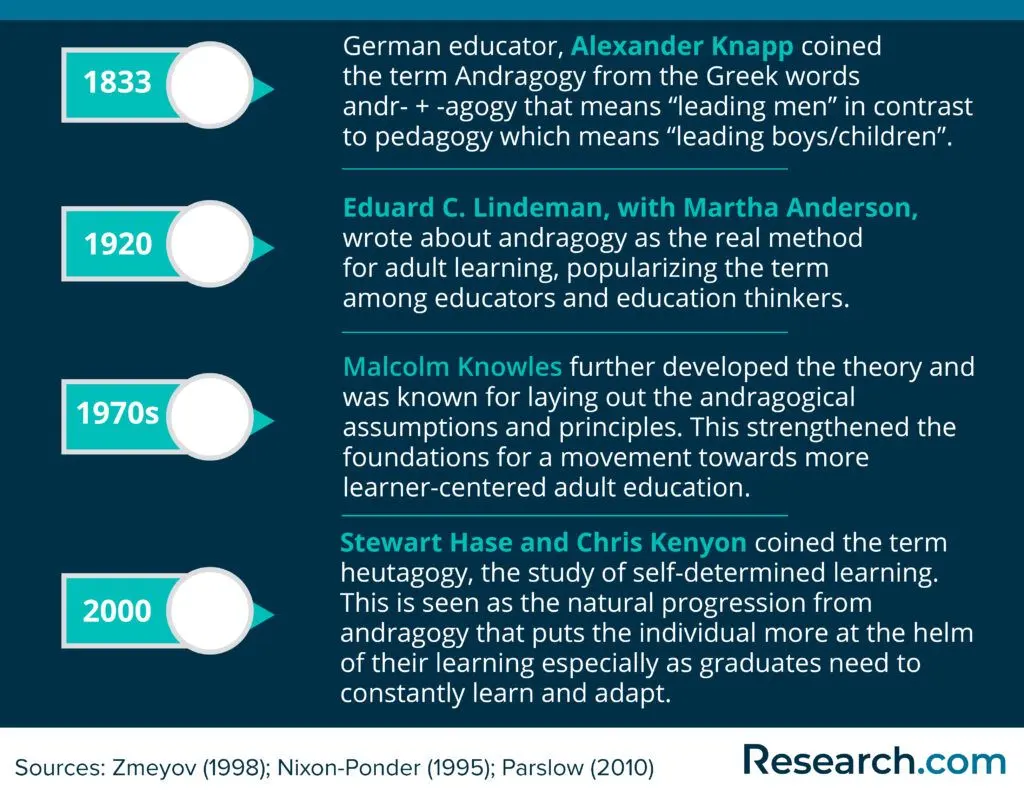
German educator Alexander Kapp introduced the term andragogy in 1833. It did not immediately become a dominant concept in education. Later, Eduard C. Lindeman helped renew attention to the idea that adult learning has distinct qualities, especially because adults learn in connection with life situations, work, civic participation, and personal development.
Adult learners are now widely understood as people who often pursue education to build competence, remain employable, change roles, or meet personal and professional goals. Park University’s 2025 discussion of adult learning theory emphasizes that adults commonly bring self-directed motivation and prior life experience into learning situations. This supports the central andragogical idea that adult education should not treat learners as empty vessels.
Learning Everest’s 2025 account of andragogy also traces how the concept moved from Kapp’s 1833 use to later adult-centered approaches. The main idea became more influential in the 20th century, especially as educators began to question whether fact-heavy, instructor-centered methods were sufficient for adults.
The Malcolm Knowles Era
Malcolm Knowles brought andragogy into broader educational discussion in the 1970s. He argued that adult education required assumptions different from those commonly used in child-centered teaching. For Knowles, adults were not simply older students; they were learners with identities, experiences, responsibilities, and practical reasons for participating.
Knowles criticized traditional instruction when it treated learners as passive recipients of information. In a teacher-centered model, the instructor decides what learners need, presents the material, and expects learners to absorb it. That model can work in some settings, but it often fails adults who want relevance, participation, and clear application.
Adult learners are often less responsive to methods that rely heavily on drills, memorization, disconnected quizzes, and lectures that do not explain why the material matters. They are more likely to engage when learning tasks connect with workplace decisions, family responsibilities, community problems, licensure requirements, career mobility, or academic goals.
Knowles’ influence expanded into higher education, workplace learning, management, medicine, education, criminal justice, and other fields. Learning Everest’s 2025 discussion notes that andragogical ideas have been applied internationally and across disciplines, making the framework one of the most recognizable models in adult education.
From Andragogy to Heutagogy
Andragogy also helped open the door to heutagogy, a later concept associated with self-determined learning. While andragogy emphasizes adult self-direction within a facilitated learning environment, heutagogy goes further by focusing on learners who define not only how they learn but also what they need to learn and why.
This progression matters in a world where information is widely available, professional skills can become outdated, and online education gives learners more control over pace and format. Adults who can evaluate sources, identify skill gaps, choose learning tools, and apply knowledge independently are better positioned for continuing education and career mobility.
That does not mean every adult learner should be left alone to design an entire education pathway. Many still need advising, structure, feedback, and credible assessment. But andragogy and heutagogy both challenge educators to move beyond one-way content delivery and toward learning experiences that build autonomy. This is especially important in applied fields such as substance abuse counseling, where adult learners must connect theory, ethical practice, supervised experience, and human-centered judgment.
Knowles’ Six Assumptions of Adult Learners
Knowles’ andragogy is commonly summarized through six assumptions about adult learners. These assumptions should not be treated as rigid laws, but they are useful design principles for courses, degree programs, workplace training, and professional development.
| Knowles’ Assumption | What It Means | What It Looks Like in Practice |
| Self-concept | Adults generally want to be treated as capable, responsible, and self-directed. | Programs include choices, goal-setting, reflection, and learner input. |
| Experience | Adults bring prior life and work experience that can support learning. | Courses use discussion, case analysis, portfolios, simulations, and peer learning. |
| Readiness to learn | Adults are more ready to study when the topic connects to a real role or need. | Learning activities are tied to job tasks, academic milestones, career changes, or personal goals. |
| Orientation to learning | Adults often prefer learning that solves immediate problems. | Assignments use scenarios, projects, applied research, and performance tasks. |
| Motivation | Adults are often driven by internal reasons, though external pressures can also matter. | Programs clarify purpose, relevance, progress, and personal value. |
| Need to know | Adults want to understand why they are learning something before investing effort. | Instructors explain outcomes, criteria, use cases, and connections to future decisions. |
These assumptions support the idea that adult educators should not only “teach” in the narrow sense. They should facilitate learning by helping adults connect content with experience, test ideas against real problems, receive useful feedback, and build confidence in applying new knowledge.
In an andragogical environment, learners and facilitators may also discuss assessment methods, performance expectations, and the practical meaning of success. This does not eliminate academic standards. Instead, it makes standards more transparent and meaningful.
Core Principles Behind Andragogical Learning Design
Andragogy works best when learning is active, relevant, and connected to performance. Drawing from Knowles and later adult-learning scholarship, strong adult education programs usually share several design principles.
- Start with the learner’s goal. Adult learners should understand how a course, degree, or credential supports a specific academic, professional, or personal objective.
- Use experience as evidence and context. Prior work and life experience should be invited into discussion, but it should also be examined critically.
- Organize learning around problems. Adults often learn best when content is attached to realistic decisions, cases, projects, or workplace scenarios.
- Make feedback frequent and usable. Adult learners need more than final grades; they need feedback that helps them improve performance.
- Respect time constraints. Programs for adults should avoid unnecessary busywork and should clearly connect assignments to outcomes.
- Build transfer into the course. Learners should practice using knowledge in settings similar to where they will need it later.
These principles can apply to short courses, professional certificates, associate degrees, bachelor’s programs, graduate study, and workplace training. For example, adults considering shorter academic pathways may compare time, cost, transfer policies, and career alignment before deciding whether an associate program fits their goals. Research.com’s guide to what an associate degree is and how it works can help learners evaluate that option in context.
Related Adult Learning Theories That Support Andragogy
Andragogy is not the only framework used to explain adult learning. It overlaps with other approaches that emphasize context, problem-solving, and learner participation.
- Situated cognition: This theory argues that learning is connected to the situation in which it happens. Tools, social interaction, workplace norms, and real activities all shape what learners understand and remember.
- Minimalist instruction: This approach focuses on giving learners enough structure to start solving meaningful problems rather than overwhelming them with excessive explanation before practice.
- Experiential learning: Adult learners often learn deeply when they move through cycles of action, feedback, reflection, and adjustment.
- Self-directed learning: Adults develop the capacity to identify what they need to learn, choose resources, monitor progress, and evaluate outcomes.
Together, these theories reinforce a practical point: adult education should not be designed as a content dump. Adults need guided opportunities to use knowledge, test assumptions, and improve performance.
Integrating Andragogy with Online Learning
Online education can support andragogy when it is intentionally designed for adults. Flexibility alone is not enough. A self-paced course with unclear expectations, weak feedback, and disconnected readings may be convenient, but it is not automatically adult-centered.
Strong online programs for adults usually include clear outcomes, applied assignments, instructor presence, peer interaction, accessible support, and opportunities to connect coursework with professional or personal goals. Discussion boards, simulations, project-based assessments, video demonstrations, and digital portfolios can all support andragogical learning when they are tied to meaningful outcomes.
Online study is especially relevant for adults balancing education with employment or caregiving. Learners comparing graduate options may want to review affordability, accreditation, course format, faculty support, and total program requirements before enrolling. For cost-conscious learners, Research.com’s list of affordable online master’s programs can be a starting point for comparing options, though students should still verify accreditation, admissions requirements, and fit.
How Can the Effectiveness of Andragogical Methods Be Evaluated?
Andragogical methods should be evaluated by asking whether adults can use what they learned, not only whether they completed activities. Effective evaluation combines measurable outcomes with learner feedback and evidence of real-world transfer.
| Evaluation Area | Useful Evidence | Why It Matters |
| Learning outcomes | Projects, exams, demonstrations, portfolios, or competency checks | Shows whether learners met the stated goals. |
| Application | Workplace tasks, simulations, case responses, or scenario-based assessments | Shows whether learners can transfer knowledge to practical problems. |
| Learner experience | Surveys, interviews, reflection journals, or course feedback | Shows whether learners found the course relevant, clear, and supportive. |
| Persistence and completion | Progress tracking, course completion, and participation patterns | Helps identify barriers such as pacing, workload, technology, or support gaps. |
| Career or academic next steps | Credential completion, promotion readiness, licensure preparation, or further study | Connects learning to the learner’s broader goal, while avoiding guaranteed outcome claims. |
For short career-focused programs, evaluation should look at both skill acquisition and whether the format helps learners prepare for realistic next steps. For instance, students exploring a fast online medical billing and coding course should ask how the program measures competency, what practice tasks are included, and whether the course expectations match their schedule and career plans.
What Are the Best Practices for Designing Andragogical Curricula?
Adult-centered curriculum design begins with outcomes, not content volume. The question is not “How much material can we cover?” but “What should learners be able to do, explain, decide, or demonstrate after this learning experience?”
- Define practical outcomes first. Every module should connect to a skill, decision, concept, or performance standard.
- Explain why each topic matters. Adults are more likely to engage when the purpose of an activity is visible.
- Use authentic tasks. Case studies, workplace scenarios, applied projects, and role-based simulations make learning more transferable.
- Allow structured choice. Adults benefit from options, but choices should still support the course goals.
- Build in reflection. Reflection helps learners connect new concepts with prior experience and future action.
- Use formative assessment. Low-stakes feedback during the course helps adults adjust before final evaluation.
- Consult field expectations. Industry, licensure, employer, or academic standards should inform applied programs.
Accelerated and competency-based programs can align well with andragogy when they preserve rigor and support. Adults comparing fast options should examine credit requirements, transfer policies, faculty access, and whether the pace is realistic. A resource on the fastest accelerated associate degree options can help learners understand how speed, workload, and credential value interact.
The Role of the Facilitator in Andragogy
In andragogy, the educator acts less like a lecturer who controls every step and more like a facilitator who guides adults through purposeful learning. The facilitator still provides expertise, structure, content, and standards. The difference is that the learning process is more collaborative and application-focused.
A strong facilitator helps adult learners clarify goals, connect new material to prior experience, test ideas, receive feedback, and apply concepts in realistic situations. This role requires judgment: too little structure can leave learners confused, while too much control can undermine autonomy.
Facilitators also need to recognize that adult learners are not all the same. Some return to school after years away. Some are confident professionals seeking advancement. Others are changing careers, rebuilding academic skills, or navigating online learning for the first time. Effective facilitation adapts support without lowering expectations.
| Facilitator Responsibility | Practical Example |
| Clarify expectations | Provide rubrics, examples, timelines, and success criteria before major assignments. |
| Connect theory to practice | Use scenarios, cases, workplace examples, or learner-generated problems. |
| Support autonomy | Offer project choices or flexible topics within a clear academic framework. |
| Encourage reflection | Ask learners to compare prior assumptions with new evidence or feedback. |
| Provide timely feedback | Give specific guidance that learners can use to improve the next task. |
How Do Accelerated Learning Pathways Complement Andragogical Strategies?
Accelerated learning pathways can work well for adults because they often focus on efficiency, relevance, and measurable progress. However, accelerated does not automatically mean better. A shorter program is only useful if learners have enough time, support, and preparation to meet the required outcomes.
Andragogy supports accelerated learning by emphasizing prior experience, self-direction, applied assignments, and competency-focused progress. Adults who already have related work experience may move more confidently through concentrated coursework, especially when programs help them connect experience with academic standards.
Professionals considering faster degree completion should compare program structure, workload, accreditation, credit transfer, faculty support, and whether the credential fits their career goal. Research.com’s guide to fast-track degree options can help learners understand how accelerated formats are commonly structured.
How Does Andragogy Facilitate Accelerated Learning Pathways?
Andragogy can make accelerated pathways more effective by focusing learning time on what adults need to master. Instead of requiring learners to sit through content they already understand, adult-centered programs may use prior learning assessment, applied projects, competency checks, or flexible pacing where appropriate.
This approach is especially useful when learners have clear goals and relevant background experience. For example, an adult with workplace knowledge may benefit from an accelerated associate degree program if the curriculum recognizes transfer credit, sets clear outcomes, and provides enough support to manage a compressed schedule.
The risk is overload. Adults should not choose accelerated study only because it sounds efficient. They should ask whether the weekly workload is realistic, whether advising is available, whether credits transfer, and whether the program meets employer, graduate school, or licensure expectations.
How Can Andragogical Strategies Facilitate Transition to Advanced Academic Degrees?
Adult learners moving into graduate or doctoral study often need to shift from practical experience to scholarly analysis. Andragogy can support that transition by helping learners connect professional problems with research questions, evidence evaluation, writing, and advanced theory.
Self-directed learning is especially important at advanced levels. Learners must manage long-term projects, read complex material, ask better questions, and accept iterative feedback. Experience can be an asset, but it must be paired with academic rigor and openness to critique.
Professionals exploring doctoral study should compare program expectations, dissertation or capstone requirements, faculty expertise, residency rules, cost, and time commitment. Research.com’s overview of online doctorate degrees can help learners start thinking about format and timeline, but individual program requirements should always be verified with the institution.
Applications of Andragogy
Andragogy is most useful in settings where adults must apply knowledge to real decisions, changing conditions, or professional responsibilities. It is common in higher education, workplace training, public safety instruction, healthcare education, management development, and career-change programs.
The model is especially relevant when facts alone are not enough. Adults often need judgment, adaptability, communication, ethical reasoning, and problem-solving. A course that only delivers information may not prepare learners to perform under uncertainty.
General Higher Education
Higher education increasingly serves adult learners who need flexible schedules, relevant coursework, and support systems that fit complex lives. Learning Everest’s 2025 discussion argues that colleges and universities still need to do more to align teaching and institutional practices with adult learners’ needs.
Adult learning theory is also relevant to participation and persistence. Park and Su’s 2026 systematic review of adult learners’ participation in higher education emphasizes that adult participation is shaped by motivation, life circumstances, institutional conditions, flexible learning formats, and supportive policies. This supports a practical conclusion: adult learner success depends not only on personal drive but also on whether institutions remove unnecessary barriers.
In colleges and universities, andragogical design may appear as applied projects, prior learning assessment, career-connected assignments, flexible online formats, evening schedules, advising for returning students, and clearer links between coursework and professional goals.
Police Training
Law enforcement training is a strong example of where adult learning principles can matter. Police officers need more than memorized procedures; they need judgment, communication skills, de-escalation strategies, legal awareness, and the ability to respond to unpredictable situations.
Morgan and Harfield’s 2025 work on police negotiator training highlights the value of andragogical, learner-centered approaches for developing communication and de-escalation skills. This aligns with the broader idea that adult trainees benefit from realistic practice, reflection, feedback, and scenario-based learning.
Case studies and simulations are especially relevant in police training because they allow learners to practice decision-making before facing high-stakes situations. Andragogy also supports community-oriented policing by encouraging officers to become reflective, self-directed practitioners rather than passive recipients of rules.
Business Management
Business education and management training often use andragogical methods because managers must make decisions in changing markets. Case studies, simulations, consulting projects, leadership reflection, and peer discussion all help adult learners connect theory with organizational realities.
Many management learners are already professionals. Their experience can enrich the classroom, but it can also create blind spots. A skilled facilitator helps learners use experience as a starting point while challenging assumptions with evidence, frameworks, and feedback.
In workplace learning, andragogy is useful for leadership development, compliance training, software adoption, onboarding, change management, and reskilling. The key is to design learning around tasks employees actually perform instead of presenting isolated information.
Are There Limitations to the Andragogical Approach?
Andragogy is useful, but it should not be treated as a universal explanation for every adult learner in every setting. Adult motivation is more complicated than a simple internal-versus-external distinction. Park and Su’s 2026 systematic review emphasizes that adult participation in higher education is shaped by internal motivation, external pressures, life circumstances, and institutional conditions.
This matters because adults may enroll for many reasons: personal fulfillment, promotion requirements, family expectations, job loss, licensure rules, employer reimbursement, immigration goals, or career change. A strong adult-learning design accounts for this complexity instead of assuming all adults are equally self-directed or intrinsically motivated.
Another limitation involves fields where immediate application is not the main purpose. Some areas of mathematics, theoretical computer science, philosophy, music, or pure research may involve long-term inquiry rather than direct practical payoff. Andragogy can still help by framing inquiry as problem-centered, but educators should not force every discipline into a narrow job-task model.
Finally, experience can help learning, but it can also reinforce outdated habits. Adult educators must create space for learners to examine, update, and sometimes unlearn prior assumptions.
Common Mistakes When Applying Andragogy
| Mistake | Why It Causes Problems | Better Approach |
| Assuming all adults are fully self-directed | Some learners need structure, coaching, academic support, or technology help. | Offer autonomy within a clear framework of expectations and deadlines. |
| Making everything “practical” in a shallow way | Overemphasis on immediate tasks can weaken theory, reflection, and long-term thinking. | Connect concepts to practice while preserving intellectual depth. |
| Ignoring accreditation or credential requirements | A convenient program may not meet employer, transfer, licensure, or graduate school expectations. | Verify accreditation, recognition, and program outcomes before enrolling. |
| Using discussion without direction | Adult learners may share experience without reaching deeper learning outcomes. | Guide discussion with prompts, evidence, cases, and reflection tasks. |
| Choosing programs based only on speed | Accelerated formats can become overwhelming or unsuitable for the learner’s goals. | Compare workload, support, cost, transfer credit, and credential value. |
| Assuming salary or job outcomes are guaranteed | Education can support career mobility, but outcomes depend on location, experience, field, and labor market conditions. | Use career data carefully and compare multiple pathways before deciding. |
How Can Educators Ensure Successful Implementation of Andragogical Strategies?
Educators can implement andragogy more effectively by designing courses around outcomes, relevance, feedback, and learner support. The goal is not to make adult learning easier; it is to make it more purposeful and transferable.
- Identify the adult learner profile. Determine whether learners are career changers, working professionals, returning students, first-generation college students, or credential seekers.
- Define measurable outcomes. Clarify what learners should be able to do, explain, analyze, or demonstrate by the end of the course.
- Use relevant problems. Build assignments around situations learners may actually encounter in work, academic study, or civic life.
- Offer early feedback. Adults benefit from knowing whether they are on track before high-stakes assessments.
- Train faculty and facilitators. Adult-centered teaching requires skill in discussion, coaching, assessment, and inclusive course design.
- Review results and revise. Use learner feedback, performance evidence, completion patterns, and employer or field expectations to improve the course.
Career-connected programs should also help learners understand realistic pathways. For example, adults exploring shorter healthcare training routes may want to compare education requirements, scope of practice, certification expectations, and advancement possibilities. Research.com’s guide to medical jobs with limited schooling requirements can support that kind of comparison.
How Does Andragogy Impact Career Development and Employability?
Andragogy can support career development because it builds habits that employers and professional fields often value: self-directed learning, problem-solving, reflection, adaptability, and the ability to connect knowledge with action. It does not guarantee employment or salary growth, but it can make education more relevant to career goals.
- Skill development: Adult-centered learning helps learners focus on abilities they can use in current or future roles.
- Adaptability: Self-directed learning prepares adults to keep updating skills as tools, industries, and expectations change.
- Problem-solving: Scenario-based and project-based learning helps learners practice applying concepts to real situations.
- Professional confidence: Adults who connect coursework with experience may be better able to explain their skills to employers.
- Networking: Adult learning environments can create peer and professional connections, especially in cohort-based programs.
Adult learners considering degree options for career growth should compare cost, completion time, accreditation, field demand, and personal fit. Lists such as Research.com’s guide to high-paying bachelor’s degrees can be useful, but learners should avoid choosing a major based only on potential earnings. Prior experience, aptitude, location, and employer expectations also matter.
How Can Andragogy Inform Decisions About Lucrative College Majors?
Andragogy encourages adults to make education decisions through self-directed research and reflection. That is especially useful when comparing majors with different costs, workloads, career routes, and earning potential.
An adult learner choosing a major should ask practical questions: What problem am I trying to solve by earning this degree? What skills do I already have? What careers does the major realistically support? What additional licensure, certification, graduate education, or experience might be required? How much time and money can I invest?
Resources on lucrative college majors can help learners identify options to investigate, but andragogical decision-making goes beyond rankings. The best choice is the one that connects market research with the learner’s abilities, constraints, values, and long-term goals.
Questions Adult Learners Should Ask Before Choosing a Program
- Accreditation: Is the school or program properly accredited for my academic or career goal?
- Transfer credit: Will my previous credits, military training, certifications, or work-based learning be evaluated?
- Format: Does the schedule fit my work, family, and study capacity?
- Support: Are advising, tutoring, library access, career services, and technology support available to online or adult learners?
- Assessment: Will I complete exams, projects, clinical hours, portfolios, practica, or capstones?
- Career alignment: Does the program connect clearly to the role, credential, or advancement path I want?
- Total cost: Beyond tuition, what fees, books, software, travel, exams, or lost work time should I plan for?
- Licensure or certification: If my field requires licensure, does the program meet the requirements where I plan to work?
Andragogy in the Unpredictable Future
Andragogy remains important because adults will continue to face changing technologies, unstable career paths, and evolving education options. The model’s strongest contribution is its insistence that adult education should be purposeful, experience-aware, and connected to real problems.
At the same time, adult education must avoid oversimplifying adults. Not every learner is equally confident, equally motivated, or equally prepared for self-direction. The future of adult learning will likely combine andragogy with better advising, stronger online design, clearer assessment, more flexible pathways, and support for lifelong learning.
Robert Maynard Hutchins, who became the youngest university president in America at age 30, warned against education that becomes rich in facts but poor in principles. His concern still applies. Adult learning should not merely collect information; it should help learners decide what information matters, how to evaluate it, and how to use it responsibly.
-
: "Education weakens when it treats data gathering as a substitute for disciplined thinking and principled inquiry.
"
Hutchins also argued that facts remain necessary, but they must be gathered for a reason and interpreted through sound judgment.
-
: "Facts are useful when learners know which ones to seek, why they need them, and what to do with them after they are found.
"
This is close to the best version of andragogy: adult education should honor experience, build judgment, support autonomy, and connect knowledge with meaningful action.
Key Insights
- Andragogy is adult-centered learning. It focuses on self-direction, experience, relevance, application, motivation, and the learner’s need to know why the material matters.
- Knowles made the framework widely known. Although Alexander Kapp introduced the term in 1833, Malcolm Knowles popularized and developed the model in the 1970s.
- The facilitator role is central. Adult educators still provide expertise and structure, but they also guide discussion, application, reflection, and feedback.
- Online and accelerated learning can fit andragogy. These formats work best when they include clear outcomes, meaningful support, applied assessments, and realistic workloads.
- Andragogy supports career development but does not guarantee outcomes. It can improve relevance and skill transfer, but employment and salary depend on many factors.
- The model has limits. Adult motivation is shaped by both internal and external factors, and some fields do not fit a narrow immediate-application approach.
- Good adult learning design is practical and rigorous. The strongest programs combine relevance with academic quality, credible assessment, accreditation, and learner support.
References:
- Caruth, G. D. (n.d.). Meeting the needs of older students in higher education. Participatory Educational Research, 1 (2), 21-35. https://files.eric.ed.gov/fulltext/ED552755.pdf
- Knowles, M. S. (1980). The Modern Practice of Adult Education: From Pedagogy to Andragogy: Revised and Updates. New York, NY: Association Press. Google Books record
- Knowles, M. S. (1984). Andragogy in Action: Applying Modern Principles of Adult Learning. Google Books record
- Park University. (2025, February 14). Adult learning theory: How adults learn differently. https://www.park.edu/blog/adult-learning-theory-how-adults-learn-differently/
- Learning Everest. (2025, April 30). Andragogy – adult learning theory. https://www.learningeverest.com/andragogy-adult-learning-theory/
- Park, J.-H., & Su, M. N. (2026). Adult learners’ participation in higher education: A systematic review of determinants and barriers. Trends in Higher Education, 5(1), 19. https://doi.org/10.3390/higheredu5010019
- Morgan, M., & Harfield, C. (2025, September 22). Andragogical learning in police negotiator training. Journal of Police Training and Practice. https://www.sciencedirect.com/org/science/article/pii/S1366562625000245
Other Things You Should Know About The Andragogy Approach
Andragogy is an approach to learning specifically focused on adult learners, emphasizing self-direction, experience, readiness to learn, and practical applications of knowledge.
Andragogy differs from pedagogy in that it is learner-centered, focusing on the needs and experiences of adult learners, whereas pedagogy is more teacher-centered and often used for teaching children.
The core assumptions include self-concept (autonomy and self-direction), learning from experience, readiness to learn, immediate application of knowledge, internal motivation, and the need to understand the reasons for learning.
Andragogy is applied in higher education by allowing students to take control of their learning, integrating their experiences into the curriculum, and focusing on practical, problem-solving skills relevant to their lives and careers.
Criticisms of andragogy in 2027 include its perceived inflexibility and over-reliance on self-directed learning, which might not suit all adult learners. Critics also argue that it doesn't adequately address cultural differences and may oversimplify complex learning processes.
Andragogy is important in business management education because it emphasizes real-life case studies and problem-solving skills, making the learning process more relevant and applicable to professionals in the field.
Some criticisms of andragogy include the argument that internal and external motivations for learning are complex and context-dependent, and that some theoretical or abstract disciplines may not fit well with the andragogical approach.
Andragogy promotes lifelong learning by encouraging adults to continuously seek knowledge and skills that are immediately applicable and relevant to their personal and professional development.


