
2027 Cardiovascular Technologist Careers: Skills, Education, Salary & Job Outlook

Co-Founder and Chief Data Scientist
Becoming a cardiovascular technologist is a practical healthcare path for people who want direct patient contact, medical technology, and a faster route into clinical work than many licensed provider careers require. The main decision is whether the required training, clinical hours, and credentialing are worth the investment for your goals.
The answer depends on your tolerance for hands-on procedures, shift-based healthcare work, and technical responsibility. Cardiovascular technologists help physicians diagnose and treat heart and vascular conditions using specialized equipment, patient monitoring, imaging, and procedure support. The field is projected to grow 3% through 2034, and the median salary is $67,260, which makes it a stable option for students seeking a skilled allied health career.
This guide explains what cardiovascular technologists do, the skills and credentials employers expect, realistic salary and job outlook considerations, work settings, advancement options, and related careers to compare before choosing a program.
Key Things You Should Know About Cardiovascular Technologist Career
- The typical earning potential for cardiovascular technologists and technicians in the U.S. is about $67,260 per year as of May 2024.
- Employment in this field is expected to grow 3% from 2024 to 2034, matching the average growth rate for all occupations, indicating a stable and steady demand.
- An associate's degree or postsecondary certificate is generally required to enter this career, with some roles needing licensure or certification.
- Success relies on strong skills in diagnostic imaging equipment, attention to detail, effective interpersonal communication, technical troubleshooting, and performing well under pressure.
- Career advancement often leads to supervisory roles, specialization in areas like invasive cardiology or echocardiography, or shifts into management, education, or medical device sales.
What do Cardiovascular Technologists do?
Cardiovascular technologists perform diagnostic and procedure-support work focused on the heart and blood vessels. They operate medical equipment, prepare patients, capture or record cardiovascular data, monitor patient responses, and help physicians interpret information needed for diagnosis and treatment planning.
The role sits at the intersection of technology and patient care. A cardiovascular technologist must understand anatomy, physiology, imaging or monitoring equipment, safety procedures, and clinical workflow. The job is not limited to pushing buttons on machines; it requires judgment, accuracy, communication, and the ability to respond when a patient’s condition changes.
A Day in the Life of Cardiovascular Technologists
A typical day may include reviewing physician orders, explaining tests to patients, preparing exam rooms, attaching monitoring equipment, positioning patients, recording images or waveforms, checking image quality, documenting results, and coordinating with nurses and physicians. In hospital-based roles, the day may also involve urgent cases, cardiac catheterization support, or procedures that require sterile technique and close monitoring.
Work can be routine one hour and high-pressure the next. A technologist may perform scheduled diagnostic tests in the morning, then assist with a more complex cardiovascular procedure later in the day. The best fit is someone who can stay calm, work carefully, and communicate clearly while handling both patients and advanced medical technology.
What are the key responsibilities of Cardiovascular Technologists?
Cardiovascular technologists are responsible for producing accurate cardiovascular data while keeping patients safe and informed. Their duties vary by specialty, employer, and level of experience, but most roles combine technical testing, documentation, patient preparation, and physician support.
- Perform cardiovascular diagnostic tests such as echocardiograms, EKGs, stress tests, and cardiac catheterizations.
- Operate, calibrate, and maintain specialized imaging and monitoring equipment so tests are accurate and safe.
- Assist physicians during invasive procedures by preparing equipment, monitoring patient vitals, maintaining sterile conditions, and responding to procedural needs.
- Prepare patients physically and emotionally by explaining procedures, collecting health information, positioning patients correctly, and answering basic process-related questions.
- Record, document, and organize test results clearly so physicians and care teams can use the information in treatment decisions.
- Follow infection control, radiation safety, patient privacy, and emergency response protocols required in clinical settings.
The Most Challenging vs. The Most Rewarding Tasks
The most challenging part of the job is often assisting during invasive or urgent cardiovascular procedures. These situations require fast coordination, sharp attention to patient status, and the discipline to follow protocols under pressure. A small documentation error, missed vital-sign change, or equipment issue can affect the procedure.
The most rewarding part is seeing how accurate testing and steady support contribute to diagnosis, treatment, and recovery. Cardiovascular technologists may not make the final diagnosis, but their work often gives physicians the evidence needed to act quickly and appropriately.
Students comparing entry routes should look closely at program length, accreditation, clinical placement quality, and certification preparation. Some learners explore flexible options such as the best online associate's degree in 6 months, but cardiovascular technology itself usually requires substantial in-person lab and clinical training.
What are the key skills for Cardiovascular Technologists?
Successful cardiovascular technologists combine technical precision with calm, respectful patient care. Employers look for candidates who can produce reliable results, communicate with anxious patients, and work smoothly with physicians, nurses, and other clinical staff.
Key hard skills for Cardiovascular Technologists
- Operating EKG, echocardiogram, imaging, monitoring, and related cardiovascular testing equipment.
- Understanding cardiac anatomy, vascular anatomy, physiology, and common cardiovascular conditions.
- Preparing patients for tests and procedures, including positioning, electrode or transducer placement, and vital-sign monitoring.
- Recognizing image quality issues, abnormal patterns, and technical problems that require correction or escalation.
- Using Electronic Health Records (EHR) and clinical documentation systems accurately.
- Following safety procedures, infection control standards, and sterile technique when required.
Essential soft skills to master
- Active listening, especially when patients describe symptoms, fears, or prior medical history.
- Attention to detail when documenting results, setting up equipment, and following physician orders.
- Critical thinking when test conditions change or equipment readings do not match patient presentation.
- Dependability, because clinical teams rely on technologists to be prepared, punctual, and accurate.
- Emotional control in stressful situations, including urgent cases or patients in distress.
- Clear communication with patients, physicians, nurses, and other technologists.
The One Overlooked Skill That Separates the Good from the Great
Patient communication is often the difference between a technically competent technologist and an excellent one. Many cardiovascular tests make patients nervous because they involve the heart, unfamiliar equipment, or the possibility of serious results. A technologist who can explain what will happen in plain language, reduce anxiety, and gain cooperation often produces better-quality tests and smoother procedures.
This skill is especially valuable when patients are in pain, afraid, elderly, or medically fragile. Strong communication does not replace technical knowledge, but it makes that technical knowledge more effective in real clinical settings.
Students who need flexible academic options while building foundational coursework may compare online colleges open enrollment, but they should confirm whether any credits transfer into an accredited cardiovascular technology pathway and whether required clinical training is available locally.
Cardiovascular Technologist Careers: A Step-by-Step Guide to Getting Started
The path into cardiovascular technology is structured, but it is important to choose the right program and credential for the specialty you want. Employers may prefer or require graduates who are prepared for professional certification and who have completed supervised clinical experience.
- Research the specialty areas. Decide whether you are more interested in invasive cardiology, cardiac sonography, vascular technology, EKG, stress testing, or a broader cardiovascular technology track.
- Choose an appropriate postsecondary program. Look for an accredited program that includes classroom instruction, lab practice, and supervised clinical training.
- Complete clinical rotations seriously. Clinical experience is where students learn workflow, patient interaction, sterile technique, equipment handling, and professional expectations.
- Prepare for certification. Identify the credential most relevant to your intended role, such as RCIS or RCS, and confirm exam eligibility requirements early.
- Apply for entry-level roles strategically. Target hospitals, cardiac labs, imaging departments, physician practices, and diagnostic laboratories that match your training.
- Keep learning after hire. Cardiovascular technology changes with new equipment, procedures, and protocols, so continuing education is part of long-term employability.
A strong program should help you connect these steps. Before enrolling, ask about certification pass preparation, clinical placement sites, graduate outcomes, faculty experience, and whether the curriculum matches the specialty you want to enter.
What education, training, or certifications are required?
The most common education route is an Associate in Science (AS) in Cardiovascular Technology, a two-year program that combines classroom study, laboratory practice, and clinical training. Bachelor of Science (BS) programs are also available and usually involve four years of broader coursework and more extensive clinical preparation. Certificate programs are commonly designed for people who already have healthcare training and want to add a cardiovascular specialty.
Important certifications include the Registered Cardiovascular Invasive Specialist (RCIS) and Registered Cardiac Sonographer (RCS), both awarded by Cardiovascular Credentialing International (CCI). Certification typically requires graduating from a CAAHEP-accredited program. Candidates also complete substantial hands-on preparation through clinical rotations or on-the-job training, often lasting 12 to 18 months in settings such as hospital cath labs and related cardiovascular departments.
How to evaluate a program before enrolling
- Accreditation: Confirm whether the program is CAAHEP-accredited if your certification pathway depends on it.
- Clinical placement: Ask where students complete rotations and whether placements are guaranteed or competitive.
- Specialty alignment: Make sure the curriculum supports your intended credential, such as invasive cardiology, cardiac sonography, or vascular technology.
- Equipment access: Strong programs give students repeated practice with current clinical equipment before patient-facing rotations.
- Certification preparation: Ask how the program prepares students for RCIS, RCS, or other relevant exams.
Are advanced degrees or niche certifications worth the investment?
Advanced degrees and specialized credentials can be worthwhile for technologists who want supervisory, education, specialized clinical, or administrative roles. A bachelor's degree may broaden advancement options, while credentials such as Registered Vascular Specialist (RVS) can support movement into a focused specialty.
However, more education also means more tuition, more time, and often more clinical requirements. For many entry-level candidates, an associate degree plus a relevant credential such as RCIS or RCS can be enough to qualify for stable cardiovascular technology roles. The better choice depends on your target job, local employer preferences, financial situation, and willingness to stay in school longer.
If speed and cost are major concerns, compare accelerated options carefully. A fast track associates degree may help some students complete general education or related requirements sooner, but cardiovascular technology programs still need adequate lab and clinical hours to prepare graduates safely.
What is the earning potential for Cardiovascular Technologists?
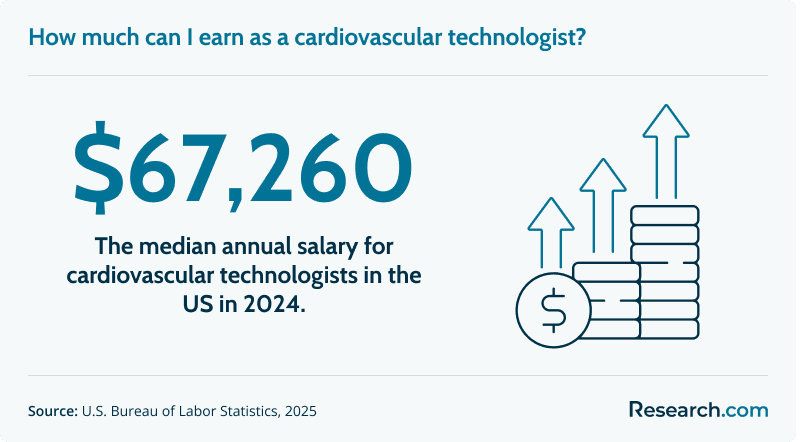
The median annual salary for a cardiovascular technologist is $67,260. Earnings vary widely by experience, location, work setting, specialty, shift requirements, and credential level. Entry-level technologists earn around $38,990 per year, while experienced professionals at the senior level can make up to $100,850 annually.
Several factors can influence long-term earning potential. Hospital roles may offer different compensation structures than physician offices or diagnostic laboratories. Some employers pay more for technologists who can work in high-acuity settings, take call, assist with invasive procedures, or hold multiple relevant credentials. Location also matters; salaries tend to be higher in states like California and in hospital settings compared to physician offices.
How to improve earning potential over time
- Earn the credential most closely aligned with your specialty and employer expectations.
- Build experience in higher-complexity settings, such as cardiac catheterization labs or advanced imaging departments.
- Cross-train in related cardiovascular procedures when your employer allows it.
- Consider supervisory, lead technologist, education, or clinical applications roles after gaining experience.
- Evaluate total compensation, not just base pay, including shift differentials, call pay, benefits, tuition reimbursement, and schedule expectations.
What is the job outlook for Cardiovascular Technologists?
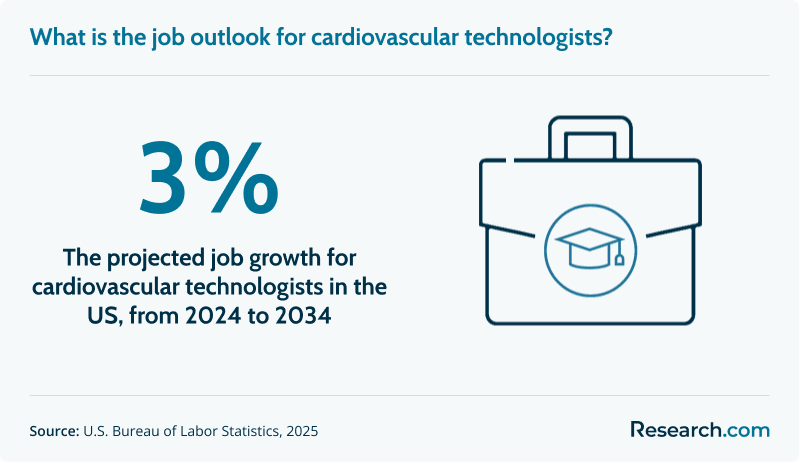
The demand for cardiovascular technologists is projected to grow about 3% from 2024 to 2034, which is around the average for all occupations. This points to a stable field rather than a rapidly expanding one. For students, that means program quality, clinical experience, certification, and local employer demand matter.
The Key Factors Shaping the Future Outlook
An aging population is one of the main drivers of demand because cardiovascular and vascular conditions become more common with age. Healthcare systems also continue to emphasize early diagnosis, monitoring, and treatment of heart and vascular disease, which supports the need for skilled diagnostic and procedural staff.
Technology will continue to change the work. Newer imaging systems, digital records, and procedure tools may improve efficiency, but they do not remove the need for trained technologists who can position patients, obtain usable data, monitor responses, and work safely in clinical environments.
Many openings are likely to come from replacing workers who retire, transfer, or move into other roles. Students considering this field should review job postings in their region before enrolling and compare requirements across hospitals, physician offices, and diagnostic centers. Those still choosing a school can also review the best accredited non-profit online universities when planning prerequisite or related coursework.
What is the typical work environment for Cardiovascular Technologists?
Cardiovascular technologists usually work indoors in hospitals, cardiac catheterization labs, diagnostic imaging departments, physician offices, and medical or diagnostic laboratories. Most cardiovascular technologists-about 78%-are employed in hospitals, especially in cardiac catheterization labs or diagnostic imaging departments. Others work in offices of physicians (13%) or medical and diagnostic laboratories (4%).
The work is hands-on and patient-facing. Technologists may spend much of the day standing, moving equipment, positioning patients, assisting during procedures, and coordinating with physicians, nurses, and other technologists. Because the job requires specialized equipment and direct patient care, remote or hybrid work is generally not feasible.
Schedules vary by employer. Some roles follow regular daytime hours, especially in outpatient settings. Hospital-based roles may include evenings, weekends, holidays, rotating shifts, or on-call responsibilities. Before accepting a position, candidates should ask about call frequency, emergency coverage, shift differentials, staffing levels, and expectations for overtime.
What are the pros and cons of Cardiovascular Technologist careers?
Cardiovascular technology can be a strong career fit for people who want meaningful clinical work without spending many years in medical or nursing school. It can also be stressful, physically demanding, and schedule-intensive. Weigh both sides before committing to a program.
Pros
- Direct patient impact: Your work helps physicians diagnose and treat heart and vascular conditions.
- Technical specialization: The role uses advanced medical equipment and requires marketable clinical skills.
- Clearer entry path than many healthcare careers: Many technologists enter through associate degree or certificate pathways, depending on background and employer requirements.
- Variety within the field: You can focus on invasive cardiology, echocardiography, vascular technology, EKG, or stress testing.
- Stable healthcare demand: Cardiovascular care remains a core need in hospitals and outpatient settings.
Cons
- Stress and urgency: Some settings involve acutely ill patients, invasive procedures, and rapid decision-making.
- Shift and call demands: Hospital roles may include nights, weekends, overnight shifts, or on-call coverage.
- Physical strain: Standing for long periods, positioning patients, and handling equipment can be tiring.
- Emotional intensity: Working with patients facing serious heart conditions can be difficult.
- Limited remote flexibility: The role generally requires in-person clinical work.
If you are comparing programs, do not choose only by convenience. Accreditation, clinical training, and certification alignment are more important than a school’s marketing claims. Flexible academic routes through online nationally accredited colleges may help with prerequisites or related coursework, but cardiovascular technology training usually requires supervised in-person practice.
What are the opportunities for advancement for Cardiovascular Technologists?
Cardiovascular technologists can advance by gaining experience, earning additional credentials, cross-training in related procedures, and moving into lead, supervisory, educational, or administrative roles. Advancement is usually strongest for technologists who combine technical competence with reliability, communication, and leadership.
How to get promoted as a cardiovascular technologist
Promotion often starts with becoming the person a team can trust with complex cases, equipment troubleshooting, new staff support, and accurate documentation. Additional credentials in specialized areas can improve mobility, especially when they match an employer’s service lines. Experience in multiple clinical settings may also make a technologist more competitive for senior or lead roles.
Advancement paths and specialization areas
- Entry-Level Cardiovascular Technologist: Performs routine diagnostic procedures and learns department workflow under supervision.
- Senior or Lead Technologist: Handles more complex cases, supports quality control, trains staff, and helps coordinate daily operations.
- Supervisor or Manager: Oversees scheduling, compliance, equipment needs, staff performance, and department processes.
- Clinical Applications Specialist: Supports medical technology use, training, and implementation for healthcare teams or equipment vendors.
- Invasive Cardiology: Assists with procedures such as catheterizations and device implantations.
- Cardiac Sonography (Echocardiography): Focuses on ultrasound imaging of the heart, including adult and pediatric echocardiography.
- Vascular Technology or Sonography: Concentrates on imaging and evaluating blood vessel diseases.
- Electrocardiography (ECG) and Stress Testing: Develops expertise in heart rhythm recording, exercise testing, and related monitoring.
The best advancement plan is specific. Instead of collecting credentials randomly, identify the roles you want next, review job postings, and ask managers which certifications, procedures, or leadership skills are valued in your local market.
What other careers should you consider?
If you are interested in cardiovascular technology but not fully certain it fits, compare it with related allied health careers. The right choice depends on whether you prefer imaging, procedures, respiratory care, treatment delivery, or broader diagnostic work.
- Diagnostic Medical Sonographer: Uses ultrasound equipment to create images of internal structures. This may appeal to students who like imaging but want options beyond the cardiovascular system.
- Respiratory Therapist: Provides care for patients with breathing and cardiopulmonary conditions. This path may fit people who want ongoing bedside care and emergency response responsibilities.
- Nuclear Medicine Technologist: Operates specialized diagnostic equipment and works with radioactive materials used in imaging studies. This career is highly technical and procedure-oriented.
- Radiation Therapist: Delivers radiation treatments to patients, typically in oncology settings. It combines patient care, precision technology, and treatment planning support.
- Cardiovascular Invasive Specialist: Works directly in cardiovascular procedures and may be a good fit for those who prefer interventional, high-acuity clinical environments.
When comparing these careers, consider program length, accreditation, certification requirements, patient population, physical demands, schedule expectations, and whether you prefer diagnostic testing or treatment support. Shadowing professionals or speaking with program directors can help you avoid choosing a field based only on salary or job title.
Here's What Professionals Say About Their Cardiovascular Technologist Careers
- : "Being a cardiovascular technologist allows me to finish each day knowing I've contributed directly to someone's health. Using specialized equipment to monitor heart functions, I see firsthand how my skills can influence treatment decisions. The respect I receive from both patients and doctors keeps me motivated, especially during long shifts. It feels meaningful to be part of a team that supports longer, healthier lives. - Malik Lucia"
- : "Balancing full-time work and school while raising a young child has tested my limits, but it's been worth every challenge. The physical demands of operating ultrasound machines and the mental focus required for accurate diagnostics sometimes feel overwhelming. Fortunately, my instructors have been incredibly flexible, which helped me build the confidence I needed. Every day brought new scenarios to solve, and that kept me pushing forward. - Layla Jimmuel"
- : "After completing my clinical hours and passing the board exam, I felt an immense sense of accomplishment and readiness to begin my career. Scoring 845 on the exam reflected the solid foundation my program provided, especially in mastering echocardiography techniques. I'm grateful to my instructors for their guidance, which gave me the skills to work effectively in this field. The opportunity to keep learning and growing now excites me as I advance professionally. - Emma"
Key Findings
- Cardiovascular technologists use specialized equipment to help diagnose and treat heart and vascular conditions.
- The median annual salary is $67,260, with entry-level technologists earning around $38,990 and senior-level professionals making up to $100,850 annually.
- Demand is projected to grow about 3% from 2024 to 2034, indicating a stable outlook rather than rapid expansion.
- Most cardiovascular technologists-about 78%-work in hospitals, while others work in offices of physicians (13%) or medical and diagnostic laboratories (4%).
- The most common education route is an Associate in Science (AS) in Cardiovascular Technology, though bachelor’s degrees and certificate programs are also available.
- Important credentials include the Registered Cardiovascular Invasive Specialist (RCIS) and Registered Cardiac Sonographer (RCS), both awarded by Cardiovascular Credentialing International (CCI).
- The best candidates have strong technical skills, patient communication skills, attention to detail, and the ability to stay calm in clinical settings.
- Advancement can come through specialization, additional credentials, leadership experience, or movement into supervisory, educational, clinical applications, or administrative roles.
Other Things You Should Know About Cardiovascular Technologist
In 2027, cardiovascular technologists can expect a salary range between $55,000 to $90,000 annually, depending on factors like experience, location, and specific facility. The demand for skilled technologists is increasing, which can also influence potential earnings.
Success as a cardiovascular technologist in 2027 requires strong analytical skills to interpret diagnostic results, excellent interpersonal communication for patient interaction, and technical proficiency to operate complex medical equipment. Additionally, attention to detail is crucial for accurately reporting findings and coordinating with healthcare teams.
References
- Cardiovascular Technologist / Technician https://explorehealthcareers.org/careers/technologists-and-technicians/cardiovascular-technologist-technician/
- Industry Outlook - CCI - Cardiovascular Credentialing International https://cci-online.org/industry-outlook/
- 22 Amazing Reasons to Become a Cardiovascular Technologist | AIMS https://aimseducation.edu/blog/reasons-become-cardiovascular-technologist
- Cardiovascular Technology https://www.grossmont.edu/academics/pathways/health-sciences/cvt.php
- Cardiovascular Technologists and Technicians https://online.missouri.edu/career-explorer/career/cardiovascular-technologist-and-technician
- Essential Skills and Qualities for Cath Lab Techs | Prolink https://prolinkworks.com/perspectives/essential-skills-and-qualities-for-cath-lab-techs
- Occupation Profile | NC Careers.org https://nccareers.org/occupation-profile/292031/1284
- Cardiovascular Technologist Career Path | Jobtrees https://www.jobtrees.com/tree/cardiovascular-technologist-career-path
- How to Become a Cardiovascular Technologist https://www.ultrasoundschoolsinfo.com/cardiovascular-technologist-career/
- Career Paths in Cardiology - American College of Cardiology https://www.acc.org/Tools-and-Practice-Support/Cardiology-as-a-Career-Path/Career-Paths-in-Cardiology


