
2027 Crime and Intelligence Analyst Careers: Skills, Education, Salary & Job Outlook

Co-Founder and Chief Data Scientist
Choosing a crime and intelligence analyst career means deciding whether you want to work at the intersection of public safety, investigations, and data. The role is not the same as being a detective, police officer, or general data analyst. Analysts usually work behind the scenes, turning crime reports, intelligence records, location data, open-source information, and investigative leads into usable insights for law enforcement, public agencies, and security teams.
This field suits people who are detail-oriented, comfortable with sensitive information, and interested in using evidence rather than assumptions to support decisions. It also requires more than an interest in criminal justice. Employers increasingly look for candidates who can use databases, mapping tools, statistical methods, and clear written communication to explain patterns and risks.
Pay and opportunity can vary by agency, location, experience, and specialization. Reported salary figures include median salaries between $55,000 and $64,000, with top earners making over $98,000. Other salary sources place the median salary at $70,001 and the average salary at $67,676 as of 2025. This guide explains what crime and intelligence analysts do, the skills and education employers expect, salary and job outlook considerations, and how to decide whether this career path fits your goals.
Key Things You Should Know About Crime and Intelligence Analyst Career
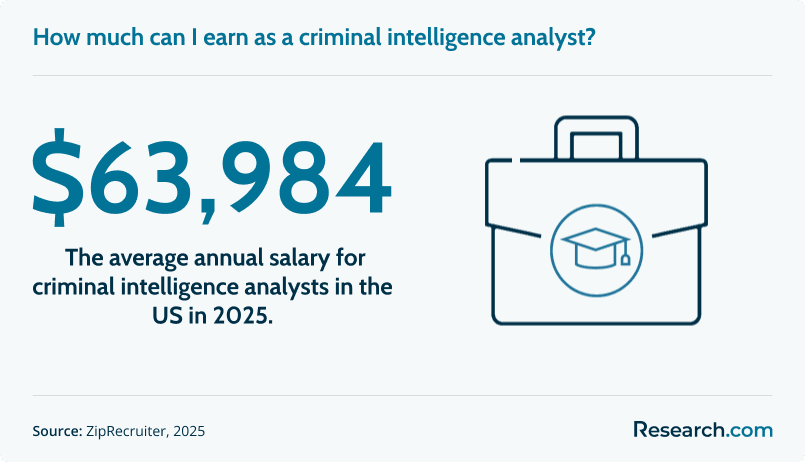
- The typical earning potential for a crime and intelligence analyst in the United States ranges from about $63,984 to $67,700 annually, with most professionals earning between $59,000 and $79,000 depending on location and specialization.
- This field offers steady demand but is not expected to grow rapidly; moderate job opportunities exist, and advancement often depends on gaining experience and specialized skills.
- A bachelor's degree in criminal justice, criminology, or a related area such as psychology, computer science, or data analytics is usually required to start a career as a crime and intelligence analyst.
- Success in this role depends on strong data analysis, critical thinking, research abilities, clear written and verbal communication, proficiency with GIS and analytics software, and careful attention to detail.
- Career advancement typically moves from entry-level analyst to senior analyst, team lead, or supervisor, with possibilities to become an intelligence manager, crime analysis director, or enter specialized federal or private sector roles.
What do Crime and Intelligence Analysts do?
Crime and intelligence analysts collect, organize, interpret, and explain information that helps agencies understand criminal activity, emerging threats, and investigative priorities. Their work supports decisions about patrol deployment, investigations, resource allocation, crime prevention, and public safety strategy.
In practice, the job is less about dramatic breakthroughs and more about disciplined analysis. Analysts review crime reports, calls for service, arrest records, intelligence submissions, social media or open-source information, and other approved data sources. They look for patterns, connections, timelines, locations, suspects, methods, and changes in activity that may not be obvious from a single case file.
A Day in the Life of Crime and Intelligence Analysts
A typical day may include checking new reports, updating dashboards or spreadsheets, mapping recent incidents, preparing a briefing for command staff, responding to information requests from investigators, or building a link chart that shows relationships among people, places, vehicles, and events.
The work usually happens in an office or secure agency setting, but it is highly connected to field operations. Analysts may brief detectives, support a task force, prepare intelligence products for other agencies, or provide real-time support during urgent incidents. Common deliverables include crime bulletins, hotspot maps, suspect or network profiles, trend reports, tactical updates, and strategic assessments.
The best analysts do not simply summarize data. They explain what the information may mean, how confident they are in their assessment, what gaps remain, and what decision-makers can do next.
What are the key responsibilities of Crime and Intelligence Analysts?
The central responsibility of a crime and intelligence analyst is to convert raw information into accurate, timely, and actionable intelligence. That requires technical skill, investigative judgment, confidentiality, and the ability to communicate clearly to people who may need to act quickly.
- Review crime reports, intelligence records, case files, public safety data, and approved open-source information to identify patterns, relationships, and emerging risks.
- Use crime mapping and geospatial analysis to locate hotspots, track movement patterns, and support patrol or investigative deployment.
- Prepare intelligence reports, bulletins, charts, maps, timelines, and presentations for investigators, supervisors, command staff, or partner agencies.
- Build suspect, victim, location, vehicle, or network profiles by connecting information from multiple sources while respecting legal and policy limits.
- Support active investigations or critical incidents with timely intelligence updates, database checks, and analytical summaries.
- Respond to information requests from law enforcement personnel, government partners, or authorized stakeholders while protecting confidential and sensitive data.
- Maintain data quality by checking sources, documenting assumptions, correcting errors, and distinguishing verified facts from leads or hypotheses.
The Most Challenging vs. The Most Rewarding Tasks
The hardest part of the job is often working with incomplete, inconsistent, or sensitive information under time pressure. Analysts may need to make sense of conflicting records, recognize when data is missing, and avoid overstating conclusions. Mistakes can affect investigations, public trust, and operational decisions, so precision matters.
The most rewarding part is seeing analysis lead to better decisions. A well-built map may help an agency deploy officers more effectively. A careful timeline may clarify a case. A network chart may reveal a connection investigators had not yet seen. For many analysts, the appeal is the chance to contribute to public safety without necessarily serving in a sworn law enforcement role.
Students comparing academic paths can use resources on the most employable college majors to understand which programs may build a stronger foundation for analytical, criminal justice, and data-focused careers.
What are the key skills for Crime and Intelligence Analysts?
Crime and intelligence analysts need a balanced skill set. Technical ability helps them manage and interpret information; professional judgment helps them avoid weak conclusions; communication skills help decision-makers understand what the analysis supports and what it does not.
The most important skills for crime analyst jobs include investigative thinking, critical analysis, data handling, computer literacy, writing, and the ability to work with law enforcement and partner agencies.
Key Technical Skills
- Crime mapping and geospatial analysis: Analysts use location-based tools to identify hotspots, routes, clusters, and shifts in activity over time.
- Data analysis and pattern recognition: The role requires comfort with structured and unstructured information, including reports, spreadsheets, databases, and case notes.
- Technical report writing: Analysts must explain findings, limitations, and recommendations in plain language that investigators and leaders can use.
- Database management and querying: Many roles involve searching, organizing, validating, and cross-referencing records within intelligence-sharing or agency systems.
- Visualization and presentation: Maps, charts, timelines, and link diagrams often communicate complex findings faster than narrative reports alone.
Key Soft Skills
- Critical thinking: Analysts must separate useful patterns from coincidence, bias, or incomplete data.
- Judgment and decision-making: The work often requires prioritizing requests, assessing reliability, and deciding how strongly a finding can be stated.
- Active listening: Analysts need to understand what investigators, officers, supervisors, and partner agencies are really asking for.
- Complex problem solving: Cases rarely arrive in a clean format. Analysts must connect fragments, identify gaps, and adjust as new information appears.
- Discretion and ethics: Because analysts handle sensitive information, confidentiality and responsible use of data are non-negotiable.
The One Overlooked Skill That Separates the Good from the Great
Interagency collaboration is one of the most underestimated skills in this career. Strong analysts know how to share useful intelligence with the right people, at the right time, and within legal and policy boundaries. They also know how to build trust with detectives, patrol officers, command staff, prosecutors, and partner agencies.
This matters because important information is often distributed across multiple systems and jurisdictions. An analyst who can coordinate responsibly across local, state, and federal partners may turn separate fragments into a clearer operational picture. That ability can be especially valuable in cases involving organized crime, cybercrime, human trafficking, fraud, or multi-jurisdictional activity.
Professionals who develop both technical and collaboration skills may be better positioned for advanced or higher-paying sectors, including Scientific Research and Development Services. For learners who want a lower-commitment starting point before a bachelor's degree, reviewing the easiest associate's degree to get can help clarify practical entry routes.
Crime and Intelligence Analyst Careers: A Step-by-Step Guide to Getting Started
There is no single path into crime and intelligence analysis, but most candidates follow a sequence that combines education, relevant experience, software skills, and professional credibility. The goal is to show employers that you can handle sensitive information, analyze data accurately, and communicate findings clearly.
- Build the right academic foundation. Start with coursework in criminal justice, criminology, intelligence analysis, statistics, data analytics, sociology, political science, international relations, or a related field. A bachelor's degree is commonly expected for professional analyst roles.
- Develop practical technical skills. Learn spreadsheet tools, databases, report writing, mapping, visualization, and basic statistical thinking. If possible, practice with public datasets or class projects that require pattern analysis and clear written conclusions.
- Gain relevant experience. Look for internships, research assistant roles, administrative jobs in public safety agencies, dispatch-related experience, records work, military intelligence experience, or entry-level investigative support roles.
- Learn the language of law enforcement and intelligence work. Understanding case workflows, evidence handling, privacy rules, threat assessment, and intelligence cycle concepts can make you more effective in interviews and on the job.
- Pursue professional training or credentials when they match your target role. Specialized analyst courses and certifications can help, especially once you have enough experience to apply the material in real settings.
- Choose a specialization as your interests become clearer. Options include cybercrime, geospatial analysis, strategic analysis, counterterrorism, fraud, financial intelligence, open-source intelligence, or tactical crime analysis.
- Advance through performance and reliability. Strong analysts build reputations for accuracy, discretion, timely work, and useful recommendations. Those traits often matter as much as formal credentials when agencies consider candidates for senior or supervisory roles.
The most common mistake is waiting until graduation to gain experience. If you are still in school, start building a portfolio of relevant projects, writing samples, mapping work, or internships as early as possible.
What education, training, or certifications are required?
Most professional crime and intelligence analyst roles require or strongly prefer a relevant bachelor's degree. Common degree options include a Bachelor's Degree in Intelligence Analysis, Criminal Justice, Political Science, International Relations, Sociology, Statistics, Data Analytics, or a Bachelor of Science in Crime and Intelligence Analysis.
The best degree choice depends on the type of analyst role you want. Criminal justice and criminology programs can help you understand policing, courts, corrections, crime theory, and investigation. Data analytics, statistics, and related programs may provide stronger quantitative preparation. Intelligence analysis or homeland security programs may offer more direct exposure to intelligence methods, threat assessment, and security issues.
Training and certifications
Certifications can strengthen credibility, especially for candidates who already have relevant education or experience. The Criminal Intelligence Certified Analyst (CICA) from the International Association of Law Enforcement Intelligence Analysts (IALEIA) is highly regarded and requires educational and professional experience. Another important credential is the Basic Analyst Classification from IALEIA, which requires completion of a qualifying intelligence course.
On-the-job training is also standard. Agencies often train new analysts on internal databases, records systems, intelligence procedures, data security policies, report formats, legal restrictions, and agency-specific workflows. Classroom instruction and training opportunities connected to agencies like the CIA and FBI can also help candidates understand real-world intelligence practices.
Students comparing degree value can review the top paying bachelor degrees to understand how different academic paths may affect broader career and salary options.
Are advanced degrees or niche certifications worth the investment?
Advanced degrees can be worthwhile for analysts who want senior, specialized, research-heavy, federal, policy, or leadership roles. Examples include a Master's in Law Enforcement Intelligence & Analysis, a Master of Science in Forensic Science, or a Ph.D. in Criminal Justice. Specialized certifications in areas such as cyber intelligence or counterterrorism may also help when they align with a specific job target.
However, more education is not automatically better. Graduate programs and niche credentials require time, money, and opportunity cost. In many analyst roles, employers also value practical experience, writing samples, software ability, security awareness, and proven judgment. Before enrolling, compare the credential against actual job postings you want and check whether employers list it as required, preferred, or simply helpful.
A practical strategy is to earn the minimum education needed to enter the field, gain experience, and then pursue advanced credentials once you know which specialization or promotion path you want.
What is the earning potential for Crime and Intelligence Analysts?
Crime and intelligence analyst pay varies by location, agency type, security requirements, experience, specialization, and whether the role is local, state, federal, or private sector. Entry-level candidates should expect salaries to differ widely because some positions are housed in public agencies with fixed pay scales, while others are tied to corporate security, federal contracting, or specialized intelligence work.
Entry-level crime analyst salary figures show that professionals with less than one year of experience earn an average of $47,868 per year in 2025[6]. The median salary for crime and intelligence analysts is reported at $70,001 annually. The crime intelligence analyst salary range in the United States typically spans from $51,151 to $89,503 annually, with an average salary of $67,676 as of 2025[7]. Senior-level analysts can earn as much as $107,215 per year.
Location can significantly affect compensation. Top-paying cities such as Charlotte, NC, and Washington, DC, offer salaries exceeding $100,000 yearly. Higher earnings are also more likely for analysts with specialized technical skills, advanced experience, cyber or financial intelligence expertise, supervisory duties, or roles in agencies and sectors with larger budgets.
When comparing offers, look beyond base pay. Public sector positions may provide stronger retirement or benefits packages, while private sector roles may offer higher pay but different expectations around pace, travel, availability, or performance metrics. Candidates should also consider overtime rules, shift expectations, clearance requirements, cost of living, and advancement potential.
What is the job outlook for Crime and Intelligence Analysts?
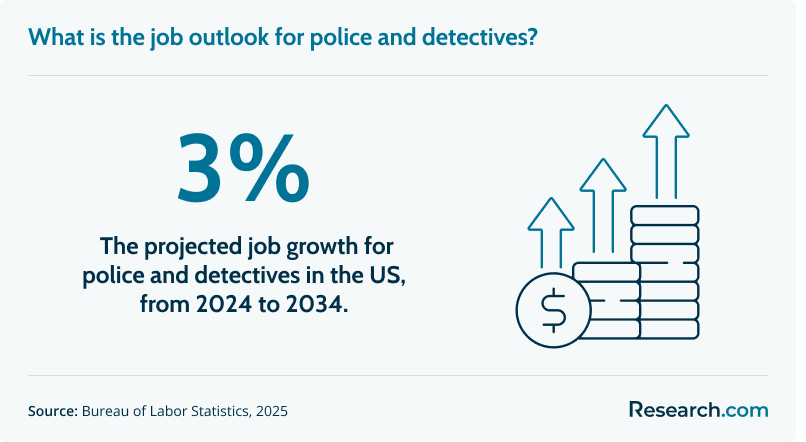
The demand for qualified crime and intelligence analysts is expected to grow up to 5% through 2030, which is slower than the average growth rate of 7-8% for all occupations. That suggests a stable but competitive field rather than a rapidly expanding one. Hiring may depend heavily on public budgets, agency priorities, retirements, technology investments, and regional public safety needs.
The Key Factors Shaping the Future Outlook
Several trends support continued demand for analysts. Agencies now manage large volumes of digital evidence, surveillance data, records, calls for service, open-source information, and interagency intelligence. As the amount of information increases, agencies need professionals who can filter noise, identify patterns, and present reliable findings.
Cybercrime is another major driver. Analysts who understand digital evidence, online behavior, fraud patterns, and cyber threat analysis may find stronger opportunities than candidates with only general criminal justice training. The shift toward intelligence-led policing also keeps analysts central to public safety planning because agencies increasingly rely on data-informed decisions.
At the same time, the field has constraints. Public sector budget shifts and changing law enforcement goals can affect hiring rates. Some smaller agencies may have limited analyst positions or combine analysis with records, administrative, or investigative support duties. Candidates can improve their competitiveness by building both criminal justice knowledge and technical skills through reputable programs, including options from the best accredited online universities.
The outlook is best for applicants who can show practical evidence of skill: strong writing, mapping or visualization examples, database experience, internships, and the ability to discuss how they handle uncertainty and sensitive information.
What is the typical work environment for Crime and Intelligence Analysts?
Crime and intelligence analysts usually work in secure office settings within police departments, sheriff's offices, fusion centers, government agencies, federal agencies, or corporate security operations. Most professionals work for government law enforcement agencies, while a growing minority work in private sector corporations and a substantial number serve in federal agencies such as the FBI or CIA.
The environment is collaborative but often controlled. Analysts may work closely with detectives, patrol supervisors, command staff, prosecutors, records personnel, other analysts, and outside agencies. Because the information can be confidential or legally sensitive, many roles require strict access controls, secure systems, and careful documentation of how information is used and shared.
A crime analyst's typical work schedule is often full-time and may follow standard business hours. However, overtime, irregular shifts, and on-call duties can occur during urgent investigations, major incidents, public safety emergencies, or special operations. Analysts supporting tactical units, fusion centers, or time-sensitive investigations may face more variable schedules than those focused on long-term research or administrative reporting.
Remote or hybrid work is possible in some private sector or technology-focused roles, but many government and law enforcement positions require on-site work because of confidentiality, system access, and operational security. Anyone considering this career should be comfortable with structured procedures, sensitive subject matter, deadlines, and regular interaction with law enforcement personnel.
What are the pros and cons of Crime and Intelligence Analyst careers?
Crime and intelligence analysis can be meaningful work for people who enjoy investigation, data, and public service. It can also be stressful, emotionally demanding, and constrained by bureaucracy or limited resources. Understanding both sides is essential before choosing the field.
Pros
- Direct public safety impact: Your work can help prevent crime, support investigations, and improve resource decisions.
- Intellectually engaging work: Analysts solve complex problems, identify hidden patterns, and connect information from multiple sources.
- Mission-driven environment: Many analysts value supporting justice, victims, investigators, and safer communities.
- Variety of specializations: Career paths can include cybercrime, fraud, geographic profiling, counterterrorism, financial intelligence, or strategic analysis.
- Non-sworn pathway into public safety: The role can appeal to people who want to contribute to law enforcement work without becoming officers.
Cons
- Exposure to disturbing material: Analysts may review violent crime details, victim information, exploitation cases, or traumatic reports.
- High pressure for accuracy: Errors, weak assumptions, or unclear language can affect investigations and operational decisions.
- Time-sensitive demands: Urgent requests, major incidents, and investigative deadlines can create stress.
- Routine data work: Not every task is strategic or exciting; data cleaning, administrative reporting, and repetitive checks are common.
- Budget and policy limits: Public agencies may have limited tools, staffing, or promotion openings compared with private sector employers.
This career is often a good fit for people who are patient, analytical, ethical, and comfortable working independently while still collaborating with teams. Those who prefer thoughtful, detail-oriented work may also find it useful to compare this path with the best career for introvert options.
What are the opportunities for advancement for Crime and Intelligence Analysts?
Crime and intelligence analysts can advance by moving into senior analytical roles, supervisory positions, specialized units, federal or private sector opportunities, training roles, or policy and research leadership. Advancement usually depends on experience, reliability, technical skill, communication ability, and trustworthiness with sensitive information.
Advancement Opportunities
Crime analyst career progression is typically built in stages:
- Entry-level analyst: Supports data collection, report preparation, mapping, database checks, recurring bulletins, and basic pattern analysis in local or state agencies, fusion centers, or public safety departments.
- Experienced analyst: Handles more complex cases, creates advanced intelligence products, briefs leadership, supports task forces, and may train new analysts.
- Senior or lead analyst: Oversees analytical priorities, reviews products for quality, coordinates with partner agencies, and may specialize in high-impact crime types or strategic planning.
- Supervisor or manager: Leads an analysis unit, manages staff, sets procedures, coordinates with command staff, and contributes to broader criminal justice leadership or policy development.
Specializations in Intelligence Analysis
Specialization can be just as valuable as management, especially for analysts who want to become subject-matter experts. Common specializations include:
- Geographic profiling and predictive modeling: Identifying location-based crime trends and supporting strategic resource deployment.
- Cybercrime and digital forensics: Analyzing digital evidence, online activity, cyber threats, and technology-enabled crime.
- Homeland security and counter-terrorism intelligence: Supporting national security, threat prevention, and interagency intelligence work.
- White-collar crime and financial intelligence: Working on fraud, money laundering, corporate security, and complex financial patterns.
- Policy development and research analysis: Using data to shape law enforcement strategy, community safety initiatives, and program evaluation.
To move up, analysts should keep examples of strong work products when allowed, pursue targeted training, learn new analytical tools, and seek assignments that demonstrate judgment under real operational conditions.
What other careers should you consider?
If crime and intelligence analysis interests you, several related careers may also fit your skills. Comparing alternatives can help you decide whether you prefer law enforcement support, national security, corporate risk, forensic work, or hands-on investigations.
- Intelligence Analyst: Reviews information from multiple sources to identify security threats, geopolitical patterns, criminal networks, or operational risks. This path may involve government, military, federal, or private sector intelligence work.
- Fraud Investigator: Examines transactions, records, claims, and behavioral patterns to identify fraud. This role may be a strong fit for people interested in financial crime, insurance, banking, compliance, or corporate investigations.
- Criminal Investigator/Detective: Gathers evidence, interviews witnesses, follows leads, and builds cases. Compared with analyst roles, this path is usually more field-based and may require sworn law enforcement status.
- Forensics Specialist: Collects, preserves, documents, and analyzes evidence using scientific or technical methods. This role may appeal to people who prefer laboratory, evidence, or technical casework.
- Cryptologist: Uses mathematics, logic, language, and data interpretation to solve security and communication problems. This path is more specialized and often requires advanced technical aptitude.
Choose based on the kind of work you want to do every day. If you enjoy writing reports, mapping data, and briefing decision-makers, crime analysis may be a strong fit. If you want to conduct interviews and collect evidence in the field, investigative roles may be better. If you prefer technical systems, cybercrime, fraud, or forensics may offer a closer match.
Here's What Professionals Say About Their Crime and Intelligence Analyst Careers
-
: "Integrating open-source intelligence into investigations has changed how I approach cases, especially those involving human trafficking. I review digital footprints alongside traditional reports to find details that may otherwise be missed. Knowing that my analysis has helped victims leave dangerous situations makes the difficult work feel meaningful.
Marisol"
-
: "One of the hardest parts of the job is building a clear picture from incomplete information across different law enforcement sources. I spend a lot of time checking small details because one missing fact can change the direction of a case. The pressure is real, but accuracy is what makes the work valuable.
Damon"
-
: "The most rewarding part is seeing complex data become intelligence that officers can actually use. When a report helps identify a pattern before it escalates, it feels like a direct contribution to community safety. Even difficult cases are easier to handle when I know the work may prevent harm.
Lenora"
Key Findings
- Crime and intelligence analysts turn reports, records, maps, open-source information, and investigative data into intelligence that supports public safety decisions.
- A relevant bachelor's degree is commonly expected, with strong options including intelligence analysis, criminal justice, political science, international relations, sociology, statistics, and data analytics.
- Core skills include crime mapping, data analysis, report writing, database work, critical thinking, judgment, confidentiality, and collaboration across agencies.
- Reported pay varies by source and role. Figures include an entry-level average of $47,868 per year in 2025[6], a median salary of $70,001, an average salary of $67,676 as of 2025[7], and senior-level earnings as high as $107,215 per year.
- The field is expected to grow up to 5% through 2030, slower than the 7-8% average growth rate for all occupations, making practical experience and technical skills especially important.
- The best candidates combine criminal justice knowledge with data fluency, ethical judgment, clear writing, and the ability to explain uncertainty without overstating conclusions.
- This career can be highly meaningful, but it also involves sensitive information, time pressure, disturbing case details, and responsibility for accurate analysis.
Other Things You Should Know About Crime and Intelligence Analyst
In 2027, essential skills for crime and intelligence analysts include data analysis, critical thinking, and proficiency in geographic information systems (GIS) software. Strong communication and report-writing abilities are also crucial, as analysts must present their findings clearly to law enforcement agencies and other stakeholders.
A major misconception is that crime and intelligence analysts solely work with data in isolation. In reality, they collaborate extensively with law enforcement agencies and other organizations to interpret data and apply insights in practical, strategic contexts. Their work significantly influences decision-making processes for public safety initiatives.
References
- Entry-level roles https://www.nationalcrimeagency.gov.uk/careers/how-to-join-the-nca/entry-level-roles
- Career Outlook and Job Vacancies for Intelligence Analysts https://www.recruiter.com/careers/intelligence-analysts/outlook/
- Criminal Intelligence Career | Degree, Requirements, Salary https://www.discoverdatascience.org/guide-to-a-career-in-criminal-intelligence/
- Intelligence Analysts Income and Hiring - BigFuture Career Search https://bigfuture.collegeboard.org/careers/intelligence-analyst/income-and-hiring
- Is Becoming a Financial Crime Analyst Worth It? [15 Pros and Cons][2025] https://digitaldefynd.com/IQ/is-becoming-financial-crime-analyst-worth-it/
- Careers - Vault https://vault.com/professions/crime-analysts/outlook
- Criminal Intelligence Analyst Careers, Salary and Outlook - MSU https://online.cj.msu.edu/masters-law-enforcement-intelligence-analysis/career-outlook
- Artistic Innovators - Where Creativity Meets Code https://aaustoreqa.dev.academyart.edu/crime-analyst-jobs
- Intelligence Analyst Careers: Protecting National Security https://www.augusta.edu/online/blog/intelligence-analyst-careers
- Becoming a Crime Analyst | Certified Crime & Intelligence Analyst (CCIA) https://www.forensicscolleges.com/blog/htb/how-to-become-a-crime-analyst


