
2027 What Does a Cybersecurity Specialist Do: Responsibilities, Requirements, and Salary

Co-Founder and Chief Data Scientist
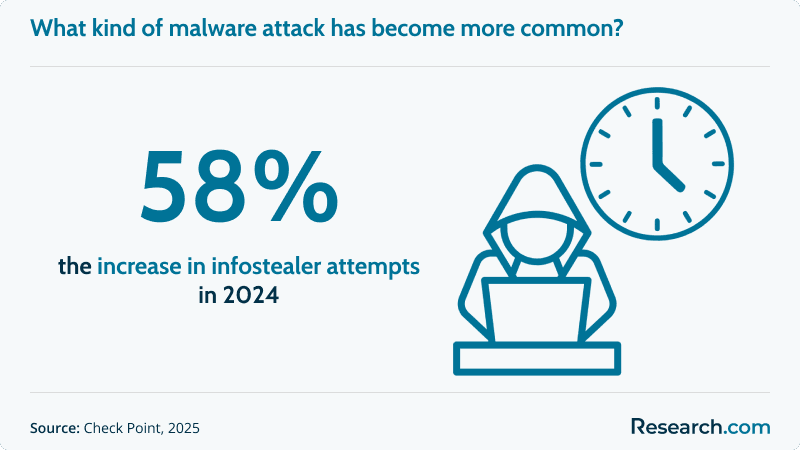
Our digital world is expanding faster than we can protect it. With threats like infostealer malware attempts jumping 58% in the last year alone, the call for skilled digital defenders has never been more urgent. For anyone exploring career options, this presents a massive opportunity, but it can also be a confusing one. Where do you even begin?
To help cut through the noise, our career planning experts, with over a decade of experience, have crafted this straightforward guide. It’s designed to give you the clarity and confidence you need to start your journey toward a rewarding career as a cybersecurity specialist.
Key Things You Should Know About What a Cybersecurity Specialist Does
- The median annual salary for cybersecurity specialists is an impressive $124,910.
- Job growth in the field is projected to be a staggering 29% from 2024 to 2034.
- A core daily task involves proactively monitoring an organization's computer networks for suspicious activity.
- An essential skill for success is a strong aptitude for analytical and problem-solving.
- A common first step for aspiring professionals is earning a foundational certification like the CompTIA Security+.
What does a cybersecurity specialist do?
Think of a cybersecurity specialist as a digital bodyguard for an organization's most valuable information. While many people picture a specialist swooping in to fix a crisis, the reality is that the role is overwhelmingly proactive.
Their main job is to build and maintain secure systems to prevent attacks from ever happening in the first place. It’s about making sure the digital doors are locked and monitored, long before anyone tries to break in.
The Core Mission: Confidentiality, Integrity, and Availability
This proactive stance is guided by three core principles that form the bedrock of all information security. In simple terms, a specialist's mission is to ensure:
- Confidentiality: This means ensuring sensitive information is only seen by authorized people.
- Integrity: This ensures that the data is accurate and trustworthy, and can’t be changed without permission.
- Availability: This means making sure that systems and data are up and running for the people who need them, when they need them.
What tasks define a cybersecurity specialist's day?
While every day can bring new challenges, the work is a blend of routine vigilance and, when needed, rapid response. A huge part of the job involves proactive measures designed to find and fix security weaknesses before an attacker can.
These proactive responsibilities often include:
- Monitoring security systems and computer networks for suspicious events or traffic.
- Conducting vulnerability assessments and penetration tests to find security flaws.
- Developing and updating security policies and procedures for the organization.
- Training employees on security best practices to create a security-conscious culture.
Responding When Threats Emerge
Of course, when a potential threat is detected, the specialist's role shifts from proactive defense to reactive response. This is the critical, time-sensitive aspect of the job where they must act quickly to protect the organization. These tasks can include:
- Investigating security alerts and potential breaches to determine the scope and impact.
- Containing active threats to prevent further damage and data loss.
- Recovering compromised systems and restoring data to get operations back to normal.
What salary can a cybersecurity specialist expect?
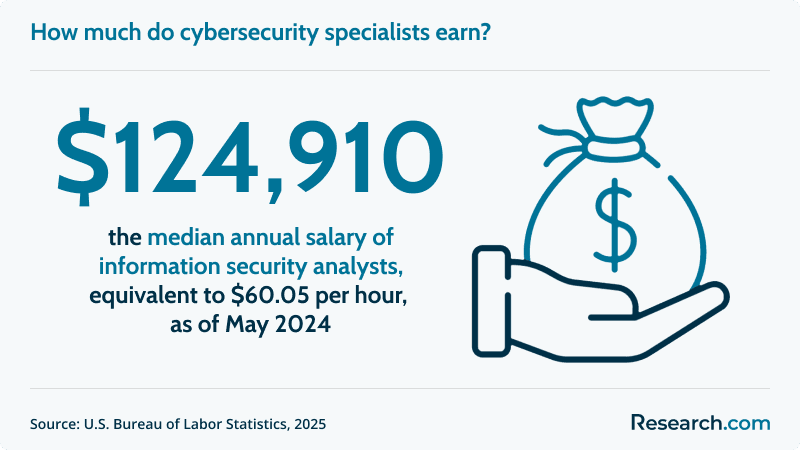
The median annual salary for a cybersecurity specialist is $124,910, which works out to about $60.05 per hour, according to the U.S. Bureau of Labor Statistics.
Now, it's important to remember that this is the midpoint for professionals across all experience levels. An entry-level salary will naturally start lower, but this field is known for strong and relatively quick income growth as you gain experience.
Your specific salary will depend on a few key things: your experience level, the certifications you earn, where you live, and the size of your employer. As you might expect, specialists working in major cities or for large corporations often command higher salaries.
Which Industries Pay the Most?
While cybersecurity professionals are needed everywhere, some industries pay a premium for their skills. According to the U.S. Bureau of Labor Statistics, the top-paying sectors for information security analysts include:
Why are cybersecurity specialists in high demand?
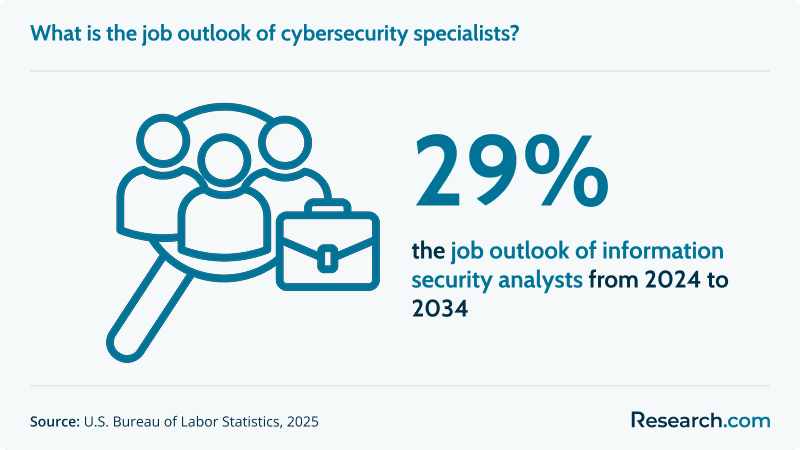
The job outlook for cybersecurity specialists is exceptionally strong. The U.S. Bureau of Labor Statistics projects a 29% growth rate from 2024 to 2034, which is significantly faster than the average for all other jobs.
This isn't a temporary trend. The high demand is driven by deep, long-term factors like the constant evolution of cyber threats and the increasing number of data privacy laws that companies are required to follow.
A Closer Look at the Talent Gap
What this incredible growth has created is a well-documented "talent gap." Put simply, there are far more open cybersecurity jobs than there are qualified people to fill them.
For you, this is a major advantage. It means that once you have the right skills, you'll be in a strong position. This translates directly into excellent job security and gives you real leverage when it comes to salary and choosing where you want to work.
What types of companies hire cybersecurity specialists?
Cybersecurity specialists are hired by virtually every type of organization, as data protection and network integrity are universal needs. The field is often described as industry-agnostic, meaning demand is high across all sectors—private, public, and non-profit.
However, certain industries have a particularly urgent need for cybersecurity professionals due to the sensitivity of the data they handle, the complexity of their operations, or regulatory requirements.
The largest employers of cybersecurity specialists fall into the following categories:
- Technology and Telecommunications: This includes software development companies, cloud service providers (like Amazon, Microsoft, Google), and telecommunications firms. They need specialists for application security, security architecture, and protecting massive network infrastructures.
- Finance and Insurance: These institutions are prime targets for cybercrime due to the highly lucrative financial data they hold. They hire heavily for roles focused on fraud prevention, risk management, and ensuring compliance with financial regulations.
- Government and Defense: Federal, state, and local agencies, including the military and intelligence services, require professionals for critical infrastructure protection, national security, and managing vast amounts of classified and sensitive citizen data.
- Healthcare: Hospitals, clinics, and insurance providers handle protected health information (PHI), making them frequent targets. Cybersecurity specialists here focus on data privacy (HIPAA compliance), protecting electronic health records, and securing interconnected medical devices.
- Consulting Firms: Large and specialized consulting firms (like Accenture, Deloitte, KPMG) hire vast teams of security experts. They work with thousands of clients across all industries, providing services like penetration testing, security audits, and implementing new security frameworks.
In-House vs. Consulting Roles
Beyond the specific industry, you can also think about the type of work environment you'd prefer. Many specialists work in-house, meaning they are part of an internal security team that focuses deeply on protecting a single organization.
Alternatively, you could work for a consulting firm or a Managed Security Service Provider (MSSP). In that role, you would get broad experience serving many different clients and tackling a wide variety of security challenges.
What skills do you need to become a cybersecurity specialist?
It can feel intimidating to look at a long list of technical requirements, but it helps to think of these skills as a toolkit you build over time. No one starts out as an expert in everything. Your focus should be on creating a balanced toolkit with both "hard" technical skills and "soft" professional skills.
Here are the foundational hard skills to start with:
- Network fundamentals: You need to understand how data travels through networks, including key concepts like IP addressing, routing, and protocols (such as TCP/IP and DNS). A solid grasp of these principles is essential for identifying and solving connectivity or security issues.
- Operating system knowledge: Proficiency with both Windows and Linux is crucial, as most organizations rely on a mix of these environments. Knowing how to navigate, configure, and troubleshoot each system helps you adapt to varied IT infrastructures.
- Basic understanding of cloud platforms: Knowledge of services like AWS, Azure, or Google Cloud is increasingly important as companies migrate their data and applications online. Understanding how to deploy, secure, and monitor cloud environments can set you apart from other candidates.
- Familiarity with security tools: This includes firewalls, antivirus software, and Security Information and Event Management (SIEM) systems. Learning how these tools detect, prevent, and respond to threats will strengthen your ability to safeguard organizational data.
Understanding network fundamentals is so crucial that many professionals start by studying for certifications that can lead to the shortest CCNA online training course.
The Overlooked Essentials: Key Soft Skills
Technical ability is only half the equation. To truly succeed and advance, you need strong soft skills to apply your knowledge effectively. These are just as critical as any certification, and you may already have many of them. They include:
- Communication: Cybersecurity professionals must translate complex technical risks and jargon (like "SQL injection" or "DDoS attack") into clear, actionable, business-focused language for non-technical audiences, including executives and end-users. Strong written communication is vital for drafting precise incident reports and policy documents.
- Critical Thinking & Analytical Reasoning: This is the ability to objectively analyze complex security incidents, evaluate vast amounts of data, and identify underlying patterns or inconsistencies that signal a breach. It enables specialists to move beyond assumptions to form data-driven conclusions about threat mitigation.
- Problem-Solving and Creativity: Since cyber threats are constantly evolving, specialists must be able to think laterally and creatively. When standard defenses fail, they need to quickly develop innovative, non-obvious solutions to complex security challenges, often while under high pressure.
- Adaptability and Continuous Learning: The threat landscape changes daily due to new technologies (like AI and IoT) and emerging criminal tactics. Specialists must have an inquisitive mindset and be committed to continuous learning to keep skills current and swiftly adapt security strategies.
- Collaboration and Teamwork: Cybersecurity is rarely a solo job. Professionals must collaborate effectively with IT, legal, HR, and executive teams to enforce policies, conduct security audits, and coordinate incident response, ensuring all departments are aligned in protecting the organization.
What are the education requirements for a cybersecurity specialist?
One of the biggest misconceptions about this field is that you absolutely must have a four-year computer science degree. While it's true that many professionals hold bachelor's or associate's degrees in areas like computer science, information technology, or cybersecurity, that is definitely not the only path to a successful career.
In this industry, employers often value demonstrated skills and certifications just as much, if not more, than a specific degree.
Because the demand for talent is so high, there are several other highly effective ways to enter the field. Intensive cybersecurity bootcamps have become a very popular and respected option, offering hands-on training that can prepare you for a job in a matter of months.
For others, military experience with a focus on communications or intelligence provides an excellent foundation. And finally, a dedicated self-study path that focuses on earning key industry certifications is another proven way to break into the industry and land a great role.
What certifications are most valuable for a cybersecurity specialist?
In an industry where practical skills are what matter most, certifications act as a clear, standardized signal to employers that you have a specific level of knowledge. They are often the key to getting your resume past initial screenings. With so many options out there, the best approach is to start with a solid, foundational one.
For an aspiring cybersecurity specialist, the most common and valuable starting point is the CompTIA Security+. This certification is globally recognized and covers the essential principles of network security and risk management. Another strong option for beginners is the (ISC)² Systems Security Certified Practitioner (SSCP).
Advancing Your Expertise: Intermediate and Advanced Certs
Once you have a foundational certification and some experience, you can pursue more advanced credentials to deepen your expertise and increase your earning potential. Certifications like the CompTIA CySA+ are great for those interested in security analytics, while the Certified Ethical Hacker (CEH) is popular for those who want to specialize in offensive security.
As you progress, you might find yourself drawn to a specific area of the field; for example, some specialists focus on governance and compliance, seeking out the fastest online ISC2 CGRC training bootcamps to advance their careers.
What are the common career paths for a cybersecurity specialist?
A career in cybersecurity isn't just one job; it's a journey with many different routes for growth. It's helpful to know that most people don't start out as senior specialists. The most common entry points are foundational roles that give you a broad base of experience to build on.
Typical entry-level jobs include titles like Security Operations Center (SOC) Analyst, IT Security Specialist, or Cybersecurity Technician. As cloud technologies become central to how businesses operate, many people wonder what jobs you can get with a cloud computing degree, and cloud security specialist is a top answer.
Specialization and Leadership Tracks
After you have a few years of experience, you can start to specialize in an area that interests you most. You might be drawn to the offensive side of security and become a Penetration Tester, or you might prefer the investigative work of a Digital Forensics Analyst.
Other common paths include becoming a Security Architect, who designs secure systems from the ground up. With significant experience, you can also move into leadership roles like Security Manager or even Chief Information Security Officer (CISO).
How do you get started on your cybersecurity career?
Moving from interest to your first job can feel like the biggest hurdle, but you can get there by following a clear, structured process. Here is a simple, five-step plan to guide you.
- Build Your Foundational IT Knowledge. Before you can secure a network, you need to understand how it works. This often starts with mastering the basics covered in a top CompTIA A+ boot camp online.
- Choose Your Primary Learning Pathway. Decide whether a degree, a bootcamp, or a self-study certification path is the right fit for your goals, budget, and timeline.
- Gain Hands-On Experience. This is the most important step for overcoming the "entry-level job that needs experience" paradox.
- Earn Your First Foundational Certification. Getting a certification like the CompTIA Security+ is a non-negotiable step to prove your skills to employers.
- Craft Your Resume and Network. Tailor your resume to highlight your hands-on projects and certifications, and start connecting with other professionals in the field.
Building Your Home Lab: A Practical First Step
The best way to gain hands-on experience without a job is to build your own virtual "home lab." Using free software, you can create a network of virtual machines on your own computer to practice your skills in a safe environment.
You can also participate in online Capture the Flag (CTF) competitions, which are ethical hacking games that test your problem-solving abilities, and contribute to open-source security projects. This is the kind of practical experience that really stands out to hiring managers.
What advancement opportunities are available for cybersecurity specialists?
A career in cybersecurity offers excellent opportunities for growth, and advancement isn't limited to just one path. You can think of your options in two main directions: moving up into management or going deep into a technical specialty.
A senior cybersecurity specialist with strong leadership skills is highly valued and can move into management roles like Security Manager or Director of Security. This path often involves earning management-focused credentials, and many professionals look for the shortest CISM training online to help them make that leap.
Deepening Your Expertise: The Specialist Path
If management isn't your goal, you can advance by becoming a true subject matter expert in a specific, high-demand niche. This is known as horizontal growth.
You could become the go-to expert in cloud security, threat intelligence, or application security. Both the management and specialist paths are highly respected and financially rewarding. The key to both is a commitment to continuous learning to keep your skills sharp in this ever-changing field.
Is a career as a cybersecurity specialist worth it?
For individuals with a passion for problem-solving and a deep curiosity about technology, a career as a cybersecurity specialist is absolutely worth it. It is one of the few fields that offers a powerful combination of high salary potential, exceptional job security, and intellectually stimulating work that has a real-world impact.
You are on the front lines of a digital world, playing a critical role in protecting people and organizations from harm. However, like any rewarding career, it's important to go in with a clear view of the demands.
The field of cybersecurity is not static; it is a constant learning process. The threats of today will be replaced by new ones tomorrow, which requires a genuine commitment to lifelong education to stay effective. The work can also be high-pressure, especially when you are responding to an active security incident.
Is This Career the Right Fit for You?
To know if this path is right for you, take a moment for some honest self-reflection. Ask yourself:
- Are you a naturally curious person who enjoys taking things apart to see how they work?
- Do you enjoy solving complex puzzles and thinking analytically?
- Can you remain calm and methodical when faced with a high-stakes situation?
If you answered "yes" to these questions, you likely have the mindset to not only succeed but also thrive in this dynamic field. For those who are up for the challenge, a career in cybersecurity is one of the most rewarding and future-proof paths available today.
Here's What Cybersecurity Specialists Have to Say About Their Career
- Joy: "The excitement of being a cybersecurity specialist comes from knowing I'm on the front line of defense, proactively stopping threats that could cost our company millions—a proven value highlighted by our zero-breach record last year. The adrenaline rush when successfully mitigating a sophisticated attack is immensely satisfying, making this a rewarding and vital job. "
- Harper: "My role as a cybersecurity specialist offers unparalleled career mobility and strong compensation; I secured a 15% salary increase last year through certification alone. More meaningfully, I enjoy the constant intellectual challenge of solving complex puzzles and learning new technologies every day, ensuring my expertise never stagnates. "
- Amanda: "The best part of being a cybersecurity specialist is the global demand and the ability to work remotely for international clients, which gives me tremendous lifestyle flexibility. I find deep professional satisfaction in building robust security systems and knowing that my work protects not just data, but the trust and privacy of thousands of customers worldwide. "
Key Findings
- The primary responsibility of cybersecurity specialists is to safeguard an organization's IT systems (networks, software, data) by identifying and resolving vulnerabilities, protecting against external threats like hacking, and ensuring security compliance.
- Aside from having a relevant bachelor's degree is common, you can also enter the cybersecurity field without a degree by earning industry certifications (like CompTIA Security+ or CISSP), gaining hands-on experience through internships or lab work, and building a portfolio of real-world projects.
- Success requires a blend of strong technical skills and critical soft skills like creative problem-solving, communication, and meticulous attention to detail.
- The median annual salary for Information Security Analysts in the U.S. is highly competitive, falling around $124,910, with top earners exceeding this based on experience and specialization.
- The demand for these roles is exceptionally high, with the U.S. Bureau of Labor Statistics projecting employment growth for Information Security Analysts at a much faster than average rate of 29% through 2034.
Other Things You Need To Know About a Career as a Cybersecurity Specialist
In 2027, a cybersecurity specialist should ideally have a bachelor's degree in cybersecurity, computer science, or a related field. Certifications like CISSP or CEH are beneficial. Coding knowledge, while not mandatory, is advantageous for understanding and mitigating security threats effectively.
In 2027, cybersecurity specialists typically need certifications like Certified Information Systems Security Professional (CISSP) or Certified Ethical Hacker (CEH). These certifications validate expertise and are often required or highly recommended by employers for this field.
References
- (ISC)². (2023). 2023 (ISC)² cybersecurity workforce study. https://www.isc2.org/research/workforce-study
- CompTIA. (2024). State of cybersecurity 2024. https://www.comptia.org/content/research/state-of-cybersecurity-2024
- ISACA. (2024). State of Cybersecurity 2024: The professional imperative. https://www.isaca.org/state-of-cybersecurity-2024
- U.S. Bureau of Labor Statistics. (2024, September 6). Occupational outlook handbook: Information security analysts. U.S. Department of Labor. https://www.bls.gov/ooh/computer-and-information-technology/information-security-analysts.htm
- Verizon. (2024). 2024 data breach investigations report. https://www.verizon.com/business/resources/reports/dbir/


