2027: What Does a BCBA Do: Responsibilities, Salary & Career Paths

Co-Founder and Chief Data Scientist
Becoming a Board Certified Behavior Analyst is a serious career decision: it requires graduate education, supervised fieldwork, certification, and a commitment to data-based practice. For people drawn to behavioral health, special education, autism services, or clinical program leadership, the BCBA credential can lead to meaningful work—but the path is structured and demanding.
The need for behavioral health professionals remains strong. According to the Bureau of Labor Statistics (BLS), employment of substance abuse, behavioral disorder, and mental health counselors—including BCBAs—is projected to grow 17 percent from 2024 to 2034, much faster than the average for all occupations. This guide explains what BCBAs do, the qualifications required, how behavior intervention plans are created, where BCBAs work, what salaries may look like, and how professionals maintain and advance their certification over time.
Key Things You Should Know About BCBAs
- BCBAs assess behavior, design and implement evidence-based interventions, and oversee ethical practices for clients with developmental or behavioral challenges.
- Candidates must earn a graduate degree, complete 1,500–2,000 hours of supervised fieldwork, and pass the BCBA exam.
- BCBAs earn an average annual salary of $75,109, with demand growing rapidly in states like California, Massachusetts, Texas, New Jersey, and Florida.
What is a BCBA and what qualifications are required to become one?
A Board Certified Behavior Analyst (BCBA) is a graduate-level professional certified by the Behavior Analyst Certification Board (BACB) to assess behavior, identify why it occurs, and design interventions using applied behavior analysis (ABA). BCBAs often work with individuals with autism spectrum disorder (ASD), developmental disabilities, learning differences, communication challenges, or behavioral concerns that affect daily functioning.
The credential matters because it signals that a professional has met education, supervised experience, examination, and ethics requirements. In practice, BCBAs are expected to make decisions from observable data rather than assumptions, use evidence-based interventions, and adjust treatment when progress stalls.
Core education and certification requirements
To become a BCBA, candidates must complete a defined sequence of academic and professional steps:
- Earn a master’s degree or higher in behavior analysis, education, or psychology from an accredited institution. Many candidates consider online or hybrid formats when they need to balance coursework with employment or fieldwork.
- Complete 315 hours of graduate-level coursework aligned with the BACB’s verified course sequence (VCS).
- Complete 1,500 to 2,000 hours of supervised fieldwork under a qualified BCBA.
- Pass the BCBA certification exam, a four-hour, 185-question assessment covering ethics, behavior principles, assessment, measurement, and intervention strategies.
What successful candidates should understand before starting
The BCBA pathway is not only an academic commitment. Candidates also need access to appropriate supervision, enough time to accrue fieldwork hours, and a work or practicum setting where they can apply ABA procedures ethically. A common mistake is choosing a program before confirming how fieldwork supervision will be arranged. Before enrolling, applicants should verify accreditation, coursework alignment, supervision options, faculty expertise, and whether the program’s schedule fits their timeline.
Certification renewal
After certification, BCBAs must renew every two years and complete 32 continuing education units (CEUs), including ethics and supervision credits. Renewal is designed to ensure that practitioners continue to follow current professional standards, update their clinical skills, and maintain ethical decision-making throughout their careers.
What are the core responsibilities of a BCBA in clinical and educational settings?
BCBAs are responsible for turning behavioral concerns into measurable goals and practical intervention plans. Their work combines assessment, treatment design, staff training, family collaboration, progress monitoring, and ethical oversight. The exact duties vary by setting, but the central purpose is the same: improve socially meaningful behavior using data-supported methods.
Clinical settings
In clinics, hospitals, home-based programs, and community care settings, BCBAs commonly:
- Conduct functional behavior assessments (FBAs) to identify the conditions that contribute to challenging behavior.
- Develop individualized behavior intervention plans (BIPs) that reduce unsafe or disruptive behaviors while teaching replacement skills.
- Coordinate with speech therapists, occupational therapists, physicians, psychologists, caregivers, and direct support staff.
- Train families and intervention staff so strategies are implemented consistently across home, clinic, and community environments.
- Review treatment data and revise goals when interventions are not producing meaningful change.
Educational settings
In schools, BCBAs support students and educators by applying behavior analysis within classroom routines, special education services, and schoolwide systems. Their responsibilities may include:
- Supporting students with autism, ADHD, learning differences, and behavioral needs that interfere with instruction or peer interaction.
- Creating positive behavior support systems that help teachers manage classrooms without relying only on punishment or exclusionary discipline.
- Training teachers and paraprofessionals to collect data, reinforce target behaviors, and respond consistently to challenging behavior.
- Helping teams align behavior supports with Individualized Education Programs (IEPs) and special education policies.
- Interpreting behavior data for school teams so decisions are based on patterns rather than isolated incidents.
Clinical vs. school-based BCBA work
The biggest difference between clinical and educational BCBA roles is the operating environment. Clinical roles may focus more heavily on individualized treatment intensity, caregiver training, and coordination with healthcare providers. School-based roles often require navigating classroom schedules, IEP teams, district policies, and teacher capacity. Both require strong communication skills, careful documentation, and the ability to translate ABA concepts into steps that non-specialists can use.
Those pursuing school or clinical roles often begin with accredited BCBA programs online, which can combine research-based coursework with supervised field experience and prepare candidates for different practice environments.
How do BCBAs design and implement behavior intervention plans?
BCBAs design behavior intervention plans by first identifying the function of a behavior, then selecting strategies that address that function while teaching safer or more useful replacement skills. A strong plan does not simply try to stop a behavior. It explains what the person is communicating or obtaining through the behavior and provides a practical, ethical path toward better outcomes.
Step 1: Define the target behavior clearly
The process starts with an observable definition. Instead of vague labels such as “noncompliant” or “aggressive,” a BCBA defines exactly what is happening, when it happens, and how it will be measured. Clear definitions help staff, caregivers, and teachers respond consistently and collect reliable data.
Step 2: Conduct a Functional Behavior Assessment
The design phase usually includes a Functional Behavior Assessment (FBA). The purpose of the FBA is to understand the “why” behind a behavior. BCBAs gather information through direct observation, interviews, rating tools, record reviews, and data collection. They look for patterns involving antecedents, the behavior itself, and consequences that may be maintaining the behavior.
Step 3: Select intervention strategies that match the function
Once the likely function is identified, the BCBA designs a plan that may include prevention strategies, teaching procedures, reinforcement systems, environmental adjustments, and crisis-response procedures when necessary. Effective plans are individualized. A strategy that works for attention-maintained behavior may not work for behavior maintained by escape, sensory stimulation, or access to preferred items.
Step 4: Train the implementation team
A behavior intervention plan is only useful if the people around the client can implement it correctly. BCBAs train parents, teachers, Registered Behavior Technicians (RBTs), and other team members through modeling, practice, feedback, and written protocols. Training should make the plan understandable enough to use during real routines, not just in ideal conditions.
Step 5: Monitor outcomes and revise the plan
Implementation is not the end of the process. BCBAs continue collecting data to determine whether the intervention is reducing harmful or disruptive behavior and increasing meaningful skills. If progress is limited, the BCBA revisits the assessment, adjusts procedures, improves staff training, or changes goals. Ethical practice requires treatment decisions to be based on evidence rather than habit or preference.
The role of skill building
The best behavior intervention plans teach what to do instead. That may include communication, self-management, social interaction, coping strategies, academic readiness, daily living skills, or workplace behaviors. This skill-building focus is what separates high-quality ABA practice from simple behavior control.
How do BCBAs monitor and analyze client progress using data?
BCBAs use data to decide whether treatment is working, whether goals are appropriate, and whether an intervention should continue, change, or stop. Data collection helps reduce guesswork and makes progress visible to families, educators, funders, and clinical teams.
Common data collection methods
The type of data depends on the behavior and treatment goal. BCBAs commonly use:
- Frequency recording to track how often a behavior occurs.
- Duration recording to measure how long a behavior lasts.
- ABC charts, or Antecedent-Behavior-Consequence records, to identify patterns before and after behavior occurs.
- Interval recording when behavior happens at high rates or must be sampled across time.
- Skill acquisition data to measure whether the client is learning targeted replacement behaviors or new functional skills.
- Digital behavior tracking software for real-time entry, graphing, and team communication.
How BCBAs interpret progress
Data are reviewed regularly to determine whether the behavior intervention plan is producing meaningful improvement. BCBAs often use visual analysis, such as line graphs, to look for trends, variability, level changes, and maintenance over time. If a client’s progress plateaus or regresses, the BCBA may adjust reinforcement, change prompts, revise the replacement skill, provide additional staff training, or reassess the behavior’s function.
Why data quality matters
Poor data can lead to poor clinical decisions. If staff define behavior inconsistently, skip data collection, or record information after the fact, the BCBA may overestimate or underestimate progress. Strong BCBA practice includes training data collectors, checking reliability, and choosing measurement systems that are realistic for the setting.
In BCBA masters programs, students learn to apply statistical reasoning and visual data analysis, including line graphs, to guide clinical decision-making. This systematic approach supports ethical treatment because decisions are tied to measurable outcomes rather than impressions alone.
What supervision and training responsibilities do BCBAs have for staff and trainees?
BCBAs often supervise the people who deliver day-to-day ABA services, which makes supervision one of the most important parts of the role. Good supervision protects clients, improves treatment integrity, and helps trainees develop professional judgment—not just technical skills.
Supervision responsibilities
BCBAs may supervise registered behavior technicians (RBTs), BCaBAs, graduate students, and other staff involved in behavior intervention. Their responsibilities commonly include:
- Providing structured supervision for RBTs, BCaBAs, and graduate students.
- Observing staff as they implement behavior intervention plans and skill-building procedures.
- Giving performance feedback that is specific, timely, and tied to client outcomes.
- Conducting competency-based assessments to confirm that staff can perform required procedures correctly.
- Reviewing documentation, data collection, and treatment notes for accuracy and completeness.
- Documenting supervision hours and feedback as required by the BACB.
Training responsibilities
BCBAs also train staff and caregivers so that interventions are consistent across people and settings. Training may include workshops, role-play, modeling, written protocols, case review, and direct coaching. Topics often include ABA principles, ethical guidelines, behavior measurement, reinforcement, crisis prevention, confidentiality, and client-centered care.
What effective supervision looks like
Effective supervision is active, not passive. A BCBA should not simply sign forms or review data from a distance without observing implementation. Strong supervision includes direct observation, corrective feedback, opportunities to practice, and follow-up checks to see whether performance improved. This protects clients from poorly implemented services and helps staff build confidence.
This dual focus on mentorship and accountability supports high-quality ABA services and promotes continuous learning within the profession.
Which industries and work settings commonly employ BCBAs?
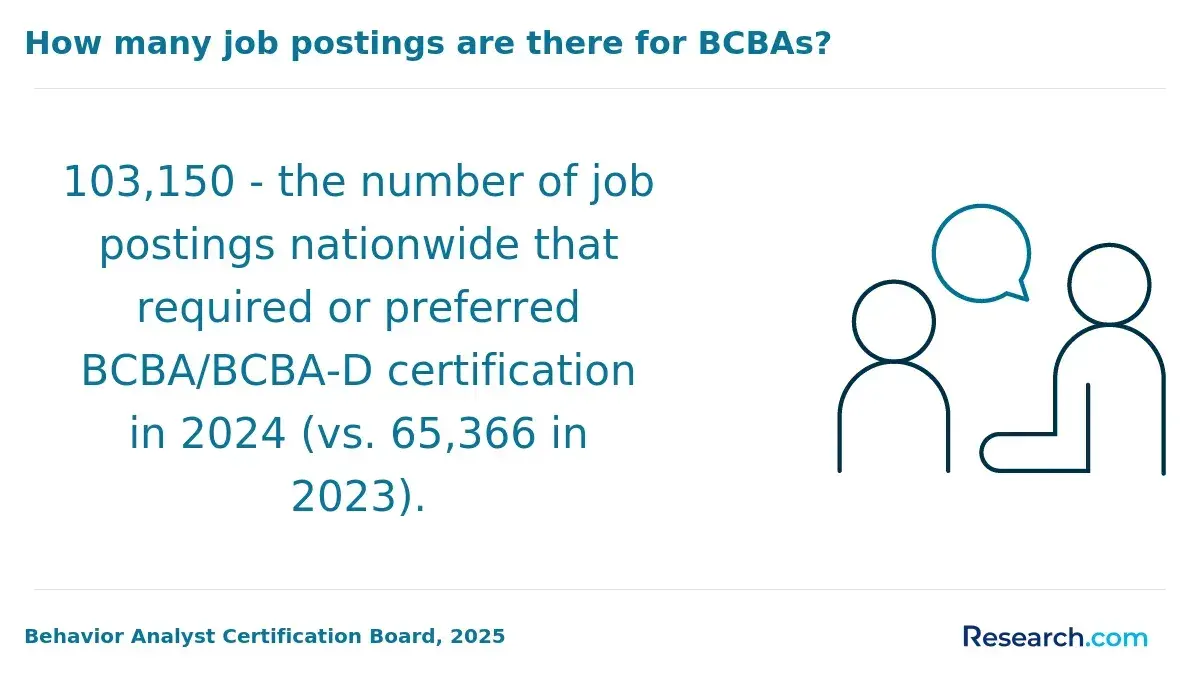
BCBAs are employed wherever organizations need expertise in behavior assessment, intervention, staff training, and performance change. According to 2025 data from the Behavior Analyst Certification Board (BACB), most job postings are concentrated in educational and clinical sectors, while opportunities in corporate and research environments are also rising.
Common work settings
- Clinical and healthcare environments: BCBAs may work in hospitals, rehabilitation centers, outpatient clinics, or intensive treatment programs serving individuals with developmental disabilities, autism spectrum disorders, traumatic brain injuries, or complex behavioral needs.
- Home- and community-based services: Many BCBAs design interventions that are implemented in homes, community programs, and everyday routines, often with strong caregiver training components.
- Educational institutions: In schools and universities, BCBAs develop behavior support plans, train teachers, monitor student progress, and help teams support IEP-related goals.
- Private practice and consulting: Some BCBAs provide independent services to families, schools, agencies, or organizations. This path can offer autonomy but also requires business, documentation, billing, and compliance skills.
- Corporate, research, and government roles: A smaller but growing number of BCBAs work in organizational behavior management, public policy, workforce training, behavioral research, and program evaluation.
How to choose a setting
The right work setting depends on a BCBA’s strengths and career priorities. Clinical roles may offer intensive client contact and clear treatment structures. School-based roles may appeal to professionals who enjoy collaboration with educators and systems-level problem solving. Consulting and private practice can provide flexibility but usually require more administrative responsibility. Research, corporate, and government roles may fit BCBAs interested in large-scale behavior change rather than one-on-one clinical service.
Workforce trends
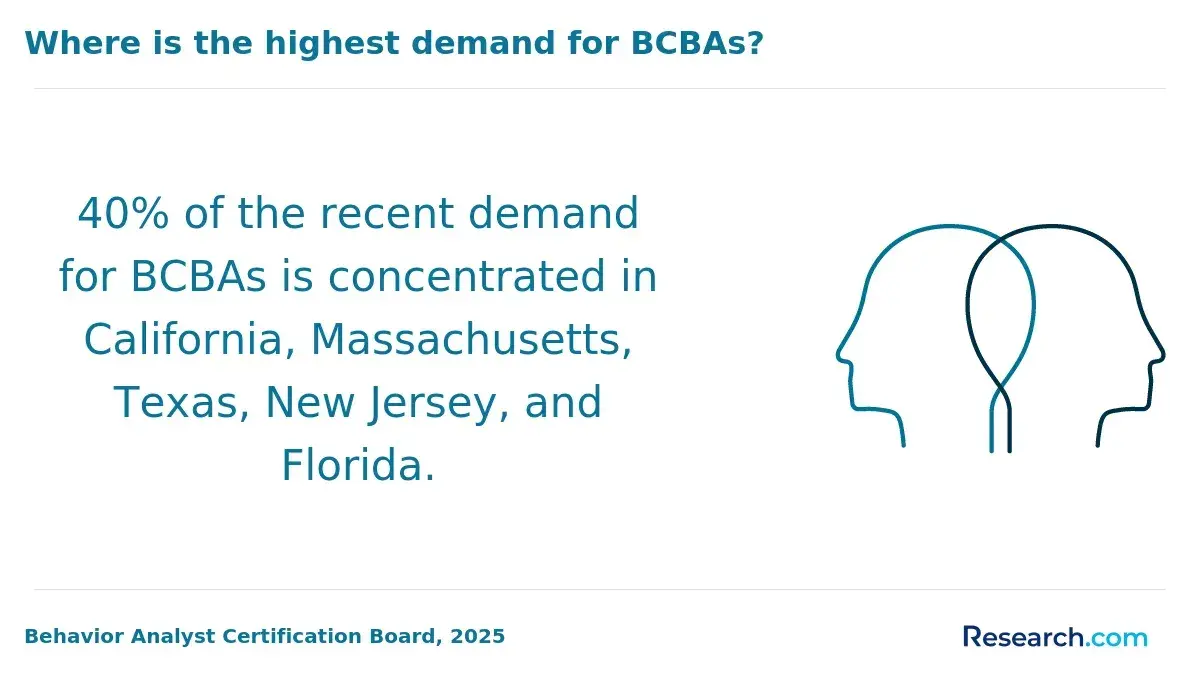
Demand remains highest in states like California, Texas, and Massachusetts, which together represent nearly 40% of the total U.S. demand for behavior analysts. As awareness of behavioral science grows, more organizations are incorporating BCBAs into multidisciplinary teams focused on long-term behavior change, skill development, and mental health outcomes.
What is the typical BCBA salary and how do factors like location and experience affect it?
BCBA salaries vary by experience, employer type, geography, specialization, and responsibility level. As of 2025, Payscale reports that the average BCBA salary is $75,109 per year, with the top 10% earning over $90,000 annually. These figures should be treated as general benchmarks rather than guarantees, because compensation can shift substantially by setting and local labor market.
Salary by experience
- Early-career (1–4 years): $65,000–$70,000
- Mid-career (5–9 years): $72,000–$78,000
- Experienced (10+ years): $80,000–$90,000+
How location affects pay
California, New Jersey, and Massachusetts offer the highest pay due to strong regional demand and higher living costs. States in the Midwest and South may offer lower salaries, but the overall financial picture can be more favorable when housing, transportation, taxes, and cost of living are considered. For job seekers comparing offers, base salary is only one part of the decision.
Other compensation factors
Work setting can affect earnings. BCBAs in hospitals or private practice tend to earn more than those in educational settings, while school-based roles may offer different advantages such as predictable schedules or public-sector benefits. BCBAs with doctoral-level certification (BCBA-D), advanced supervision responsibilities, leadership roles, or specialization in autism spectrum disorders may also command higher salaries.
What to compare in a BCBA job offer
Beyond salary, candidates should review caseload size, billable-hour expectations, supervision support, travel requirements, documentation time, benefits, continuing education funding, ethical workload expectations, and opportunities for promotion. A higher salary may not be worth it if the role requires unsustainable caseloads or weak clinical oversight.
Professionals who complete online ABA masters programs may be able to move toward clinical roles while maintaining flexibility for supervised fieldwork, depending on program structure and employer requirements.
What are the potential career advancement paths for BCBAs?
BCBA certification can lead to advancement in clinical leadership, supervision, research, consulting, operations, and specialized practice. Career growth usually depends on experience, quality of supervision, communication skills, additional education, ethical judgment, and the ability to manage complex cases or teams.
Common advancement options
- Clinical Director or Program Supervisor: Oversees therapy teams, manages client caseloads, reviews treatment quality, supports staff development, and ensures ABA services are delivered ethically and consistently.
- BCBA-D (Doctoral Level): Professionals who complete doctoral-level studies can move into advanced research, university teaching, high-level consultation, or policy development.
- Organizational Behavior Management (OBM) Specialist: Applies ABA principles to workplace performance, productivity, safety, training systems, and organizational improvement.
- Private Practice Owner or Consultant: Provides independent services to families, schools, agencies, or organizations and may mentor new BCBAs or supervise clinical teams.
- Specialized clinical practitioner: Focuses on areas such as severe behavior, early intervention, caregiver training, school consultation, or adult services, depending on training and experience.
Skills that support advancement
Technical ABA knowledge is essential, but advancement often requires broader professional skills. BCBAs who move into leadership need to manage people, interpret data across caseloads, communicate with families and agencies, handle compliance expectations, and make ethical decisions under pressure. Strong writing, supervision, conflict resolution, and program evaluation skills can distinguish candidates for senior roles.
Many professionals build long-term career options through masters in ABA online programs, especially when programs include leadership training, research methods, ethics, and supervision preparation. Employers often value BCBAs who continue developing these skills because they directly affect treatment quality and team performance.
How do BCBAs maintain professional development and certification over time?
BCBA certification is not a one-time achievement. Professionals must continue learning, follow ethical standards, and renew the credential through the Behavior Analyst Certification Board (BACB). The certification renewal cycle occurs every two years.
Renewal and continuing education
BCBAs must complete 32 continuing education units (CEUs) every renewal period, including:
- 4 CEUs in ethics and professional conduct
- 3 CEUs in supervision for those overseeing trainees
- The remaining 25 CEUs from approved conferences, workshops, or university courses
What counts as meaningful professional development
Continuing education should do more than satisfy a renewal requirement. Strong professional development helps BCBAs improve clinical judgment, stay current with evidence-based practices, and respond to new challenges in client care. Useful activities may include peer consultation, case review, research participation, conference training, supervision workshops, and collaboration with professionals from related fields.
Areas for ongoing growth
Many BCBAs pursue additional training in areas such as trauma-informed care, behavioral gerontology, supervision, assessment, severe behavior, school consultation, caregiver coaching, or organizational behavior management. The best choices depend on the populations served, work setting, and long-term career goals.
Maintaining certification helps ensure that BCBAs uphold professional standards, remain accountable to ethical expectations, and continue improving behavioral outcomes for diverse clients and communities.
Other Things You Should Know About Becoming a BCBA
In 2027, BCBAs can expect a rewarding career with competitive salaries, often averaging between $70,000 and $80,000 annually. Additionally, BCBAs enjoy professional growth opportunities, job stability due to high demand for their expertise, and the personal satisfaction of making a meaningful impact in applied behavior analysis.
Absolutely. BCBAs can focus their expertise on specific populations or behavioral domains. As of 2025, the largest specialty area is autism spectrum disorders, representing over 74% of active practitioners. Other specializations include education, developmental disabilities, clinical behavior analysis, and higher education. Specializing not only increases employability but also allows practitioners to refine advanced competencies within applied behavior analysis.
To become a BCBA in 2027, candidates must hold a master's degree in behavior analysis or a related field, complete 1,500 hours of supervised fieldwork, and pass the BCBA certification exam administered by the Behavior Analyst Certification Board (BACB).
References
- Behavior Analyst Certification Board. (2025). US employment demand for behavior analysts: 2010–2024 [Lightcast report]. https://www.bacb.com/wp-content/uploads/2025/02/Lightcast2025_250204-a.pdf Behavior Analyst Certification Board+1
- The Chicago School. (n.d.). Career development: BCBA certification exam guide. https://www.thechicagoschool.edu/insight/career-development/bcba-guide-bcba-certification-exam/ Behavior Analyst Certification Board+1
- Psychology.org. (n.d.). What is a BCBA? Meaning, career overview. https://www.psychology.org/resources/bcba-meaning-career-overview/ BH Business
- PayScale. (2025). Board Certified Behavior Analyst salary. https://www.payscale.com/research/US/Job%3DBoard_Certified_Behavior_Analyst/Salary
- McDonald, S. (2025, January 13). What is a Board‑Certified Behavioral Analyst (BCBA)? Indeed. https://www.indeed.com/career-advice/finding-a-job/what-is-a-bcba
- Dream Big Children. (2023, September 26). ABA vs BCBA: Unpacking the key differences. http://dreambigchildren.com/blog/aba-vs-bcba-unpacking-the-key-differences/
- Autism Speaks. (n.d.). Applied Behavior Analysis (ABA). https://www.autismspeaks.org/applied-behavior-analysis