
2027 Highest-Paying Jobs You Can Get with a Forensic Degree

Co-Founder and Chief Data Scientist
Earning a forensics degree can lead to financially rewarding careers in the U.S. However, a significant challenge when researching potential jobs is the wide disparity in reported salary data. As a career and education expert, I want to help you cut through the noise. What one source labels a "forensic scientist," another might call a "forensic chemist" or "DNA analyst," each with a different pay scale.
Compensation can also vary dramatically based on the sector, with federal government jobs often paying more than state or local ones. My goal is to guide you toward the roles that offer the highest earning potential.
What are the benefits of a forensic degree?
- High Earning Potential: Specialized forensic roles like pathologists and psychiatrists earn over $300,000 annually. Forensic accountants average $85,000, with top earners exceeding $135,000, while forensic scientists average $71,000, reaching up to $110,000. Forensic nurses earn around $65,000, with some making over $107,000
- Specialized Skillset: Provides a unique blend of scientific, analytical, and investigative skills that are in high demand across multiple sectors, including law enforcement, legal, healthcare, and finance.
- Diverse Career Paths: The degree is not limited to a crime lab; it can be a gateway to diverse, high-paying roles in fields like accounting, engineering, and digital security.
What can I expect from a career in forensic science?
- Extensive Education Required: The highest-paying jobs often require education beyond a bachelor's degree, such as a medical degree for roles like a forensic pathologist or a doctorate for a forensic psychologist.
- Varying Compensation: Salary can differ significantly based on the specific job, years of experience, and whether you work for a government agency, a private company, or in a consulting role.
- Interdisciplinary Focus: You can expect to apply knowledge from multiple fields. For example, a forensic accountant merges finance with law, while a digital forensic analyst combines computer science with criminology.
- Highly Specialized Work: Many of these roles focus on a single, niche area of investigation, such as analyzing financial fraud, examining human remains, or recovering data from a single type of device.
Where can I work with a forensic degree?
- Federal Government: Agencies like the FBI, DEA, and Secret Service hire forensic experts in both digital and physical disciplines, often offering competitive salaries.
- Private Consulting Firms: Companies specializing in fraud examination, cybersecurity, or litigation support employ forensic accountants and digital experts to assist corporate clients.
- Hospitals and Medical Examiner's Offices: Forensic pathologists and nurses are crucial to medical facilities and government offices where they conduct autopsies and document injuries for legal cases.
- Law Firms: Some large law firms employ their own investigators and digital experts to handle complex cases.
How much can I make with a forensic degree?
- Forensic Pathologist: These medical doctors are the top earners, with an average salary of around $219,000 to over $300,000 annually, depending on experience and location.
- Forensic Psychiatrist: A psychiatrist specializing in legal issues, this role can command an average salary of around $232,000 to $266,000, with top earners making over $300,000.
- Forensic Accountant: The average salary for this financial investigator is about $85,000, with top earners with advanced certifications and experience potentially reaching over $135,000.
- Forensic Nurse: A forensic nurse can expect an average salary of around $65,000 to $86,000, with some earning over $100,000 with advanced training and experience.
- Forensic Scientist: For a typical lab role, salaries can range widely, with the average falling around $71,000, and top earners reaching up to $112,000.
- What are the career opportunities for graduates with a forensic degree? Career Paths
- What are the average salaries for graduates with a forensic degree? Salaries
- How do the various forensic disciplines differ? Forensic Disciplines
- What are some specializations within forensics? Specializations
- What internship and research opportunities are available in forensics? What internship and research opportunities are available in forensics?
- Which universities offer top-ranked forensic science programs? Universities
- What are the biggest challenges faced by students pursuing a forensic degree? What are the biggest challenges faced by students pursuing a forensic degree?
- What are the biggest opportunities for students pursuing a forensic degree? Opportunities
- How can a forensic degree pave the way to federal law enforcement roles? How can a forensic degree pave the way to federal law enforcement roles?
Highest-Paying Jobs You Can Get with a Forensic Degree in 2027
A forensic degree can lead to very different careers: some graduates work in crime labs, some investigate cyberattacks, some analyze financial fraud, and others spend years in medical or doctoral training before entering the highest-paid roles. The key question is not simply whether forensics interests you. It is which forensic path fits your salary expectations, education timeline, work environment, and ability to handle technical evidence or difficult case material.
This guide breaks down the forensic degree jobs with the strongest earning potential, how major forensic specialties compare, what education and credentials each path may require, and how to choose a program that supports your target career. It is designed for students, career changers, and working professionals who want a practical view of forensic careers before investing time and money in a degree.
Quick Answer: Which forensic degree jobs pay the most?
The best-paid forensic jobs are typically the ones that require the deepest specialization. Forensic pathologists and forensic psychiatrists often earn the most because they are physicians. Other high-earning options can include forensic accounting, forensic engineering, digital forensics, forensic toxicology, forensic biology, forensic management, criminology teaching at the college level, and experienced forensic science technician roles. Pay depends heavily on credentials, employer type, geography, seniority, and case expertise.
| Forensic career | Why pay may be higher | Salary information stated | Common education or preparation |
| Forensic Pathologist | Uses medical and pathology expertise to determine cause and manner of death | Average salary can be $219,325 and can reach over $300,000 annually | Medical degree, pathology training, and forensic pathology specialization |
| Forensic Psychiatrist | Applies medical and psychiatric knowledge to legal questions involving mental state | Salaries can be between $232,000 and $266,000 | Medical degree, psychiatry residency, and forensic training |
| Forensic Accountant | Investigates fraud, litigation matters, embezzlement, and corporate financial misconduct | Average salary is around $80,852, while top earners can exceed $135,000 | Accounting background, CPA experience, and forensic credentials can help |
| Forensic Engineer | Analyzes failures involving products, vehicles, buildings, systems, or accidents | Average salary is $89,671, with top earners making over $104,000 | Engineering degree and professional experience in failure analysis |
| Digital Forensics Examiner | Handles cybercrime, device recovery, cloud evidence, logs, and data investigations | Average salary is around $70,429, with experienced professionals able to earn over $103,000 | Computer science, cybersecurity, digital forensics, or related training |
| Forensic Manager | Supervises forensic staff, lab operations, quality systems, compliance, and case workflow | Average salaries are around $92,979, with high-end potential of over $102,000 | Forensic experience plus supervisory, compliance, and lab management skills |
| Forensic Toxicologist | Interprets drugs, alcohol, poisons, and chemicals found in biological samples | Average salary is around $81,460, with some earning up to $134,000 a year | Chemistry, toxicology, biology, or forensic science background |
| Criminology Professor | Combines doctoral-level teaching, research, publication, and academic service | Average salary is $114,792 | Doctoral degree and research or teaching record |
| Forensic Biologist | Analyzes DNA and biological evidence used in investigations and court proceedings | Average salary is about $89,403 per year, with top earners reaching up to $138,000 | Biology, molecular biology, forensic biology, or forensic science training |
| Forensic Science Technician | Performs evidence collection, testing, documentation, and laboratory support | Average salary is around $59,140, but in high-demand locations it can reach as high as $125,490 | Bachelor's degree is commonly expected for entry-level roles |
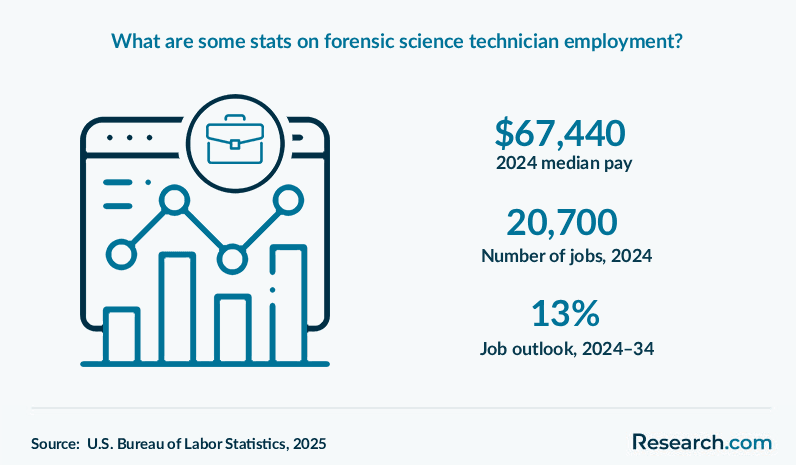
The U.S. Bureau of Labor Statistics reported that forensic science technicians had median annual pay of $67,440, equal to $32.42 per hour, in 2024. A bachelor's degree is the typical entry-level requirement for this occupation, and new hires generally complete moderate-term on-the-job training.
If you are drawn to laboratory-based investigation, compare forensic chemistry specializations such as toxicology, drug composition testing, and trace evidence analysis. Targeted science preparation can make a difference for students pursuing crime lab work, medical examiner roles, federal agency jobs, and private research positions.
In 2024, there were 20,700 forensic science technician jobs, and about 2,600 new jobs are projected to be added. The occupation is expected to grow 13% from 2024 to 2034, as shown below.
What can you do with a forensic degree?
A forensic degree does not point to only one job. Graduates may work in laboratories, document crime scenes, recover digital evidence, investigate fraud, assist medical examiners, support litigation, teach, consult, or move into law enforcement. If you are comparing campus programs with a forensic science degree online, pay close attention to lab requirements, internship options, accreditation status, and whether the curriculum matches the specialty you actually want.
| Career path | What the role involves | Best fit for students who prefer |
| Forensic Scientist | Tests and interprets physical evidence such as DNA, fibers, fingerprints, and trace materials | Lab-centered science, careful documentation, and systematic analysis |
| Crime Scene Investigator | Photographs scenes, records observations, collects evidence, and maintains chain of custody | Fieldwork, procedure-driven tasks, and law enforcement collaboration |
| Digital Forensics Examiner | Recovers and analyzes evidence from phones, computers, drives, cloud systems, and networks | Technology, cybersecurity, cybercrime, and data reconstruction |
| Forensic Accountant | Examines financial records for fraud, embezzlement, money laundering, and disputed transactions | Accounting, analytics, law, and corporate investigations |
| Forensic Toxicologist | Tests bodily fluids or tissues for alcohol, drugs, poisons, and chemical substances | Chemistry, biology, instrumentation, and medical-legal evidence |
| Forensic Anthropologist | Studies human remains, especially skeletal remains, to support identification and death investigation | Anthropology, human biology, and complex recovery cases |
| Forensic Psychologist | Uses psychological assessment in legal settings involving competency, risk, behavior, and reports | Behavioral science, legal systems, interviewing, and written evaluations |
| Forensic Engineer | Investigates failures involving structures, vehicles, products, machines, or technical systems | Engineering analysis, reconstruction, technical writing, and consulting |
| DNA Analyst or Technician | Processes biological samples and develops genetic profiles from forensic evidence | Molecular biology, genetics, contamination control, and precision lab work |
| Forensic Document Examiner | Reviews handwriting, signatures, ink, paper, and altered documents for authenticity questions | Pattern recognition, close visual comparison, and expert reporting |
| Higher Education Lecturer in Forensics | Teaches forensic science or criminal justice courses and may participate in research | Instruction, mentoring, scholarship, and academic service |
| Security Consultant in Cyberforensics | Helps organizations investigate breaches, preserve digital evidence, and strengthen security practices | Cybersecurity, incident response, consulting, and organizational risk |
Students interested in fraud and financial crime should understand how credentials affect advancement. A common starting point is learning what is CFF certification. The Certified in Financial Forensics credential, issued by the American Institute of CPAs, recognizes specialized ability in forensic accounting, litigation support, and fraud-related work.
The strongest forensic skill sets are portable. Evidence control, scientific reasoning, analytical writing, expert communication, data interpretation, and investigative discipline are useful in law enforcement agencies, private laboratories, consulting firms, accounting firms, cybersecurity teams, insurance investigations, and research organizations.
CODIS, the FBI’s Combined DNA Index System, is the national DNA database that includes profiles from convicted offenders, arrestees, and forensic evidence. As of June 2025, CODIS included over 18.6 million offender profiles, nearly 6 million arrestee profiles, and over 1.4 million forensic profiles from crime scenes. It has generated 761,872 CODIS hits and assisted 739,456 investigations across all 50 states, Puerto Rico, Washington, D.C., and the U.S. Army, as shown below.
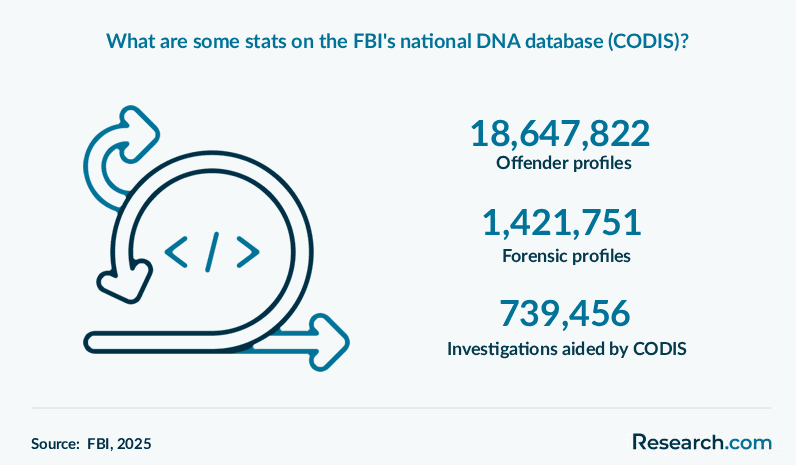
Those figures show why DNA analysis remains one of the most important parts of modern forensic work. Large forensic databases can link cases, support cold investigations, identify potential suspects, and create leads that traditional investigative methods may miss.
How much do forensic degree graduates make?
Forensic pay varies because the field includes technicians, scientists, cyber investigators, accountants, engineers, professors, medical doctors, and consultants. A bachelor's degree may qualify graduates for some entry-level technician and analyst positions, but the better-paid tracks often require graduate school, professional licensure, medical education, technical certification, or years of case experience.
Compensation can also change by location, agency or employer, specialization, overtime policies, union agreements, federal pay systems, courtroom experience, and management responsibility. The salary figures discussed here reflect the sources represented in the article graphics and reference list; individual job offers can be higher or lower.
Among the roles listed, forensic pathologist has the highest stated average annual salary at $219,325. Forensic odontologist follows at $153,915, and forensic accountant is listed at $122,968. These roles usually require training beyond a broad forensic science bachelor's degree, such as medical, dental, accounting, or other advanced professional preparation. Forensic psychologist is listed at $113,370, and forensic engineer is listed at about $104,519.
Other roles fall into a middle range. Clinical laboratory scientist is listed at $86,779, while computer forensic analyst is listed at $74,085. Early-career positions such as forensic science technician at $67,440 and crime scene investigator at $59,636 can help graduates gain experience before moving into a more specialized track.
The salary pattern is straightforward: higher earnings usually come with more specialized expertise, stronger credentials, and greater legal, scientific, medical, or technical responsibility. A forensic degree can create career options, but it should not be treated as a guaranteed route to a specific income.
How do the main forensic disciplines compare?
Forensic specialties differ in the evidence they handle, the methods they use, where the work happens, and how often professionals interact with courts. Before choosing a major, concentration, or graduate program, decide whether you want laboratory science, field investigation, digital evidence, behavioral assessment, medical-legal work, or technical consulting.
| Discipline | Main evidence or problem | Typical work setting | Important skills |
| Physical Forensics | Hair, fibers, fingerprints, trace materials, and other physical evidence | Crime lab | Microscopy, comparison methods, documentation, and quality control |
| Digital and Cyber Forensics | Computers, phones, drives, logs, networks, and cloud-based data | Cybersecurity teams, law enforcement units, and consulting firms | Data recovery, scripting, incident response, and evidence preservation |
| Forensic Biology | Blood, saliva, tissue, semen, and DNA evidence | DNA laboratory or forensic biology unit | Molecular biology, contamination prevention, and statistical interpretation |
| Forensic Anthropology | Skeletal remains and decomposed human remains | Medical examiner office, university, or field recovery site | Human osteology, identification methods, and trauma analysis |
| Forensic Toxicology | Drugs, alcohol, poisons, and chemicals in fluids or tissues | Medical examiner office, toxicology lab, or hospital lab | Analytical chemistry, instrumentation, and toxic substance interpretation |
| Forensic Document Examination | Handwriting, signatures, paper, ink, and altered records | Crime lab, private consulting practice, or legal support setting | Visual comparison, document analysis, and expert reporting |
| Firearms and Toolmark Identification | Guns, cartridge cases, bullets, and tool marks | Crime lab | Microscopic comparison, ballistics knowledge, and chain-of-custody control |
| Forensic Psychology and Psychiatry | Mental state, competency, risk, behavior, and legal capacity | Courts, hospitals, correctional systems, and private practice | Assessment, diagnosis, interviewing, and expert testimony |
| Crime Scene Investigation | Evidence located at a scene before laboratory analysis | Field locations and law enforcement agencies | Photography, collection procedures, scene notes, and evidence packaging |
Some forensic jobs involve regular exposure to violent scenes, weapons, remains, or traumatic case details. Others are mostly laboratory-based, digital, office-based, or advisory. Choose based on the daily work you can sustain, not only on the specialty that sounds most exciting.
In 2024, credential harvesting was the most common cyberattack impact at 29%, followed by data theft at 18% and extortion at 13%. Nearly half of all attacks involved stolen credentials or stolen data. Other impacts included reconnaissance at 14%, data leaks at 11%, brand reputation damage at 7%, digital currency mining at 4%, and illicit financial gain, espionage, and data destruction at 2% each, as shown below.
IBM’s 2025 findings suggest that many attacks are becoming more data-centered and harder to detect quickly. Forensic professionals who can interpret credentials, cloud records, logs, endpoints, and extortion-related evidence are increasingly important as cyber investigations move beyond traditional computer imaging.
Which forensic specializations should students consider?
Specialization affects employability because forensic employers often need expertise tied to a specific evidence type. A general forensic science program can introduce the field, but students who want stronger career alignment should use electives, internships, research, and certifications to build depth in a defined area.
- Forensic Odontology: Uses dental comparison, dental records, and bite-related evidence to support human identification or other legal questions involving teeth.
- Forensic Entomology: Interprets insect activity to help estimate time since death, movement of remains, or environmental conditions around decomposition.
- Digital Vehicle Forensics: Recovers and evaluates information from infotainment systems, navigation tools, event data recorders, and connected vehicle technologies.
- Forensic Linguistics: Examines language evidence in threats, disputed authorship, ransom communications, and other written or spoken material.
- Forensic Accounting: Uses accounting, law, and investigative methods to evaluate fraud, embezzlement, money laundering, and financial disputes. A forensic accounting degree may be useful for students aiming for CPA-related or corporate investigation roles.
- Forensic Anthropology: Applies physical anthropology to skeletal remains, identification work, biological profile development, and trauma interpretation.
- Forensic Geology: Compares soil, minerals, rocks, and other geological materials to connect people, objects, or vehicles with locations.
- Forensic Psychology: Applies psychological assessment and behavioral science to criminal, civil, correctional, and court-related questions.
- Bloodstain Pattern Analysis: Studies bloodstain shape, size, location, and distribution to help reconstruct possible events.
- Questioned Document Examination: Evaluates handwriting, signatures, typewriting, printing, ink, paper, and document alterations.
- Forensic Engineering: Investigates why structures, products, vehicles, machines, or systems failed in incidents involving litigation, insurance, or safety questions.
A practical way to choose a specialization is to answer three questions: What type of evidence do I want to handle regularly? What education or credential does the specialty require? Which employers actually hire people for this work?
How important are internships and research in forensic science?
Internships and research experience can strongly influence forensic hiring because employers want candidates who understand evidence integrity, confidentiality, lab procedures, chain of custody, report writing, and quality standards. Start early. Many opportunities are competitive and may involve transcripts, references, background checks, application deadlines, or eligibility requirements tied to the agency.
- Federal agencies: Agencies such as the FBI, DEA, and Secret Service may offer competitive student opportunities in chemistry, digital forensics, investigative support, and related areas.
- Medical examiner offices: These placements may expose students to death investigation procedures, autopsy observation, pathology workflows, and evidence handling.
- Police department crime labs: Local and state laboratories may provide experience with evidence processing, laboratory assistance, documentation, and quality systems.
- State and local forensic institutes: The Harris County Institute of Forensic Sciences is one example of an organization with opportunities in forensic genetics, firearms identification, drug chemistry, and related fields.
- University research labs: Faculty-led projects can involve method development, validation studies, biological evidence, toxicology, or forensic technology.
- Private forensic companies: Consulting firms and private laboratories may offer exposure to digital forensics, forensic accounting, civil litigation support, and corporate investigations.
- Undergraduate research projects: Independent work can demonstrate experimental design, technical writing, data analysis, and presentation ability.
- Crime scene internships: Some agencies train students in field documentation, photography, evidence packaging, and preservation procedures.
- Academic and professional directories: The American Academy of Forensic Sciences and similar professional groups can help students find postings, conferences, and networking opportunities.
- Virtual internships: Remote options are most realistic for cyber investigations, digital evidence projects, research assistance, and data-focused assignments.
Plan internships around your academic timeline. For instance, students weighing criminology against forensic science may first want to understand how many years to study criminology before deciding when to pursue field placements, research, or specialized lab training.
Which universities are known for forensic science programs?
Some universities are recognized for forensic science education, research opportunities, laboratory training, and connections to criminal justice or investigative agencies. Reputation can help, but it should not be the only factor. Accreditation, lab access, faculty background, internship placement, evidence-focused coursework, and graduate outcomes are more important when comparing programs.
- Pennsylvania State University: Offers FEPAC-accredited forensic science programs with biology and chemistry tracks.
- University of Central Florida: Provides a nationally recognized forensic science program with extensive laboratory training.
- George Mason University: Includes multiple forensic areas, such as DNA, chemistry, and trace evidence.
- CUNY John Jay College of Criminal Justice: A New York City institution known for undergraduate and graduate education in criminal justice and forensics.
- Texas A&M University: Offers forensic and investigative sciences options, including science-focused and pre-law pathways with environmental and ecological forensic elements.
- West Virginia University: Has a FEPAC-accredited program recognized for applied forensic training and research access.
- University of Nebraska-Lincoln: Builds forensic education around core scientific principles and applied practice.
- Towson University: Offers a Forensic Chemistry major with General Forensic, Trace Evidence and Drug Analysis, and DNA tracks.
- Loyola University Chicago: Integrates chemistry, biology, physics, and criminal justice into its forensic science curriculum.
- University of New Haven: Features the Henry C. Lee Institute of Forensic Science and specialized forensic learning opportunities.
For a school-by-school comparison, see Research.com’s guide to the top 10 forensic science colleges.
How to evaluate a forensic science program
| Factor to review | Why it matters | Question to ask before enrolling |
| FEPAC accreditation | Accreditation can show that a program follows recognized forensic science education standards | Is this exact degree FEPAC-accredited, or is accreditation limited to another program? |
| Laboratory coursework | Many forensic employers expect direct hands-on scientific preparation | How many required courses include laboratory work with current instruments and methods? |
| Internship access | Practical experience can improve competitiveness for entry-level jobs | Which labs, agencies, or companies have recently accepted interns from this program? |
| Specialization tracks | DNA, toxicology, digital forensics, and accounting require different preparation | Can I focus my coursework on DNA, chemistry, toxicology, digital forensics, or another area? |
| Faculty expertise | Instructor backgrounds influence mentoring, research access, and professional networks | Do faculty members have forensic casework, laboratory, law enforcement, or court experience? |
| Career outcomes | Graduate placement information helps students evaluate potential return on investment | Where do graduates work, and how many enter forensic positions after finishing the program? |
What challenges come with forensic degree jobs?
Forensic work can be meaningful, but students should know what they are entering. The real field is more technical, slower, and more procedure-heavy than crime shows suggest. Errors can affect investigations, trials, victims, defendants, and public trust.
- Rigorous science requirements: Biology, chemistry, physics, statistics, and laboratory methods can be demanding, especially for students expecting mostly criminal justice coursework.
- Reality is not television: Many jobs involve repeated testing, quality control, documentation, report writing, and long review processes.
- Competitive entry-level hiring: Crime labs and public agencies may receive many applications, making internships, research, and references important.
- Emotional burden: Some roles involve violent crimes, traumatic images, human remains, child victims, or distressing case facts.
- Uneven program quality: Not all forensic degrees provide equal depth in chemistry, biology, statistics, courtroom testimony, and evidence handling.
- Public funding limits: Hiring at state and local laboratories can depend on budgets, staffing priorities, and agency needs.
- Advanced training for top roles: Many highly paid positions require graduate study, medical school, doctoral training, licensure, or specialized certification.
- Bias risk: Forensic conclusions must be protected from cognitive bias, investigative pressure, and assumptions not supported by evidence.
Common mistakes forensic students should avoid
| Mistake | Why it creates problems | Better decision |
| Picking a degree only because “forensic” appears in the title | The coursework may not match crime lab standards or specialty employer expectations | Review accreditation, lab courses, faculty expertise, and internship records |
| Underestimating chemistry, biology, or statistics | Many forensic roles depend on scientific reasoning, data interpretation, and laboratory skill | Build a strong science foundation from the beginning of the program |
| Assuming all forensic careers happen at crime scenes | Many jobs are laboratory-based, digital, office-based, clinical, or consultative | Interview alumni, shadow professionals, or attend career events before choosing a track |
| Delaying internship applications | Forensic internships can require early deadlines, screening, and background checks | Research opportunities during the first half of your degree |
| Choosing only by salary | The highest-paid roles often require long and costly additional training | Compare pay with education length, debt, work environment, and lifestyle fit |
| Ignoring emotional fit | Repeated exposure to disturbing evidence can become difficult over time | Think realistically about the case material you can handle long term |
Where are the strongest opportunities for forensic degree students?
The most promising opportunities often appear where forensic science overlaps with technology, finance, medicine, federal investigation, and private-sector risk management. Students who add strong technical skills to forensic training may have more career flexibility than those who complete only a general program.
- Digital forensics and cyber investigations: Cybercrime creates need for professionals who can preserve, recover, and interpret digital evidence. Students considering this path may compare forensic programs with cheapest cybersecurity degree options.
- Medical and financial specialties: Forensic pathology, forensic psychiatry, and forensic accounting can offer higher earning potential, but they require substantial additional preparation.
- Transferable analytical ability: Evidence evaluation, documentation, scientific reasoning, and investigative logic apply in finance, IT security, pharmaceuticals, insurance, compliance, and consulting.
- Federal career pathways: Forensic education can support federal applications when paired with relevant internships, technical skills, and eligibility for background screening.
- Forensic technology innovation: AI, advanced DNA sequencing, blockchain, 3D reconstruction, and digital evidence tools are creating research and implementation opportunities.
- Expert witness and consulting roles: Experienced specialists may assist attorneys, insurers, corporations, government agencies, or courts.
- Academic and research careers: Graduate education can lead to teaching, publishing, lab leadership, and forensic research.
- Private-sector investigations: Organizations need help with fraud, intellectual property theft, data breaches, workplace misconduct, and internal investigations.
If your goal is cyber-focused forensic work, compare traditional forensic science programs with accelerated cyber security degree online options, especially if you want to enter incident response, cyber investigation, or digital evidence analysis more quickly.
What trends are shaping forensic careers?
Forensic careers are changing as evidence becomes more digital, biological methods become more advanced, and courts expect stronger validation of scientific conclusions. Students entering the field should expect continual training rather than assuming one degree will cover every tool and method they will use over a full career.
- AI and machine learning: AI can help sort large datasets, identify patterns, and speed up repetitive analysis, but human validation and expert review remain essential.
- Next-generation DNA sequencing: NGS can produce more detailed DNA information from small or degraded samples and connects to genomics-related careers in biology.
- Blockchain for evidence integrity: Some organizations are exploring blockchain-based systems to strengthen digital chain-of-custody records.
- Cloud forensics: Investigators increasingly collect and interpret evidence from cloud platforms, remote servers, and distributed systems. Students interested in this area may first learn how to start a cloud computing career before adding forensic investigation skills.
- Forensic genealogy: Public genealogical databases are helping investigators identify unknown suspects and human remains, while also raising privacy concerns.
- Digital vehicle forensics: Connected vehicles produce data that can support accident reconstruction and criminal investigations.
- 3D crime scene reconstruction: Laser scanning and photogrammetry can create detailed models for investigation, courtroom presentation, and later review.
- Portable laboratory tools: Smaller field equipment can support preliminary testing near a scene, although confirmatory analysis may still require a formal lab.
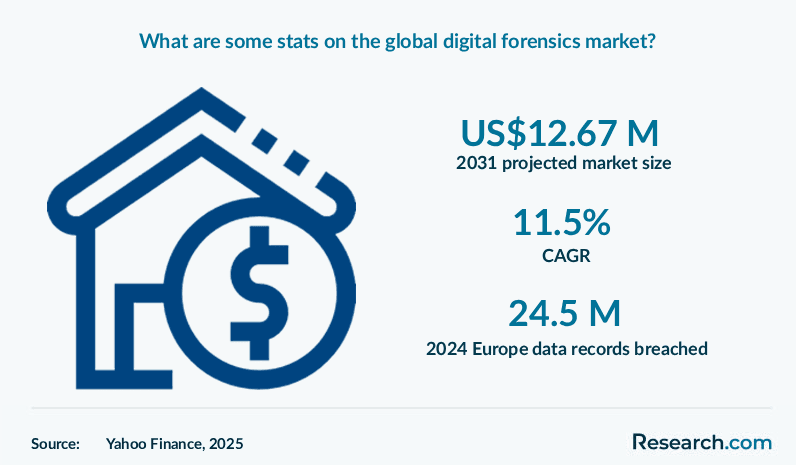
The digital forensics market is expanding as digital infrastructure grows and cybercrime increases. Forecasts vary, but the direction points to strong double-digit growth: one report projects $12.67 million by 2031 at a CAGR of 11.5%, as shown below.
Can a forensic degree help with federal law enforcement careers?
A forensic degree can build the scientific, analytical, and evidence-handling background useful in federal investigative work. It is not a shortcut into federal employment, however. Hiring may involve citizenship eligibility, background investigations, physical or medical standards, work experience, and agency-specific qualifications. Students who want to become a DEA agent or pursue similar roles should align coursework and internships with areas such as controlled substances, digital evidence, financial crime, intelligence analysis, and laboratory testing.
Digitalization, remote work, and interconnected supply chains are increasing organizational exposure to cyber risk. In April 2024 alone, Europe recorded over 24.5 million breached data records, which illustrates why cyber investigations, breach response, and digital evidence preservation are becoming more important. Major investments, including Blue Owl Capital’s $7 billion fund and Brookfield Asset Management’s $10 billion data center initiative, also show how important digital infrastructure has become.
As communications, records, transactions, and operations continue moving into digital systems, digital forensics is becoming central to security, compliance, litigation, and infrastructure protection.
Is a forensic degree worth it?
A forensic degree can be worth it if you want evidence-based work and are prepared to develop strong scientific, technical, or investigative skills. It may be a poor fit if you want quick advancement without specialized training, dislike detailed documentation, or are uncomfortable with strict procedures and traumatic case material.
| A forensic degree may fit you if you... | Another path may be better if you... |
| Enjoy science, investigation, and evidence-based problem solving | Prefer broad criminal justice theory without lab or technical requirements |
| Can follow detailed procedures, write reports, and meet quality standards | Want work that feels like fast-paced television crime drama |
| Are willing to pursue internships, certifications, or graduate study when needed | Need a high salary immediately after earning a bachelor's degree |
| Want options in laboratories, cybercrime, finance, law enforcement, or consulting | Do not want exposure to difficult evidence or distressing subject matter |
| Can testify, defend conclusions, and communicate technical findings clearly | Dislike review processes, documentation, and chain-of-custody rules |
How to choose the right forensic career path
- Choose the work environment first: Decide whether you want a lab, crime scene, office, hospital, courtroom, cyber unit, corporate setting, or academic role.
- Work backward from the target job: DNA analysis, toxicology, accounting, digital forensics, engineering, and psychology each require different preparation.
- Check accreditation and course depth: Look for relevant accreditation, science-heavy coursework, laboratory hours, and evidence-focused training.
- Plan internships early: Agency deadlines, screening requirements, and background checks can take time.
- Add complementary skills: Statistics, technical writing, coding, accounting, chemistry, molecular biology, cybersecurity, and courtroom communication can strengthen your profile.
- Compare cost with the full timeline: High-paying roles may require medical school, doctoral study, licensure, certification, or years of experience.
- Talk to practitioners: Ask what their weekly work actually looks like, what surprised them, and what they wish they had studied sooner.
What graduates say about forensic degree careers
-
: "Medical training was the hardest part of becoming a forensic pathologist, but the role gives me a clear mission: determining what happened in unexplained deaths. I earn over $250,000 annually, and the level of responsibility is high.
— Kayla"
-
: "As a digital forensic analyst, I recover data and support federal investigations. Cyber evidence changes quickly, so my background in computer science and forensics helps me keep learning while earning six figures.
— Steph"
-
: "I started as a CPA before moving into forensic accounting. I now investigate financial fraud for large corporations, and with credentials like CFE, I make over $130,000 doing work that blends logic, law, and investigation.
— Bella"
References
- Federal Bureau of Investigation. (2025, June). CODIS-NDIS statistics. U.S. Department of Justice.
- IBM. (2025). IBM X-Force 2025 Threat Intelligence Index. IBM Institute for Business Value.
- Indeed. (2025, August 24). Clinical laboratory scientist salary in United States. Indeed.
- Indeed. (2025, August 29). Computer forensic analyst salary in United States. Indeed.
- Indeed. (2025, August 30). Criminal investigator salary in United States. Indeed.
- Indeed. (2025, August 3). Examiner salary in United States. Indeed.
- Indeed. (2025, August 23). Forensic accountant salary in United States. Indeed.
- Indeed. (2025, August 24). DNA analyst salary in United States. Indeed.
- U.S. Bureau of Labor Statistics. (2025, August 28). Forensic science technicians: Occupational outlook handbook. U.S. Bureau of Labor Statistics.
- Yahoo Finance. (2025, September 2). Digital forensics market projected to reach $25.97 billion by 2032, growing at 11.2% CAGR. Yahoo Finance.
Key Insights
- The highest-paying forensic careers usually require specialized expertise beyond a general forensic science bachelor's degree.
- Forensic pathologists and forensic psychiatrists often sit near the top of the pay range because they require medical training.
- Digital forensics, forensic accounting, forensic engineering, toxicology, and forensic biology can be strong options for students who want specialized careers without becoming physicians.
- The U.S. Bureau of Labor Statistics reported median annual pay of $67,440 for forensic science technicians in 2024 and projected 13% growth from 2024 to 2034.
- Program selection matters. Before enrolling, check accreditation, lab access, internship support, specialization tracks, faculty expertise, and graduate outcomes.
- Forensics is a broad field that includes laboratory science, crime scene work, digital evidence, psychology, medicine, accounting, engineering, teaching, and consulting.
- Students who pair forensic training with chemistry, biology, cybersecurity, accounting, statistics, cloud technology, or technical writing can keep more career options open.
- The smartest planning strategy is to choose a target role first, then identify the degree, internships, certifications, and experience that role actually requires.
Other Things You Should Know About the Highest-Paying Jobs You Can Get with Forensic Degrees
Many high-paying forensic jobs in 2027 require certifications like Certified Forensic Accountant (Cr.FA) or Certified Forensic Computer Examiner (CFCE). These certifications enhance credibility and often lead to positions with competitive salaries. Requirements vary by certification and typically include passing an exam and relevant work experience.
In 2027, forensic graduates can pursue top-paying positions such as forensic computer analyst, forensic psychologist, forensic accountant, and forensic pathologist. These roles command high salaries due to specialized skills and the rising demand across legal and law enforcement sectors.


