
2027 Forensic Chemistry Fields of Specialization & Career Paths

Co-Founder and Chief Data Scientist
Forensic chemistry is a specialized branch of science that connects chemistry with criminal investigations, helping to uncover evidence and solve complex cases. In modern times, numerous advances in science have been applied to forensic chemistry, enabling law enforcement agencies to revisit old cases and uncover findings that were not possible just decades ago.
This article explores the various fields of specialization and career paths available in forensic chemistry, highlighting how students can align their education with a growing and impactful profession.
What are the benefits of getting into forensic chemistry?
- Careers in forensic chemistry span law enforcement agencies, government laboratories, environmental organizations, and private industry.
- Forensic science technicians, which include forensic chemistry professionals, earn a median annual wage of around $67,440 as of 2024.
- Entering forensic chemistry allows individuals to contribute to criminal justice, public safety, and scientific discovery in meaningful ways.
What can you do with a forensic chemistry specialization?
With a forensic chemistry specialization, students and professionals can apply advanced chemical analysis to criminal investigations, public safety, and environmental cases. This specialization prepares individuals to examine trace evidence, analyze toxic substances, identify controlled substances, and provide expert testimony in court.
Forensic chemistry connects directly with legal processes, offering career paths in toxicology, drug analysis, environmental forensics, and materials testing. It also creates opportunities in research and development within government, law enforcement, and private laboratories.
Where can you work with a forensic chemistry specialization?
Those with a forensic chemistry specialization often find employment in crime laboratories at the local, state, or federal level. Law enforcement agencies, such as police departments and the Federal Bureau of Investigation (FBI), rely heavily on forensic chemists to analyze physical evidence and prepare reports used in criminal trials.
In addition, government agencies, such as the Drug Enforcement Administration (DEA) or Environmental Protection Agency (EPA), hire forensic chemistry specialists to investigate controlled substances, hazardous waste, or chemical contamination.
Beyond government institutions, forensic chemistry skills are also valued in private-sector laboratories, consulting firms, and environmental testing companies. Pharmaceutical industries, research organizations, and academic institutions may also hire forensic chemists for specialized roles in chemical analysis and toxicology.
How much can you earn with a forensic chemistry specialization?
The median annual wage for forensic science technicians, which includes forensic chemists, is approximately $67,440. Forensic chemists working for federal agencies or in highly specialized laboratories often earn salaries on the higher end of this range.
Forensic chemists who move into managerial roles or advanced research positions can see salaries rise significantly. Specializations such as forensic toxicology or environmental forensic chemistry may also provide higher earnings due to the technical expertise required.
- What is forensic chemistry and how does it differ from general chemistry? Career Overview
- What are the main fields of specialization within forensic chemistry? Specializations
- What are the top forensic chemistry career paths in 2027? Career Paths
- How much do forensic chemists earn on average? Salary
- What is the demand for forensic chemists in the job market today? Job Outlook
- What degree do you need to become a forensic chemist? Degrees
- What lab techniques are commonly used in forensic chemistry? Skills
- What ethical issues do forensic chemists face in criminal cases? What ethical issues do forensic chemists face in criminal cases?
- What new technologies are shaping forensic chemistry in 2027? What new technologies are shaping forensic chemistry in 2027?
- How is AI being used in forensic chemical analysis? How is AI being used in forensic chemical analysis?
- What benefits do accreditation and ongoing certifications offer forensic chemists? What benefits do accreditation and ongoing certifications offer forensic chemists?
What is forensic chemistry and how does it differ from general chemistry?
Forensic chemistry is a specialized branch of chemistry that applies chemical principles and techniques directly to criminal investigations, law enforcement, and public safety. While general chemistry focuses on broad concepts such as reactions, bonding, and material properties, forensic chemistry narrows its scope to evidence analysis, toxicology, and trace materials testing in a legal context. It requires not only a strong background in analytical and organic chemistry but also knowledge of how to handle evidence in a way that is admissible in court.
This distinction often attracts students considering careers that combine science with investigative work. Some wonder, is forensic science a hard major? The answer depends on one’s ability to balance rigorous laboratory science with the real-world application of evidence handling and criminal procedure. Forensic chemistry offers the challenge of applying chemical knowledge to meaningful societal outcomes, setting it apart from more traditional chemistry roles.
What are the main fields of specialization within forensic chemistry?
Forensic chemistry offers several distinct areas of specialization, each with a specific role in supporting criminal investigations and public safety. Students who pursue a fast track natural sciences degree online may later choose to focus on one of these paths:
- Forensic Toxicology – Examines drugs, alcohol, and poisons in biological samples.
- Trace Evidence Analysis – Analyzes fibers, glass, paint, soil, and other small evidence.
- Environmental Forensic Chemistry – Investigates pollution sources and chemical contamination.
- Controlled Substance Analysis – Identifies and classifies illegal drugs and narcotics.
Employment data highlights how these fields differ from general chemistry careers:
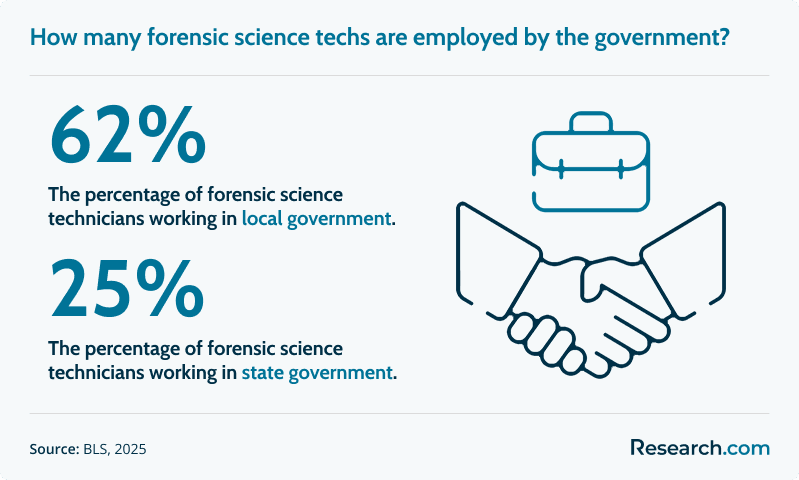
- Forensic science technicians: About 62% work in local government, 25% in state government, and smaller numbers in education or testing laboratories.
- Chemists in general: Around 29% are employed in chemical manufacturing, 19% in research and development, 11% in testing labs, with others in federal agencies and environmental remediation services.
This contrast shows how forensic chemistry is more directly connected to law enforcement and justice, whereas general chemistry careers are spread across industry and research sectors.
What are the top forensic chemistry career paths in 2027?
In 2027, students and professionals pursuing forensic chemistry can choose from a variety of career paths. These roles combine laboratory science with investigative applications and are expected to remain in high demand:
- Forensic Toxicologist – Specializes in analyzing bodily fluids for drugs, alcohol, or poisons.
- Drug Chemist – Focuses on identifying and classifying controlled substances.
- Trace Evidence Analyst – Examines small, often microscopic evidence like fibers and glass.
- Environmental Forensic Chemist – Works on cases involving pollution or hazardous materials.
Each of these careers requires technical laboratory expertise and familiarity with courtroom procedures. For students building a foundation, complementary studies like an accelerated online bachelor’s in mathematics can sharpen critical analysis and problem-solving skills, which are vital in forensic chemistry.
How much do forensic chemists earn on average?
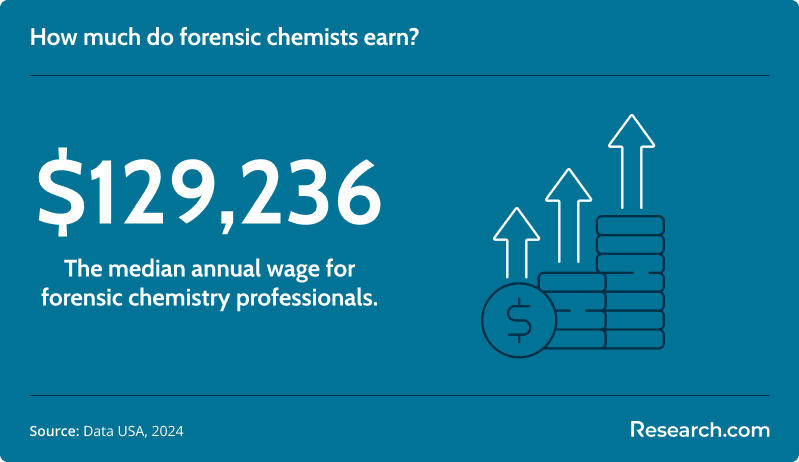
Earnings for forensic chemistry professionals vary by specialization, employer, and level of education. According to the U.S. Bureau of Labor Statistics (BLS), forensic science technicians earned a median annual wage of $67,440 in May 2024, while chemists earned a higher median of $84,150 in the same year. Data USA further reports that forensic chemistry professionals specifically average around $129,236 annually, reflecting the value of specialized skills in this field.
Some forensic chemists eventually move into roles connected to highest paying forensic jobs, including positions in federal crime labs, private forensic consulting, or specialized toxicology units, where advanced analytical expertise is in high demand.
Forensic chemists can also increase their earning potential by pursuing advanced education, such as a fast track master’s in mathematics online. Higher-level degrees often lead to leadership roles, supervisory positions, or advanced research opportunities in federal agencies or specialized laboratories.
What is the demand for forensic chemists in the job market today?
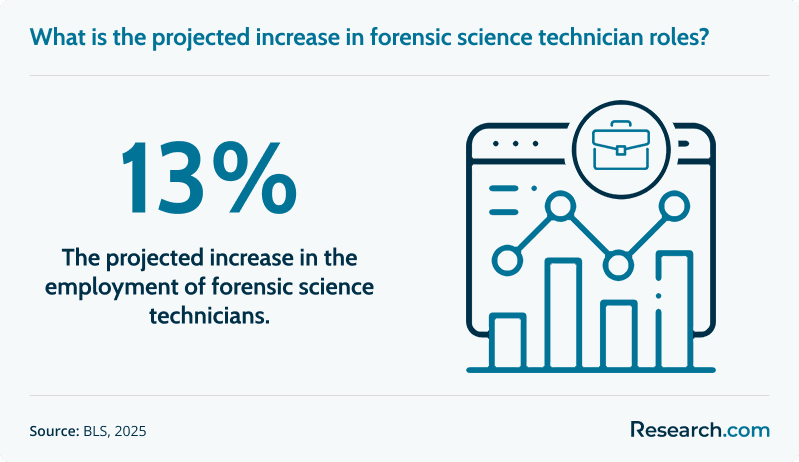
BLS projects that employment of forensic science technicians, which includes forensic chemists, will grow 13% from 2024 to 2034, a rate much faster than the national average. By comparison, overall employment of chemists is expected to grow by 5% during the same period. These figures suggest that forensic chemistry offers both job stability and long-term growth opportunities.
Students considering careers in this area often prepare with technical majors and sometimes additional fields, like a top online master’s degree in mathematics, which sharpens quantitative analysis skills. This preparation not only improves employability but also positions candidates for advancement as demand continues to rise in government, private, and laboratory sectors. The increasing reliance on forensic chemistry in criminal justice and environmental cases ensures steady opportunities for well-trained professionals.
What degree do you need to become a forensic chemist?
According to data from Zippia, 82% of forensic chemists hold a bachelor’s degree, making it the most common educational level in the field. Master’s degrees account for about 13%, while 3% hold an associate degree. A bachelor’s in chemistry or forensic science is the most typical pathway, but additional coursework in biology, toxicology, or criminal justice is often valuable.
For those interested in accelerated study, a fast track physics degree online can serve as a foundation, particularly for careers involving advanced instrumentation and evidence analysis. Graduate-level degrees may open doors to supervisory roles, research positions, and academic appointments.
What lab techniques are commonly used in forensic chemistry?
Forensic chemists rely on a wide range of laboratory techniques to analyze evidence accurately and present findings that can stand up in court. These methods combine classical chemistry principles with advanced instrumentation, ensuring that even the smallest trace of evidence can be identified and linked to a case.
Based on skill usage data for forensic chemists in 2027, the most common techniques fall into several categories:
- Spectroscopy Methods (about 22%) – Includes mass spectrometry (MS), Fourier-transform infrared spectroscopy (FTIR), nuclear magnetic resonance (NMR), and X-ray fluorescence (XRF).
- Chromatography Methods (about 18%) – Covers gas chromatography (GC) and liquid chromatography (LC), essential for analyzing drugs, toxins, and trace evidence.
- General Laboratory Skills (about 16%) – Includes use of laboratory equipment, chemical analysis, and routine maintenance tasks.
- Other Specialized Skills (about 44%) – Encompasses test result interpretation, analytical instrumentation, laboratory information management systems (LIMS), and case-specific expertise such as marijuana identification.
This distribution highlights how forensic chemistry requires proficiency across multiple disciplines, with a heavy emphasis on spectroscopy and chromatography, supported by strong analytical and reporting skills.
What ethical issues do forensic chemists face in criminal cases?
Forensic chemists play a crucial role in the justice system, and with that responsibility comes significant ethical challenges. The accuracy of their work can influence the outcome of trials, meaning errors or misconduct could lead to wrongful convictions or acquittals. Maintaining strict adherence to protocols is essential to ensure that evidence remains uncontaminated and results are scientifically valid.
Some students interested in this field also explore related career paths, such as criminology, and often ask how long does it take to become a criminologist, since both professions require strong analytical skills and a commitment to ethical standards in legal settings.
Some of the most pressing ethical issues include:
- Bias and impartiality – Forensic chemists must present evidence objectively, regardless of pressure from law enforcement or attorneys.
- Chain of custody – Any break in how evidence is handled can compromise its credibility in court.
- Transparency of methods – Chemists must clearly explain how tests are performed and acknowledge limitations in their analyses.
- Avoiding overstated conclusions – Experts must report findings accurately, without extending results beyond what the science can support.
By upholding these standards, forensic chemists help protect the integrity of the legal system while ensuring that justice is served fairly.
What new technologies are shaping forensic chemistry in 2027?
Forensic chemistry continues to evolve as new technologies enhance the accuracy and speed of evidence analysis. In 2027, laboratories are adopting advanced instrumentation and computational tools that expand the range of detectable substances and improve turnaround times for results.
Some of the most influential technologies include:
- High-resolution mass spectrometry (HRMS) – Offers greater precision in identifying unknown compounds.
- Portable spectrometers – Allow rapid, on-site analysis of drugs, explosives, or environmental samples.
- Next-generation chromatography systems – Provide faster and more detailed separations for complex mixtures.
- Digital evidence integration tools – Help combine chemical findings with other forensic data for comprehensive case reviews.
These innovations are not only advancing laboratory capabilities but also supporting real-time decision-making in the field, making forensic chemistry a more dynamic and efficient discipline.
How is AI being used in forensic chemical analysis?
Artificial intelligence (AI) is increasingly becoming a valuable tool in forensic chemistry. Its primary role lies in managing and interpreting the large volumes of data generated by advanced analytical techniques. Machine learning algorithms can recognize patterns in chemical signatures, helping chemists identify substances more quickly and with greater accuracy.
Interestingly, similar technologies are being adopted across various biomedical engineering fields, where AI assists in analyzing biological samples, developing diagnostic tools, and improving precision in laboratory research.
Key applications of AI in forensic chemical analysis include:
- Automated spectral analysis – AI can rapidly interpret complex spectra from MS, FTIR, or NMR instruments.
- Predictive modeling – Algorithms can estimate the likelihood of certain compounds being present in a sample.
- Quality assurance – AI systems help monitor test consistency and flag anomalies in results.
- Casework prioritization – Data-driven tools assist labs in managing backlogs by identifying cases with the highest urgency.
By combining traditional forensic chemistry methods with AI-driven analysis, laboratories in 2027 are improving efficiency, reducing errors, and enhancing the reliability of evidence presented in court.
What benefits do accreditation and ongoing certifications offer forensic chemists?
Accreditation and continuous professional development play a critical role in upholding rigorous analytical standards and ensuring compliance with legal and regulatory frameworks. Formal certification builds technical proficiency and reinforces adherence to best practices within advanced laboratory environments. Forensic professionals who pursue specialized credentials—such as meeting the CFF certification requirements (Certified Forensic Financial)—gain deeper insight into financial evidence analysis, fraud detection, and investigative techniques that enhance their credibility in multidisciplinary forensic contexts.
Structured training programs offer consistent updates on evolving methodologies and instrumentation, thereby enhancing operational precision and credibility in forensic reports. In addition, cross-disciplinary learning—such as exploring opportunities through the cheapest medical billing and coding certificate program—can provide valuable administrative and analytical perspectives that complement scientific expertise.
Here’s What Graduates Have to Say About Forensic Chemistry Fields of Specialization and Career Paths
- Sasha: "After completing my forensic chemistry degree, I began working in a state crime lab analyzing toxicology samples. The program gave me both the technical lab skills and courtroom training needed for expert testimony. My work directly impacts criminal investigations, which gives me a strong sense of purpose. I was pleasantly surprised to see my starting salary align with national averages for forensic chemists. This career path has been both rewarding and intellectually stimulating."
- Ricky: "I specialized in trace evidence analysis and now work in a local government laboratory. The ability to identify fibers, paint chips, and glass fragments has played a critical role in several high-profile cases. My education in forensic chemistry gave me the confidence to handle advanced instruments like GC and FTIR on a daily basis. Beyond the technical work, I value the responsibility of ensuring evidence is handled ethically. The balance of science and justice makes this career especially meaningful."
- Ellyza: "With my background in forensic chemistry, I pursued a career in environmental forensics, investigating cases of chemical pollution. The field is expanding quickly as more companies and agencies prioritize environmental accountability. My coursework prepared me to work with advanced chromatography and spectrometry techniques, skills that are in high demand. I also found that salaries in this niche are competitive, with plenty of opportunities for advancement. Choosing this specialization allowed me to merge chemistry with my passion for environmental protection."
Key Findings
- Forensic chemistry bridges science and justice, applying chemical analysis directly to criminal cases, environmental investigations, and controlled substance testing.
- Top specializations include forensic toxicology, trace evidence analysis, environmental forensic chemistry, and controlled substance analysis.
- About 62% of forensic science technicians work in local government, while general chemists are most often employed in chemical manufacturing (29%).
- The median annual wage for forensic science technicians is $67,440 (2024), while chemists earn $84,150, and forensic chemistry specialists average $129,236.
- Job demand is growing rapidly, with forensic science technician roles projected to increase by 13% from 2024 to 2034, outpacing the 5% growth for general chemists.
- Most forensic chemists hold a bachelor’s degree (82%), though advanced degrees can lead to higher earnings and leadership positions.
References:
- BLS. (2025, August 28). Chemists and materials scientists. bls.gov.
- BLS. (2025, August 28). Forensic science technicians. bls.gov.
- Data USA. (2024). Forensic Chemistry. datausa.io.
- EBSCO Research. (2024). Forensic chemistry | Research Starters. ebsco.com.
- U.S. Department of Justice. (2024, November 14). Forensic science. justice.gov.
- Zippia. (2025, January 8). Forensic Chemist Demographics and Statistics [2025]: Number of forensic chemists in the US. zippia.com.
Other Things You Should Know About Forensic Chemistry Fields of Specialization and Career Paths
In 2027, forensic chemistry offers several specializations, including toxicology, drug analysis, and DNA analysis. Each specialization provides unique opportunities to apply chemical principles in criminal investigations, with career paths in law enforcement agencies, private laboratories, and consultancy. Specialization helps define a forensic chemist's career trajectory.
To pursue a specialization in forensic chemistry in 2027, students typically need a bachelor's degree in chemistry or a related field. Additional coursework in analytical chemistry, biochemistry, and forensic science may be required by some institutions or programs.


