
2027 How Long Does It Take to Get a Criminology Degree: Program Length & Skills

Co-Founder and Chief Data Scientist
Embarking on a Criminology degree in the USA can feel like entering a labyrinth. As an education and career planning expert, I see many students struggling to find clear, consistent information on program duration and essential skills.
The reality is that a Bachelor's degree typically takes four years, but variables like accelerated tracks or transfer credits can alter this timeline significantly. The challenge stems from the sheer variety of programs (BA vs. BS) and the need to sift through marketing claims to uncover the core analytical, research, and critical thinking skills employers truly demand.
This guide will cut through the noise, providing you with a reliable map to understand the real-time commitment and the valuable competencies you'll gain.
What are the benefits of getting a criminology degree?
- Career Advancement: Provides the foundational knowledge required for roles in federal, state, and local law enforcement, as well as policy analysis and social advocacy.
- Earning Potential: Graduates with a Bachelor’s degree typically start in the $40,000 to $60,000 range, but roles like first-line supervisors of police or FBI agents can earn significantly more, often over $100,000 annually with experience and advanced education (PayScale, 2025; UTEP, 2025).
- Transferable Skills: Develops highly valued skills like critical thinking, statistical analysis, complex problem-solving, and effective communication for a wide range of careers.
What can I expect from a Criminology degree program in the USA?
- Undergraduate Program Length (Bachelor’s): Typically a four-year commitment for full-time students to complete the required 120 credit hours.
- Graduate Program Length (Master’s): Usually takes 1.5 to 2 years of full-time study; may extend up to three years for part-time students.
- Accelerated Options: Some universities offer a three-year Bachelor’s path or a combined 4+1 Bachelor’s/Master’s program to reduce the overall time.
- Core Coursework: Expect classes focused on Criminological Theory (causes of crime), Research Methods, Criminal Law, and Statistics.
- Interdisciplinary Focus: The curriculum integrates concepts from Sociology, Psychology, Political Science, and Law to provide a holistic view of crime and justice.
- Practical Experience: Programs often require or offer internships in settings like police departments, correctional facilities, or non-profits to gain real-world application.
Where can I work with a Criminology degree?
- Law Enforcement Agencies: Work as a police officer, state trooper, or sheriff’s deputy at the local and state level.
- Federal Government: Pursue roles as a special agent (FBI, DEA, Secret Service), intelligence analyst (CIA), or customs inspector.
- Corrections and Rehabilitation: Work as a probation or parole officer, correctional counselor, or jail/prison administrator.
- Courts and Legal System: Serve as a paralegal, victim advocate, or court services specialist.
- Research and Analysis: Become a crime analyst for police departments or a criminologist/sociologist for think tanks and universities.
- Private/Corporate Sector: Utilize skills as a fraud investigator, corporate compliance officer, or security manager for private firms.
How much can I make with a Criminology degree?
- Entry-Level Roles (Bachelor’s): Positions like correctional officer or private investigator typically command salaries from $45,000 to $65,000 (PayScale, 2025).
- Specialized and Government Roles: Mid-career professionals in roles such as crime analyst, police detective, or probation officer often earn between $65,000 and $85,000 (ZipRecruiter, 2025).
- Advanced and Leadership Roles: Positions requiring a Master’s degree or extensive experience, such as a criminology professor, criminal justice policy analyst, or first-line supervisor, frequently command $90,000 to over $120,000 (PayScale, 2025; UTEP, 2025; ZipRecruiter, 2025).
- Highest Earning Potential: Top-tier federal law enforcement agents or senior-level academics and administrators can achieve annual compensation exceeding $130,000 (ZipRecruiter, 2025).
- How long does it take to complete a criminology program in 2027? Completion Time
- What are the career opportunities for criminology program graduates? Career Paths
- What are the salaries of criminology program graduates? Salaries
- What is the job market like for criminology program graduates? Job Market
- What are some specializations within criminology programs? Specializations
- What internship and research opportunities are available in criminology programs? What internship and research opportunities are available in criminology programs?
- Which universities offer top-ranked criminology programs? Universities
- What are the biggest challenges faced by students pursuing a criminology degree? What are the biggest challenges faced by students pursuing a criminology degree?
- What are the biggest opportunities for students pursuing a criminology degree? Opportunities
- What are some current and future trends in the criminology field? Trends
How long does it take to complete a criminology program in 2027?
Criminology degree programs in the United States vary in length depending on the degree level, study format, and student pacing. Most follow traditional academic timelines, though accelerated and combined pathways are increasingly common.
- Associate degree: Requires about two years of full-time study to complete 60–65 credit hours.
- Bachelor’s degree: Typically a four-year program requiring 120 credit hours.
- Accelerated bachelor’s: Some schools allow students to finish in three years by taking heavier course loads.
- Combined bachelor’s/master’s: A 4+1 structure lets students earn both degrees in about five years.
- Master’s degree: Full-time programs usually take 1.5 to 2 years, with part-time extending up to three years.
- Doctoral degree: PhD programs in criminology often take 4–6 years to complete beyond the master’s.
- Online bachelor’s programs: Can follow the same four-year timeline, but sometimes allow faster progress.
- Part-time study: Students balancing work often extend a bachelor’s or master’s program by 1–2 years.
- Credit transfer: Prior coursework, military training, or community college credits can shorten time-to-degree.
- Professional certificates: Short-term certificates in criminology or criminal justice may take under a year.
Overall, students can expect anywhere from two to six years of study depending on the pathway. Flexible formats allow learners to tailor the pace to personal and career needs.
Some students also consider complementary fields like cybersecurity, especially if they are interested in digital investigations or cybercrime. In exploring this path, it can be helpful to understand how much do cyber security certifications cost, since stacking a certification alongside a criminology degree can enhance employability in roles involving digital forensics, information protection, or law enforcement technology.
What are the career opportunities for criminology program graduates?
A criminology degree opens doors across public, private, and academic sectors, allowing graduates to apply theory and research in real-world settings of careers in criminology.
- Police officer: Enforce laws, respond to calls, patrol communities, and serve as front-line public safety agents.
- Detective/criminal investigator: Investigate crimes, collect evidence, interview suspects and witnesses, and build cases for prosecution.
- Federal agent: Work within agencies such as the FBI, DEA, or ATF on interstate or national criminal matters.
- Probation/parole officer: Supervise offenders released into the community and coordinate rehabilitation efforts.
- Correctional officer/administrator: Manage prison operations, oversee inmate rehabilitation, and maintain security.
- Crime analyst: Use data and analytics to detect crime patterns and inform policing strategy.
- Intelligence analyst: Monitor threats, evaluate information, and support counterterrorism or national security.
- Victim advocate/support specialist: Provide services, guidance, and emotional support for crime victims through the justice process.
- Policy analyst: Research and recommend criminal justice reforms and evaluate the effectiveness of programs.
- University faculty/researcher: Teach criminology, produce scholarly work, and lead funded research projects.
- Fraud investigator/loss prevention: Work for corporations or insurance firms to detect and prevent financial crimes.
- Compliance/regulatory officer: Ensure organizations adhere to legal, ethical, and regulatory standards.
- Private security manager: Oversee corporate security, threat assessment, and risk mitigation operations.
- Consultant: Advise government agencies, nonprofits, or private firms on crime prevention, audit, and policy.
- Community outreach/crime prevention coordinator: Run programs aimed at reducing crime at the grassroots level.
These paths show the versatility of a criminology degree, allowing graduates to align their careers with their interests in enforcement, policy, research, or social services.
Employment for detectives and criminal investigators is overwhelmingly concentrated in government agencies, with the largest number of jobs found in local government, excluding schools and hospitals, which employs 44,480. Trailing closely behind is the combined category of federal, state, and local government, excluding various educational and postal services, which reports 39,480 employed, representing the highest concentration at 1.85% of that industry’s total employment.
Following these major employers is the state government, excluding schools and hospitals, with 21,910 investigators, comprising 1.03% of its industry employment. Finally, the postal service (federal government) employs 480 investigators, making up 0.08% of its workforce, while psychiatric and substance abuse hospitals employ the fewest at only 40, or 0.02% of that industry.
Many students also find paths in the scientific side of criminal justice, where crime laboratories and investigative agencies rely on chemistry to analyze evidence such as toxins, fibers, and substances. This intersection of science and investigation highlights a range of careers in forensic chemistry, where professionals work directly with laboratory technology and scientific analysis to support criminal cases and public safety.
These figures, shown in the graph below, clearly illustrate that the vast majority of investigative roles reside within local and federal protective services, affirming the public-sector dominance of the occupation.
What are the salaries of criminology program graduates?
Salaries for criminology graduates vary by role, experience, employer, and location. Here are typical criminology salary ranges of criminology degree graduates, also shown in the graph below:
- Entry-level criminologist/social science role: ~ $42,000 to $56,000 per year (PayScale average $56,345)
- Police officer/detective: Median wage $77,270 in May 2024 (BLS)
- Forensic science technician (crime scene work): Median wage $67,440 in May 2024 (BLS)
- Crime analyst: Often falls between $60,000 and $75,000, depending on jurisdiction and experience
- Federal agent/special investigator: Starting salaries above $70,000 and increasing significantly with seniority
- Intelligence analyst: Mid-career roles often reach $80,000 to $90,000+
- Compliance/regulatory officer: $65,000 to $90,000+ depending on industry (corporate, finance, healthcare)
- University assistant professor/lecturer in criminology: $70,000 to $90,000, depending on institution
- Correctional administrator/warden: Salaries may range from $80,000 to $120,000+, depending on state and facility size
- Senior law enforcement leadership (e.g., police chief): $100,000+, often depending on city/population
- Criminology researcher/policy director: $80,000 to $120,000+, depending on funding and reputation
- Private sector consultant/security director: $90,000 to $130,000+ or more for specialized consultancy roles
- International/federal policy roles: Compensation may exceed $130,000 in high-responsibility positions
These ranges illustrate both entry-level and advanced earning potential. Graduate education, specialization, and experience significantly influence where you fall in these brackets.
What is the job market like for criminology program graduates?
The demand for criminology-related professionals is shaped by societal needs, criminal justice reform, and technological change. Overall growth is steady to favorable in many adjacent fields.
- Steady demand for law enforcement: Police departments and state agencies continue to hire to maintain public safety.
- Projected growth in forensic science: The BLS forecasts 13% growth for forensic science technicians from 2024 to 2034, faster than average.
- Police and detectives growth: BLS projects ~ 3% employment growth from 2024 to 2034.
- Sociologists/criminologist roles: The field of sociology (which includes criminologists) is projected to grow by ~7% between 2023 and 2033.
- Data & analytics expansion: Increased emphasis on crime data, predictive analytics, and evidence-based policing.
- Cybercrime/digital investigations: Growing need for specialists in computer crime, cybersecurity, and digital forensics.
- Policy & reform demand: As criminal justice systems evolve, roles in policy evaluation and implementation will expand.
- Nonprofit & victim services: Communities will seek more support roles in advocacy, rehabilitation, and prevention.
- Private sector roles: Financial crime, corporate security, and compliance functions continue to hire criminology-trained individuals.
- Geographic variation: Growth and demand are stronger in large urban centers and regions with higher crime or budget allocations.
- Competitive entry into top roles: Highly desirable positions (e.g., federal agents, elite units) remain competitive.
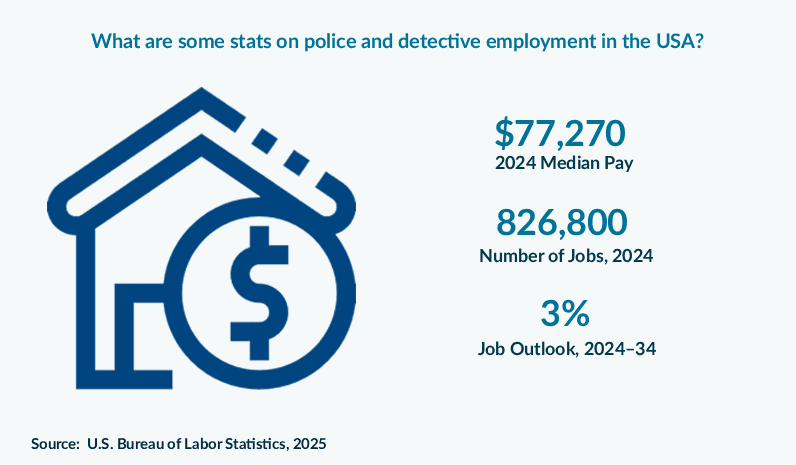
As shown in the graphic below, police and detectives held 826,800 jobs in the United States as of 2024, earning a median annual pay of $77,270, which translates to $37.15 per hour (U.S. Bureau of Labor Statistics, 2025).
Employment for these protective service occupations is projected to grow 3% from 2024 to 2034, a rate considered about as fast as the average for all occupations. This modest job outlook is expected to result in an employment change of 20,900 new jobs over the decade, though employers typically look for work experience in a related occupation and provide moderate-term on-the-job training for new entrants.
Additionally, within forensic science careers, pay levels vary significantly based on specialization, education, and agency. Some advanced forensic roles—such as forensic pathologists and high-level digital forensics consultants—are often cited among the highest paying jobs in forensics, reflecting the strong demand for specialized expertise at the intersection of science, law, and technology.
Job growth in many criminology-adjacent roles is expected to outpace or match the national average, particularly where technology, reform, and analysis converge. Graduates who build strong analytical and interdisciplinary skills may enjoy superior prospects.
What are some specializations within criminology programs?
Criminology degree programs allow students to select concentrations that align with their career goals. These specializations build targeted expertise and prepare graduates for distinct roles across justice, research, and policy.
- Comparative criminology: Explores crime and justice systems across global contexts, examining international policing, human rights, and cross-border crime. Graduates often pursue roles in NGOs, international law enforcement, or policy analysis.
- Corrections: Focuses on prison management, offender rehabilitation, and reentry strategies. Students study correctional law, counseling, and security procedures, preparing for careers as wardens, reentry coordinators, or correctional counselors.
- Criminal justice administration: Provides leadership and management training for justice organizations. Coursework emphasizes budgeting, supervision, and organizational behavior, leading to roles as administrators, policy directors, or managers.
- Criminological theory: Concentrates on the underlying causes of crime, integrating sociological, psychological, and economic perspectives. This track is often pursued by students interested in academic research or policy evaluation.
- Cybercrime: Addresses computer-based crimes, cybersecurity, and digital investigations. Students develop technical expertise in digital forensics and cyberlaw, enabling careers in corporate security, law enforcement cyber units, or federal agencies.
- Environmental criminology: Examines how urban design, physical spaces, and environmental conditions shape crime. This specialization prepares students for roles in urban planning, public safety, and community development.
- Forensic criminology: Blends criminological theory with forensic science practices. Coursework covers evidence collection, crime scene analysis, and courtroom testimony, leading to careers in forensic labs, law enforcement, or consulting.
- Juvenile justice: Concentrates on youth crime, prevention, and rehabilitation. Students study adolescent psychology and diversion programs, preparing for positions in juvenile courts, youth probation, or advocacy organizations.
- Law enforcement studies: Prepares students for policing and investigative careers, emphasizing patrol operations, investigative techniques, and community engagement strategies.
- Research and statistics: Equips students with advanced quantitative and qualitative research skills. This path suits students pursuing doctoral studies or data-driven careers in think tanks, government, or academia. Many also explore how to become a data scientist as a side career.
- Social justice and policy: Focuses on equity, reform, and restorative justice approaches. Graduates often work in nonprofits, advocacy groups, or policy institutes, driving systemic change.
- Terrorism and security studies: Examines extremist movements, counterterrorism, and national security. This track prepares students for intelligence and defense-related roles in government or security organizations. Students interested in transitioning into corporate or private sector protection roles often look into certifications for security consultant careers, such as Certified Protection Professional (CPP), Physical Security Professional (PSP), or Certified Information Systems Security Professional (CISSP), depending on whether they are focusing on physical security, organizational risk, or cybersecurity.
- Victimology: Studies the needs, rights, and support systems for crime victims. Coursework prepares graduates to work in advocacy, trauma services, and community outreach programs.
- White-collar crime: Investigates financial fraud, corporate misconduct, and regulatory breaches. Students learn compliance and auditing, leading to careers in finance, corporate investigations, or federal enforcement.
Specializations offer both depth and direction, allowing graduates to stand out in a competitive field by tailoring their education to specific career niches.
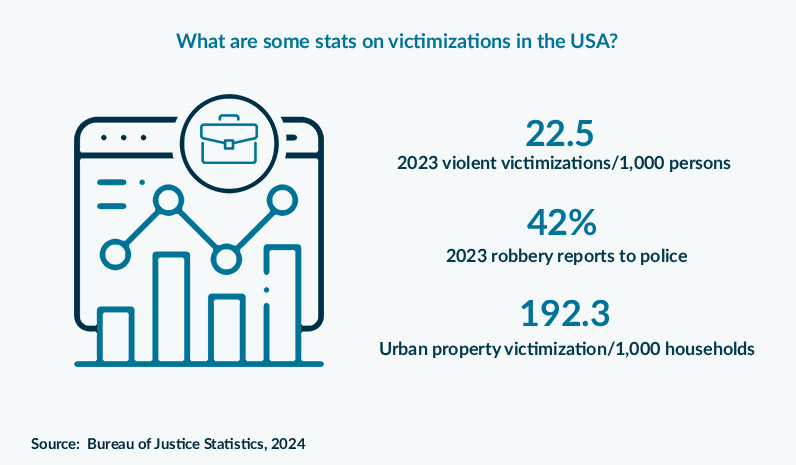
Violent victimization in the U.S. remained steady in 2023 at 22.5 victimizations per 1,000 persons age 12 or older, similar to the 2022 rate. This overall rate includes rape or sexual assault, robbery, aggravated assault, and simple assault. However, the prevalence of experiencing at least one violent victimization declined from 1.51% in 2022 to 1.36% in 2023. Specifically, the rate of violent victimization (excluding simple assault) for males dropped from 9.5 per 1,000 persons in 2022 to 6.9 per 1,000 in 2023, while firearm involvement in violent crimes remained stable at about 9% in 2023.
Reporting of certain crimes decreased substantially: the rate of robbery victimizations reported to police fell from 64% in 2022 to 42% in 2023, and motor vehicle theft reporting dropped from 81% to 72%. Concurrently, property victimization in urban areas rose from 176.1 per 1,000 households to 192.3 per 1,000 households. Conversely, household victimization by burglary or trespassing saw a slight decline from 1.12% in 2022 to 1.01% in 2023.
The data, shown in the graphic below, indicates a drop in the personal prevalence of violent crime in 2023, but this is complicated by increasing urban property crime and a significant decline in victim reporting.
What internship and research opportunities are available in criminology programs?
Internships and research experiences bridge classroom learning with real-world application, providing students with valuable exposure to professional environments and scholarly work.
- Community outreach programs: Opportunities to support nonprofit organizations focused on prevention, education, and rehabilitation.
- Corrections placements: Experience in prisons, probation offices, or halfway houses, gaining insights into offender management and rehabilitation.
- Court system internships: Direct exposure to judicial processes, case management, and court administration tasks.
- Data analysis projects: Faculty-led opportunities to work with crime statistics, predictive modeling, or program evaluation. The cheapest online data science bootcamps can help augment one's skills.
- Federal internships: Positions in agencies such as the FBI, DEA, or DHS, offering competitive and prestigious experiences in federal law enforcement or intelligence.
- Forensic lab work: Practical experience assisting with evidence processing, laboratory techniques, and forensic reporting.
- International placements: Study abroad or exchange programs focused on comparative justice and transnational crime issues.
- Nonprofit roles: Internships with victim advocacy groups, shelters, or crime-prevention organizations.
- Police department internships: Training in patrol assistance, community engagement, and administrative tasks in local law enforcement.
- Policy internships: Opportunities in legislative offices, think tanks, or advocacy groups shaping criminal justice reform.
- University research projects: Collaboration with faculty on criminological studies, preparing students for graduate school or research-based careers.
These opportunities offered by criminology degree programs develop applied skills and enhance employability. Students who complete internships or research often secure jobs faster and are better equipped to address real-world criminal justice challenges.
Which universities offer top-ranked criminology programs?
Several universities in the United States are nationally and internationally recognized for their criminology programs. These institutions stand out for their faculty expertise, research centers, and influence on criminal justice policy and practice.
- Florida State University: FSU’s College of Criminology and Criminal Justice consistently ranks among the top in the nation. It is known for its large research output, strong graduate programs, and partnerships with criminal justice agencies. The college also offers extensive online options, making it accessible to working professionals.
- Michigan State University: MSU is well-regarded for its international focus and expertise in policing research. The School of Criminal Justice offers programs from the undergraduate to doctoral level, with particular strengths in comparative criminology and homeland security studies.
- Rutgers University: Rutgers’ School of Criminal Justice in Newark is recognized for its urban crime research and focus on public policy. Its location provides students with direct access to metropolitan criminal justice systems, and it emphasizes reform, social equity, and community engagement.
- University at Albany, SUNY: This program is notable for combining criminology with public policy, sociology, and criminal justice research. The school operates major research centers, such as the Hindelang Criminal Justice Research Center, which is influential in crime analysis and policy development.
- University of California, Irvine: UC Irvine’s Department of Criminology, Law and Society is nationally ranked for its innovative, interdisciplinary approach. It emphasizes theory, law, and social policy, and is particularly strong in areas such as cybercrime, law and society, and criminal justice reform.
- University of Cincinnati: Known for pioneering research in criminal justice theory and corrections, Cincinnati houses one of the oldest criminology doctoral programs in the country. It has strong ties to corrections and community supervision research, and its faculty are highly cited in criminological scholarship.
- University of Maryland, College Park: Maryland is frequently cited as one of the most influential criminology programs in the U.S. The Department of Criminology and Criminal Justice produces research that directly informs state and federal policy. Its PhD program is ranked highly for research productivity and scholarly impact.
- University of Pennsylvania: Penn offers one of the only standalone Ivy League criminology programs. It emphasizes a strong theoretical and research foundation, preparing students for leadership roles in research, law, and public policy. Students benefit from access to interdisciplinary resources across law, public health, and social sciences.
These universities provide strong academic and professional networks, making them leading destinations for students interested in criminology careers and research.
What are the biggest challenges faced by students pursuing a criminology degree?
Criminology students face challenges that can impact both academic performance and career development. These obstacles reflect the rigor of the field and the demands of criminal justice professions.
- Balancing theory and application: Bridging abstract criminological concepts with practical skills needed for careers can be difficult.
- Career competition: Highly sought-after roles, such as federal agent positions, are competitive and require top academic and physical preparation.
- Emotional toll: Studying topics like violent crime, victimization, and trauma can be psychologically taxing.
- Financial pressures: Tuition costs, combined with unpaid internships, may create barriers for students with limited resources.
- Internship scarcity: Securing placements with prestigious agencies is often highly competitive.
- Legal and ethical complexity: Navigating topics like racial equity, constitutional law, and justice reform requires careful reasoning.
- Research intensity: Courses often demand proficiency in statistics and data analysis, which can be challenging for students without strong math backgrounds.
- Staying current: Rapid changes in technology, cybercrime, and policy reforms require constant learning.
- Time management: Students balancing part-time work, internships, and study often struggle to maintain equilibrium.
- Work-life stress: Exposure to criminal justice environments can affect personal well-being, especially during fieldwork.
These challenges demand resilience, adaptability, and institutional support, but overcoming them helps students develop critical professional skills.
In addition, crime rates in the USA seem very daunting, although a few of them have decreased. The FBI’s 2024 crime statistics covered over 14 million offenses from 16,419 agencies, representing 95.6% of the U.S. population. Overall violent crime declined by 4.5% compared to 2023, though serious incidents remained frequent, with a violent crime occurring every 25.9 seconds, as shown in the graphic below. Within this, a rape was reported every 4.1 minutes and a murder every 31.1 minutes, underscoring the ongoing severity despite improvements.
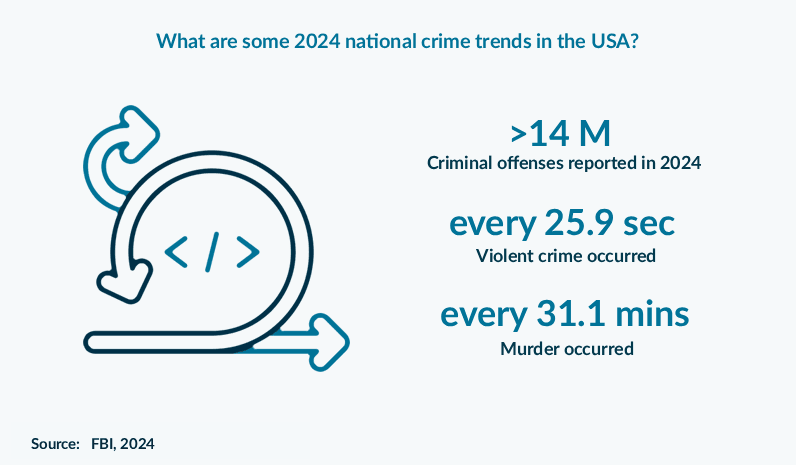
Major violent crime categories showed notable reductions: murder and non-negligent manslaughter fell 14.9%, robbery dropped 8.9%, aggravated assault decreased 3.0%, and revised rape offenses declined 5.2%. Agencies also recorded 11,679 hate crime incidents involving 13,683 offenses, with a 1.5% drop in cases from 11,041 in 2023 to 10,873 in 2024 within a shared dataset. The data highlights a broad national slowdown in both violent and bias-motivated crime, while also stressing the need for sustained prevention efforts.
What are the biggest opportunities for students pursuing a criminology degree?
Criminology education provides students with opportunities to make meaningful contributions while advancing their careers. These opportunities reflect growth areas in justice, policy, and security.
- Community engagement: Expanding roles in grassroots organizations focused on prevention and rehabilitation.
- Cybersecurity and digital forensics: Rising need for professionals skilled in investigating cybercrime and protecting networks.
- Data-driven policing: Law enforcement agencies increasingly use analytics, creating demand for graduates with quantitative skills.
- Federal careers: Expanding opportunities in agencies such as the FBI, DEA, DHS, and ATF.
- Global opportunities: Careers with international organizations combating transnational crime, human trafficking, and terrorism.
- Graduate study: Pathways into master’s or PhD programs that lead to advanced teaching, research, or policy roles. These are sure pathways to the highest paying criminology jobs.
- Intelligence and security analysis: Demand for experts to assess threats and protect national interests.
- Networking potential: Strong alumni and faculty networks provide mentorship and job opportunities.
- Policy reform involvement: Students can directly contribute to shaping and evaluating justice reform initiatives.
- Social justice advocacy: Increasing opportunities in nonprofits dedicated to equity and systemic change.
Criminology graduates can leverage these opportunities to shape their careers in meaningful ways while contributing to safer, fairer communities.
What are some current and future trends in the criminology field?
Criminology is adapting to societal and technological changes that redefine how crime is studied and addressed. Understanding these trends helps students and professionals stay relevant.
- Community partnerships: Expanded collaboration between police and community groups to build trust and improve safety.
- Cross-disciplinary integration: Growing overlap with sociology, psychology, public health, and law to address complex crime causes.
- Criminal justice reform: Continued emphasis on reducing incarceration rates, addressing disparities, and promoting alternatives.
- Cybercrime expansion: Increasing online fraud, identity theft, and ransomware demand specialized expertise.
- Data-driven decision-making: Predictive analytics and big data tools are increasingly used in policing and corrections.
- Diversity and inclusion: Focus on addressing inequities and increasing representation within the justice system.
- Educational innovation: Growth in online criminology programs and certificate pathways.
- Environmental criminology: Attention to how neighborhood design and environment influence crime.
- Forensic advancements: New technologies in DNA testing, digital forensics, and evidence analysis. A forensic science degree online is quickly becoming popular among non-criminology students as an alternative degree.
- Global cooperation: Rising collaboration across countries to address human trafficking, terrorism, and cybercrime.
- Mental health integration: Incorporating psychological services and diversion programs into justice systems.
- Restorative justice: Growing use of reconciliation-based approaches to reduce recidivism and repair harm.
- Terrorism studies: Continued research into extremist groups and evolving threats.
These trends show a field that is both expanding in scope and becoming more technologically sophisticated. Professionals who adapt to these shifts will remain in high demand across sectors.
Here's What Graduates Say About Their Criminology Degrees
- Hector: "Studying criminology in the U.S. gave me hands-on experience through internships with local law enforcement and exposure to real-world case studies. I feel more confident pursuing a career in criminal justice thanks to the mentorship I received. "
- Mike: "My criminology program emphasized data analysis and forensic psychology, which helped me land a research assistant role before graduation. The professors were incredibly supportive and made complex topics feel accessible and exciting."
- Wendy: "The diversity of perspectives in my criminology classes opened my eyes to systemic issues and inspired me to focus on policy reform. I’ve never felt more driven to make a difference in my community."
Key Findings
- Employment Distribution of Investigators: Local government employs 44,480 detectives and criminal investigators, followed by federal, state, and local government combined at 39,480 (1.85% of industry employment), state government at 21,910 (1.03%), the postal service at 480 (0.08%), and psychiatric and substance abuse hospitals at only 40 (0.02%) (U.S. Bureau of Labor Statistics, 2025).
- Police and Detectives Employment Outlook: Police and detectives held 826,800 jobs in 2024, earning a median annual pay of $77,270 ($37.15/hour), with projected growth of 3% from 2024–2034, adding about 20,900 jobs, supported by moderate-term on-the-job training requirements (U.S. Bureau of Labor Statistics, 2025).
- Violent Victimization Rates: In 2023, the U.S. recorded 22.5 violent victimizations per 1,000 persons age 12 or older, with prevalence falling from 1.51% in 2022 to 1.36% in 2023, while male victimization rates dropped from 9.5 to 6.9 per 1,000, and firearm involvement in violent crimes remained steady at 9% (Bureau of Justice Statistics, 2024).
- Crime Reporting Declines: The rate of robbery victimizations reported to police dropped from 64% in 2022 to 42% in 2023, while motor vehicle theft reporting fell from 81% to 72% during the same period (Bureau of Justice Statistics, 2024).
- Property Victimization Trends: Property victimization in urban areas rose from 176.1 per 1,000 households in 2022 to 192.3 per 1,000 in 2023, while burglary or trespassing victimization slightly decreased from 1.12% to 1.01% (Bureau of Justice Statistics, 2024).
- National Crime Totals: The FBI reported over 14 million offenses in 2024 from 16,419 agencies covering 95.6% of the population, with violent crime decreasing by 4.5% year over year, though violent crimes still occurred every 25.9 seconds, with rapes reported every 4.1 minutes and murders every 31.1 minutes (Federal Bureau of Investigation, 2025).
- Major Violent Crime Declines: Murder fell 14.9% in 2024, robbery declined 8.9%, aggravated assault decreased 3.0%, and revised rape offenses dropped 5.2%, while hate crime incidents totaled 11,679, with a 1.5% reduction from 11,041 in 2023 to 10,873 in 2024 (Federal Bureau of Investigation, 2025).
- Entry-Level Salaries: Criminologists (~$56,345), forensic science technicians ($67,440), crime analysts (~$67,500), and new federal agents ($70,000+) typically earn $55,000–$70,000 annually (BLS, 2025; PayScale, 2025).
- Mid-Career Salaries: Police officers and detectives ($77,270), compliance officers ($77,500), intelligence analysts (~$85,000), and professors (~$80,000) earn in the $75,000–$90,000 range (BLS, 2025; PayScale, 2025).
- Senior and Executive Salaries: Correctional administrators ($100,000), police chiefs and researchers ($100,000), consultants ($110,000), and federal policy leaders ($130,000+) earn $100,000 and above (BLS, 2025; PayScale, 2025).
References:
- Bureau of Labor Statistics. (2024). Police and detectives. U.S. Department of Labor, Occupational Outlook Handbook. U.S. Bureau of Labor Statistics.
- Bureau of Labor Statistics. (2024, May). Occupational employment and wage statistics: Police and sheriff’s patrol officers (33-3051). U.S. Department of Labor. Bureau of Labor Statistics.
- Bureau of Labor Statistics. (2024, May). Occupational employment and wage statistics: Detectives and criminal investigators (33-3021). U.S. Department of Labor. Bureau of Labor Statistics.
- Bureau of Labor Statistics. (2024, May). Occupational employment and wage statistics: Postsecondary criminal justice and law enforcement teachers (25-1111). U.S. Department of Labor. Bureau of Labor Statistics.
- Bureau of Labor Statistics. (2024, May). Forensic science technicians. U.S. Department of Labor, Occupational Outlook Handbook. U.S. Bureau of Labor Statistics.
- Federal Bureau of Investigation. (2024). FBI releases 2024 reported crimes in the nation statistics. Federal Bureau of Investigation.
- PayScale. (2025). Criminologist salary. PayScale.
- PayScale. (2025). Master of Science (MS), Criminology salary. PayScale.
- University of Texas at El Paso. (2025). Criminology career outlook. The University of Texas at El Paso.
- U.S. Bureau of Labor Statistics. (2025). Police and detectives. Occupational Outlook Handbook. U.S. Bureau of Labor Statistics.
- ZipRecruiter. (2025). Criminal justice/criminology salary. ZipRecruiter.
- ZipRecruiter. (2025). Criminology salary. ZipRecruiter.
Other Things You Should Know About How Long to Get a Criminology Degree Program
An accelerated 4+1 criminology program allows students to earn both a bachelor's and master's degree in five years instead of the typical six or more. Students take graduate-level courses during their senior undergraduate year, which count towards both degrees, thus shortening the overall program duration.
In 2027, criminology graduates can explore non-law enforcement careers such as forensic analyst, crime scene investigator, social worker, policy advisor, community development worker, and research analyst. These roles utilize criminological skills in diverse fields beyond traditional law enforcement.


