2027 How to Earn a CFF Certification: Requirements, Cost & Exam Coverage

Co-Founder and Chief Data Scientist
Only 0.4% of forensic accountants hold specialized credentials, including the CFF certification (Zippia, 2025), highlighting its exclusivity and professional prestige. Earning this certification signals mastery in forensic accounting, fraud investigations, and litigation support, giving candidates a competitive edge in a high-demand field. For aspiring professionals, it opens doors to roles in corporate investigations, fraud prevention, and expert witness services, enhancing employability and career resilience.
In this article, I will explain how to earn a CFF certification in 2027. I will also cover eligibility requirements, exam structure, and associated costs to help candidates strategically plan their certification journey, maximize their preparedness, and enhance career opportunities in forensic accounting and related fields.
What are the benefits of pursuing a CFF certification?
- Pursuing a CFF certification increases earning potential, reflecting the high demand for skilled forensic accounting professionals.
- It provides professional recognition, enabling accountants to serve as expert witnesses and lead complex fraud investigations.
- The credential supports career mobility, offering access to leadership roles, specialized assignments, and a global network of certified professionals, while enhancing visibility to clients and employers.
- What is the CFF certification and why does it matter? CFF Certification
- What are the eligibility requirements for CFF certification in 2027? Eligibility Requirements
- What educational pathway leads to earning the CFF credential? Educational Pathway
- How is the CFF exam structured and delivered? Exam Structure
- What topics and knowledge areas does the CFF exam cover? Exam Coverage
- How much does the CFF exam cost? Exam Cost
- How do you register for the CFF certification exam? How do you register for the CFF certification exam?
- What are the best ways to prepare for the CFF exam? What are the best ways to prepare for the CFF exam?
- What is required to maintain CFF certification each year? What is required to maintain CFF certification each year?
- How can advanced education complement my CFF certification? How can advanced education complement my CFF certification?
- What career benefits come with earning the CFF credential? What career benefits come with earning the CFF credential?
What is the CFF certification and why does it matter?
The Certified in Financial Forensics (CFF) credential is a prestigious designation offered by the American Institute of Certified Public Accountants (AICPA). It is awarded exclusively to CPAs who demonstrate advanced expertise in applying forensic accounting to investigative and litigation contexts.
This certification matters because it highlights both technical ability and professional credibility in areas where financial truth is critical. CFF holders are trusted to bridge accounting knowledge with investigative insight, making them highly valued in high-stakes environments.
The CFF credential is applied to the following:
- Fraud Investigation: It involves tracing financial transactions, documenting irregularities, and presenting evidence of misconduct in a manner that withstands legal scrutiny.
- Bankruptcy and Insolvency: It requires forensic accountants to analyze complex reorganizations, assess the causes of financial failure, and provide clarity for restructuring or liquidation processes.
- Family Law Disputes: It benefits from forensic expertise by clarifying issues such as asset division, business valuation, and financial support obligations in sensitive personal contexts.
- Valuations: It calls for the determination of fair value in contested or high-stakes matters, ensuring that business or asset assessments are both accurate and defensible.
- Economic Damages Calculations: It supports litigation by quantifying losses with precision, thereby helping courts and stakeholders understand the true financial impact of a dispute.
- Financial Statement Misrepresentation: It focuses on uncovering errors, omissions, or deliberate distortions in reporting that may mislead investors, regulators, or other stakeholders.
- Expert Witness Services: It enables forensic accountants to present their findings in court as credible testimony, bridging technical analysis with accessible explanations for judges and juries.
The importance of the CFF credential lies in the trust and recognition it commands across professional settings. Courts often regard it as proof of specialized expertise, while employers view it as clear evidence of advanced forensic capability. Clients also place confidence in the credential, seeing it as assurance of ethical conduct and impartial judgment in complex financial matters.
On a global scale, it reflects the growing demand for specialists trained to address the increasing complexity of financial forensics. Ultimately, the CFF sets professionals apart by validating not only their technical knowledge but also their ability to apply that knowledge with accuracy and integrity in high-stakes environments.
For CPAs or finance professionals looking to diversify their skills, exploring other accounting certifications—such as Certified Public Accountant (CPA), Certified Management Accountant (CMA), or Certified Internal Auditor (CIA)—can further expand career opportunities and complement the CFF credential’s focus on forensic expertise.
What are the eligibility requirements for CFF certification in 2027?
To qualify for the CFF certification in 2027, candidates must demonstrate both professional standing and technical readiness. Eligibility for the certification is built around four pillars, which include:
- Active AICPA Membership: Candidates must maintain continuous membership to demonstrate adherence to the profession’s ethical and professional standards.
- A Current and Valid CPA license or an Equivalent Credential Approved by the AICPA Board: Applicants need recognized licensure to confirm their foundational authority in accounting practice.
- Successful Completion of the CFF Exam: Candidates must pass this assessment to validate their advanced knowledge in forensic accounting and related practice areas.
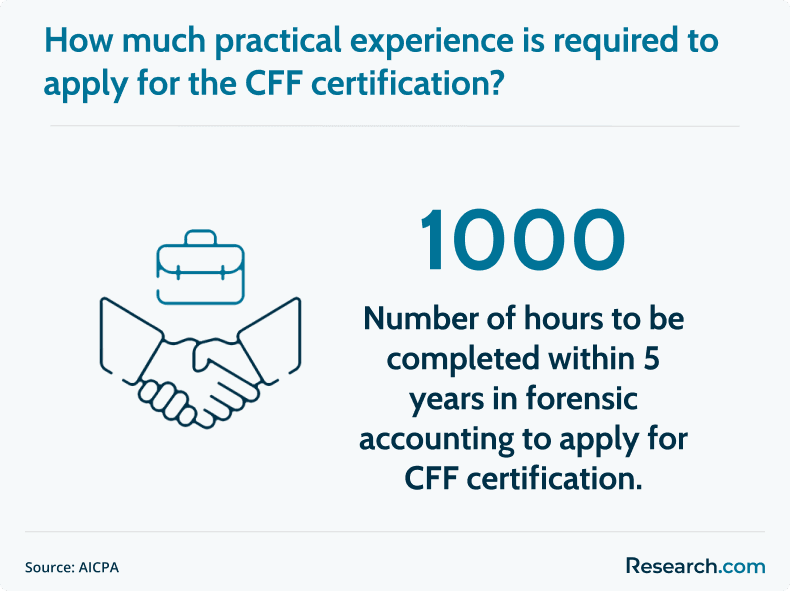
- Verified Business Experience and CPD Compliance: Applicants must document at least 1,000 hours of forensic accounting experience within the five years preceding their application and meet ongoing continuing professional development (CPD) requirements to ensure their expertise remains both current and applicable.
Earning the CFF credential is a rigorous process that reflects the depth of knowledge required to excel in financial forensics. Like other technical disciplines—where professionals often ask how hard is data science due to its analytical complexity—the CFF pathway also demands a mix of critical thinking, technical skill, and practical experience. Both fields require not just theoretical understanding but the ability to apply advanced concepts to real-world problems, making them equally challenging and rewarding career pursuits.
What educational pathway leads to earning the CFF credential?
While professional experience is essential, education provides a structured foundation that prepares candidates for the CFF exam. The AICPA offers several programs that support candidates in mastering both the technical and ethical dimensions of forensic practice. These programs build competence in investigative methodologies, fraud detection, and litigation support.
Pursuing a CFF certification increases earning potential, reflecting the high demand for skilled forensic accounting professionals. It provides professional recognition, enabling accountants to serve as expert witnesses and lead complex investigations into fraud.
The credential supports career mobility, offering access to leadership roles, specialized assignments, and a global network of certified professionals, while enhancing visibility to clients and employers.
Here are the educational options that can lead to a CFF credential:
- CFF Learning Pathway (72.5 CPE hours): A comprehensive, self-paced program that addresses the full CFF Body of Knowledge, making it ideal for those seeking structured preparation.
- CFF Exam Review Course (20 CPE hours): A focused review resource designed for professionals with existing forensic experience who want targeted exam preparation.
- Fundamentals of Forensic Accounting Certificate (21.5 CPE hours): An introductory program that equips newer professionals with essential skills before pursuing advanced certification.
- Independent CPD Courses: Flexible options that allow candidates to strengthen knowledge in specific areas of forensic accounting based on individual needs.
- Case-Study Workshops: Interactive sessions that provide practical experience in applying forensic techniques to simulated real-world scenarios.
Many forensic accountants also explore related disciplines such as criminology to deepen their investigative perspective. Understanding the criminology degree how many years it typically takes and what it entails can help aspiring forensic professionals appreciate the broader context of criminal behavior, evidence analysis, and legal frameworks that complement their financial expertise. This interdisciplinary knowledge often strengthens a CFF’s ability to interpret complex financial crimes within a legal and behavioral framework.
How is the CFF exam structured and delivered?
The CFF exam is carefully structured to balance theoretical knowledge with applied expertise, ensuring candidates are fully prepared for professional practice. Its design emphasizes both ethical standards and real-world applications, reflecting the complexity and diversity of modern forensic accounting.
Two Modules of Assessment
The CFF examination is structured into two primary modules, each designed to evaluate both theoretical knowledge and practical expertise in forensic accounting.
- Core Knowledge, Information, and Skills (55%): This covers professional standards, global legal systems, laws and regulations, evidence handling, and reporting practices, with emphasis on ethical and investigative rigor.
- Core Practice Areas (45%): This focuses on applied topics such as fraud risk management, litigation services, economic damages, bankruptcy, and family law disputes, reflecting the real-world scope of forensic practice.
Delivery Methods
The CFF exam is available through two delivery options to ensure both security and accessibility. Candidates may take the exam at authorized testing centers, which provide a controlled setting, or use remote proctoring platforms, which allow global access while upholding strict security standards.
Pathways to Completion
Candidates can choose between two pathways based on their experience level. The Global Standard Pathway requires completing 175 multiple-choice questions in a four-hour session, offering the most comprehensive assessment. In contrast, the Experienced Pathway consists of 95 multiple-choice questions to be completed in two hours, providing a more streamlined option for seasoned professionals.
Scoring Framework
Both pathways draw from the same CFF Body of Knowledge to ensure consistent evaluation. The exam uses a holistic scoring method, meaning partial passes are not accepted. Candidates must show complete mastery of all content areas to earn certification, underscoring the rigor and credibility of the credential.
This chart from AICPA shows the two modules' assessment for the CFF examination.
What topics and knowledge areas does the CFF exam cover?
The CFF exam draws on the Global CFF Content Specification Outline (CSO), which reflects the complex challenges encountered in forensic accounting practice. It actively assesses both conceptual knowledge and applied expertise, preparing candidates to perform effectively in investigative, litigation, and advisory roles.
By addressing a broad range of subject areas, the exam establishes a comprehensive foundation in forensic accounting degree while balancing theoretical understanding with practical application. In this way, it aligns directly with the diverse and demanding responsibilities placed on modern forensic accounting professionals.
These are the exam topics one can expect from the CFF exam:
- Fraud Prevention, Detection, and Response: Candidates must analyze financial records to identify irregularities and recommend strategies for mitigating fraud risks.
- Financial Statement Misrepresentation: The exam tests the ability to uncover errors, omissions, or intentional distortions that mislead stakeholders.
- Digital Forensics: Candidates are evaluated on managing and analyzing electronic evidence, a growing necessity in today’s digital economy.
- Bankruptcy, Insolvency, and Restructuring: This area involves assessing causes of financial distress and guiding restructuring or liquidation processes.
- Damages Calculations: Candidates demonstrate the ability to quantify financial losses and provide defensible valuations in litigation contexts.
- Family Law Services: The exam includes applying forensic techniques to sensitive issues such as asset division and divorce-related valuations.
- Expert Witness Testimony and Reporting: This area tests the skill of presenting complex findings credibly and clearly in court or arbitration settings.
How much does the CFF exam cost?
The cost of earning a CFF certification depends on both membership status and pathway. Candidates should anticipate not only the examination fee but also additional expenses for study resources and preparation.
While the financial commitment may appear substantial, the long-term career advantages of holding the CFF credential often outweigh the initial investment. To support candidates, the AICPA provides flexible pricing structures and bundled options tailored to different stages of professional development.
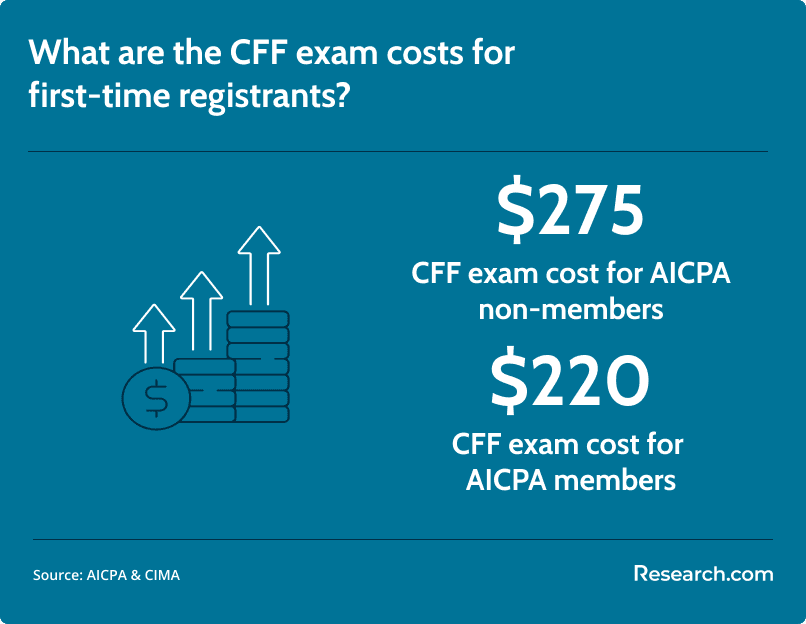
CFF exam costs for first-time registrants include:
- $275 for AICPA non-members
- $220 for AICPA members
- $175 for AICPA Forensic and Valuation Services (FVS) Section members
These are the additional cost considerations that interested examiners should factor in:
- Retake Fee: $60 per attempt
- Volume Pricing: Companies registering two or more candidates in the same exam window receive a $60 discount per exam
By offering tiered and discounted pricing, the AICPA reduces barriers to entry while encouraging broader participation among individual accountants and organizations.
For those looking beyond exam costs, it’s also worth exploring how the CFF credential compares to other specialized forensic roles in terms of salary potential. Many professionals pursuing forensic accounting often wonder what is the highest paying forensic job, and while compensation varies by experience and setting, top forensic accountants and financial investigators in corporate litigation, government consulting, or fraud examination can command some of the most competitive salaries in the accounting and finance field.
How do you register for the CFF certification exam?
Registration for the CFF exam follows a structured process overseen by the AICPA. The procedure is designed to confirm candidate eligibility, provide scheduling flexibility, and uphold exam security.
For professionals pursuing the highest paying accounting jobs, completing this registration process marks an essential step toward earning a credential that reinforces credibility and career advancement. Here are the steps in the registration process for the CFF certification exam:
- Confirm Eligibility Requirements: Review the official criteria, which include education, experience, and membership standards.
- Select the Appropriate Pathway: Choose from the Standard Pathway, Experienced Pathway, or Reinstatement Pathway, depending on your professional background and prior credentials.
- Access the Official Registration Portal: Complete your application through the AICPA CFF Exam Registration Portal. Make sure all required details are accurate.
- Submit Membership Details and Payment Information: Provide AICPA membership verification (if applicable) and pay the exam fee based on your membership status.
- Receive a Notice to Schedule (NTS): After approval, you will receive an NTS via email. This document authorizes you to book your exam date.
- Schedule your Exam with Kryterion: Using your NTS, schedule an exam through Kryterion’s Webassessor platform. After which, select either a global test center or a secure remote proctoring option.
What are the best ways to prepare for the CFF exam?
Preparing for the CFF exam requires more than simply memorizing terms and frameworks; it demands a disciplined and strategic approach that blends conceptual learning with applied practice. Successful candidates typically integrate structured resources from the AICPA with self-directed study and real-world application, ensuring both breadth and depth of knowledge.
By systematically engaging with study tools and reinforcing concepts through professional practice, candidates can enter the exam with confidence. These are some of the effective preparation strategies you can apply for the CFF examination:
- Complete the CFF Learning Pathway: Engage with the AICPA CFF Learning Pathway to gain structured, comprehensive coverage of all exam topics. This program aligns directly with the Content Specification Outline (CSO).
- Enroll in the CFF Exam Review Course: Use the official CFF Exam Review Course to strengthen conceptual understanding and reinforce complex topics. This course includes practice questions, case-based examples, and exam-taking strategies.
- Practice with Case Studies and Mock Exams: Work through past scenarios, sample questions, and simulations that mirror exam conditions. These exercises train candidates to apply forensic concepts under time pressure.
- Join Peer Study Groups or Online Forums: Participate in study networks where candidates exchange insights, clarify complex areas, and share effective strategies. Peer accountability often helps sustain discipline.
- Target Weak Areas with CPD Courses: Identify knowledge gaps early and enroll in continuing professional development (CPD) courses that address those specific areas, such as fraud detection or litigation support.
- Follow a Structured Study Schedule: Create a timeline with weekly milestones to ensure steady progress. Consistency in study habits reduces last-minute stress and improves retention.
- Apply Forensic Concepts in Daily Practice: Reinforce learning by integrating forensic accounting principles into current professional tasks. Real-world application deepens understanding and strengthens problem-solving skills.
What is required to maintain CFF certification each year?
Practitioners maintain the CFF certification by actively demonstrating ongoing commitment to professional development, ethical integrity, and applied expertise. Renewal affirms their dedication to the field while ensuring they remain current with evolving forensic accounting standards, legal frameworks, and investigative methodologies. This process upholds the credential’s integrity and reinforces public trust in its holders.
To remain in good standing, credential holders must meet the following requirements:
Maintain AICPA Membership
Credential holders must sustain active membership with the AICPA, including timely payment of dues and adherence to all membership obligations. Active membership ensures alignment with the AICPA’s professional, ethical, and continuing education standards, which are foundational to maintaining the credibility of the CFF designation.
Hold a Valid CPA License or Equivalent
Practitioners must maintain an unrevoked and active Certified Public Accountant (CPA) license or an equivalent recognized credential in their jurisdiction. For those who begin their careers through the fastest online forensic accounting degree, this requirement confirms that they meet statutory and regulatory standards for professional practice and reinforces their authority to provide forensic accounting services.
Complete Continuing Professional Development (CPD) Hours
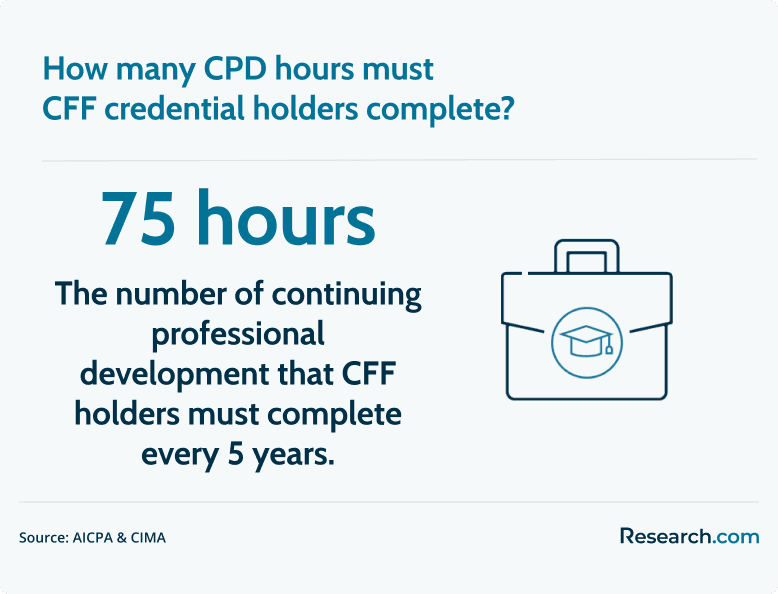
CFF credential holders must complete 75 CPD hours every five years, with at least 20 hours specifically focused on forensic accounting topics, including fraud examination, litigation support, valuation, and forensic technology. The remaining hours can cover general accounting, auditing, or related subjects. CPD activities may include formal courses, webinars, self-study, or participation in professional conferences, so practitioners can maintain up-to-date knowledge and applied expertise.
Attest to Relevant Forensic Practice
As part of the renewal process, practitioners must certify that they continue to perform forensic accounting engagements, including litigation support, fraud investigations, valuations, or advisory services. This attestation reinforces that the credential is not only theoretical but also grounded in ongoing professional experience.
Adhere to the AICPA’s Code of Professional Conduct
Credential holders must comply with the AICPA Code of Professional Conduct, which requires integrity, objectivity, due care, and independence in performing forensic engagements. Violations, including ethical lapses or legal sanctions, can result in suspension or revocation of the CFF credential.
Renew the Credential Online within the Required Timelines
Practitioners must submit their renewal applications through the AICPA CFF credentialing portal by the specified deadline. The online process requires submission of CPD documentation, confirmation of continuing forensic practice, updated membership and licensing details, and attestation to adherence to ethical standards. Timely renewal ensures uninterrupted credential status and eligibility to represent oneself as a CFF-certified professional.
How can advanced education complement my CFF certification?
Forensic accounting professionals can benefit from supplementing their CFF credential with advanced business education that sharpens strategic and managerial skills. Integrating additional academic experiences not only deepens expertise in financial investigations but also prepares candidates for leadership roles involving risk management and strategic decision-making. Pursuing courses or degrees that emphasize business strategy can bridge the gap between technical forensic skills and executive acumen. For instance, earning a best online MBA cheap can provide a competitive edge by reinforcing analytical rigor and fostering a holistic understanding of financial systems.
What career benefits come with earning the CFF credential?
Earning the CFF credential provides professionals with a strategic advantage in forensic accounting, a rapidly expanding and high-demand sector. For those who have completed a masters in forensic accounting, the designation further validates advanced technical expertise while enhancing professional credibility, increasing market visibility, and strengthening career resilience in a competitive field.
By demonstrating mastery in investigative, litigation, and advisory services, CFF holders position themselves for specialized roles and leadership opportunities that may not be accessible without the certification. Below are the benefits of earning a CFF certification:
- Recognition as an expert in forensic accounting and litigation support, establishing professional authority.
- Opportunities to serve as an expert witness in legal proceedings, applying technical knowledge in high-stakes environments.
- Increased employability in fraud prevention, corporate investigations, and related advisory services.
- Inclusion in the official online CFF directory enhances visibility to prospective clients and employers.
- Access to AICPA marketing resources and digital badges, enabling professionals to showcase their expertise.
- Membership in a global community of forensic accounting practitioners fosters networking and collaboration.
- Enhanced earning potential is a key benefit, with the forensic accounting salary, with CFF certification averaging around $130,000 per year; 34.8% of surveyed holders are experienced professionals, while 17.4% are in early career stages.
This Payscale chart illustrates the distribution of years of experience among CFF credential holders.
What Graduates Have to Say About Their CFF Certification
- Sarah: "Preparing for the CFF exam challenged me to think critically about real-world fraud scenarios and sharpen my investigative skills. The structured study resources made complex concepts manageable, and passing the exam gave me the confidence to tackle high-stakes forensic cases. "
- David: "Studying for the CFF certification was intense but incredibly rewarding. The exam coverage pushed me to strengthen areas like damage calculations and dispute resolution, which I now apply daily in my work. "
- Maria: "The CFF learning pathway helped me balance theory with practice, especially in fraud prevention and financial misrepresentation. The journey wasn’t just about earning a credential; it completely transformed how I approach forensic accounting challenges. "
Key Findings
- Applicants must complete 1,000 hours of forensic accounting experience within the five years preceding the CFF application, ensuring relevant hands-on practice.
- The CFF exam assesses two modules: Core Knowledge, Information, and Skills (55%) and Core Practice Areas (45%), covering both theory and applied expertise.
- First-time registrants pay $275 if they are AICPA non-members, and $220 for AICPA members, reflecting the credential’s investment in professional development.
- Credential holders must complete 75 CPD hours every five years, including at least 20 hours specifically in forensic accounting, to maintain currency and competence.
- On average, CFF credential holders earn around $130,000 per year, reflecting the market value of specialized forensic expertise
References:
- AICPA. (2025). AICPA 2025 Trends Report. https://www.aicpa-cima.com/professional-insights/download/2025-trends-report
- AICPA & CIMA. (2026). Global CFF examination: Content specification outline. Association of International Certified Professional Accountants. https://assets.ctfassets.net/rb9cdnjh59cm/5L2SPojifp3QF6ciyxjtwo/7cf780cce95d392bf909e3408b850648/forensic-global-CFF-credential-exam-CSO.pdf
- AICPA & CIMA (2025). Pathways to the CFF Credential. Retrieved from https://www.aicpa-cima.com/certifications/article/pathways-to-the-cff-r-credential
- AICPA & CIMA (n.d.). What is the CFF credential? Retrieved from https://www.aicpa-cima.com/membership/landing/certified-in-financial-forensics-cff-credential
- Payscale (2025). Salary for Certification: Certified in Financial Forensics (CFF). Retrieved from https://www.payscale.com/research/US/Certification=Certified_in_Financial_Forensics_(CFF)/Salary
Other Things You Should Know About Earning a CFF Certification
To earn a CFF certification in 2027, candidates must be a CPA with a good standing, accumulate 1,000 hours in forensic accounting over five years, complete 75 hours of forensic accounting education, and pass the CFF exam. --- **Question** Do you need to be a CPA to sit for the CFF exam? **Answer** Yes, to sit for the CFF exam in 2027, candidates must be Certified Public Accountants (CPAs) in good standing. Being a CPA ensures the candidate has a foundational understanding of accounting principles, which is crucial for forensic work. --- **Question** Can international CPAs apply for the CFF certification? **Answer** International CPAs can apply for the CFF certification in 2027 as long as they meet specific requirements, including holding an active CPA license recognized in the United States, completing requisite education and experience in forensic accounting, and passing the CFF exam. --- **Question** How can a candidate retake a failed section of the CFF exam? **Answer** In 2027, if a candidate fails a section of the CFF exam, they must wait for the next available testing window to retake the exam. They must pay the retake fee and use provided feedback to address areas of weakness in their exam preparation.
Yes, you must be a licensed CPA or hold an AICPA-approved equivalent to qualify for the CFF exam. This ensures candidates have a strong accounting foundation before specializing in forensic practices.
The CFF certification exam is administered by the American Institute of Certified Public Accountants (AICPA) in 2027. This governing body sets the standards and ensures the exam content is relevant and up-to-date with current financial forensic practices.
In 2027, candidates preparing for the CFF certification exam can access a variety of study materials, including the AICPA's official review courses, CFF exam review books, and online resources. These materials provide comprehensive coverage of the exam topics, helping candidates deepen their understanding effectively.