
2027 Most In-Demand Finance and Accounting Careers

Co-Founder and Chief Data Scientist
The U.S. Bureau of Labor Statistics projects more than 911,400 business and financial job openings each year, highlighting the ongoing demand for professionals who can manage money, analyze risks, and keep businesses compliant.
This article breaks down which finance and accounting careers are most in demand for 2027, using official BLS data and employer insights. You’ll learn which roles are growing fastest, which pay the most, and which skills employers consistently seek. By the end, you’ll know where the strongest career opportunities truly are.
Key Things You Should Know About Finance and Accounting Careers
- Finance and accounting careers remain essential across industries, with BLS projecting steady openings driven by retirements, turnover, and business growth. Even roles with slower job outlooks, such as bookkeeping clerks, still generate significant hiring needs because of constant workforce replacement.
- High-paying opportunities exist beyond traditional accounting, with financial managers, actuaries, and financial examiners showing faster-than-average growth. These specialized roles often require advanced education, certifications, or technical expertise, but they offer strong long-term prospects and salaries well above the national median.
- Employers consistently seek both technical and soft skills. Reconciling, financial reporting, and compliance dominate technical requirements, while communication skills and attention to detail remain universal. Candidates who combine industry knowledge with adaptability to new technology stand out the most.
- What are the most in-demand finance and accounting careers for 2027? In-Demand Careers
- Which finance and accounting roles offer the highest salaries this year? Highest Salaries
- What entry-level finance or accounting jobs are hiring the most right now? Entry-Level Jobs
- What skills do employers look for in in-demand finance and accounting professionals? Employer-Wanted Skills
- How important are certifications (CPA, CFA, etc.) for finance and accounting careers in 2027? Certifications’ Importance
- Which industries or sectors are driving demand for finance and accounting careers? Industries Driving Demand
- What are the challenges or downsides people should know before pursuing finance and accounting careers? Career Challenges
- How has technology (automation, AI, data analytics) changed what employers expect from finance/accounting applicants? Tech Impact
- What education or degree levels are required or preferred for in-demand finance/accounting roles? What education or degree levels are required or preferred for in-demand finance/accounting roles?
- How can an online MBA accelerate career growth in finance and accounting? How can an online MBA accelerate career growth in finance and accounting?
- What is the job outlook for finance and accounting careers beyond 2027? What is the job outlook for finance and accounting careers beyond 2027?
What are the most in-demand finance and accounting careers for 2027?
The finance and accounting sector is a paradox: some roles face declining long-term employment, yet still generate thousands of openings every year due to retirements, turnover, and the steady demand for financial oversight. Choosing the right specialization in accounting can help professionals align with careers that balance stability, growth, and personal interest. Below are the ten careers with the highest projected openings, each shaped by unique industry pressures.
- Bookkeeping, Accounting, and Auditing Clerks – 183,900 openings. Despite a projected decline, turnover is high, keeping demand strong for clerks who maintain accurate financial records.
- Financial Clerks – 105,400 openings. Their roles span customer-facing services to back-office operations, with automation reshaping but not erasing demand.
- Accountants and Auditors – 130,800 openings. Core to every industry, they remain indispensable for compliance, tax reporting, and financial accuracy.
- Securities, Commodities, and Financial Services Sales Agents – 41,500 openings. These workers thrive in volatile markets, helping clients invest and hedge risk.
- Cost Estimators – 16,600 openings (2024). Rising construction and infrastructure projects sustain demand for precise cost forecasting.
- Budget Analysts – 4,000 openings (2024). Limited growth but vital in both public and private sectors where resource allocation is under scrutiny.
- Property Appraisers and Assessors – 5,900 openings (2024). Tied closely to real estate cycles, their expertise ensures accurate valuations.
- Insurance Underwriters – 8,100 openings. Technology reduces routine tasks, yet complex risk assessments keep this role relevant.
- Financial Examiners – 6,100 openings. Demand has spiked due to increased regulation and compliance requirements in banking.
- Tax Examiners and Collectors, and Revenue Agents – 3,900 openings. Government budgets dictate hiring, but tax oversight ensures a steady stream of jobs.
Which finance and accounting roles offer the highest salaries this year?
Earnings potential is often a deciding factor when evaluating finance and accounting careers. While not all roles guarantee steady growth in employment, certain positions stand out for their high median salaries. These jobs reflect the value placed on advanced expertise, responsibility, and the ability to manage financial risk in an evolving economy. Understanding the top paying careers finance degree holders can pursue helps highlight which paths are both lucrative and resilient.
- Financial Managers: Oversee investment strategies, financial planning, and risk management across industries.
- Actuaries: Use mathematics and statistics to analyze financial risks for insurance companies, pensions, and consulting firms.
- Financial Analysts: Provide critical guidance on investment decisions for corporations, banks, and individual clients.
- Personal Financial Advisors: Advise clients on retirement planning, investments, and wealth management.
- Financial Examiners: Ensure regulatory compliance, with strong demand from banking and federal oversight.
- Budget Analysts: Monitor spending, analyze efficiency, and develop financial plans for governments and corporations.
- Property Appraisers and Assessors: Value real estate and tangible assets, essential for lending and taxation.
- Cost Estimators: Forecast project costs for construction, manufacturing, and service industries.
- Insurance Underwriters: Evaluate applications and determine coverage terms, balancing risk and profitability.
- Accountants and Auditors: Provide tax, audit, and assurance services, integral to organizational transparency.
The chart below highlights the highest-paying finance and accounting careers, reinforcing how salary trends align with specialized skills and responsibilities. Use it as a quick comparison tool against the detailed descriptions above.
What entry-level finance or accounting jobs are hiring the most right now?
When considering a first step into finance or accounting, job availability is often just as important as salary. Some roles are experiencing declining long-term growth but still generate a significant number of yearly openings due to retirements and career shifts.
These entry-level paths remain accessible for candidates with degrees in business, finance, or related fields and offer practical experience that can lead to advancement into specialized or higher-paying positions later on.
Professionals exploring the best online MBAs can use these entry-level opportunities to gain foundational experience before pursuing advanced degrees and more competitive finance or accounting roles.
- Bookkeeping, Accounting, and Auditing Clerks: Despite a projected decline, this role continues to see nearly 158,800 openings each year, mainly from workforce turnover.
- Financial Clerks: A broad category including payroll, billing, and loan clerks, offering varied entry-level options.
- Accountants and Auditors: Critical to compliance and reporting, with steady replacement demand.
- Loan Officers: Connect individuals and businesses with financing, requiring analytical and interpersonal skills.
- Compliance Officers: Ensure regulations are met across banking, insurance, and corporate sectors.
The chart below summarizes which finance and accounting jobs have the largest employment bases. These figures provide a snapshot of where entry-level candidates are most likely to find immediate opportunities.
What skills do employers look for in in-demand finance and accounting professionals?
Landing a role in finance or accounting requires more than just a degree. Employers consistently seek candidates who bring a mix of technical expertise, analytical strength, and soft skills that allow them to operate in complex, fast-moving environments. Technical proficiency ensures accuracy and compliance, while communication and problem-solving make professionals valuable team members who can work with both financial and non-financial colleagues. For those considering programs at the best affordable college for finance, knowing which skills employers prioritize can help shape both education and career planning.
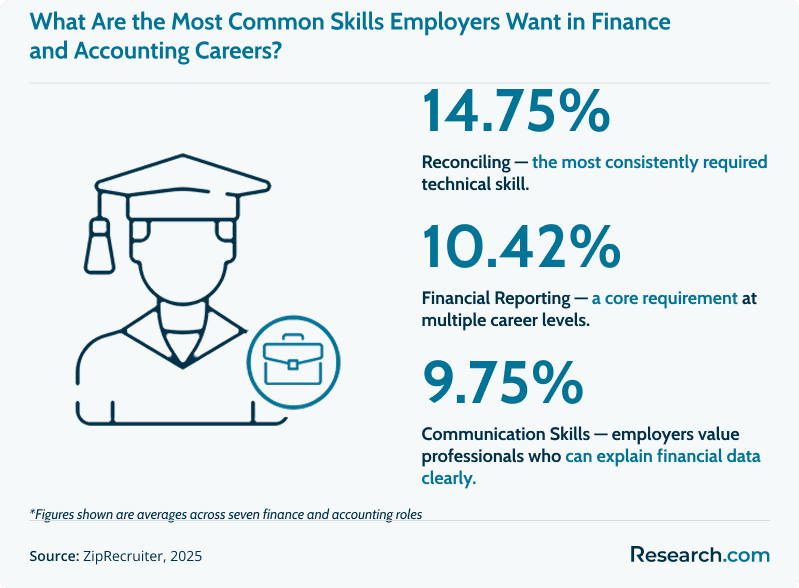
- Reconciling – Accuracy in balancing ledgers and ensuring financial records align remains the single most requested technical skill.
- Financial Reporting – Employers value professionals who can prepare, analyze, and present reports used in decision-making.
- Communication Skills – Clear explanation of financial data to clients, teams, and leadership is a consistent requirement.
- Analytical Thinking – Critical for evaluating risk, identifying trends, and interpreting data across roles.
- Attention to Detail – Errors in finance carry real consequences, so precision is essential.
- Technology Skills – Familiarity with accounting software, data tools, and automation systems is increasingly expected.
- Problem-Solving – Employers want professionals who can identify inefficiencies and recommend solutions.
The infographic below highlights how often these skills appear in job postings, underscoring their importance across multiple career paths in finance and accounting.
How important are certifications (CPA, CFA, etc.) for finance and accounting careers in 2027?
In today’s finance and accounting job market, certifications carry significant weight. While a degree is the entry ticket, credentials like the Certified Public Accountant (CPA), Chartered Financial Analyst (CFA), or Certified Management Accountant (CMA) often determine who moves into higher-paying, specialized roles.
These designations signal not only technical expertise but also a commitment to rigorous professional standards. Employers frequently view certifications as proof that candidates can handle complex responsibilities, from corporate financial reporting to investment analysis.
Similar to how workforce data explores are male nurses in demand to understand staffing needs in healthcare, certifications help employers identify qualified professionals in finance and accounting.
For example, CPAs remain in demand across auditing, tax, and compliance roles, while CFAs are highly sought after in investment banking and portfolio management. CMA holders, meanwhile, often excel in corporate strategy and management accounting. Though certifications take years of preparation, exams, and continuing education, the return is measurable in career advancement and salary potential. For professionals balancing study with work, pursuing an accelerated finance degree online can provide a streamlined path toward meeting prerequisites for these designations.
Ultimately, certifications are not mandatory for all finance and accounting careers, but they have become critical differentiators in a competitive field. In 2025, they often mark the line between mid-level positions and leadership tracks.
Which industries or sectors are driving demand for finance and accounting careers?
Finance and accounting professionals are needed across nearly every sector, but some industries drive demand more than others. These fields not only provide the greatest number of jobs but also influence hiring trends for related occupations. The demand reflects both regulatory requirements and the need for organizations to manage increasingly complex financial systems.
Just as healthcare professionals often research how much do Med Surg nurses make to understand career potential, aspiring finance and accounting professionals examine high-demand industries to gauge opportunities and earning potential in their field.
Professionals with expertise in compliance, reporting, and forecasting are especially valued, and roles often scale with industry size and profitability. Understanding where jobs are concentrated can also help job seekers anticipate career stability and accountant salary expectations.
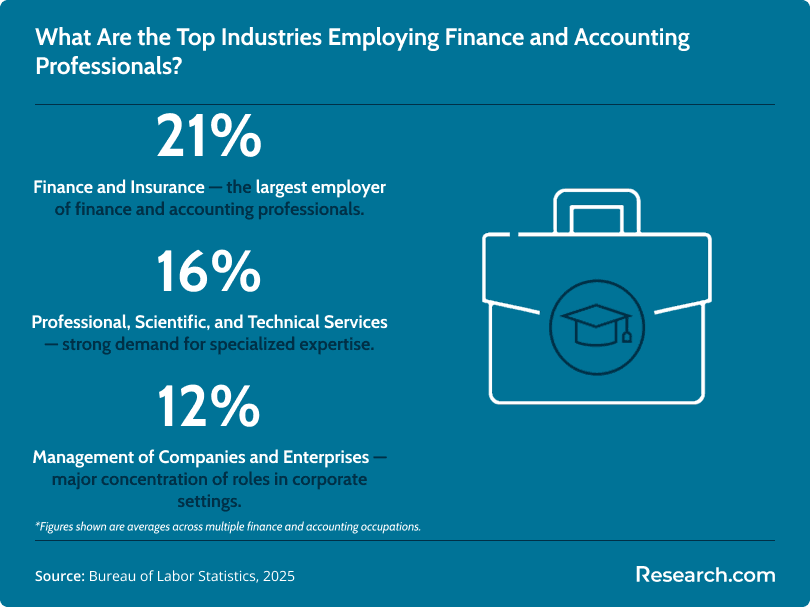
- Finance and Insurance: The largest employer of finance and accounting professionals, covering banks, investment firms, and insurance carriers.
- Professional, Scientific, and Technical Services: High demand for advisory, auditing, and consulting work in specialized industries.
- Management of Companies and Enterprises: Corporate headquarters concentrate roles in financial strategy, compliance, and analysis.
- Government: Federal, state, and local agencies consistently hire for tax, compliance, and budget-related roles.
- Healthcare and Social Assistance: Driven by billing, compliance, and the financial management of large institutions.
- Manufacturing: Ongoing need for cost estimation, inventory accounting, and financial oversight.
These industries highlight the range of opportunities available to finance and accounting workers. The infographic below illustrates which sectors dominate overall employment in the field and where career demand is most concentrated.
What are the challenges or downsides people should know before pursuing finance and accounting careers?
While finance and accounting careers can be rewarding, they also come with notable challenges that potential professionals should weigh carefully. These fields often demand high accuracy, adherence to strict regulations, and resilience under pressure. The work environment varies widely—ranging from structured office settings to client-facing roles—but in most cases, expectations for precision and accountability remain constant.
Similar to how students consider medical billing and coding certification cost before entering the healthcare field, aspiring finance and accounting professionals must assess the time, effort, and potential obstacles involved before committing to these careers.
- High stress levels: Tight deadlines during tax season, audits, or financial reporting periods can lead to long hours and significant pressure.
- Repetitive tasks: Entry-level roles may involve routine data entry or reconciliations, which can feel monotonous before advancing to more analytical positions.
- Heavy regulation: Professionals must keep up with constant changes in tax laws, compliance rules, and financial reporting standards.
- Technology disruption: Automation and AI tools are reshaping traditional responsibilities, potentially reducing demand for some routine roles.
- Certification demands: Many career paths require additional exams and licenses, which take time and money to pursue.
- Work-life balance: Some jobs, especially in corporate finance or investment, require extended hours that can affect personal time.
These challenges don’t make finance and accounting unattractive, but they highlight the realities behind the numbers. Success often depends on balancing technical expertise with adaptability and long-term career planning.
How has technology (automation, AI, data analytics) changed what employers expect from finance/accounting applicants?
Technology has dramatically reshaped the landscape of finance and accounting careers. Tasks that once required hours of manual effort—like reconciliations, invoice processing, or compliance checks—are now frequently automated. This shift means employers are less focused on hiring for basic data entry skills and more interested in professionals who can interpret, analyze, and apply financial insights generated by digital tools.
Employers increasingly expect applicants to be comfortable with data analytics platforms, enterprise resource planning (ERP) systems, and AI-driven forecasting tools. For instance, financial analysts are now valued not only for building models but also for leveraging predictive analytics to anticipate risks and opportunities. Similarly, accountants are expected to complement their traditional reporting expertise with skills in visualization tools such as Tableau or Power BI.
Another key expectation is adaptability. As automation handles more routine work, professionals must show they can pivot into advisory or strategic functions, guiding organizations in decision-making rather than just recording transactions. Those who combine technical literacy with problem-solving and communication skills will remain competitive, even as technology continues to evolve.
What education or degree levels are required or preferred for in-demand finance/accounting roles?
Education plays a central role in shaping finance and accounting career opportunities, with requirements varying widely depending on the role. Many entry-level positions, such as bookkeeping, accounting clerks, or financial clerks, often require only a high school diploma or some college coursework. However, even in these jobs, employers increasingly prefer applicants who have completed at least some formal training in business or accounting.
For professional roles like accountants, auditors, budget analysts, financial examiners, and insurance underwriters, a bachelor’s degree in accounting, finance, or a related field is the standard requirement. These programs provide grounding in economics, statistics, and financial reporting—skills that are essential for advancing in the field. A specialization or concentration can also make graduates more competitive.
More advanced positions, such as financial managers, actuaries, or senior analysts, often require not only a bachelor’s degree but also professional certifications or graduate-level training. A master’s in finance, accounting, or business administration (MBA) is frequently preferred for leadership roles, as it signals readiness for strategic and decision-making responsibilities.
In short, while entry points exist without a degree, higher levels of education remain the most direct path to long-term growth in finance and accounting.
How can an online MBA accelerate career growth in finance and accounting?
An online MBA offers finance and accounting professionals a pathway to enhance strategic management capabilities alongside core financial expertise. This advanced degree equips candidates with leadership acumen, a comprehensive understanding of global markets, and exposure to innovative problem-solving techniques that are essential for higher-level decision-making. Professionals can integrate academic insights with practical business challenges, ultimately positioning themselves for executive roles and improved salary trajectories. Explore the best online MBA programs affordable to understand how this qualification can unlock accelerated career growth without sacrificing work-life flexibility.
What is the job outlook for finance and accounting careers beyond 2027?
Looking ahead, finance and accounting careers show highly uneven growth patterns. Some occupations are expanding at rates far above the national average, while others face contraction due to automation and digital tools. For example, financial examiners (19% growth) and actuaries (22% growth) are among the fastest-growing roles, reflecting heightened regulatory oversight and increased demand for risk management expertise. Similarly, financial managers are expected to grow 16%, highlighting the need for leadership in corporate finance and investment planning.
On the other hand, support roles such as bookkeeping clerks (-5%) and financial clerks (-5%) are in decline as software and AI tools reduce manual tasks. Yet, these roles still generate thousands of annual job openings because of workforce turnover. This illustrates a broader trend: even in shrinking occupations, replacement needs sustain demand. For those pursuing a fastest accounting degree online, aligning education with high-growth areas like compliance, analytics, or financial advising may provide a stronger long-term advantage.
The chart below highlights occupations with the strongest job outlook. These figures underscore the divide between high-growth professional careers and clerical roles that are contracting.
Here's What Graduates Have To Say About Their Finance and Accounting Careers Program
- Lucienne: "Working in finance and accounting has been both challenging and rewarding. The online program I completed gave me real-world tools like advanced Excel modeling and auditing methods. What I value most is how these skills translated directly into client-facing projects, building my confidence and credibility at work from day one."
- Halden: "The flexibility of an online program prepared me to manage multiple priorities—something essential in finance and accounting roles. I not only learned technical accounting principles but also how to communicate financial insights to teams across departments. That combination of skills opened doors to career advancement much faster than I expected."
- Aislin: "Studying online while starting my career in finance was a game-changer. The program reinforced concepts like risk management and financial reporting, which I apply daily. Beyond the technical skills, the experience taught me discipline, independence, and adaptability—qualities that have been just as important in shaping my career path."
Key Findings
- Bookkeeping, accounting, and auditing clerks project 174,900 openings annually despite a 5% job decline.
- Financial managers earn the highest median salary at $166,050 in 2025.
- Compliance officers see around 33,300 job openings per year with 3% job growth.
- Actuaries hold the strongest outlook, with 22% growth and 2,400 openings annually.
- Financial clerks provide 102,200 openings per year despite a 5% employment drop.
- Property appraisers and assessors expect 6,300 openings yearly with stable 4% growth.
References:
- U.S. Bureau of Labor Statistics. Accountants and Auditors.
- U.S. Bureau of Labor Statistics. Actuaries.
- U.S. Bureau of Labor Statistics. Appraisers and Assessors of Real Estate.
- U.S. Bureau of Labor Statistics. Bookkeeping, Accounting, and Auditing Clerks.
- U.S. Bureau of Labor Statistics. Budget Analysts.
- U.S. Bureau of Labor Statistics. Compliance Officers.
- U.S. Bureau of Labor Statistics. Cost Estimators.
- U.S. Bureau of Labor Statistics. Financial Analysts.
- U.S. Bureau of Labor Statistics. Financial Examiners.
- U.S. Bureau of Labor Statistics. Financial Managers.
- U.S. Bureau of Labor Statistics. Financial Clerks.
- U.S. Bureau of Labor Statistics. Insurance Underwriters.
- U.S. Bureau of Labor Statistics. Loan Officers.
- U.S. Bureau of Labor Statistics. Management Analysts.
- U.S. Bureau of Labor Statistics. Personal Financial Advisors.
- U.S. Bureau of Labor Statistics. Securities, Commodities, and Financial Services Sales Agents.
- U.S. Bureau of Labor Statistics. Tax Examiners and Collectors, and Revenue Agents.
- ZipRecruiter. Accounting.
- ZipRecruiter. Accounting Officer.
- ZipRecruiter. Accounting Professional.
- ZipRecruiter. Accounting Supervisor.
- ZipRecruiter. Finance and Accounting Manager.
- ZipRecruiter. Finance Assistant.
- ZipRecruiter. Financial Accountant.
Other Things You Should Know About Finance and Accounting Careers
Essential skills for finance and accounting careers in 2027 include data analysis proficiency, understanding of AI tools, regulatory compliance knowledge, and advanced financial modeling. Mastery of these skills will be crucial due to the evolving technological landscape and increased data-driven decision-making in the industry.
In 2027, the most in-demand finance and accounting careers include Financial Analysts, Risk Managers, Compliance Specialists, and Data Analysts. These roles are crucial due to evolving financial regulations, the increasing importance of data-driven decision making, and growing global economic unpredictability.
Yes, many finance and accounting jobs have transitioned to remote or hybrid setups. Roles like financial analysts, compliance officers, and accountants can be done effectively online with secure software. However, positions requiring site visits—such as property appraisers—or extensive collaboration in investment banking may still require in-person work. Overall, technology has expanded remote opportunities for many professionals.


