
2027 Nurse Consultant Salary by State

Co-Founder and Chief Data Scientist
Nurses in the United States (US) have many profitable job opportunities available to them. For instance, registered nurses (RNs) in the country have a median annual wage of $93,600, which is much higher than that of all US occupations ($49,500). Moreover, employment for RNs is expected to grow by 5% from 2024 to 2034 [US Bureau of Labor Statistics (BLS), 2025].
Notably, to increase income potential and employability, a nursing professional—from RNs to advanced practice registered nurses (APRNs)—can also become a nurse consultant. These professionals help healthcare organizations and staff develop healthcare practices, improve patient outcomes, and ensure regulatory compliance. And what sets them apart from other nurses is their business knowledge and skills.
To help you learn more about the income potential of a nurse consultant, I created this extensive guide to the average annual salaries and the median annual wages of nursing professionals by US state.
Key Things You Should Know about Nurse Consultant Salary Potential
- Some of the highest-paying states for nurse consultants in the US based on average annual salaries include Nevada ($139,487), Washington ($131,278), and Georgia ($109,917) (Glassdoor & Salary.com, 2025).
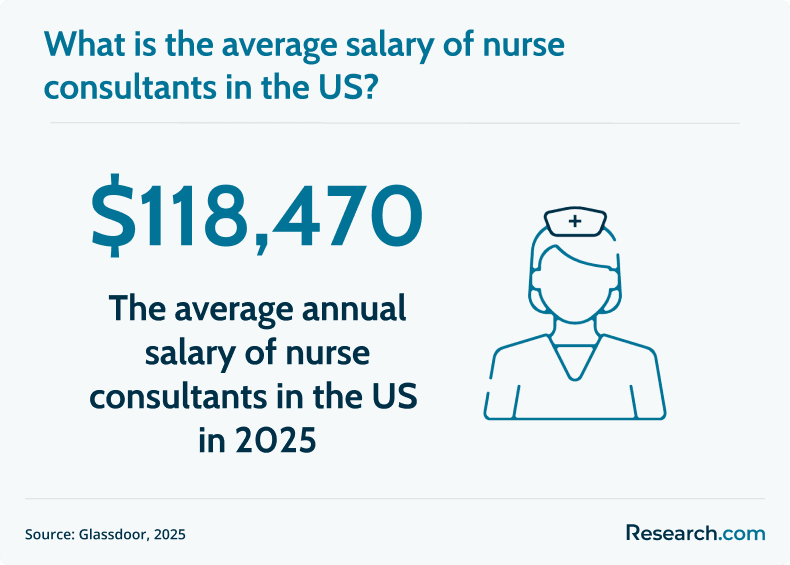
- In 2025, the average annual salary for a nurse consultant across the US was $118,470 (Glassdoor, 2025). This varies depending on factors like educational attainment, licensure, and location.
- In 2024, RNs in the US had a median annual wage of $93,600, while nurse practitioners had $129,210 (US BLS, 2025).
- What is the average salary of nurse consultants by US state? Salary by State
- What is the average salary of nurse consultants in the US? Average National Salary
- What is the starting salary for nurse consultants? Starting Salary
- Do nurse consultants with advanced degrees earn more? Do nurse consultants with advanced degrees earn more?
- What factors influence the average nurse consultant salary nationwide? Salary Drivers
- Which states pay nursing professionals the highest salaries? Highest-paying States
- How does cost of living impact the income of nursing professionals? How does cost of living impact the income of nursing professionals?
- Which states pay nursing professionals the lowest salaries? Lowest-paying States
- Which states employ the most nursing professionals in the US? Which states employ the most nursing professionals in the US?
What is the average salary of nurse consultants by US state?
The income potential for nurse consultants in the US varies, depending on several factors, including educational attainment, years of clinical experience, licensure, specialization, and location. Becoming a nurse consultant may also be one of the most feasible business ideas for nurses looking to improve or add to their incomes.
For instance, a nurse consultant licensed as an advanced practice registered nurse (APRN) can earn significantly more than a nurse consultant licensed as a registered nurse (RN).
Notably, the US state where a nurse consultant resides or works also influences salary. Explore the following average annual salaries of nurse consultants in the US by state, according to 2025 data from ZipRecruiter, Glassdoor, and GovSalaries:
- Utah: $87,583
- Tennessee: $83,289
- Indiana: $87,322
- North Carolina: $83,397
- North Dakota: $92,774
- Arizona: $85,516
- Idaho: $90,520
- South Dakota: $87,681
- Texas: $81,689
- Arkansas: $75,882
- Alabama: $83,176
- Alaska: $98,827
- California: $96,206
- Colorado: $101,868
- Connecticut: $87,296
- Delaware: $91,845
- Florida: $68,576
- Georgia: $109,917
- Hawaii: $95,342
- Illinois: $143,658
- Massachusetts: $100,220
- Nevada: $139,487
- New Jersey: $93,165
- New York: $100,396
- Pennsylvania: $91,987
- Washington: $131,278
- Rhode Island: $85,867
- South Carolina: $85,155
- Vermont: $97,571
- Virginia: $90,979
What is the average salary of nurse consultants in the US?
Nurse consultants play an important role in bridging clinical expertise with organizational and legal needs, and their salaries reflect their specialized skills. Those researching nursing care coordinator salary can gain context for how advanced nursing roles compare. According to Glassdoor (2025), the average annual salary for a nurse consultant in the US was $118,470. Meanwhile, Indeed (2025) reported that the average yearly base salary for these professionals in 2025 is $110,401.
This range demonstrates how compensation can vary based on data sources, employer type, and state location. Several factors, such as years of experience, advanced certifications, and industry demand, also influence earnings. Overall, nurse consultants enjoy competitive salaries and may surpass traditional nursing roles, particularly when transitioning into nurse executive leadership jobs.
What is the starting salary for nurse consultants?
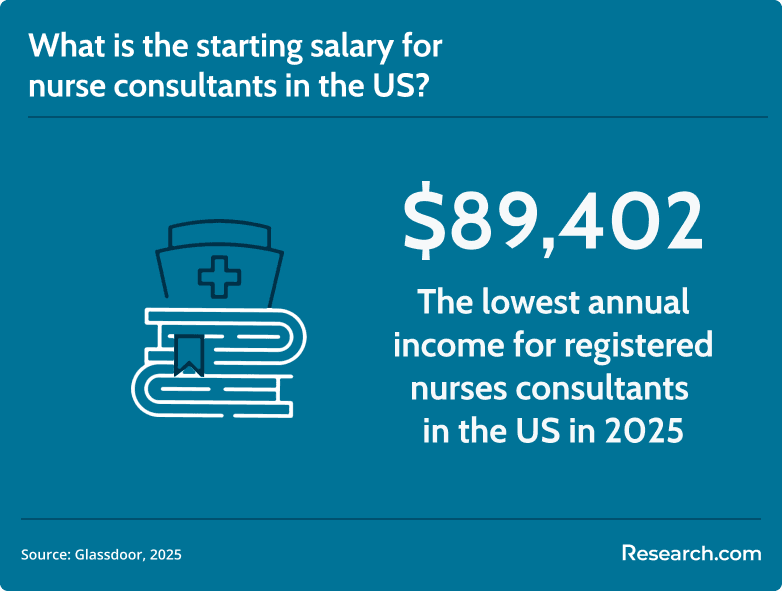
The starting salary of a nurse consultant depends on several factors, including licensure, educational attainment, and years of clinical experience. In 2025, the lowest annual income for registered nurse consultants in the US was $89,402 (Glassdoor, 2025). Understanding the DNP mandate can help aspiring nurse consultants plan their education and career path, as advanced degrees may influence starting salaries and eligibility for certain roles.
Notably, since a registered nurse (RN) and an advanced practice registered nurse (APRN) can become a nurse consultant, aspirants may explore the income potential of these nursing professionals to better understand their possible starting salaries.
In May 2024, the lowest 10% of RNs in the US in terms of wages earned below $66,030. Meanwhile, the median annual wage of RNs across the country was $93,600 in the same period (US BLS, 2025).
Moreover, the lowest 10% of APRNs in the US, such as nurse-anesthetists, nurse-midwives, and nurse practitioners, earned below $98,520 in May 2024 (US BLS, 2025). In the same period, nurse-anesthetists had a median annual wage of $223,210; nurse practitioners had $129,210; and nurse-midwives had $128,790 (US BLS, 2025).
Do nurse consultants with advanced degrees earn more?
A nurse consultant with an advanced degree may earn higher due to specialized education, training, and professional experience.
In general, professionals with higher-level academic credentials may earn more. For instance, in 2022, 25- to 34-year-old Americans who worked full time and had earned master’s or more advanced degrees had median wages ($80,200) that were 20% higher than those with only bachelor’s degrees ($66,600) (US Census Bureau, 2023).
Holding a master’s degree in nursing or healthcare administration often positions professionals for leadership roles, complex case evaluations, or work in consulting firms that demand advanced knowledge. Moreover, a Doctor of Nursing Practice (DNP) can significantly increase salary potential, particularly in states with high demand for healthcare consultants.
Employers value advanced degrees because they signal deeper clinical insight, strong analytical skills, and the ability to guide policy or organizational decisions. In turn, nurse consultants with graduate-level education often command salaries well above the national average. Exploring the best jobs for nurses with an MSN and MBA can further highlight advanced career pathways that combine clinical expertise with business leadership.
What factors influence the average nurse consultant salary nationwide?
Several individual and regional factors influence the salaries of nurse consultants in the US. Key factors include the following:
- Experience Level: Nurse consultants with years of clinical or consulting experience usually receive higher incomes due to their advanced expertise and proven ability to manage complex cases.
- Geographic Location: Salaries often reflect the cost of living and demand for healthcare professionals in each state.
- Education and Certifications: Advanced degrees and specialized certifications enhance credibility and opportunities for senior roles. They also lead to higher pay compared to the salaries of professionals with only a basic nursing qualification, highlighting the benefits of getting a DNP for nurse practitioners.
Which states pay nursing professionals the highest salaries?
Income trends for nursing professionals in the US vary by role and state. Certain locations consistently rank at the top for median annual wages. For registered nurses (RNs), California leads with a median annual salary of $140,330 in May 2024. The Golden State is followed by Hawaii at $136,320, Oregon at $123,990, Washington at $112,180, and Alaska at $110,690 (US BLS, 2025). Professionals pursuing an MSW dual degree may also find opportunities in states with higher healthcare salaries, as interdisciplinary roles increasingly value combined expertise.
Nurse practitioners (NPs) also see the highest median annual wage in California, with $166,610 in the same period. NPs in New Jersey had $149,620, while those in Alaska had $145,450. Moreover, NPs in New York had a median annual wage of $145,390, and those in Oregon had $144,600 (US BLS, 2025).
These figures show that coastal states and regions with higher costs of living tend to offer the most competitive salaries. They reflect both demand for healthcare expertise and economic conditions, similar to trends seen in family nurse practitioner salary by state comparisons.
The chart below provides a visualization of the highest-paying states for registered nurses (RNs) in the US in May 2024 (US BLS, 2025).
How does cost of living impact the income of nursing professionals?
The cost of living plays a significant role in shaping the real income and financial well-being of nursing professionals across the US. Its impact can be seen in several ways, such as the following:
- Salary Adjustments: States with higher living costs often offer higher nursing salaries to offset expenses, such as housing, transportation, and healthcare. Understanding how much does a CRNA make can help nurses compare compensation across regions and evaluate the true value of higher salaries.
- Reduced Purchasing Power: Even with higher wages, nurses in expensive states may find their take-home pay stretched thin due to higher everyday costs.
- Relocation Decisions: Many nurses weigh salary against living expenses. Sometimes, they choose lower-paying states with affordable living costs to achieve better financial stability and overall quality of life.
Which states pay nursing professionals the lowest salaries?
Nursing professionals, including nurse consultants, in some US states earn significantly less compared to other states and national levels. Salaries may be influenced by local economic and healthcare conditions. For instance, the states with the lowest median annual wages for registered nurses (RNs) in May 2024 include the following (US BLS, 2025):
- Puerto Rico: $35,280
- South Dakota: $62,920
- Alabama: $63,090
- Mississippi: $63,330
- Arkansas: $64,130
- Iowa: $65,000
- Tennessee: $65,800
- Kansas: $66,460
- Missouri: $71,460
- West Virginia: $74,160
- Nebraska: $74,990
- South Carolina: $75,610
In comparison, the following are the highest-paying US states for RNs in the same period, as mentioned in the previous section (US BLS, 2025):
- California: $140,330
- Hawaii: $136,320
- Oregon: $123,990
- Washington: $112,180
- Alaska: $110,690
Moreover, the following three factors may contribute to lower salaries for RNs:
- Lower Cost of Living
- Limited Healthcare Funding
- Reduced Local Demand Due to Smaller Populations
The chart below provides a visualization of the lowest-paying states for RNs in the US in May 2024 in terms of median annual wages (US BLS, 2025).
Which states employ the most nursing professionals in the US?
Despite the rewards, not all nurses aim to become a nurse consultant for many reasons, including the mental and physical demands of the profession. Credible sources of labor data for nurse consultants in the US are limited.
Notably, as mentioned in the previous sections, any skilled nursing professional—from a licensed registered nurse (RN) to an advanced practice registered nurse (APRN)—can become a nurse consultant. Thus, you can use labor data for RNs and APRNs as your benchmarks for your own nursing career journey.
For instance, in 2024, the following US states employed the largest shares of RNs across the country (US BLS, 2025):
- California: 326,720
- Texas: 261,050
- Florida: 218,100
- New York: 204,120
- Pennsylvania: 146,840
Additionally, the following states employed the largest shares of nurse practitioners in the US in the same year (US BLS, 2025):
- Florida: 24,690
- Texas: 21,690
- California: 20,980
- New York: 20,430
- Ohio: 14,550
Moreover, employment for RNs in the US is expected to increase by 5% from 2024 to 2034, which is faster than the average job outlook for all occupations across the country. The figure also translates to an average of around 189,100 annual job openings over the decade (US BLS, 2025).
Employment for advanced practice registered nurses (APRNs), such as nurse-anesthetists, nurse-midwives, and nurse practitioners, is expected to grow by 35% during the same period. The figure is equivalent to an average of about 32,700 yearly job openings over the decade (US BLS, 2025).
The chart below provides a visualization of the employment levels of RNs in the US states with the largest shares of these professionals (US BLS, 2025).
Key Findings
- A nurse consultant licensed as an advanced practice registered nurse (APRN) can earn significantly higher than a nurse consultant licensed as a registered nurse (RN).
- California is the highest-paying US state for RNs, with a median annual wage of $140,330 in May 2024 (US BLS, 2025).
- In May 2024, the lowest-paying US state for RNs in terms of median annual wage was Puerto Rico, with $35,280 (US BLS, 2025).
- According to Glassdoor (2025), the average annual salary for a nurse consultant in the US was $118,470. Meanwhile, Indeed (2025) reported that the average yearly base salary for these professionals in 2025 is $110,401.
- In 2025, the lowest annual income for registered nurse consultants in the US was $89,402 (Glassdoor, 2025).
References:
- CGFNS International, Inc. (n.d.). Certified Global Nurse Consultant. https://cgnc.cgfns.org/?ref=icnweb
- Glassdoor. (2025). How much does a Nurse Consultant make in Georgia? https://www.glassdoor.com/Salaries/georgia-nurse-consultant-salary-SRCH_IL.0,7_IS3426_KO8,24.htm
- Glassdoor. (2025). How much does a Nurse Consultant make in Washington State? https://www.glassdoor.com/Salaries/washington-state-nurse-consultant-salary-SRCH_IL.0,16_IS3020_KO17,33.htm
- Glassdoor. (2025, April 10). Nurse Consultant Salaries. https://www.glassdoor.com/Salaries/nurse-consultant-salary-SRCH_KO0,16.htm
- Glassdoor. (2025, April 10). How much does a Registered Nurse Consultant make? https://www.glassdoor.com/Salaries/registered-nurse-consultant-salary-SRCH_KO0,27.htm
- GovSalaries. (n.d.). Nurse Consultant Salary in Colorado. https://govsalaries.com/salaries/nurse-consultant-salary/colorado
- Indeed. (2025, September 08). Nurse consultant salary in United States. https://www.indeed.com/career/nurse-consultant/salaries
- National Nurses in Business Association. (n.d.). Nurse Consultant. https://nursesbusiness.com/faq/nurse-consultant
- Salary.com. (2025). How Much Does a Nurse Consultant Make in Illinois? (2025 Salary Guide). salary.com/research/salary/posting/nurse-consultant-salary/il
- Salary.com. (2025). How Much Does a Nurse Consultant Make in Nevada? (2025 Salary Guide). salary.com/research/salary/posting/nurse-consultant-salary/nv
- US Bureau of Labor Statistics. (2025, August 28). Registered Nurses. Occupational Outlook Handbook. https://www.bls.gov/ooh/healthcare/registered-nurses.htm
- US Bureau of Labor Statistics. (2025, August 28). Nurse Anesthetists, Nurse Midwives, and Nurse Practitioners. Occupational Outlook Handbook. https://www.bls.gov/ooh/healthcare/nurse-anesthetists-nurse-midwives-and-nurse-practitioners.htm
- US Bureau of Labor Statistics. (2025). May 2024 OEWS Profiles. Occupational Employment and Wage Statistics (OEWS) Profiles. https://data.bls.gov/oesprofile
- US Census Bureau. (2023, October). Current Population Survey (CPS), Annual Social and Economic Supplement, 2006 through 2023. US Department of Commerce. https://nces.ed.gov/programs/digest/d23/tables/dt23_502.30.asp
- ZipRecruiter. (2025). Clinical Nurse Consultant Salary in Idaho. https://www.ziprecruiter.com/Salaries/Clinical-Nurse-Consultant-Salary--in-Idaho
- ZipRecruiter. (2025). Clinical Nurse Consultant Salary in Utah. https://www.ziprecruiter.com/Salaries/Clinical-Nurse-Consultant-Salary--in-Utah
- ZipRecruiter. (2025). Legal Nurse Consultant Salary in North Dakota. https://www.ziprecruiter.com/Salaries/Legal-Nurse-Consultant-Salary--in-North-Dakota
- ZipRecruiter. (2025). Legal Nurse Consultant Salary in South Dakota. https://www.ziprecruiter.com/Salaries/Legal-Nurse-Consultant-Salary--in-South-Dakota
- ZipRecruiter. (2025). Legal Nurse Consultant Salary in Texas. https://www.ziprecruiter.com/Salaries/Legal-Nurse-Consultant-Salary--in-Texas
- ZipRecruiter. (2025). Nurse Consultant Salary in Alabama. https://www.ziprecruiter.com/Salaries/Nurse-Consultant-Salary--in-Alabama
- ZipRecruiter. (2025). Nurse Consultant Salary in Alaska. https://www.ziprecruiter.com/Salaries/Nursing-Consultant-Salary--in-Alaska
- ZipRecruiter. (2025). Nurse Consultant Salary in Arizona. https://www.ziprecruiter.com/Salaries/Nurse-Consultant-Salary--in-Arizona
- ZipRecruiter. (2025). Nurse Consultant Salary in Arkansas. https://www.ziprecruiter.com/Salaries/Regional-Nurse-Consultant-Salary--in-Arkansas
- ZipRecruiter. (2025). Nurse Consultant Salary in California. https://www.ziprecruiter.com/Salaries/Clinical-Nurse-Consultant-Salary
- ZipRecruiter. (2025). Nurse Consultant Salary in Connecticut. https://www.ziprecruiter.com/Salaries/Nurse-Consultant-Salary--in-Connecticut
- ZipRecruiter. (2025). Nurse Consultant Salary in Delaware. https://www.ziprecruiter.com/Salaries/Nurse-Consultant-Salary--in-Delaware
- ZipRecruiter. (2025). Nurse Consultant Salary in Florida. https://www.ziprecruiter.com/Salaries/Nurse-Consultant-Salary--in-Florida
- ZipRecruiter. (2025). Nursing Consultant Salary in Massachusetts. https://www.ziprecruiter.com/Salaries/Nursing-Consultant-Salary--in-Massachusetts
- ZipRecruiter. (2025). Nurse Consultant Salary in New Jersey. https://www.ziprecruiter.com/Salaries/Nurse-Consultant-Salary--in-New-Jersey
- ZipRecruiter. (2025). Nurse Consultant Salary in New York. https://www.ziprecruiter.com/Salaries/Nurse-Consultant-Salary--in-New-York
- ZipRecruiter. (2025). Nurse Consultant Salary in North Carolina. https://www.ziprecruiter.com/Salaries/Nurse-Consultant-Salary--in-North-Carolina
- ZipRecruiter. (2025). Nurse Consultant Salary in Pennsylvania. https://www.ziprecruiter.com/Salaries/Nurse-Consultant-Salary--in-Pennsylvania
- ZipRecruiter. (2025). Legal Nurse Consultant Salary in Rhode Island. https://www.ziprecruiter.com/Salaries/Legal-Nurse-Consultant-Salary--in-Rhode-Island
- ZipRecruiter. (2025). Nurse Consultant Salary in Tennessee. https://www.ziprecruiter.com/Salaries/Nurse-Consultant-Salary--in-Tennessee
- ZipRecruiter. (2025). Nurse Consultant Salary in South Carolina. https://www.ziprecruiter.com/Salaries/Nurse-Consultant-Salary--in-South-Carolina
- ZipRecruiter. (2025). Nurse Consultant Salary in Vermont. https://www.ziprecruiter.com/Salaries/Nurse-Consultant-Salary--in-Vermont
- ZipRecruiter. (2025). Nurse Consultant Salary in Virginia. https://www.ziprecruiter.com/Salaries/Nurse-Consultant-Salary--in-Virginia
- ZipRecruiter. (2025). Regional Nurse Consultant Salary in Hawaii. https://www.ziprecruiter.com/Salaries/Regional-Nurse-Consultant-Salary--in-Hawaii
- ZipRecruiter. (2025). Regional Nurse Consultant Salary in Indiana. https://www.ziprecruiter.com/Salaries/Regional-Nurse-Consultant-Salary--in-Indiana
Other Things You Should Know About Nurse Consultant Salary Potential
In California, a nurse consultant's salary in 2027 typically averages around $120,000 annually. This reflects the state's demand for healthcare expertise and its higher cost of living, which influences wage offerings for specialized roles.
Nurse consultant salaries in 2027 vary due to factors such as cost of living, state-specific demand for nursing consultants, and regulatory requirements. States with higher living costs and stronger healthcare industries often offer higher salaries to attract qualified nurse consultants.


