
2027 MSW Dual-Degree Programs: Career Paths, Program Cost & Salary

Co-Founder and Chief Data Scientist
In 2023, there were over 58,453 degrees awarded in social work in the U.S. (Data USA, 2024). As the complexity of modern social issues grows, so does the demand for highly skilled professionals who can address them through both clinical and administrative roles.
For aspiring social workers seeking to maximize their impact and career potential, a Master of Social Work (MSW) dual-degree program offers a comprehensive pathway that combines the core competencies of social work with a complementary field. This specialized training allows graduates to navigate interconnected sectors and lead change from multiple perspectives.
In this article, I will explain the most popular pairings for MSW dual degree programs, delve into the program costs and available financial aid options, and outline the typical admissions requirements.
What are the benefits of pursuing MSW Dual Degree Programs?
- MSW dual-degree programs in fields like law, public health, business, and public administration are popular pairings that offer an interdisciplinary skill set for social work professionals.
- The average program cost for an MSW dual-degree varies significantly by program, with total costs for popular pairings like the MBA exceeding $50,000 and annual tuition for JD programs nearing $30,000.
- An MSW dual degree provides a strong foundation for a higher starting salary, with graduates of pairings like the JD and MBA often earning over $94,000 and $100,000 respectively.
- An MSW dual degree significantly increases long-term earning potential, with senior-level roles for MSW/MPH graduates making between $141,000 and $183,000 annually.
- What are the most popular pairings for MSW dual-degree programs? Dual Degree Pairings
- What is the average program cost for an MSW dual-degree in 2027? Program Costs
- What financial aid options are available to help offset the cost of MSW dual-degree programs? Financial Aid
- What is the typical length of a full-time MSW dual-degree program? What is the typical length of a full-time MSW dual-degree program?
- What are the typical admissions requirements for MSW dual-degree programs? What are the typical admissions requirements for MSW dual-degree programs?
- What should you look for when choosing an MSW dual-degree program? What should you look for when choosing an MSW dual-degree program?
- What new dual-degree pairings are being developed to meet emerging trends and future career opportunities? What new dual-degree pairings are being developed to meet emerging trends and future career opportunities?
- Are there affordable online MSW dual degree programs available? Are there affordable online MSW dual degree programs available?
- What are the most promising career paths for graduates of MSW dual-degree programs? Career Paths
- What is the long-term earning potential for someone with an MSW dual degree? Salary Potential
- What is the job market for graduates of an MSW dual degree? Job Outlook
What are the most popular pairings for MSW dual-degree programs?
A dual-degree program combines an MSW with a complementary field, allowing graduates to develop interdisciplinary skills that address complex social issues from multiple perspectives. This approach prepares professionals to influence policy, manage large organizations, and lead public health initiatives.
The following pairings are among the most sought-after due to their complementary skill sets:
- MSW and Juris Doctor (JD): This pairing integrates social work theory with legal expertise, preparing graduates for careers in legal advocacy and civil rights.
- MSW and Master of Public Health (MPH): Designed for those who want to address health disparities, this program combines individual social work intervention with large-scale public health strategies.
- MSW and Master of Business Administration (MBA): This dual degree merges social service leadership with business acumen, providing the skills necessary to manage nonprofit organizations or lead corporate social responsibility initiatives.
- MSW and Master of Public Administration (MPA): By pairing clinical practice with administrative skills, this program prepares graduates to influence public policy and manage government and social service agencies.
- MSW and Master of Divinity (M.Div.): This pairing integrates social work ethics with spiritual and pastoral care, preparing graduates for roles in faith-based social services and community ministry.
Understanding which states offer reciprocity with LPC licensure is also important for dual-degree graduates who plan to practice counseling, as it impacts where they can work legally and expand their interdisciplinary career opportunities.
By combining deep-rooted social work values with a specialized secondary field, these programs create a powerful credential that positions graduates for impactful leadership roles.
What is the average program cost for an MSW dual-degree in 2027?
The cost of a dual-degree program in 2027 can vary significantly depending on whether you attend a public or private university and your residency status. While a standalone MSW degree is a significant investment, the combined tuition for a dual degree is often higher due to the cost of the complementary master's program. For example, law or business schools typically have higher tuition rates than social work schools.
Similarly, students exploring dual concentration NP MSN programs online often consider program cost alongside the potential return on investment, balancing tuition with career advancement and expanded clinical opportunities.
Below are the average program costs for the most popular degrees paired with an MSW:
- Juris Doctor: These programs are among the most expensive, with annual tuition rates often close to $30,000.
- Master of Public Health: The total cost can range from $30,000 to $80,000 for two to three years of study.
- Master of Business Administration: The total cost can exceed $50,000, with some online programs, including accelerated online sustainability MBA programs, costing between $20,000 and $80,000 in total tuition.
- Master of Public Administration: The total program cost can be over $50,000, with some schools charging a per-credit rate of around $635.
- Master of Divinity: These programs can also be expensive, with some schools charging annual tuition upwards of $37,500.
The final price of a dual-degree program is heavily influenced by factors such as in-state versus out-of-state tuition and whether you are attending a public or private institution.
What are the potential hidden costs, such as program fees and living expenses, for an MSW dual degree?
Beyond tuition, students in a dual-degree program must also plan for various other expenses that can quickly add up. These are often overlooked but are essential for a complete budget.
Here are some additional costs that students should be prepared for:
- Program and Administrative Fees: Universities charge a variety of fees beyond tuition for technology, student activities, and even specific field placements.
- Books and Supplies: The cost of textbooks and other required materials can be substantial, particularly for programs covering two distinct fields.
- Cost of Living: This includes rent, groceries, transportation, and personal expenses. Housing and food alone can average from $1,500 to $2,500 per month, depending on the program's location.
- Health Insurance: Most universities require students to have health insurance, and a university-sponsored plan can cost thousands of dollars annually.
While considering these costs, students may also wonder are MSN programs being phased out, as such trends could impact the value, structure, and long-term planning of advanced nursing education alongside dual-degree programs.
A clear understanding of these potential expenses is crucial. Students should always consult the detailed cost of attendance breakdown from their prospective university to get a full financial picture.
To better understand the various costs associated with higher education, the table below provides a detailed breakdown of a full-time undergraduate student's total budget, including tuition, fees, and other expenses for different types of institutions.
What financial aid options are available to help offset the cost of MSW dual-degree programs?
Graduate-level education represents a significant financial investment, but students have multiple options to help offset the cost of MSW dual-degree programs. In addition to personal savings and family contributions, prospective students pursuing a masters in psychology accreditation can explore various forms of financial aid to make their education more affordable.
The following are some of the most common financial aid options for students in these programs:
- Federal Loans: This is one of the most common ways to fund a graduate degree. Students can apply for federal loans by completing the Free Application for Federal Student Aid (FAFSA). These loans, such as the Direct Unsubsidized Loan and the Grad PLUS Loan, are provided by the government and often have more favorable terms than private loans.
- Federal Work-Study: This program provides part-time jobs for students with financial needs, allowing them to earn money to help pay for educational expenses. For dual-degree students, a work-study award may need to be earned through a field placement or a campus-based job, depending on the program's requirements.
- Institutional Grants: Many universities offer their own grants, which are a form of gift aid that does not need to be repaid. These grants can be based on academic merit, financial need, or a student's commitment to the school's mission.
- Loan Forgiveness Programs: Although not a form of direct financial aid, loan forgiveness can be a significant benefit. Programs like the Public Service Loan Forgiveness (PSLF) program can erase the remaining balance on federal direct loans for individuals working in a qualifying public service job after making 120 qualifying monthly payments.
Exploring these financial aid avenues is a critical step in planning for graduate school. Many programs automatically consider students for institutional aid upon admission, but it's essential to complete the FAFSA and apply for other specific opportunities to maximize your funding potential.
What scholarships or fellowships are available for students in MSW dual-degree programs?
Securing scholarships and fellowships is one of the most effective ways for students to reduce the financial burden of a dual degree. These awards are often highly competitive and can be based on academic merit, a commitment to a specific area of social work, or a demonstration of financial need.
Here are some of the most prominent scholarships and fellowships available:
- University of Chicago JD/AM Program Scholarship: This scholarship provides a limited number of full-tuition awards for students in the university's dual degree in law and social work.
- National Association of Social Workers (NASW) Foundation: The NASW Foundation offers scholarships and fellowships for social work students who are committed to working in areas like mental health and substance abuse.
- National Health Service Corps (NHSC) Scholarship Program: This program provides full tuition, eligible fees, and a monthly stipend of approximately $1,631 in exchange for a service commitment in an underserved community after graduation.
- University of Maryland Child Welfare Fellowship: This program provides a stipend of $7,200 per semester for students who commit to working in public child welfare services after graduation.
- University of Michigan Geriatric Scholarship Program: This program provides a scholarship of $6,000 per term for students who demonstrate a commitment to serving older adults.
These awards are a crucial step for making a dual-degree education financially feasible. Students should also check with their state's social work licensing board for a list of available grant programs and scholarships.
What is the typical length of a full-time MSW dual-degree program?
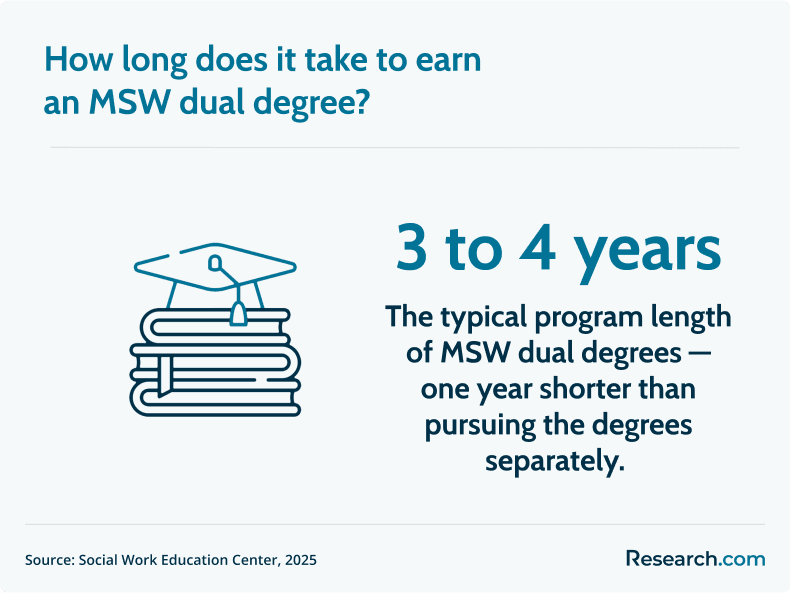
Pursuing a dual-degree program offers an accelerated path to earning two credentials, allowing students to save significant time compared to completing each degree separately. While a standard master's degree can take up to two years, a full-time dual-degree program condenses the coursework into a more efficient timeline, though the exact length varies by pairing.
Below are the typical lengths for the most popular dual-degree options:
- Juris Doctor: Students can typically complete an MSW/JD in four years, which is one year less than it would take to earn both degrees independently.
- Master of Public Health: These programs generally take three to three and a half years to complete, saving students a year or more compared to pursuing the degrees one after the other.
- Master of Business Administration: The program length for a full-time program is usually three years, but students with a Bachelor of Social Work (BSW) can sometimes finish in as few as two years. Some programs, like a fast track social sciences degree online, may further shorten the completion time.
- Master of Public Administration: The typical duration for an MSW/MPA dual degree is three years, but some programs may extend to four or five years depending on the student's course-load.
- Master of Divinity: This dual degree is generally designed to be completed in four years of full-time study, which is a year shorter than earning both degrees on their own.
The condensed timeline of a dual-degree program is made possible by allowing students to apply credits from one program toward the other, effectively reducing the total number of required credit hours. This efficiency makes it a strategic choice for professionals seeking to advance their careers quickly.
What online or part-time options for an MSW dual degree are available?
While most dual degrees are designed for full-time on-campus study, an increasing number of universities are offering online and part-time options to accommodate working professionals and students with other commitments. These formats provide flexibility by allowing students to complete coursework at their own pace without relocating.
Here are some alternative pairings that offer substantial online and part-time options:
- Master of Education: Some programs, such as an MSW/M.Ed. in Human Sexuality Studies, are available in a fully online or hybrid format, with classes scheduled for evenings and weekends to accommodate working adults.
- Master of Science in Criminology: Some universities offer the MSW/MS in Criminology, which can be completed part-time. This degree prepares graduates for policy and administrative roles in criminal justice and crime prevention agencies.
- Master of Urban Planning: Offered at a handful of universities, this dual degree can be completed with a part-time option, preparing graduates to work in city and regional planning.
- Master of Science in Gerontology: For students interested in working with the elderly, an MSW/MS in Gerontology is available as an online dual degree option at some schools, preparing graduates for leadership roles in aging-related services.
These flexible options allow students to earn a valuable dual degree without sacrificing their professional careers or personal commitments. It is crucial to confirm the specific format and requirements with each university, as they can vary widely.
What are the typical admissions requirements for MSW dual-degree programs?
Applying for a dual-degree program means meeting the admissions standards of two separate schools. An applicant for an MSW/JD, for instance, must be accepted into both the school of social work and the law school. While specific requirements vary by institution, most programs seek a strong academic background, relevant experience, and clear career goals.
The following are the most common application requirements for dual-degree candidates:
- Academic Transcripts and GPA: Applicants must submit official transcripts from all post-secondary institutions. Most programs require a minimum undergraduate GPA of 3.0, though some may accept a lower GPA with a strong professional background.
- Standardized Test Scores: While many social work programs no longer require the GRE, a student applying for a dual degree may still need to submit a standardized test score for the partner school. An applicant to a JD program, for example, will likely need to submit an LSAT score.
- Letters of Recommendation: Programs typically require two to three letters of recommendation from individuals who can speak to the applicant's academic and professional abilities, such as professors or work supervisors.
- Personal Statements and Essays: Most applications require a personal statement or essay. This is an opportunity for dual-degree applicants to explain their interest in both fields and how the degrees will complement their career aspirations.
- Relevant Experience: While not always mandatory, programs prefer applicants with some relevant work or volunteer experience in social work, the partner field, or a related area. This experience demonstrates a student’s commitment and passion for their chosen career path.
For students exploring accessible options, some universities that offer an affordable open admission online college may have different requirements, but they also often focus on a student’s academic potential and professional experience rather than just test scores.
Researching the specific requirements for each program is crucial, as deadlines and prerequisites can differ significantly.
What should you look for when choosing an MSW dual-degree program?
Choosing the right MSW dual-degree program requires careful consideration of several factors beyond just academics. It is an investment in both your education and your future career, so it is essential to find a program that aligns with your professional aspirations and personal needs.
One of the most important factors is accreditation. For a social work degree to be valid for licensure in most states, it must be accredited by the Council on Social Work Education (CSWE).
When selecting a dual-degree program, you must ensure that both the social work program and the partner school (e.g., law, business, or public health) hold the necessary accreditations from their respective governing bodies. This ensures that you are receiving a high-quality education and will be eligible to pursue licensure in both fields.
You should also look at the curriculum and specializations offered. A dual-degree program's curriculum should be integrated, allowing you to build on the knowledge from both fields.
Some programs may offer concentrations that can further specialize your training, such as child welfare, health policy, or community development. These specializations can be a key factor in choosing a program that prepares you for your desired career path.
Finally, consider the program’s reputation and career services. A school’s reputation and network can be invaluable for job placement after graduation. Look into the program's job placement rates, the types of jobs graduates secure, and the strength of the alumni network.
Additionally, investigate the career services available to dual-degree students. They can offer tailored support for your unique career goals, which may involve working in a non-traditional role that combines both disciplines.
What new dual-degree pairings are being developed to meet emerging trends and future career opportunities?
As social work evolves to address an increasingly complex world, new dual-degree pairings are emerging to prepare professionals for future career opportunities. These innovative programs reflect a growing demand for social workers with highly specialized skills in fields such as data analysis, urban planning, and human sexuality.
By combining the core competencies of social work with these new disciplines, graduates can take on leadership roles in niche areas and drive change from a macro perspective.
Several new pairings are being developed to meet these emerging trends. For example, some universities now offer an MSW and a Master of Science in Gerontology. This pairing is designed to meet the growing needs of the elderly population by training social workers in aging-related services and policy.
Additionally, some schools are developing dual degrees in social work and urban planning, preparing graduates to work on issues of housing, community development, and equitable resource allocation. Other new programs include an MSW with a Master of Science in Disaster Resilience Leadership, a pairing that prepares professionals to help communities prepare for and recover from natural and man-made disasters.
These new programs are a direct response to the evolving challenges faced by modern society. They equip graduates with the interdisciplinary knowledge needed to tackle complex social issues, making them highly valuable in the job market and positioning them as leaders in their respective fields.
Are there affordable online MSW dual degree programs available?
Rising tuition costs and the need for flexible learning environments have driven many universities to offer affordable online dual degree options in social work. Many of these programs deliver comprehensive curricula that integrate core social work competencies with specialized fields via digital platforms. Leveraging online MSW programs can provide students with significant savings on ancillary costs while maintaining academic rigor and accreditation standards. Applicants should assess program curriculum, technological support, and digital learning infrastructure to ensure it aligns with industry requirements and personal career objectives.
What are the most promising career paths for graduates of MSW dual-degree programs?
Graduates of MSW dual degree programs are well-positioned for leadership roles across various sectors. Their unique combination of social work expertise and specialized knowledge in a complementary field allows them to address complex social issues at both the individual and systemic levels. The most promising roles often involve a blend of direct practice and administrative or policy-level responsibilities.
The most promising career paths for dual-degree holders include:
- Legal Advocate (MSW/JD): This career focuses on the intersection of law and social justice, preparing graduates for roles as public defenders, family law attorneys, or policy analysts.
- Medical and Health Services Manager (MSW/MBA): This path prepares graduates for leadership and administrative roles within healthcare organizations, focusing on improving efficiency while ensuring patient-centered care.
- Health Policy Analyst (MSW/MPH): This career combines clinical practice with public health expertise to develop and implement programs that address social determinants of health and community wellness.
- Nonprofit Executive Director (MSW/MPA): This role is for those who want to lead and manage nonprofit organizations, using administrative and social work skills to develop programs and oversee staff.
- Chaplain and Pastoral Counselor (MSW/M.Div.): This role integrates spiritual and pastoral care with social work ethics, preparing graduates for positions in faith-based social services and community ministry.
These diverse roles are in high demand as social issues become more complex and organizations seek professionals with interdisciplinary skill sets. Dual-degree holders are uniquely qualified to lead this change and fill a critical gap in the workforce.
What types of high-paying social work jobs are available to MSW dual-degree holders?
Holding a dual degree in social work can lead to a variety of high-paying jobs, as the combined skills in social work and a complementary field create a valuable, interdisciplinary professional. The following are some of the most lucrative career paths and alternative jobs for MSW graduates available to graduates with a dual degree.
Here are some of the high-paying jobs for dual-degree holders:
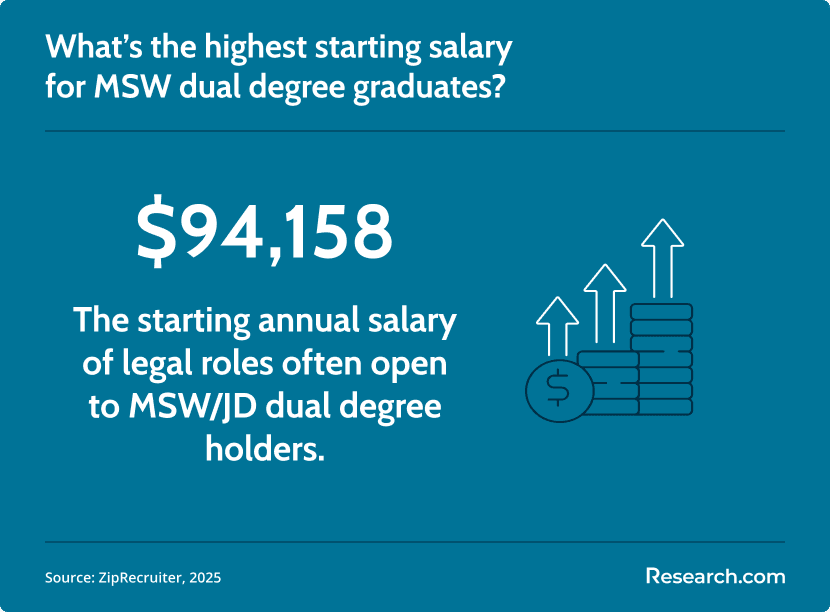
- Legal Advisor or Counselor: An MSW/JD combination can lead to an average annual salary of $94,158, with top earners making as much as $144,000 annually (ZipRecruiter, 2025).
- Medical and Health Services Manager: Graduates with an MSW/MBA can earn over $100,000 on average in this role (MSW Online, 2025). These professionals administer or oversee hospitals, clinics, and public health organizations.
- Social and Community Service Manager: This position is a common path for MSW/MPH and MSW/MPA graduates, with a median salary of $69,600 and a top-end salary of over $115,800 (MSW Online, 2025).
- Chaplain and Pastoral Counselor: An MSW/M.Div. can lead to a variety of roles, with a Master of Divinity degree holder earning an average annual salary of $120,688 (ZipRecruiter, 2025), while a hospice chaplain averages $66,452 annually (ZipRecruiter, 2025).
- Social Science Researcher: For MSW graduates with strong analytical skills, this role offers a path to a high salary, with some researchers earning a median salary of $94,500 (MSW Online, 2025).
These roles demonstrate how an MSW dual degree can lead to a substantial increase in earning potential by allowing graduates to enter leadership, administrative, or specialized roles that go beyond traditional social work practice.
This chart shows employment distribution by occupation, highlighting areas where these graduates can make a significant impact.
What is the long-term earning potential for someone with an MSW dual degree?
A dual degree is a strategic pathway for social workers who wish to significantly increase their long-term earning potential. While a standalone MSW opens the door to many rewarding careers, a dual degree equips graduates with the interdisciplinary skills needed to move into senior-level, administrative, or policy-making roles that command a higher salary. Over the course of a career, this can translate to a substantial increase in lifetime earnings.
For MSW/JD holders, long-term earning potential often extends into six figures, with careers in legal advocacy and policy leadership. Similarly, an MSW/MBA can lead to high-level positions in hospital administration or corporate social responsibility, with salaries for experienced managers often exceeding $110,000 (SocialWorkDegrees.org, 2025).
For those with an MSW/MPH, roles as senior health policy analysts can see salaries ranging from $141,000 to $183,000 (Coursera, 2025). Social and community service managers, a common career path for MSW/MPA graduates, can earn over $129,820 (Bureau of Labor Statistics, 2024).
The specialized knowledge gained from a dual degree is highly valued by employers seeking professionals who can navigate complex systems. These roles offer a clear path for career progression and salary growth, demonstrating how a dual degree can turn a passion for social work into a lucrative and lasting career.
What is the average starting salary for graduates of MSW dual-degree programs?
A dual degree provides a strong foundation for a higher starting salary than a standalone MSW, reflecting the interdisciplinary skills and leadership potential gained. While specific figures can vary based on location and experience, an entry-level professional with a dual degree often commands a more lucrative salary.
The following are some of the average starting salaries for dual-degree holders:
- Juris Doctor: Graduates with an MSW/JD often command a high starting salary, with some legal roles averaging close to $94,158 annually.
- Master of Public Health: An entry-level professional with an MSW/MPH can expect to earn a salary in the range of $46,203 to $58,750, with the 25th percentile for this position at $59,500.
- Master of Business Administration: While a standalone MSW can start in the mid-$40,000s, an MSW/MBA can lead to administrative roles that offer a significantly higher entry-level salary, often in the high-five-figure or low-six-figure range. A related role, like a position with an MBA engineering management salary, can average over $114,000 annually.
- Master of Public Administration: Graduates with an MSW/MPA can expect to earn a starting salary in the range of $45,000 to $55,000 in nonprofit or administrative roles.
- Master of Divinity: A dual degree in MSW/M.Div. can lead to a starting salary of approximately $40,280 in ministry or counseling.
These figures demonstrate how an MSW dual degree can lead to a more lucrative starting point, which often translates into greater long-term earning potential.
What is the job market for graduates of an MSW dual degree?
The job market for professionals with a dual degree is robust, as employers across various sectors seek candidates with a unique combination of social work expertise and a complementary skill set. The interdisciplinary training of these graduates allows them to address complex challenges in leadership, administration, and policy.
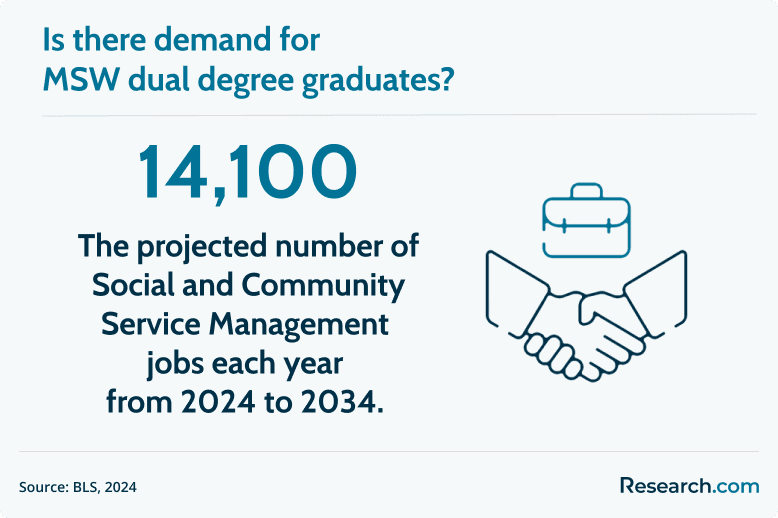
The job outlook for these specialized roles is very promising. For example, the BLS projects that employment for social and community service managers will grow 6% from 2024 to 2034, which is faster than the average for all occupations. The demand for graduates with a business or public health background is even greater, as employment for medical and health services managers is projected to grow 23% during the same period, much faster than the average. This robust job growth is driven by the aging population, a greater need for social services, and a shift toward integrated healthcare models.
As organizations and governments recognize the value of professionals who can navigate complex systems and drive meaningful change, graduates of MSW dual-degree programs are uniquely positioned to excel in the workforce and fill critical leadership roles.
Here’s What Graduates Have to Say About MSW Dual Degree Programs
- Rebecca: "I knew I wanted to work in health policy, but I needed to understand both the individual and systemic sides of healthcare. My MSW/MPH dual degree gave me exactly that. I now work as a policy analyst for a national health organization and earn a salary that reflects the value of my interdisciplinary skills."
- Cathy: "I was working in a private practice when I decided to get a dual degree in gerontology online. The flexibility of the online courses allowed me to continue seeing clients while completing my coursework. Now, I specialize in family caregiving issues and am a go-to resource in my community."
- Laura: "My MSW dual degree with a focus on public administration was a game-changer. I transitioned from a direct-practice role to a leadership position at a major nonprofit, overseeing program development and policy. The combination of clinical social work and administrative skills has been invaluable, allowing me to make a broader impact on the community."
Key Findings
- The average cost of MSW dual-degree programs varies, with popular pairings like MBA and MPA often exceeding $50,000 in total program cost.
- In addition to tuition, hidden costs for an MSW dual degree include program fees, supplies, and living expenses, which can add thousands of dollars to the total program cost.
- Scholarships and fellowships from organizations like the NASW Foundation and the National Health Service Corps are a powerful way to reduce the financial burden of an MSW dual degree.
- A full-time MSW dual-degree typically takes three to four years to complete, condensing the coursework and saving students time compared to pursuing each degree separately.
- Graduates with an MSW dual degree are qualified for leadership roles that combine direct social work practice with administrative or policy-level responsibilities, such as Legal Advocate or Nonprofit Executive Director.
- An MSW dual degree can lead to a substantial increase in earning potential, with roles like Medical and Health Services Manager and Legal Advisor offering salaries of over $100,000 annually.
References:
- Bureau of Labor Statistics. (2024). Medical and Health Services Managers. https://www.bls.gov/ooh/management/medical-and-health-services-managers.htm
- Bureau of Labor Statistics. (2024). Social and Community Service Managers. https://www.bls.gov/ooh/management/social-and-community-service-managers.htm
- Coursera. (2025). Public Health Analyst: Job Roles, Courses, and Salaries. https://www.coursera.org/articles/public-health-analyst
- Data USA. (2024). Social work degrees. https://datausa.io/profile/cip/social-work-440701
- Ma, J., Pender, M., & Oster, M. (2024). Trends in College Pricing and Student Aid 2024. College Board. https://research.collegeboard.org/media/pdf/Trends-in-College-Pricing-and-Student-Aid-2024-ADA.pdf
- MSW Online. (2025). MSW and MPA dual degree programs. https://mastersinsocialworkonline.org/degrees/msw-mpa-dual-degree/
- Scholarships360. (2025). NHSC Scholarship: What You Need to Know. https://scholarships360.org/scholarships/nhsc-scholarship/
- Social Work Education Center. (2025). 9 Best Dual Degree MSW Programs That Save You Time and Money. https://www.socialworkdegree.net/online-msw-programs/dual-degree-msw-programs/
- Social Work Degree Center. (2025). Scholarships and Financial Aid Options for Accelerated MSW Students. https://www.socialworkdegreecenter.com/accelerated-msw/scholarships-and-financial-aid-options/
- SocialWorkDegrees.org. (2025). Highest Paid Social Workers: 2025 Salary Guide & Career Strategies. https://www.socialworkdegrees.org/highest-paid-social-workers-guide
- University of Maryland. (2025). Child Welfare Fellowship. https://www.ssw.umaryland.edu/tuition--fees/scholarships--fellowships/child-welfare-fellowship/
- University of Michigan. (2025). Geriatric Scholarship Program. https://ssw.umich.edu/academic-programs/special-programs/geriatric-scholarship-program
- ZipRecruiter. (2025). JD MSW Salary. https://www.ziprecruiter.com/Salaries/jd-msw-salary
- ZipRecruiter. (2025). Master Of Divinity Degree Salary. https://www.ziprecruiter.com/Salaries/Master-Of-Divinity-Degree-Salary
- ZipRecruiter. (2025). MSW MPH Salary. https://www.ziprecruiter.com/Salaries/msw-mph-salary
Other Things You Should Know About MSW Dual Degree Programs
In 2027, the costs for MSW dual-degree programs vary widely, typically ranging from $60,000 to $120,000 for tuition. Additional expenses such as books, fees, and living costs can increase the total. It's important to compare programs to understand the full financial commitment.
Typically, pursuing a dual-degree MSW program is more cost-effective than earning two separate master's degrees. Dual-degree programs usually combine requirements, reducing the overall number of credits needed. This reduces tuition costs and the amount of time spent in school, offering a more affordable pathway to obtaining multiple qualifications.
Career paths include clinical social worker, policy analyst, and specialized counselor positions. 2027 graduates may pursue roles in healthcare, nonprofit organizations, or government agencies, with opportunities for leadership and program management positions due to the combined expertise from dual-degree programs.


