2027 What Is Forensic Accounting and Fraud Examination?

Co-Founder and Chief Data Scientist
Forensic accounting is a specialized practice that applies accounting, auditing, and investigative skills to uncover financial fraud and manipulation. It's a field built for financial detectives, not just number-crunchers. As financial systems grow more complex, the demand for these experts is rising, with the U.S. market projected to grow at a 7.2% CAGR by 2035, according to Market Research Future.
For those exploring what is forensic accounting, this signals a career with significant long-term security. Prepared by career experts with over a decade of experience, this guide provides a definitive look at the skills, certifications, and career paths you’ll need to succeed in this dynamic profession.
Key Things You Should Know About Forensic Accounting
- The average annual pay for a forensic accountant in the U.S. is $85,177, reflecting the specialized nature of the work.
- Certified Fraud Examiners (CFEs) earn significantly more than their non-certified peers.
- A four-year degree in accounting or a similar field is the standard educational starting point for this career path.
- The U.S. forensic accounting market is projected to grow at a compounded annual growth rate (CAGR) of 7.2% by 2035, indicating high demand.
- This career is fundamentally different from a traditional audit; it focuses on uncovering illegal activity for legal proceedings rather than verifying compliance.
- What is forensic accounting, and what do forensic accountants do? Overview
- What are some major specializations in forensic accounting? Specializations
- How is forensic accounting different from a traditional audit? How is forensic accounting different from a traditional audit?
- What are the educational requirements to become a forensic accountant? Educational Requirements
- What skills do you need in forensic accounting aside from a degree? Top Skills
- Which professional certifications are most valuable for your career? Best Certifications
- What does a typical forensic accountant career path look like? Career Path
- What is the earning potential for a forensic accountant? Earning Potential
- Which industries rely most heavily on forensic accountants? Which industries rely most heavily on forensic accountants?
- How is the field of forensic accounting evolving? How is the field of forensic accounting evolving?
- Who is a good fit for a forensic accountant career? Who is a good fit for a forensic accountant career?
- How do I start exploring forensic accounting? How do I start exploring forensic accounting?
What is forensic accounting, and what do forensic accountants do?
Forensic accounting is a specialized practice area of accounting that investigates fraud or financial manipulation. It applies accounting, auditing, and investigative skills to examine the finances of an individual or business, often in the context of legal proceedings.
Unlike traditional accountants who focus on compliance and reporting, forensic accountants are brought in when there is a suspicion of wrongdoing. Their primary goal is to uncover facts, present them clearly, and often, testify as an expert witness in court.
What Forensic Accountants Do
The day-to-day work of a forensic accountant is centered on investigation and analysis. Their major responsibilities often include:
- Conducting Financial Investigations: Planning and executing detailed examinations of financial records to uncover evidence of potential fraud, corruption, or asset misappropriation.
- Analyzing Data: Sifting through complex financial information, bank statements, and electronic data to identify irregularities, patterns, and discrepancies.
- Quantifying Damages: Calculating the financial impact of fraud, breach of contract, or other disputes for legal cases or insurance claims.
- Preparing Reports: Documenting findings in clear, concise forensic reports that can be used by lawyers, courts, and business leaders to make decisions.
- Providing Expert Testimony: Serving as an expert witness in legal proceedings, explaining complex financial matters to judges and juries.
What are some major specializations in forensic accounting?
Forensic accounting is not a one-size-fits-all career; it's a broad field that allows professionals to develop deep expertise in a specific area of investigation. This allows you to build a focused practice around the type of work you find most compelling.
An experienced auditor, for example, might gravitate toward financial statement fraud, while someone with an interest in law may prefer litigation support or explore non clinical jobs for occupational therapists that leverage their specialized skills in alternative settings.
Here are some of the major specializations:
Fraud Examination
This specialization is concerned with detecting, deterring, and investigating fraud from within an organization. It focuses primarily on internal threats, such as asset misappropriation, which includes theft of cash or inventory, payroll schemes, fraudulent expense reimbursements, and conflicts of interest.
Practitioners in this area use forensic auditing techniques, interview employees, and analyze internal controls to gather evidence sufficient for legal action or management intervention.
Financial Statement Fraud
These experts investigate the most complex and high-stakes white-collar crimes, which involve the deliberate misrepresentation of a company's financial records to mislead stakeholders. Their work centers on identifying deceptive practices like premature revenue recognition, hidden liabilities, or fictitious assets used to inflate earnings and deceive investors, lenders, or the public.
The goal is to establish intent and quantify the financial impact of the fraudulent reporting.
Anti-Corruption and Bribery
Specialists in this area focus on violations of laws like the U.S. Foreign Corrupt Practices Act (FCPA) or the U.K. Bribery Act. Their investigations aim to uncover illegal kickback schemes, trace illicit funds used for payoffs, and identify instances where officials or employees accept bribes to gain a business advantage, often involving complex international transactions and regulatory scrutiny.
Business and Economic Damages
In this litigation-focused role, forensic accountants act as expert witnesses, using sophisticated financial modeling to calculate the precise monetary losses or damages resulting from specific legal conflicts.
This work is critical in cases involving contract disputes, shareholder disagreements, intellectual property theft, or breaches of fiduciary duty, where they must establish a reliable monetary value for the loss suffered. Professionals interested in advancing their qualifications in related fields can also explore MBA programs that don't require work experience to broaden their career opportunities.
Insurance Claims Investigation
This niche involves analyzing complex or high-value insurance claims to identify and prevent fraudulent activities. Specialists review financial documents, medical records, and policy details to confirm the legitimacy of claims related to property damage, business interruption, or personal injury, ensuring that only valid payouts are made and contributing to the stability of the insurance sector.
Choosing a specialization allows you to become a sought-after expert in a particular type of financial investigation, giving you greater control over your career trajectory. It also allows you to center on certain industries, particularly the most profitable ones.
The chart below shows the industries that pay forensic accountants the most.
How is forensic accounting different from a traditional audit?
The roles of a forensic accountant and a traditional auditor are fundamentally different because their objectives are not the same. A traditional audit involves the examination of financial records to express an opinion on their fairness and accuracy, whereas forensic accounting is targeted at uncovering illegal activities or calculating economic damages.
For an experienced auditor considering a pivot, this means shifting from a mindset of professional skepticism to one that is actively searching for wrongdoing.
While both roles require a deep understanding of accounting principles, the application of those skills diverges significantly. Here’s a deeper look at the key distinctions.
Key Differences in Mindset, Scope, and Objective
The core distinction between the two fields comes down to purpose. An auditor’s work is regulatory and designed to ensure compliance, while a forensic accountant’s work is investigative and often tied to legal proceedings. This leads to several key differences in practice:
- Scope and Timeframe: An audit typically covers a specific period, like a fiscal year, to validate a company's overall financial health. A forensic investigation, however, is laser-focused on a specific allegation and can span multiple years to trace the flow of funds and uncover a complete sequence of events.
- Professional Mindset: Auditors operate with professional skepticism, meaning they look for evidence to corroborate financial statements but don't assume fraud. A forensic accountant starts with the presumption of wrongdoing and adopts an adversarial mindset, actively seeking evidence to prove or disprove a specific allegation of misconduct.
- The Ultimate Goal: The end product of an audit is an opinion on the fairness of financial statements. The end product of a forensic accounting engagement is a report of findings used in a legal case, an insurance claim, or an internal disciplinary action.
Understanding these differences is crucial before pursuing the specific educational and professional path required for this investigative career.
What are the educational requirements to become a forensic accountant?
A bachelor's degree in accounting or a related field is the standard educational requirement for entering the field of forensic accounting. This degree provides the non-negotiable toolkit of financial principles and practices that all employers will look for. To further enhance credentials and career prospects, students can also pursue finance certificate programs.
Here is a more specific breakdown of the academic path:
- Secure a Bachelor's Degree. This is your foundational step. Data shows that 71.2% of practicing forensic accountants hold a bachelor's degree as their highest level of education. An accounting degree is the primary and most direct path into the profession. So, is an accounting degree worth it? It sure is if you aim to become a forensic accountant.
- Focus on Core Coursework. Your transcript should show a strong foundation in key areas. Prioritize courses in auditing, advanced financial accounting, business law, and information systems. Auditing teaches you the rules of financial reporting, which you need to know before you can find where they have been broken.
- Develop Data Analytics Skills. To stand out, supplement your accounting curriculum with courses in data analytics or database management. The ability to work with large, complex datasets is a critical skill in modern financial investigations.
- Consider a Master's Degree for Advancement. While not essential for entry-level roles, a master's degree is a strategic investment for specialization and leadership. For Certified Fraud Examiners, the median compensation for those with a graduate degree is $112,000, a significant increase from the $101,000 median for those with a bachelor's.
While your degree provides the essential academic foundation, the specific skills you develop are what truly set you apart as a candidate.
Not everyone can comfortably afford a degree. Fortunately, many types of financial aid are available, from grants and scholarships to loans and assistantships. You can start by applying for the Free Application for Federal Student Aid (FAFSA) to see which types of federal aid are available to you.
Most forensic accountants hold a bachelor's degree, as seen in the visual below.
What skills do you need in forensic accounting aside from a degree?
While a degree provides the necessary accounting knowledge, success in forensic accounting depends on a unique combination of two skill sets: the technical abilities to analyze data and the investigative mindset to uncover the truth behind it.
For experienced professionals, this means leveraging existing technical skills while cultivating a more investigative approach. Exploring public health concentrations can provide additional interdisciplinary insights that strengthen analytical and investigative capabilities.
These skills are what transform a competent accountant into a successful financial detective.
Essential Hard Skills
These are the teachable, technical competencies that form the foundation of any financial investigation. They are the tools you will use every day to follow the money.
- Data Analytics: The ability to use software to sift through large volumes of electronic data, identify anomalies, and visualize patterns that may indicate fraud.
- Auditing: A deep, practical knowledge of auditing procedures and standards is essential. You need to understand how financial records are supposed to look before you can identify how they’ve been manipulated.
- Financial Modeling: Creating financial models to analyze business performance, calculate economic damages, or project the financial impact of a fraudulent event.
- Interview Techniques: Knowing how to conduct effective informational interviews to gather evidence and assess the credibility of witnesses and potential suspects.
- Digital Forensics: This involves recovering and analyzing information from digital devices. As financial crimes move online, the ability to trace digital footprints is becoming increasingly critical.
Critical Soft Skills
These skills relate to your mindset and how you approach problems. They are often what separate a good forensic accountant from a great one.
- Professional Skepticism: This is an attitude of persistent questioning and a commitment to verifying all evidence. It's the refusal to accept information at face value without corroboration.
- Attention to Detail: The smallest discrepancy in a financial record can be the key that unravels a complex fraud scheme. Meticulous, detail-oriented work is non-negotiable.
- Problem-Solving: The ability to look at a complex, often messy, set of financial data and develop a logical, structured approach to solving the puzzle it presents.
- Objectivity: You must remain impartial throughout an investigation, following the evidence wherever it leads without preconceived conclusions. This is critical for credibility in legal settings.
- Effective Communication: You must be able to distill complex financial findings into clear, persuasive reports and testimony for non-accountants like lawyers, judges, and juries.
Aside from degrees in technical fields, many find that an accelerated liberal arts degree online can be instrumental in developing these essential critical thinking and communication skills.
Which professional certifications are most valuable for your career?
The single most valuable credential for a career in fraud examination is the Certified Fraud Examiner. This certification is the gold standard for the profession, and the data proves its impact: certified fraud examiners earn significantly more than their non-certified peers, with a reported earnings premium of 32%.
For anyone serious about this career, pursuing the CFE is a direct investment in their future earning potential and professional credibility.
While the CFE is paramount, it’s important to understand how it fits with other credentials, particularly the well-known Certified Public Accountant license.
CFE vs. CPA: A Strategic Comparison
Many aspiring forensic accountants wonder whether to pursue the CFE or the CPA license. The key is to understand their different strategic purposes. The CPA license is a broad license for accounting professionals, while the CFE credential is a specialized credential focused on fraud prevention, detection, and deterrence.
- The CPA is your foundation: It demonstrates comprehensive mastery of general accounting principles. It's an excellent credential to have, especially early in your career, as it opens many doors.
- The CFE is your specialization: It signals focused expertise in the niche world of fraud. For an experienced auditor, adding the CFE is the most direct way to pivot into a forensic role.
For many, the ideal path is to earn both. However, when weighing options, some find that pursuing one of the cheapest online accounting masters degree programs provides a comparable boost in expertise and earning potential, creating another viable path for career advancement.
With the right credentials in hand, you can begin to map out a clear and rewarding career trajectory.
What does a typical forensic accountant career path look like?
The career path for a forensic accountant is well-defined, offering a clear ladder for advancement from entry-level analyst to senior partner. This structured progression allows you to build expertise and take on greater responsibility over time. For those pivoting from a field like auditing, it's often possible to enter at a mid-level role by leveraging existing experience.
The trajectory typically follows three main stages:
- Entry-Level (Analyst or Associate): In your first few years, you will work under the supervision of senior staff. Your focus will be on the technical aspects of investigation, such as gathering data, performing analysis on financial records, and helping to document findings.
- Mid-Level (Senior Associate or Consultant): After gaining experience, you will take on a more independent role. This often involves managing smaller cases, conducting interviews, drafting sections of forensic reports, and having more direct interaction with clients.
- Senior-Level (Manager, Director, or Partner): At the highest levels, you are responsible for leading complex investigations, managing teams of accountants, developing new business, and serving as an expert witness in major legal cases.
Credentials like the CFE are proven to accelerate this journey. As the data shows, earning a CFE leads to tangible career benefits that help you climb this ladder more quickly. This means you have a clear, actionable strategy to shape your professional growth.
What is the earning potential for a forensic accountant?
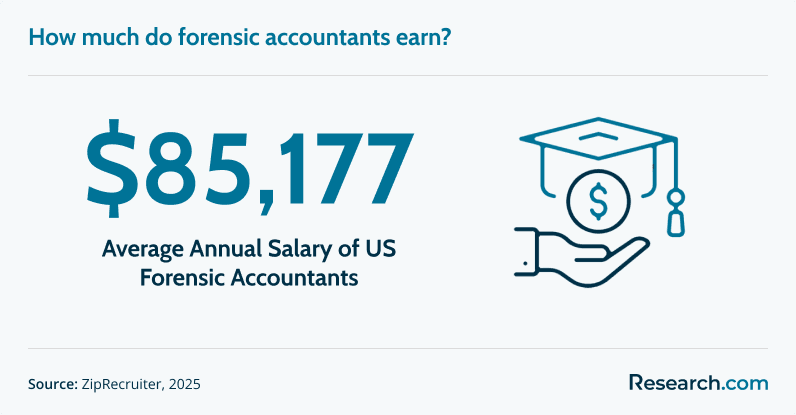
The earning potential in forensic accounting is strong, reflecting the high-stakes nature and specialized skill set required for the job. The average annual pay for a forensic accountant in the U.S. is $85,177. This figure serves as a solid baseline, but it's important to understand that compensation can increase significantly based on factors like experience, certifications, and advanced education.
For professionals who invest in their credentials, the financial rewards are even greater. As you can see in the data below, there is a clear and direct link between advanced qualifications and higher pay.
For CFEs with a four-year degree, reported median compensation is $101,000 per year, while median compensation for CFEs with a graduate degree is $112,000.
Meanwhile, according to Indeed, there are over 1,000 job openings for forensic accounting roles in the country. Accounting graduates can also pursue plenty of closely related and alternative roles in various industries. After all, enterprises typically have an accounting department.
This data provides a clear picture: specializing in forensic accounting and validating that expertise with premier credentials is a direct path to a financially rewarding career.
Which industries rely most heavily on forensic accountants?
The demand for forensic accountants extends far beyond public accounting firms, creating diverse and stable career opportunities across many key sectors of the economy. This widespread need is a strong indicator of job security, as your skills are transferable to multiple environments.
For experienced professionals, this means you can leverage your background to pivot into an industry that aligns with your interests.
Here are some of the top industries that hire forensic accountants:
- Professional, Scientific, and Technical Services: This sector, which includes major accounting and consulting firms, is the largest employer. Professionals here work on a variety of cases for different clients, from internal corporate investigations to litigation support.
- Finance and Insurance: Banks, investment firms, and insurance companies rely heavily on forensic accountants to investigate financial crimes, prevent money laundering, and analyze complex, high-value fraudulent claims.
- Government and Law Enforcement: Federal, state, and local government agencies like the FBI, SEC, and IRS employ forensic accountants to investigate public corruption, tax evasion, and other financial crimes that affect the public interest.
- Healthcare: The healthcare industry hires forensic accountants to combat widespread fraud related to insurance billing, Medicare and Medicaid claims, and kickback schemes between providers and suppliers.
- Manufacturing and Retail: Large corporations in these sectors use internal forensic accounting teams to investigate supply chain fraud, inventory theft, vendor schemes, and other forms of asset misappropriation that can impact their bottom line.
This widespread reliance shows the current stability of the career, but it's the evolving nature of financial crime that will shape its future.
How is the field of forensic accounting evolving?
The field of forensic accounting is rapidly evolving to keep pace with the growing complexity of the global financial system. Far from being a static profession, it is a dynamic area of expertise that is constantly adapting to new technologies, regulations, and criminal methods.
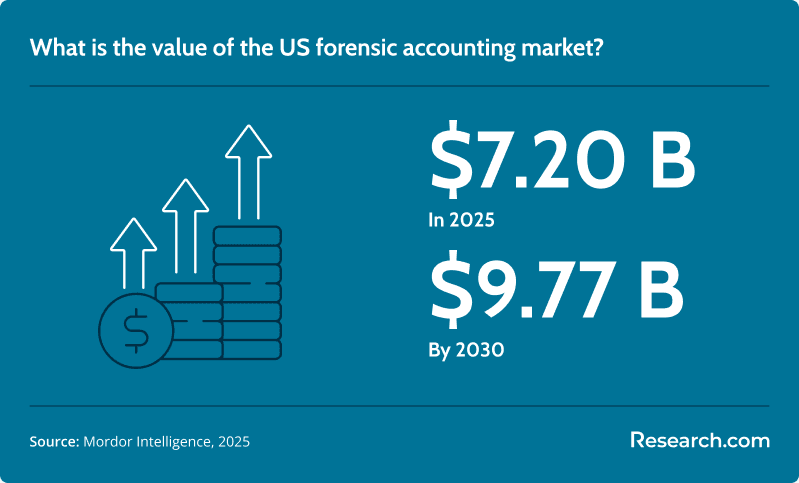
This is a key driver of the profession's long-term security and growth, with the U.S. market projected to expand significantly by 2030.
This growth isn't just happening on its own; it's being driven by powerful trends that are reshaping how financial crimes are committed and investigated.
To stay effective, professionals in forensic accounting are adapting to three major shifts in the financial landscape.
The rise of digital and cryptocurrency fraud
The field of forensic accounting is evolving due to the rise of digital transactions and cryptocurrencies, which has created new and complex avenues for financial fraud. Experts are now needed to trace assets through blockchain technology and navigate the anonymous nature of digital wallets.
Heightened risk from remote work
An increase in remote work and decentralized business operations has heightened the risk of cybercrime and internal fraud, boosting demand for forensic accountants who can investigate digital-first financial crimes and secure vulnerable systems.
The growth of AI and machine ;earning
The use of artificial intelligence (AI) and machine learning is growing in forensic accounting to analyze unstructured data and identify patterns indicative of fraudulent intent. This allows investigators to sift through massive datasets more efficiently, uncovering schemes that would be impossible to detect manually.
These trends ensure that the field will remain intellectually challenging and highly relevant for decades to come.
Who is a good fit for a forensic accountant career?
A good fit for a career in forensic accounting is someone who is naturally inquisitive, detail-oriented, and enjoys solving complex puzzles. While strong analytical skills are a must, the most successful professionals are driven by a deep sense of curiosity and a desire to find the story hidden within the numbers. They possess an investigator's mindset, which combines a healthy skepticism with a methodical approach to uncovering facts.
This career is less about traditional accounting and more about applied psychology and investigation. Many of the core traits, such as understanding human motivation and behavior, are central to online social sciences degrees, which can build a strong foundation for this kind of work.
The ideal candidate is a critical thinker who is not satisfied with surface-level answers and is persistent in the search for evidence.
For those who have these traits, the career is not only a good fit but also highly rewarding. As the data on top-paying states shows, this expertise is in high demand in major economic centers.
Reflect on whether you are the person who always asks "why" and enjoys digging for the truth—if so, this might be the perfect specialization for you.
How do I start exploring forensic accounting?
Exploring a career in forensic accounting doesn't require a major commitment upfront. You can take several small, practical steps right now to gain a clearer understanding of the field and see if it's the right fit for you. This approach allows you to build confidence and make an informed decision about your future.
Here are a few actionable first steps:
- Take a relevant elective. If you are still in college, enroll in an introductory course on forensic accounting or fraud examination. This is the single best low-risk way to get a feel for the subject matter.
- Join a professional organization. The Association of Certified Fraud Examiners (ACFE) offers student memberships. This gives you access to industry publications, webinars, and networking events, allowing you to learn directly from practicing professionals.
- Conduct informational interviews. Reach out to forensic accountants on professional networking sites and ask for a brief 15-minute conversation about their work. Ask them what they do day-to-day, what they enjoy most about their job, and what they find challenging.
- Research educational pathways. If you feel confident this is the right path, begin exploring degree programs. For those looking to enter the field efficiently, researching the fastest accounting degree programs can provide a clear and direct route to getting started.
By taking these steps, you can move from curiosity to clarity, building a solid foundation for a successful and rewarding career as a financial detective.
Here’s What Graduates Have to Say About Their Forensic Accounting Program
- William: "The best part was how practical the coursework felt from day one. I was worried it would be all theory, but we were working with case studies that mirrored real-world financial investigations. Learning the data analytics tools was intense, but it gave me a skill set that immediately got the attention of recruiters."
- Patrick: "As a mid-career professional, I couldn't afford to stop working to go back to school. The structure of this program made the transition possible, and the return on that investment was immediate. I was promoted to a senior analyst role within six months of graduating, with a salary increase that more than justified the tuition."
- Corgan: "My background was in finance, and I wanted to specialize in a way that would make me an expert. The courses on cybercrime and tracing digital assets were incredibly relevant and challenging. I now feel like I have a highly valuable skill set that puts me at the forefront of the industry's evolution."
Key Findings
- The projected 7.2% annual growth of the U.S. forensic accounting market confirms that choosing this specialization is not a high-risk decision but a strategic move into a secure and expanding field.
- The Certified Fraud Examiner (CFE) credential provides a clear and powerful upskilling path, directly translating to a 32% earnings premium over non-certified peers.
- Investing in advanced education has a clear financial payoff, as CFEs with a graduate degree report a median compensation of $112,000 per year.
- The path into this field is well-defined and accessible, with a bachelor's degree serving as the foundational requirement for over 71.2% of practicing professionals.
- The profession is actively evolving to combat complex digital challenges like cryptocurrency fraud and cybercrime, ensuring long-term relevance and intellectual stimulation.
- Professional certification is a proven career accelerator, with 11.8% of CFE recipients reporting that they received a promotion after earning the credential.
References:
- Association of Certified Fraud Examiners. (n.d.). Compensation guide for anti-fraud professionals. Retrieved September 26, 2025, from https://www.acfe.com/fraud-resources/compensation-guide
- Hood, D. (2026. January 2). Accounting in 2026: The year ahead in numbers. Accounting Today. https://www.accountingtoday.com/list/accounting-in-2026-the-year-ahead-in-numbers
- Institute of Finance & Management. (2025). 2025 accounts payable career satisfaction report. Retrieved September 26, 2025, from https://www.iofm.com/ap/whitepapers/2025-accounts-payable-career-satisfaction-report
- Market Research Future. (2025). US Forensic Accounting Market. https://www.marketresearchfuture.com/reports/us-forensic-accounting-market-18743
- Mordor Intelligence. (n.d.). Forensic accounting market size & share analysis - growth trends & forecasts. Retrieved September 26, 2025, from https://www.mordorintelligence.com/industry-reports/forensic-accounting-market
- U.S. Bureau of Labor Statistics. (n.d.). Accountants and auditors. Occupational Outlook Handbook. Retrieved September 26, 2025, from https://www.bls.gov/ooh/business-and-financial/accountants-and-auditors.htm
- U.S. Bureau of Labor Statistics. (n.d.). Occupational requirements survey: Accountants and auditors. Retrieved September 26, 2025, from https://www.bls.gov/ors/factsheet/pdf/accountants-and-auditors.pdf
- ZipRecruiter. (n.d.). Forensic accountant salary. Retrieved September 26, 2025, from https://www.ziprecruiter.com/Salaries/Forensic-Accountant-Salary
- Zippia. (n.d.). Forensic accountant salaries. Retrieved September 26, 2025, from https://www.zippia.com/salaries/forensic-accountant/
Other Things You Need To Know About Forensic Accounting
In 2027, a Certified Fraud Examiner (CFE) and a Certified Public Accountant (CPA) are beneficial certifications for a forensic accountant. Additional qualifications like the Certified Forensic Accountant (Cr.FA) enhance a professional’s skills in detecting and examining financial fraud.
Forensic accounting can be a demanding and high-pressure career. The work often involves tight deadlines, significant financial stakes, and the pressure of legal proceedings where your findings are scrutinized. The need for meticulous attention to detail and the adversarial nature of investigations can also contribute to stress, but many professionals find the challenge of solving complex financial puzzles to be highly rewarding.
In 2027, becoming a forensic accountant typically requires earning a bachelor's degree in accounting, which takes about four years. Most candidates pursue additional certifications, like the Certified Fraud Examiner (CFE), which can take additional months to achieve. Overall, the process usually spans around 5-6 years, considering the necessary education and certification steps.
Forensic accounting in 2027 involves investigating financial discrepancies and fraud, often supporting legal cases. Fraud examination focuses on detecting and preventing fraudulent activities. Both require analytical skills and a solid understanding of financial laws and regulations.