
2027 Best Online PhD in Cybersecurity Programs

Co-Founder and Chief Data Scientist
As a senior cybersecurity leader, you’ve mastered the existing playbook. But applying established knowledge can only take you so far, and you may feel you've reached the limit of your impact. The next step isn't about becoming a better practitioner; it's about becoming an originator of new knowledge. A master's degree is about mastery, but a doctorate is about origination.
This distinction is the key to unlocking the next level of your career. The career planning experts who created this guide have over 10 years of experience helping professionals decide if an online PhD in cybersecurity is the right strategic move.
What are the benefits of getting an online PhD in cybersecurity?
- You transition from being a knowledge-applier to a recognized thought leader who creates original, foundational research.
- You gain access to elite, C-suite executive and corporate R&D roles with an average salary of around $172,000 and a much higher earning ceiling.
- You develop the advanced analytical skills to solve systemic, industry-wide problems that are beyond the scope of traditional practitioners.
What can I expect from an online PhD in cybersecurity program?
You can expect a multi-year academic experience focused almost entirely on learning and applying formal research methodology. An online PhD in cybersecurity program is not an advanced version of a master's degree; it is a different kind of education altogether. While a master's program is designed to make you an expert in what is already known, a doctoral program trains you to discover what is not yet known.
The curriculum will be heavily weighted toward research design, quantitative and qualitative analysis, and academic theory. Any technical courses are not ends in themselves but are instead tools to help you build the framework for your dissertation. The entire first phase of the program is designed to give you the skills needed to produce a single, substantial piece of original research that contributes new knowledge to the field of cybersecurity. Be prepared for a process of supervised, independent inquiry, not a schedule of advanced classes.
Where can I work with an online PhD in cybersecurity?
A PhD in cybersecurity qualifies you for a select set of senior roles that are focused on strategy, research, and policy. Instead of opening up a wider array of jobs, it opens the doors to a narrower but more elite tier of opportunities that are often inaccessible to those with a master's degree.
Graduates typically work in one of four main areas:
- C-Suite & Corporate Strategy: Roles like Chief Information Security Officer (CISO) or security strategist, where you shape long-term security architecture for an entire organization.
- Corporate R&D: Leading research and development teams in private industry to create next-generation security products and frameworks.
- Academia: Serving as a professor and researcher at a university, training the next generation of experts.
- Senior Government & Policy: Advising national agencies on cybersecurity policy and strategy.
How much can I make with an online PhD in cybersecurity?
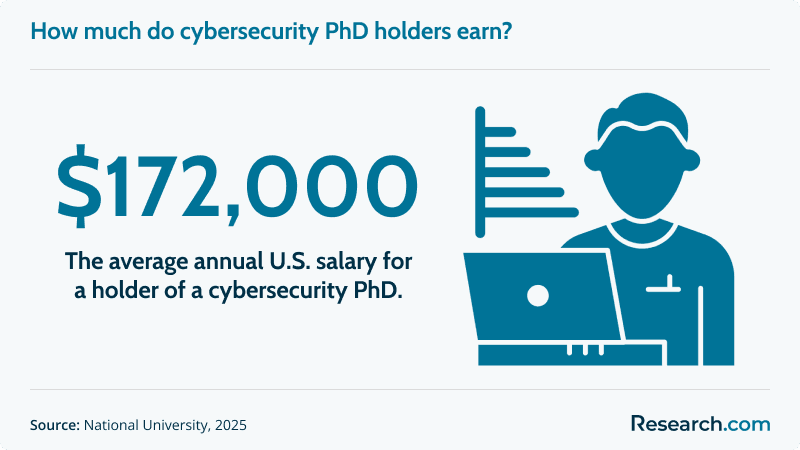
With a PhD in cybersecurity, you can expect an average salary of approximately $172,000. However, this figure only tells part of the story. The true financial value of the degree is not just in raising your salary but in unlocking access to the highest tiers of compensation.
The doctorate qualifies you for C-suite executive positions, senior roles in corporate research and development, and high-level consulting engagements. In these positions, total compensation packages—including bonuses and stock options—can significantly exceed the average salary. The degree makes you a candidate for leadership roles where you are paid for strategic oversight and innovation.
List of the Best Online PhD in Cybersecurity Programs for 2027
How do we rank schools?
Recognizing that paying for a degree is a significant investment, our ranking methodology ensures that students can make informed decisions based on comprehensive and transparent information. The ranking draws upon reliable sources such as the IPEDS database, Peterson's database, the College Scorecard database, and The National Center for Education Statistics.
These sources provide a robust foundation of data to evaluate and rank DEGREE programs. For more details on our methodology, please visit Research.com’s methodology page.
1. Arizona State University - PhD in Computer Science (Cybersecurity)
Arizona State University's program trains researchers to create innovative solutions for complex computer science and engineering problems. The curriculum focuses on developing the deep theoretical knowledge required to advance the field through original, high-impact research that addresses emerging cybersecurity threats.
- Program Length: 4–5 years (typical)
- Research Areas: Artificial intelligence; Big data; Computer systems; and Cybersecurity
- Required Credits to Graduate: 84
- Cost per Credit: $1,429
- Accreditation: Higher Learning Commission (HLC)
2. Capitol Technology University - Doctor of Science (DSc) in Cybersecurity
Capitol Technology University offers a highly technical DSc program focused on producing cybersecurity leaders for government and industry. The curriculum is designed to equip graduates with the expertise to direct and manage complex cybersecurity operations and high-level research initiatives.
- Program Length: 3 years (minimum)
- Required Credits to Graduate: 60
- Cost per Credit: $990
- Accreditation: Middle States Commission on Higher Education (MSCHE)
3. Dakota State University - PhD in Cyber Operations
Dakota State University provides a PhD in Cyber Operations designed to produce elite researchers and senior leaders for academia and government. The program focuses on developing highly specialized technical skills and the ability to conduct novel research in critical cyber domains.
- Program Length: 4–5 years (typical)
- Required Credits to Graduate: 60
- Cost per Credit: $481.35
- Accreditation: Higher Learning Commission (HLC)
4. George Mason University - PhD in Information Technology
George Mason University's PhD in Information Technology allows students to pursue a concentration in information security and assurance. The program prepares scholars to conduct innovative research that addresses foundational challenges in securing complex information systems and critical network infrastructures.
- Program Length: 4–5 years (typical)
- Concentrations: Information Security and Assurance
- Required Credits to Graduate: 72
- Cost per Credit: $1,722
- Accreditation: Southern Association of Colleges and Schools Commission on Colleges (SACSCOC)
5. Johns Hopkins University - PhD in Security Informatics
Johns Hopkins University's Information Security Institute offers a research-intensive PhD for students aiming to become premier academic and industry researchers. The program provides deep engagement with world-class faculty on foundational topics like cryptography, privacy, and system security.
- Program Length: 4–5 years (typical)
- Research Areas: Cryptography; Privacy and Anonymity; and Security and Privacy in Machine Learning
- Required Credits to Graduate: Not specified (research-focused)
- Tuition: Full tuition waiver and stipend for all admitted students
- Accreditation: Middle States Commission on Higher Education (MSCHE)
6. National University - PhD in Cybersecurity
National University provides a flexible online PhD designed for working professionals seeking leadership roles in cybersecurity. The program emphasizes the practical application of research to solve real-world security challenges, preparing graduates for influential roles in industry, government, and academia.
- Program Length: As few as 40 months
- Required Credits to Graduate: 60
- Cost per Credit: $1,000
- Accreditation: WASC Senior College and University Commission (WSCUC)
7. Northeastern University - PhD in Cybersecurity
Northeastern University's Khoury College of Computer Sciences offers a PhD in Cybersecurity focused on creating next-generation leaders for research and development. The program immerses students in a rich research environment, tackling critical challenges in areas like network security, privacy, and cryptography.
- Program Length: 4–5 years (typical)
- Research Areas: AI and data science; Human-centered computing; and Programming languages
- Required Credits to Graduate: Not specified (research-focused)
- Tuition: Full tuition waiver and stipend for all admitted students
- Accreditation: New England Commission of Higher Education (NECHE)
8. Nova Southeastern University - PhD in Cybersecurity Management
Nova Southeastern University offers a PhD in Cybersecurity Management tailored for professionals aiming for executive leadership and strategic roles. The curriculum blends technical cybersecurity principles with management theory, preparing graduates to lead complex security initiatives and inform organizational policy.
- Program Length: 4–5 years (typical)
- Required Credits to Graduate: 64
- Cost per Credit: $1,315
- Accreditation: Southern Association of Colleges and Schools Commission on Colleges (SACSCOC)
9. St. Thomas University - Graduate Certificate in Cyber Security Management
St. Thomas University provides a graduate-level certificate in Cyber Security Management designed for professionals seeking to quickly gain specialized skills. The curriculum focuses on foundational management principles for protecting digital assets, preparing students for leadership roles in information security.
- Program Length: Less than 1 year
- Required Credits to Graduate: 18
- Cost per Credit: $900
- Accreditation: Southern Association of Colleges and Schools Commission on Colleges (SACSCOC)
10. University of Colorado Colorado Springs - PhD in Security
The University of Colorado Colorado Springs offers a PhD in Security that allows for a specialization in computer science. The program trains researchers to address complex security challenges through a multidisciplinary lens, preparing them for influential roles in academia and industry.
- Program Length: 4–5 years (typical)
- Concentrations: Computer Science
- Required Credits to Graduate: 60
- Cost per Credit: $1,424
- Accreditation: Higher Learning Commission (HLC)
How long does it take to complete an online PhD in cybersecurity program?
For most students attending part-time while continuing their careers, an online PhD in cybersecurity takes between four and seven years to complete. This timeline is typically broken into two distinct phases: coursework and dissertation.
The initial coursework phase, which focuses on research methodology and theory, usually takes about two years. The remainder of the time—the most variable part of the journey—is dedicated to independent research, writing, and defending your dissertation. Unlike a master's degree with a fixed course schedule, the pace of your doctoral research is what truly dictates the timeline. Successfully managing this unstructured phase is critical to avoiding the "All But Dissertation" (ABD) trap, where students complete coursework but fail to finish their final research project. The extended duration is common in advanced, specialized programs, a reality shared by those pursuing the best online MSN in nursing informatics and other high-level credentials.
How does an online PhD in cybersecurity program compare to an on-campus program?
The primary difference between an online and an on-campus PhD program is the delivery model, which has significant implications for senior professionals. Online programs offer the flexibility to balance rigorous academic work with a demanding career, while on-campus programs provide more structured, in-person interaction with faculty and peers.
For experienced professionals, the online format can be a strategic advantage. It allows you to align your research with your real-world work environment, producing a dissertation that is both academically rigorous and directly applicable.
This approach mirrors the integrated learning experience of MSN/MHA dual degree programs online, where students combine advanced clinical and healthcare administration knowledge while continuing their professional responsibilities. Ultimately, the program’s faculty quality and research opportunities should guide your decision, rather than the mode of instruction.
What is the average cost of an online PhD in cybersecurity program?
The total tuition for an online PhD in cybersecurity typically ranges from $40,000 to over $120,000. However, focusing solely on the tuition figure can be misleading when evaluating the financial commitment of a doctoral program.
A Strategic View of Cost and ROI
The true cost of the degree must be weighed against its long-term return on investment. For a senior professional, the most significant "cost" isn't just tuition but the immense investment of time and intellectual energy over 4-7 years. The key to the ROI calculation is understanding that the degree unlocks access to higher salary tiers. While the masters in cyber security salary provides a strong baseline, the PhD provides a pathway to top-executive compensation packages that can offer a significant return over the course of your career.
Furthermore, unlike traditional students, senior leaders have a powerful funding option: corporate sponsorship. Many companies are willing to fund or reimburse tuition for an online PhD in cybersecurity if the employee's dissertation research promises to solve a critical business problem. This turns the educational expense into a strategic investment for the employer, making it one of the most effective ways to finance the degree.
The salary data below provides a clear benchmark for the earning potential that forms the foundation of this ROI.
What are the financial aid options for students enrolling in an online PhD in cybersecurity program?
While federal loans and general scholarships are available, the most significant financial aid options for senior professionals pursuing a doctorate are employer-based. Corporate sponsorship and tuition reimbursement programs are the primary funding pathways for students in your position.
Leveraging Your Professional Standing
For established leaders, financial aid is less about demonstrating need and more about demonstrating value. Many large organizations have formal policies to fund advanced degrees, recognizing the need to cultivate top-tier internal expertise. The key is to build a business case that frames your PhD research as a direct investment in solving a major challenge for your company.
When you approach your employer, be prepared to outline a potential research area that aligns with the company's strategic goals. Whether it's developing a new framework for AI security or analyzing systemic supply chain risks, your dissertation can provide immense value. This transforms the conversation from a request for a personal benefit into a proposal for a collaborative, high-return project.
What are the prerequisites for enrolling in an online PhD in cybersecurity program?
The standard prerequisites for an online PhD in cybersecurity are a relevant master's degree—such as in cybersecurity, computer science, or a related field—and extensive, high-level professional experience. Most programs expect applicants to have at least 10-15 years of experience in the field.
While these requirements are rigorous, prospective students can explore flexible pathways, similar to online dental assistant programs with financial aid, which often provide accessible entry points and support for working professionals seeking advanced credentials.
Why Your Experience is Your Biggest Asset
Admissions committees focus on your potential as a research contributor. While your master’s GPA is considered, it carries far less weight than demonstrated expertise. Professionals with advanced experience in areas like network security, ethical hacking, or software development—skills often honed through a web development degree online—bring the real-world insight necessary for rigorous doctoral research.
The most critical component of your application will be your Statement of Purpose. In this document, you must articulate a potential area of research that is specific, relevant, and demonstrates a clear understanding of the current gaps in cybersecurity knowledge. This is where you connect your practical experience to a theoretical problem, showing the committee that you have the insight and vision required to originate new ideas.
As the chart below illustrates, progressive programs place significant weight on this demonstrated expertise.
What courses are typically in an online PhD in cybersecurity program?
The curriculum in a PhD program is designed to teach you how to be a researcher. The courses are not advanced versions of the applied skills you learned in your master's program; instead, they provide the theoretical and methodological tools you will need to produce your dissertation.
Even for students coming from more accessible programs, such as cheapest open admission colleges online, the core PhD courses ensure a rigorous foundation in cybersecurity research methods and theory.
Core Curriculum Focus Areas
You should expect the majority of your coursework to fall into three main categories:
- Research Methodology: Courses on how to design a formal research study, collect and analyze data, and write for academic publication. This will include both quantitative (statistical) and qualitative methods.
- Cybersecurity Theory: An exploration of the foundational academic theories and conceptual frameworks that underpin the field of cybersecurity.
- Statistics and Data Analysis: Advanced statistical training required to rigorously test hypotheses and interpret complex datasets.
These courses provide the essential toolkit for your research. The goal is not to learn a new technical skill, like you would in a Microsoft Azure dual certification boot camp, but to learn a formal process for creating and validating new knowledge.
The need for leaders with these formal research skills is underscored by the systemic nature of the global cybersecurity talent gap, as shown in the data below.
What types of specializations are available in an online PhD in cybersecurity program?
In a doctoral program, specializations are not defined by a course catalog but by the specific research expertise of the faculty. You don’t choose a specialization from a dropdown menu; you choose a dissertation advisor whose life's work aligns with the contribution you want to make.
Finding Your Research Niche
The correct way to find a specialization in an online PhD in cybersecurity is to identify the leading academics in the niche you're passionate about—whether that's AI security, quantum cryptography, or human-computer interaction. Your task is to read their published papers and find a handful of professors whose work excites you. The "specialization" is the opportunity to contribute to that specific, ongoing stream of research under their mentorship. This faculty-first approach is essential in any research-heavy field, whether you're looking at cybersecurity or a data analytics bootcamp online.
For example, with the high demand for AI and machine learning skills, finding a faculty mentor who is a recognized leader in AI security research is the most direct path to becoming a thought leader in that domain. The program you attend is the one where that specific person works.
How to Choose the Best Online PhD in Cybersecurity Program
Choosing the best online PhD program comes down to one factor that overrides all others: the dissertation advisor. While university brand and tuition costs are considerations, a great, engaged advisor at a lesser-known school is far better than a disengaged one at a top-ranked university. Your advisor is your mentor, your advocate, and the single most important key to your success.
Follow this process to make the right choice:
- Identify Your Research Area. Before you even look at schools, define the specific niche within cybersecurity you are passionate about exploring.
- Find the Experts. Search academic databases like Google Scholar or IEEE Xplore to find the leading researchers who are actively publishing in your chosen area.
- Read Their Work. Read the recent papers of your top 3-5 target professors. Does their research genuinely interest you? Does their approach align with your own thinking?
- Initiate Contact. Reach out to these professors with a concise, professional email. Introduce yourself, express informed interest in their work, and ask if they are accepting new doctoral students. Their response will tell you everything you need to know about potential mentorship.
- Apply to Programs. The best program for you is the one where you have identified a willing and engaged advisor whose research you want to advance.
What career paths are available for graduates of an online PhD in cybersecurity program?
An online PhD in cybersecurity prepares you for four primary career tracks: C-suite executive, corporate R&D leader, academic, and senior government advisor. Your choice of dissertation topic will heavily influence which of these paths is the most direct route after graduation. A dissertation on enterprise risk management, for example, leads naturally to a CISO role, while research into novel encryption methods points toward a career in R&D.
Elite Career Trajectories
- C-Suite Executive (CISO): In this role, you are responsible for an organization's entire security strategy and posture. The projected 15% growth for CIS Managers shows strong, sustained demand for this leadership path.
- Corporate R&D Leader: You will lead teams that invent new security technologies and methodologies for major tech firms or specialized security companies. This path is ideal for those who want to stay close to the technology itself.
- Academic Researcher: As a professor, you will conduct your own research, publish your findings, and teach the next generation of cybersecurity professionals.
- Senior Government Advisor: You can work for national agencies like the NSA or CISA, shaping national security policy and advising on how to protect critical infrastructure. Many technology management degree jobs at the federal level require this level of expertise.
The chart below provides a detailed look at the specific roles and salary expectations associated with these career paths.
What is the job market for graduates of an online PhD in cybersecurity program?
While the number of job postings that explicitly require a PhD is small, this niche market exists within an overall cybersecurity industry defined by massive, sustained talent shortages and explosive growth. The demand for top-tier strategic leadership has never been higher, ensuring a strong and stable market for doctoral graduates.
Long-Term Career Resiliency
Pursuing an online PhD in cybersecurity is not about qualifying for more jobs; it's about qualifying for the right jobs. The skills you gain—formal research, complex problem-solving, and the ability to create new knowledge—are precisely the skills that are most resilient to automation and economic shifts. You are positioning yourself to be a leader in a seller's market for talent. The demand for practitioners is a rising tide that lifts all boats, but the demand for true originators who can chart the course is even more acute.
The foundational health of the industry is undeniable. With a projected 29% job growth for information security analysts and a 74% supply-demand ratio in the U.S., the field is structurally sound. This ensures that your significant investment in a doctorate is made in a market that will value your unique expertise for decades to come, as the data below shows.
Is Accreditation Important for an Online PhD in Cybersecurity Program?
Accreditation is a critical factor when evaluating an online PhD in cybersecurity program. Programs that are accredited by recognized agencies ensure adherence to rigorous academic standards and deliver a curriculum that is both current and industry-relevant. Accreditation not only enhances the degree’s credibility among employers and research organizations but also supports eligibility for federal financial aid and other funding opportunities. Prospective students should verify that the program’s accrediting body is recognized by the U.S. Department of Education or the Council for Higher Education Accreditation (CHEA), ensuring that the learning experience meets established quality benchmarks. Additionally, for an institution that offers high-quality education without breaking the bank, consider reviewing the cheapest cyber security degree online options available.
Here’s What Graduates Have to Say about Their Online PhD in Cybersecurity Programs
- Jaspal: "My search wasn't about the university's name; it was about finding one person. I found a professor whose research on IoT security was exactly what I wanted to build on. That mentorship was the single most important part of my success. My advisor challenged me, guided me through the complexities of academic writing, and ultimately became a lifelong colleague."
- Nash: "I had a master's degree and was doing well, but I couldn't seem to break into the C-suite. The doctorate gave me the strategic language and research credentials that were missing from my resume. Six months after graduating, I was hired as a CISO. The degree was the definitive factor that distinguished me from other candidates with similar technical experience."
- Kyle: "The program allowed me to use a major supply chain vulnerability at my own company as the basis for my dissertation. Studying online meant I could apply my research in real time, and my findings directly benefited my employer. It was the perfect synergy of theory and practice. My company helped fund the degree, and they received a valuable, proprietary security framework in return."
Key Findings
- The average salary for a professional with a PhD in cybersecurity is approximately $172,000, providing a strong financial baseline for the degree's return on investment.
- Demand for top-level cybersecurity leadership is robust, with roles like CIS Manager projected to grow by 15%, validating the executive career path for graduates.
- The cybersecurity field faces a massive talent shortage, with a 74% supply-to-demand ratio in the U.S., ensuring long-term career stability for those with elite credentials.
- For a successful doctoral journey, the single most critical factor is aligning with a dissertation advisor whose research interests match your own, as advisor misalignment is a primary cause of program failure.
- A PhD program's curriculum is fundamentally different from a master's, focusing on research methodology and theory to create new knowledge rather than mastering existing technical skills.
- Admissions committees for doctoral programs highly value extensive professional experience, often weighing it more heavily than traditional academic metrics like GPA.
References:
- CyberSeek. (2025). Cybersecurity supply/demand heat map. Retrieved October 1, 2025, from https://www.cyberseek.org/heatmap.html
- IBM Security. (2024). Cost of a data breach report 2024. Retrieved October 1, 2025, from https://www.ibm.com/reports/data-breach
- (ISC)². (2024). ISC2 2024 Cybersecurity workforce study. Retrieved October 1, 2025, from https://www.isc2.org/Insights/2024/10/ISC2-2024-Cybersecurity-Workforce-Study
- National University. (n.d.). Doctor of philosophy in cybersecurity. Retrieved October 1, 2025, from https://www.nu.edu/degrees/cybersecurity-and-technology/programs/doctor-of-philosophy-in-cybersecurity/
- Readynez. (2024, January 15). GIAC exam passing rates: What you need to know before taking the test. Retrieved October 1, 2025, from https://www.readynez.com/en/blog/giac-exam-passing-rates-what-you-need-to-know-before-taking-the-test/
- U.S. Bureau of Labor Statistics. (2024, September 6). Occupational outlook handbook: Computer and information systems managers. Retrieved October 1, 2025, from https://www.bls.gov/ooh/management/computer-and-information-systems-managers.htm
- U.S. Bureau of Labor Statistics. (2024, September 6). Occupational outlook handbook: Information security analysts. Retrieved October 1, 2025, from https://www.bls.gov/ooh/computer-and-information-technology/information-security-analysts.htm
- U.S. Government Accountability Office. (n.d.). Cybersecurity. Retrieved October 1, 2025, from https://www.gao.gov/cybersecurity
Other Things You Should Know About Online PhD in Cybersecurity Programs
As of 2027, many online PhD programs in Cybersecurity do not require the GRE for admission. However, requirements vary by institution, so it's crucial to check individual program prerequisites.
In 2027, GRE requirements for online PhD programs in Cybersecurity vary by institution. Some programs may require GRE scores as part of the application process, while others may waive this requirement, focusing more on professional experience and prior academic performance. It's essential to check the specific admission criteria for each program.
Students in a part-time online PhD program should expect to dedicate 15 to 20 hours per week to their studies. This time is divided between assigned readings, virtual class sessions or discussions, and independent research and writing for the dissertation. Consistent, disciplined time management is essential for balancing doctoral work with a demanding full-time career.
In 2027, part-time online PhD programs in Cybersecurity generally require a weekly time commitment of 15-20 hours. This includes attending virtual lectures, engaging in research activities, and participating in discussions. Time requirements may vary depending on the institution and specific program structure.


