
2027 GIS Degree: Types of Programs, In-Demand Jobs & Certificate Options

Co-Founder and Chief Data Scientist
Geographic information systems (GIS) are now used in nearly every major industry. From tracking supply chains to planning smarter cities, organizations rely on spatial data to make decisions. The U.S. GIS software market alone was valued at $4.3 billion in 2024 and is projected to grow to $10.1 billion by 2033.
With this growth, a GIS degree provides graduates with a direct path into high-demand careers. In this article, we’ll explore what you can do with a GIS degree, the skills that matter most, and the industries where demand is growing. We’ll also look at salaries, job outlook, and the certifications that can boost your career in this field.
Key Things to Know About Getting a GIS Degree in 2027
- GIS graduates can step into roles like GIS analysts, developers, or specialists.
- A GIS degree opens opportunities across industries such as urban planning, logistics, and environmental science.
- The average annual salary for a GIS Analyst in the United States is about $68,644.
- What can you do with a degree in GIS? Degree Overview
- Which GIS program type is best for long-term career growth? Program Types
- Is a GIS bootcamp a good alternative to a traditional GIS degree? GIS Bootcamps
- What software tools are essential for GIS students in 2027? What software tools are essential for GIS students in 2027?
- What GIS skills are most valued in 2027? Core Skills
- What industries are creating the most demand for GIS jobs? Top Industries
- What is the job outlook for GIS professionals in 2027? Job Outlook
- What is the average salary for GIS graduates? Average Salary
- What are the top industry-recognized certifications for GIS specialists? Certifications
- What is the best way to present GIS projects to employers? What is the best way to present GIS projects to employers?
- Are supplemental certifications and courses beneficial for advancing your GIS career? Are supplemental certifications and courses beneficial for advancing your GIS career?
What can you do with a degree in GIS?
GIS and geospatial occupations form a significant and growing segment of the U.S. job market. There are currently an estimated 287,000 geospatial information scientists and technicians in the U.S. This workforce is set to grow as industries from urban planning to logistics rely more on geospatial data.
Here are some jobs you can land with even the shortest GIS degree online:
- GIS Analyst – Involves analyzing spatial data, generating maps and reports, and providing geospatial insights. Professionals in this role typically earn a median wage of $78,167 as of 2023.
- GIS Technician – Creates layers and visual outputs from remote sensing and GPS data, supports GIS project operations. The median salary for GIS technicians is $61,439 per year.
- GIS Developer – Builds GIS applications and geoprocessing tools to meet organizational needs. The median annual wage for this position is approximately $87,827.
- GIS Manager – Oversees GIS teams and projects, ensuring effective use of geospatial data across departments. GIS managers earn a median salary of $99,741 per year.
- Geographer – Conducts spatial research and analysis to study Earth’s surface, often applying GIS to environmental or societal issues. The median pay in this field was $85,430 in 2020.
- Cartographer – Produces maps and geographic models; this field is expected to grow faster than average. Median earnings for cartographers are around $69,000 annually.
- Urban and Regional Planner – Uses GIS for sustainable land use planning and community development. Professionals in this role make an average of $81,800 per year.
- Surveyor – Maps property boundaries and topographical features via GIS-informed methods. The typical median salary for surveyors is $68,540.
Which GIS program type is best for long-term career growth?
For long-term career growth, a master’s degree in GIS or a related field is often the best choice. A bachelor’s degree is enough to enter the workforce in entry-level roles. However, graduate programs open the door to advanced positions such as GIS manager, urban planner, or geospatial consultant.
In fact, students interested in the highest-paying engineering careers often find GIS to be a strong specialization because of its connection to fields like environmental engineering, geospatial data science, and civil infrastructure planning.
Graduates with a GIS master’s degree can expect to earn 16% more than those with only a bachelor's degree. This higher earning potential reflects the added value of expertise in areas such as predictive analytics, remote sensing, and system integration. These are skills that often determine eligibility for senior titles.
Is a GIS bootcamp a good alternative to a traditional GIS degree?
A GIS bootcamp can be a good supplement, but it is not a full alternative to a traditional GIS degree. Bootcamps focus on short-term, skills-based training in areas like Python scripting, ArcGIS, or web mapping.
However, employers still tend to favor candidates with formal degrees for long-term career paths. In fact, about 62% of GIS technologists and technicians hold a bachelor’s degree, while 17% have a master’s degree.
Bootcamps may boost employability or complement an existing degree, but they are rarely seen as a standalone substitute when competing for higher-level GIS positions. Nevertheless, GIS bootcamps provide targeted training to enhance practical GIS skills.
What software tools are essential for GIS students in 2027?
GIS students in 2027 are expected to master tools that not only map locations but also power industries like logistics, climate science, and urban planning. With the geospatial market projected to reach $681 billion globally by 2031, employers increasingly expect graduates to bring both technical expertise and adaptability.
For students looking to build complementary skills quickly, exploring options like the shortest data science bootcamp online can provide a fast track to data analysis knowledge that pairs well with GIS training.
Key GIS software tools for students in 2027 include:
- ArcGIS: Holds 27.9% of the GIS market share, widely used in government and business mapping workflows.
- Mapbox: Slightly ahead with 28.97% market share, leading in web and mobile mapping solutions.
- QGIS: Open-source and flexible. It is a top choice for cost-effective and research-driven projects.
- Atlas: An emerging, collaborative platform ideal for quick, no-code map sharing.
- CARTO and Google Earth Pro: Specialized tools for business analytics, visualization, and education.
What GIS skills are most valued in 2027?
GIS is becoming a multidisciplinary engine that powers sectors like smart cities, environmental forecasting, and logistics optimization. In 2027, professionals who blend spatial expertise with the right complementary skills are in the highest demand.
Employers are especially looking for candidates with these skills:
- Spatial Data Analysis and Cartography: GIS professionals must decipher geographic patterns and craft clear, meaningful maps. Foundational skills like designing maps, applying color theory, and performing geostatistical techniques remain indispensable.
- Programming and Automation: Writing scripts to streamline tasks, manipulate datasets, and customize GIS workflows is increasingly essential. Python leads the pack, but web-focused languages like JavaScript are key for interactive mapping.
- Web GIS and Development: Building interactive, shareable maps and dashboards through web platforms is now expected in many roles. Skills in cloud-enabled mapping and storytelling through web GIS are rapidly climbing in value.
- Database Management: Handling, querying, and organizing large geospatial datasets is foundational. Competence with spatial databases ensures data integrity and enhances analysis efficiency. For professionals looking to deepen their expertise, enrolling in the shortest data science master's programs online can provide advanced training in this field.
- Remote Sensing and Image Analysis: Processing satellite or drone imagery remains a critical skill, especially for land-use monitoring, environmental studies, and disaster response.
What industries are creating the most demand for GIS jobs?
The U.S. GIS industry is growing at over 10% annually, fueled by investments in infrastructure, smart cities, and data-driven decision-making. This growth is not happening evenly. certain industries are absorbing GIS talent faster than others, creating clear hotspots for career opportunities.
Industries creating the most demand for GIS jobs in 2027:
- Government and Infrastructure Development: Smart city planning, transportation systems, and federally funded projects under the Infrastructure Investment and Jobs Act (IIJA) are fueling GIS hiring.
- Private Sector and Commercial Applications: Logistics, retail, energy, telecom, and real estate companies use GIS for route optimization, asset tracking, and market analysis.
- Environmental Science and Conservation: GIS supports climate monitoring, biodiversity studies, and conservation initiatives.
- Healthcare and Public Health: Mapping disease outbreaks and optimizing healthcare access are major growth areas.
- Agriculture: Precision farming and sustainable agriculture rely on GIS for monitoring crops, soil, and weather impacts.
For students eager to enter the field quickly, pursuing a fast-track geosciences degree online can provide the technical and analytical foundation to capitalize on these emerging opportunities in GIS-driven industries.
What is the job outlook for GIS professionals in 2027?
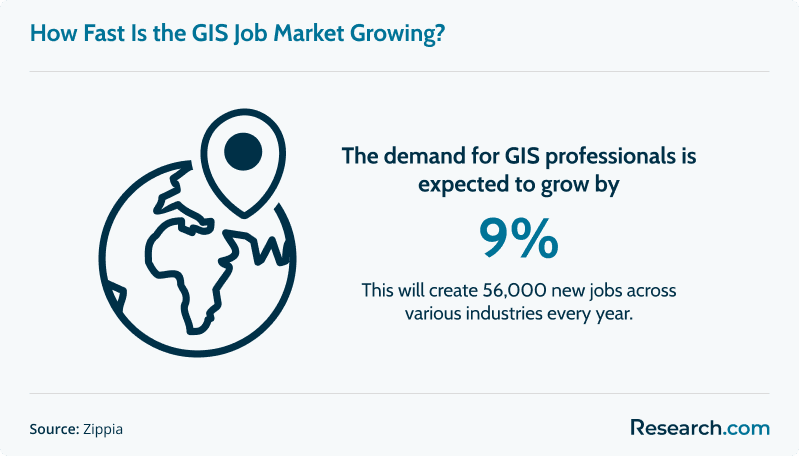
The job outlook for GIS professionals remains strong in 2027. Zippia projects a 9% growth in GIS specialist jobs until 2028. This rate is equivalent to the creation of about 56% new positions every year over that period.
Several factors are accelerating this growth. First, the rising investment in GIS technology creates demand for professionals who can implement and interpret these tools. In 2024, the U.S. GIS market is valued at $4.3 billion, expanding at a 9.9% CAGR. This demand for GIS solutions is one of the core reasons why jobs for specialists are on the rise.
For students aiming to enter this field quickly, pursuing one of the shortest online bachelor's programs in computer science can provide foundational technical knowledge that complements GIS expertise and opens the door to a broader set of career opportunities.
Government spending on infrastructure and smart city projects is also driving demand for spatial data for improving transportation, utilities, and disaster preparedness. At the same time, industries such as logistics, real estate, and environmental services are adopting GIS at a rapid pace.
Advances in cloud platforms, AI, and IoT make real-time geospatial analysis more accessible and valuable, further fueling adoption.
What is the average salary for GIS graduates?
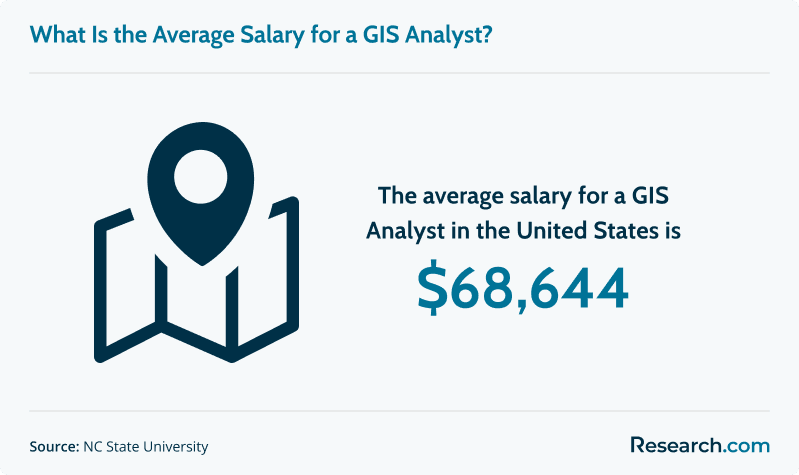
The average estimated salary for a GIS Analyst in the United States is $68,644. Entry-level professionals typically earn less, but salaries rise steadily with experience and specialization. Analysts who move into senior or managerial roles, such as GIS Managers or Geospatial Scientists, earn significantly more. Some positions exceed $90,000 annually.
This earning potential shows that GIS is not only a versatile degree but also one that provides strong long-term career growth. Salaries are also influenced by the sector. Government positions may offer stability and benefits, while private industries like logistics, utilities, and environmental consulting often provide higher pay scales.
Combined with the projected 9% job growth in GIS-related occupations, the salary outlook makes GIS a competitive career path for graduates.
For those interested in expanding their opportunities even further, pairing GIS expertise with data and systems training—such as pursuing a database management master's degree online—can help professionals qualify for advanced roles in data architecture, geospatial analytics, and enterprise information systems.
What are the top industry-recognized certifications for GIS specialists?
Earning a respected GIS certification can sharpen a specialist’s competitive edge. Employers often use them to validate skills, differentiate applicants, and justify higher pay.
Below are the top certifications that GIS specialists pursue:
- GIS Professional (GISP): The GIS Professional (GISP) certification, offered by the GIS Certification Institute (GISCI), is one of the most widely recognized GIS credentials. As of 2020, there were approximately 9,155 certified GISP holders in the U.S.
- Esri Technical Certification: Esri Technical Certification validates a professional’s competency with ArcGIS tools and workflows. By April 2027, over 15,000 Esri Technical Certifications had been awarded worldwide.
- ASPRS Certifications: ASPRS certifications are designed for specialists in remote sensing, photogrammetry, and mapping. These assess a professional’s competence in GIS/LIS applications, spatial data handling, and advanced analytical methods. ASPRS certification includes Certified GIS/LIS Technologist, Remote Sensing Specialist.
For many professionals, GIS credentials also create pathways into broader technology careers. Because GIS increasingly overlaps with data analytics, programming, and cloud-based systems, developing GIS skills can be an effective step toward learning how to get a job in tech, especially in roles involving spatial data, location intelligence, urban planning software, or geospatial modeling.
What is the best way to present GIS projects to employers?
Employers want to see evidence of how candidates apply GIS tools to solve real-world problems, not just a list of skills. The best way to present GIS projects to employers is through a professional portfolio that highlights both technical skills and practical impact.
Some professionals even pair GIS with broader software and data skills, similar to those gained in a masters in computer science for non CS majors, to demonstrate versatility and stronger analytical capabilities.
Each project should be presented clearly and engagingly. Include a concise description of the problem you tackled, detail the methods used, and highlight the outcomes achieved. Incorporate visuals like maps, charts, and screenshots to make the work immediately accessible and understandable.
Be sure to name the specific tools you used, whether it’s ArcGIS, QGIS, Python, or R, to clearly signal a technical skill set. Whenever possible, provide interactive access, such as links to live maps or code repositories.
Are supplemental certifications and courses beneficial for advancing your GIS career?
Supplementary certifications and targeted online courses can broaden a GIS specialist’s scope by enhancing both technical and strategic skills. Diversifying your qualifications with interdisciplinary training—such as advanced data analytics, project management, or even related fields—demonstrates adaptability in an evolving work environment. Pursuing nontraditional courses, like the cheapest medical billing and coding certification, can further underscore your commitment to continuous professional development without overlapping core GIS competencies.
Here’s What Professionals Have to Say About Their GIS Degree
- Matty: "Studying GIS gave me the chance to work on urban heat island mapping during my final year, which was directly connected to local government projects. That experience not only sharpened my ArcGIS and Python skills but also showed me how spatial data can shape real policies."
- Anisha: "I entered the GIS program thinking it would be mostly technical, but I loved how much emphasis there was on teamwork and fieldwork. Collecting GPS data for wildlife corridors and then analyzing it back in the lab was easily the most rewarding part of my degree."
- Dennis: "My program encouraged us to publish our class projects, and one of my StoryMaps on coastal erosion was actually shared by a regional planning office. It was surreal seeing something I made being used in a professional setting."
Key Findings
- About 56,000 new GIS specialist roles are projected annually between 2018 ad 2028.
- 84% of GIS professionals reported being "very" or "somewhat satisfied" with their jobs.
- The average annual salary for a GIS Analyst stands at around $86,644.
- The GIS market is rapidly expanding across critical industries, such as utilities, agriculture, disaster management, and healthcare.
- The GIS software market is projected to grow to US$32.04 billion by 2033, at a 10.6% CAGR.
References:
- Bureau of Labor Statistics. (n.d.). Cartographers and photogrammetrists. U.S. Department of Labor. https://www.bls.gov/ooh/architecture-and-engineering/cartographers-and-photogrammetrists.htm
- ESRI. (2025, May 12). Celebrating 15K certifications earned. https://community.esri.com/t5/esri-technical-certification-program-information/celebrating-15k-certifications-earned/bc-p/1610295
- Geography Realm. (n.d.). Certification in GIS. https://www.geographyrealm.com/certification-in-gis/
- IMARC Group. (2025). United States geographic information system market. https://www.imarcgroup.com/united-states-geographic-information-system-market
- National Association of Colleges and Employers. (2025, May 12). Employers see online degrees as comparable to in-person degrees. https://www.naceweb.org/talent-acquisition/candidate-selection/employers-see-online-degrees-as-comparable-to-in-person-degrees
- North Carolina State University. (n.d.). GIS analyst. NC State Online and Distance Education. https://online-distance.ncsu.edu/career/gis-analyst/
- Precedence Research. (2025, May 12). The geospatial analytics market size to reach USD 338.78 Bn by 2034. https://www.precedenceresearch.com/geospatial-analytics-market
- Zippia. (2025). GIS specialist job outlook and growth in the U.S. https://www.zippia.com/gis-specialist-jobs/trends/
Other Things You Should Know About Obtaining a GIS Degree
In 2027, GIS programs are offered in various formats, including bachelor's, master's, and online courses. Students can choose from degree programs focused on GIS analysis, spatial data science, or specialized applications like environmental management. Certificate programs are also available for professionals seeking to enhance their skills in specific areas.
Online GIS degrees are increasingly respected by employers, especially when earned from accredited institutions. A 2024 survey by the National Association of Colleges and Employers (NACE) found that 87.4% of employers hired new college graduates with online degrees. There is also no reported difference in starting salaries between online and traditional graduates.
Graduate certificates in GIS have gained recognition as a practical way for professionals to boost their credentials. For example, the GIS Professional (GISP) certification by the GIS Certification Institute (GISCI) is recognized by various state GIS councils and accredited by the Council of Engineering and Scientific Specialty Boards (CESB).
This certification demonstrates a combination of education, professional experience, and technical knowledge. Holding a graduate certificate in GIS can differentiate candidates and enhance their employability.
GIS programs focus on spatial data analysis and mapping, while geomatics involves surveying and managing land data, and geoinformatics integrates IT with geospatial technologies for data analysis. In 2027, these distinctions guide students towards specific career paths based on their interests and the skills they wish to develop.


