
2027 Nursing Program Math Requirements

Co-Founder and Chief Data Scientist
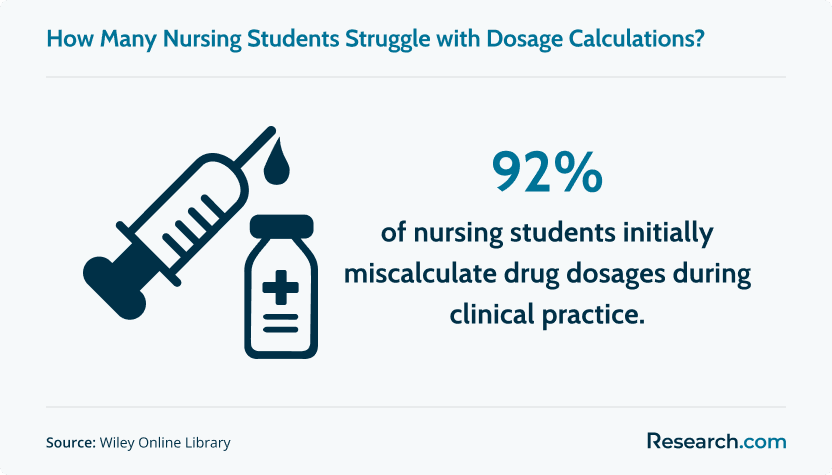
Nursing programs in the U.S. typically require algebra and dosage calculation skills. However, research shows that math is a major challenge. In one study, 98% of nursing students failed a basic dosage calculation test on their first attempt, highlighting how often math becomes a barrier in training.
With preparation and support, students who struggle in math can still complete the program and become licensed nurses. To help you understand what to expect, this guide details the most important things you need to know about the requirements for math in a nursing program.
Key Things to Know About the Math Requirements in Nursing Programs
- Many nursing programs require math placement tests to assess readiness for courses like statistics and pharmacology.
- Bachelor of Science in Nursing (BSN) programs typically require one college-level math course and one introductory statistics course. Associate Degree in Nursing (ADN) programs may only require one college-level math course.
- Nurses use math daily for calculating medication dosages, IV flow rates, lab result interpretation, and evidence-based decision-making.
- What math prerequisites are required for admission to nursing school? Prerequisites
- How do math requirements differ for associate vs. bachelor’s nursing degrees? How do math requirements differ for associate vs. bachelor’s nursing degrees?
- Are there nursing programs with lower math admission requirements? Are there nursing programs with lower math admission requirements?
- Do nursing programs require a math placement test? Placement Tests
- How many math credits are usually needed for a BSN program? Math Credits
- What are the math requirements for a master's degree in nursing (MSN)? Math Courses
- Which math courses are the most difficult for nursing students? Which math courses are the most difficult for nursing students?
- What are the most common math skills nurses use in practice? Math Skills
- What are the best resources to practice nursing math? Resources
- What types of math problems appear on the NCLEX? What types of math problems appear on the NCLEX?
What math prerequisites do nursing schools expect applicants to have?
If you are applying to nursing school and are worried about math, the real question is not whether you need advanced calculus. You usually do not. The real question is whether you can use numbers accurately in situations where a calculation error can affect patient safety. Nursing programs look for readiness in arithmetic, fractions, decimals, percentages, ratios, proportions, algebra, measurement conversions, and basic data interpretation because these skills appear in medication administration, IV therapy, lab review, research assignments, and NCLEX preparation.
This guide explains the math usually required for practical nursing, ADN, BSN, and MSN pathways. It also covers placement exams, math credits, common problem areas, NCLEX math, preparation resources, and questions to ask before choosing a program. It is designed for high school students, transfer applicants, adults returning to school, and licensed nurses considering bridge or graduate study.
Quick answer: how much math is required for nursing school?
Most nursing programs require students to demonstrate college-ready math before admission to the nursing major or before beginning clinical courses. Practical nursing and ADN programs usually focus on fractions, decimals, ratios, proportions, basic algebra, unit conversions, and medication dosage calculations. BSN programs commonly require 3 to 6 credits of college-level math, often through algebra, statistics, or data analysis. MSN programs generally expect incoming students to already have undergraduate statistics and applied quantitative skills.
Requirements vary by school, degree type, entrance exam policy, transfer credit rules, and placement testing. Do not rely only on the college’s general admission page. The nursing department’s prerequisite checklist is the document that matters most.
The American Association of Colleges of Nursing (AACN) has linked academic preparation with student success, and math readiness is one area many schools review carefully. Foundational preparation also matters in other advanced education pathways, including online EdD programs with no campus residency, where applicants must be prepared for the academic demands of the degree.
For nursing students, the purpose is immediate and practical: you must be able to calculate safe medication doses, read clinical numbers correctly, and make accurate decisions even when the setting is stressful.
| Math skill | Why it matters in nursing | Common nursing school use |
| Arithmetic, fractions, and decimals | These are the base skills behind most routine clinical calculations. | Medication labels, dosage problems, intake and output, fluid measurements, and lab values |
| Ratios and proportions | Students use proportional thinking to translate an ordered dose into the amount that can be measured and given. | Drug administration, IV therapy, pediatric dosing, and solution problems |
| Algebra | Algebra helps students solve for unknown values in formulas and clinical word problems. | Dosage equations, dimensional analysis, formulas, and multi-step nursing math problems |
| Unit conversions | Orders, labels, and patient data may use different units, so nurses must convert accurately. | mg to mcg, mL to L, pounds to kilograms, and related clinical conversions |
| Statistics | Statistics supports research literacy, quality improvement, patient outcome review, and evidence-based practice. | BSN courses, nursing research, graduate study, quality dashboards, and population health data |
High school algebra
Algebra is one of the most useful math foundations for nursing students. A school may accept a completed high school algebra sequence, a college algebra course, approved transfer credit, or a qualifying placement score. Programs care about algebra because it supports formulas, ratios, proportions, dimensional analysis, and dosage calculations.
If algebra has always been difficult for you, address it before clinical courses begin. Students with weak algebra skills often struggle more when medication problems include several steps, unit changes, patient-weight calculations, or unfamiliar wording.
Statistics
Introductory statistics is common in BSN programs because bachelor’s-level nursing includes research interpretation, evidence-based practice, and quality improvement. Nurses use statistics to read clinical studies, recognize care trends, compare outcomes, and evaluate whether evidence supports a change in patient care.
Statistics is especially important for students interested in graduate nursing, nursing education, leadership, informatics, public health, advanced practice, or policy-focused roles.
Remedial or developmental math
If your placement test score does not meet a program’s minimum, you may be required to complete remedial or developmental math before enrolling in the required prerequisite. These courses may not apply toward the nursing degree, but they can strengthen arithmetic, algebra, and problem-solving before dosage calculations become part of clinical progression.
Before registering, ask whether developmental math changes your financial aid eligibility, application timing, or clinical start date. Completing math early can prevent a delayed nursing application cycle or an extra semester before clinical admission.
How do math requirements compare in ADN and BSN programs?
ADN and BSN programs both require students to use math safely, but they often emphasize different outcomes. ADN programs usually concentrate on bedside calculations such as medication dosing, IV rates, conversions, and clinical arithmetic. BSN programs include those skills and typically add more work in statistics, research, data interpretation, leadership, and evidence-based practice.
This difference should shape your program choice. If your priority is a direct RN pathway with a shorter academic route, an ADN may offer a more focused math sequence. If you want stronger preparation for leadership, public health, graduate study, or broader employer options, a BSN may be worth the additional quantitative coursework.
Math accuracy is important across healthcare professions, especially in roles connected to medication safety. Students comparing clinical careers may also want to review the earning profile for pharmacists to understand how medication knowledge and quantitative responsibility appear in another healthcare field.
| Nursing pathway | Typical math focus | Who it may fit best | Key decision to check |
| Practical nursing or diploma program | Basic college math, fractions, decimals, ratios, conversions, and dosage calculations | Students who want an entry-level clinical pathway with a practical care focus | Confirm whether completed credits can later apply to an ADN or BSN. |
| Associate Degree in Nursing (ADN) | Algebra readiness, dosage calculations, unit conversions, and bedside arithmetic | Students seeking a direct RN route through a community college or local program | Ask whether the school has an RN-to-BSN transfer or articulation agreement. |
| Bachelor of Science in Nursing (BSN) | Algebra, statistics, dosage calculations, research methods, or data analysis | Students who want preparation for leadership, public health, research, graduate nursing, or wider mobility | Review prerequisite timing so algebra or statistics does not postpone admission. |
The career value of a BSN is also connected to hiring expectations. The American Association of Colleges of Nursing reports that 41% of hospitals now require new nurses to have a BSN, while another 82% strongly prefer it.
That does not make the BSN the only valid starting point. It does mean applicants should think beyond first licensure. A BSN’s statistics, research, and data-analysis requirements can support later advancement into management, public health, evidence-based practice, and graduate nursing.
Can you find nursing programs with lower math admission requirements?
Yes. Some practical nursing, diploma, and ADN programs have lower math thresholds at the point of admission. A school may accept basic college math, an approved placement score, or a minimum math score on an entrance exam such as TEAS.
However, a lower admission threshold does not remove nursing math from the program. Students still must learn medication calculations, unit conversions, IV math, and clinical problem-solving before or during patient care. The difference is that some programs allow students to build these skills during the pathway instead of requiring stronger preparation before entry.
Program quality still matters when requirements look flexible. Accreditation and educational standards affect professional readiness across healthcare fields. For example, students can see the importance of approval standards by reviewing PharmD accreditation requirements by state, where accreditation is directly tied to preparation for professional practice.
Recent data also indicates that vocational programs reject fewer applicants because of academic prerequisites, which may make them more accessible for students who need more time to rebuild math skills. For many learners, the smartest approach is to begin at a realistic level and then use bridge options to continue advancing.
Nurses who start with an ADN or diploma can later continue through online RN to BSN to MSN bridge programs. This step-by-step route can make math progression more manageable because students move from clinical calculations into statistics, research, and graduate-level data use over time.
Who may benefit from a lower initial math threshold?
- Applicants returning to school after a long break who need a guided math review
- Students who prefer a practical nursing or community college starting point
- Working adults who need a gradual path before taking statistics or research courses
- Learners willing to use tutoring, dosage practice, and bridge programs to keep progressing
Who should be careful with this option?
- Students who believe easier admission means dosage math will not be demanding
- Applicants who do not verify accreditation, NCLEX preparation, and credit transfer options
- Future graduate nursing students who delay statistics until it becomes a barrier
- Anyone who has not confirmed whether remedial math changes program eligibility or timing
Will you need to take a math placement test for nursing school?
Many nursing programs use math placement testing to decide whether an applicant can enter college-level math or must complete a preparatory course first. Policies differ by institution. For example, the University of Toledo requires an ALEKS placement test unless applicants already have an ACT math score of 20 or higher.
Competency checks are common in clinical education because schools want evidence that students are ready for technical and academic expectations. Students exploring occupational therapy credentials and specialty options will see similar patterns of readiness screening in other healthcare paths.
Nursing placement tests often cover whole numbers, fractions, decimals, percentages, ratios, proportions, basic algebra, measurement, and unit conversions. Some exams also include word problems that require students to choose the correct operation from a practical scenario.
TEAS, required by about 40% of U.S. nursing programs, includes a math section focused on numbers, measurement, and data interpretation.
| Assessment type | What it may evaluate | Preparation strategy |
| College math placement test | Readiness for college algebra or required prerequisite math | Review arithmetic, basic algebra, fractions, decimals, percentages, and word problems. |
| ALEKS | Current math knowledge used to determine course placement | Work through adaptive practice topics and repeat weak areas until scores improve. |
| TEAS math section | Numbers, measurement, data interpretation, and applied problem-solving | Practice timed questions involving conversions, ratios, percentages, and multi-step problems. |
| Dosage calculation exam | Medication calculation accuracy before or during clinical coursework | Repeat dimensional analysis, IV rate, pediatric dosing, and conversion problems until the process is consistent. |
Students who are starting nursing later in life should build in extra study time. Many adult learners are strong in communication and patient-care motivation but need to rebuild speed and confidence with academic math.
How many math credits do BSN programs usually require?
Most Bachelor of Science in Nursing programs require 3 to 6 credits of college-level mathematics through general education, prerequisites, or nursing-support coursework. For many students, that means one or two math-related classes before or during the nursing major.
For example, Felician University includes College Algebra (3 credits) and Statistics (3 credits) in its BSN curriculum. The Ohio State University requires an approved Data Analysis course plus one additional math course, such as College Algebra, Pre-Calculus, or a higher-level mathematics option.
These courses are not just general education boxes to check. BSN students need quantitative preparation for medication safety, research interpretation, patient-care trends, quality improvement, and evidence-based practice.
| BSN math-related requirement | Typical credit pattern | Why students need it |
| College algebra or approved math course | Often included within the 3 to 6 credit math expectation | Supports formulas, dosage calculations, conversions, and clinical problem-solving. |
| Statistics or data analysis | Often required before or during upper-division nursing courses | Helps students read research, compare outcomes, and use evidence in practice. |
| Dosage calculation instruction | Often built into nursing or pharmacology courses rather than listed as a separate math credit | Connects numerical skills directly to medication administration and patient safety. |
Students considering accelerated or graduate-entry options, including direct-entry MSN programs for non-nurses, should review undergraduate statistics and quantitative reasoning expectations closely. These programs can move quickly into probability, hypothesis testing, research appraisal, and data analysis, so weak preparation may create problems even for motivated career changers.
What math background is expected for an MSN program?
Master of Science in Nursing programs typically do not center on basic math remediation. Instead, they expect students to apply quantitative reasoning in research, advanced clinical decision-making, informatics, leadership, quality improvement, and evidence-based practice.
Students entering a bachelor’s-to-master’s nursing route are usually expected to have prior experience with algebra, statistics, and clinical calculations. At the graduate level, the focus moves from learning basic formulas to using data for professional nursing decisions.
MSN coursework may require students to interpret patient outcomes, review clinical research, understand probability and statistical significance, analyze quality metrics, and evaluate population health data. Nurse practitioner and nurse anesthetist tracks may involve more medication and pharmacology calculations, while leadership, education, and informatics tracks may place greater emphasis on outcomes measurement and healthcare data.
In practical terms, MSN students may not take many courses with “math” in the title, but they still need strong applied numeracy. Graduate nursing requires the ability to read evidence, question data, and translate findings into safe and effective practice.
Which nursing math topics are hardest for students?
Medication and dosage calculations are often the most difficult nursing math topics because they combine reading accuracy, clinical judgment, unit conversion, and arithmetic. A student might know the formula but still make a mistake by misreading the order, choosing the wrong unit, or skipping a conversion.
Research shows that students can answer about 89% of basic dosage calculation questions correctly, but accuracy falls to 2.9% for complex maximum concentration problems. Another study reports that 64% of nursing students fail at least one medication-calculation test during their program.
Difficulty rises when a problem has several steps. Students may need to convert mg to mcg, mL to L, pounds to kilograms, or calculate a dose based on body weight. In clinical settings, these calculations matter because an error can affect patient safety.
Statistics can also be challenging, particularly for students who have not taken math recently. Common trouble spots include probability, hypothesis testing, clinical data interpretation, and connecting statistical results to patient care decisions. Research shows that many undergraduates score below 70% on initial statistics exams.
Applied health statistics can be especially demanding because students must connect mathematical ideas with real healthcare information. Studies show that failure rates in applied health statistics courses can reach 15-20% on the first attempt, especially among students with weaker math backgrounds.
| Challenging area | Why it causes difficulty | Stronger way to study |
| Dosage calculations | Questions often combine formulas, conversions, labels, orders, and careful reading. | Use one calculation method consistently and label every unit as you solve. |
| IV flow rates | Students must connect volume, time, drip factor, and rate accurately. | Learn what each value means before relying on memorized formulas. |
| Pediatric and weight-based dosing | Small calculation errors can matter because doses depend on body weight. | Practice pounds-to-kilograms conversions until they become automatic. |
| Statistics | Concepts may feel abstract when they are separated from patient outcomes and research examples. | Study statistics through nursing research, quality improvement, and clinical data examples. |
| Multi-step word problems | The hardest part is often identifying what the question is asking. | Mark the order, available concentration, patient information, and final required unit before solving. |
What math do nurses use most often at work?
Nurses use math during ordinary patient care, not only on exams. The most common tasks include converting measurements, calculating medication amounts, setting IV rates, tracking patient values, and interpreting numerical data. Nursing math is less about advanced theory and more about dependable, repeatable accuracy.
Unit conversions
Unit conversion is one of the core nursing math skills. A nurse may need to convert pounds to kilograms for a weight-based dose, change milligrams to micrograms, or compare fluid amounts in different units. Because conversion mistakes can cause unsafe dosing, students should practice writing out each step.
Ratios and proportions
Ratios and proportions help nurses determine the measurable amount of medication to give when the medication strength on the label differs from the ordered dose. This skill allows nurses to move from the provider’s order to the correct administration amount without estimating.
IV flow rates
IV calculations help nurses determine how quickly fluids or medications should be delivered. Depending on the order and equipment, a nurse may calculate mL per hour or drops per minute. Accurate rates help ensure the patient receives the prescribed amount over the correct time period.
Vital signs and lab values
Nurses work constantly with numbers such as blood pressure, pulse, respiratory rate, oxygen saturation, temperature, blood glucose, intake and output, and lab results. The skill is not just reading a value; it is recognizing whether the number is stable, improving, worsening, or inconsistent with the patient’s condition.
Statistics for evidence-based care
BSN- and graduate-prepared nurses use statistical thinking to understand research and quality improvement data. They may review trends, compare outcomes, interpret risk, or decide whether evidence supports a change in practice.
What are the best ways to practice nursing math?
The best nursing math preparation combines repetition, feedback, and realistic clinical-style questions. Memorizing a formula once is rarely enough. Students improve by solving many problems, checking each step, and identifying the exact pattern behind their mistakes.
Interactive digital tools
Online modules and mobile apps can help because they provide frequent practice and immediate scoring. Look for resources that include conversions, dosage calculations, IV rates, percentages, ratios, and word problems. The most useful tools explain the solution process rather than only marking an answer correct or incorrect.
Structured study guides and workbooks
Nursing math workbooks are useful when you need a clear sequence. A strong workbook begins with arithmetic, fractions, decimals, percentages, and conversions before moving into dosage and IV problems. This step-by-step approach can help students who feel anxious when math jumps too quickly into clinical examples.
Campus support and peer learning
Use support services early. Tutoring centers, math labs, faculty office hours, nursing skills labs, and peer study groups can help you determine whether your mistakes come from arithmetic, question interpretation, unit conversion, formula choice, or rushing.
Step-by-step study plan for students who struggle with math
- Start with a diagnostic quiz so you can identify your weakest topics before studying.
- Review fractions, decimals, percentages, ratios, and conversions before attempting advanced dosage questions.
- Choose one reliable solving method, such as dimensional analysis, and use it consistently.
- Write units through every step so errors become easier to catch.
- Practice short sets every day instead of cramming before a medication calculation exam.
- Redo missed questions until you can explain the correct process in your own words.
- Get help as soon as the same type of error appears more than once.
| Practice resource | Most useful for | What to verify |
| TEAS or entrance exam prep | Applicants preparing for nursing admission testing | Confirm that the topics match the exam your program actually requires. |
| Dosage calculation workbook | Students preparing for pharmacology or clinical courses | Use nursing-specific materials instead of relying only on general algebra review. |
| School tutoring center | Students who need individual explanation and error correction | Bring missed questions so the tutor can identify recurring mistakes. |
| Peer study group | Students who learn best by explaining and discussing problems | Check answers against faculty-approved resources so incorrect methods do not spread. |
| Practice apps or online modules | Building repetition, speed, and confidence | Do not rely only on multiple choice; also practice writing calculations by hand. |
What nursing math appears on the NCLEX?
The NCLEX-RN includes math-related questions because beginning nurses must be able to calculate, verify, and administer medication and fluids safely. These questions are applied rather than theoretical. They test whether candidates can use math in situations similar to real patient care.
Common NCLEX math topics include medication dosage, IV flow rates, drip factors, unit conversions, adult and pediatric dosing, and formula-based clinical calculations. Many questions require close reading because the correct answer depends on the order, the available medication or fluid, and the unit required in the final response.
The exam is built around four major client needs categories, and math most often appears in Pharmacological and Parenteral Therapies. This category covers medication administration, IV therapy, dosage safety, and related calculations.
According to the National Council of State Boards of Nursing, Pharmacological and Parenteral Therapies account for 12–18% of the RN exam. That range is why nursing math should be treated as a core NCLEX preparation area, not a minor review topic.
| NCLEX math area | Skill being tested | Preparation tip |
| Dosage calculation | Determining how much to administer based on the ordered dose and available concentration | Practice ordered dose, available dose, and supply amount problems regularly. |
| IV flow rate | Calculating mL per hour or drops per minute | Review the relationship among volume, time, rate, and drip factor. |
| Unit conversion | Converting among mg, mcg, g, mL, L, pounds, and kilograms | Memorize common clinical conversions and keep units visible throughout the problem. |
| Weight-based dosing | Calculating medication amounts based on patient weight | Convert pounds to kilograms when required before completing the calculation. |
| Data interpretation | Using numerical patient information to support a safe clinical decision | Read the entire scenario so you do not solve from the numbers alone. |
Common mistakes to avoid with nursing school math requirements
Many applicants run into problems not because nursing math is impossible, but because they misunderstand how schools use math for admission, course placement, and clinical progression. Avoiding the mistakes below can protect your timeline and reduce unnecessary costs.
| Common mistake | Why it can hurt you | Better decision |
| Reviewing only the college’s general admission rules | The nursing department may require specific math courses, placement scores, or prerequisite grades. | Use the official nursing prerequisite checklist, not only the college admissions page. |
| Assuming transfer or online math credits will count automatically | A school may reject a course if the level, credit value, or content does not match its requirement. | Request written transfer approval before taking math elsewhere. |
| Waiting until pharmacology to learn dosage calculations | Clinical math becomes more stressful when it arrives alongside new nursing content. | Practice conversions, ratios, and dosage problems before the first clinical term. |
| Comparing programs by tuition only | Remedial courses, delayed admission, repeat attempts, and extra fees can change the real cost. | Compare total timeline, prerequisite order, fees, progression rules, and support services. |
| Choosing based only on rankings or name recognition | A highly visible school may not fit your timeline if its math sequence delays entry into nursing courses. | Ask which math requirements must be finished before application and before clinical placement. |
| Assuming career outcomes are guaranteed | Salary and employment depend on location, licensure, experience, degree level, and employer demand. | Use program outcomes as one part of your decision, not as a promise of future results. |
Questions to ask before applying to a nursing program
- Which math courses must be completed before I can apply to the nursing major?
- Does the program require algebra, statistics, data analysis, or another approved math course?
- Is a math placement test required, and what score places me into the correct course?
- Does the school use TEAS, ALEKS, or its own medication calculation exam?
- Will my previous college math credits transfer, and who makes the final decision?
- Do developmental math classes count toward the degree, or do they only prepare me for prerequisites?
- How many attempts are allowed on dosage calculation exams?
- Are tutoring, math labs, medication calculation workshops, or online practice modules available?
- Can the math sequence delay my clinical start date?
- If I plan to earn a BSN or MSN later, will these math credits transfer into the next program?
What nursing graduates often say about math preparation
- : "I thought math might keep me out of nursing. Once dosage conversions were tied to patient safety, the practice felt more important and less abstract. Working problems before clinical days helped me feel ready instead of overwhelmed. — Lindsey"
- : "Statistics scared me because it seemed far from bedside care. When our assignments used lab trends, patient outcomes, and nursing research, the numbers became easier to understand. I started seeing statistics as a tool for better care. — Johnson"
- : "Algebra was never my strongest subject, but repeated dosage practice made a difference. The workshops taught me to slow down, label units, and check every step. By NCLEX review, IV rates and pediatric dosing felt manageable. — Celine"
Current trends shaping nursing math preparation
Nursing programs are paying closer attention to quantitative readiness because medication safety, evidence-based practice, and data-informed care are central parts of modern nursing education. Students are increasingly expected to move between bedside calculations and research interpretation, especially in BSN and MSN pathways.
Online and hybrid nursing education also makes self-directed preparation more important. Students in flexible formats may have fewer informal opportunities to ask quick math questions in person, so tutoring access, practice modules, and faculty responsiveness should be part of your program comparison.
Data literacy is also becoming more important in nursing practice. Nurses work with electronic health records, quality dashboards, research summaries, population health information, and patient outcome trends. This does not mean every nurse needs advanced mathematics, but it does mean nursing math extends beyond basic medication arithmetic.
References
- Austerberry, J. (2024). Mathematics anxiety and undergraduate nursing students. Nursing Open, 11(2), 1–10. https://doi.org/10.1002/nop2.70082
- Alteren, J. (2015). Relationship between high school mathematics grade and medication calculation test performance in Norwegian nurse education. Healthcare, 3(2), 351–358. https://doi.org/10.3390/healthcare3020351
- Gemuhay, H. M. (2019). Factors affecting performance in clinical practice among preservice diploma nursing students in Northern Tanzania. Nursing Research and Practice, 2019, 1–8. https://doi.org/10.1155/2019/3453085
- Mulac, A. (2022). Medication dose calculation errors and other numeracy mishaps in hospitals: Analysis of the nature and enablers of incident reports. Journal of Advanced Nursing, 78(5), 1403–1413. https://doi.org/10.1111/jan.15072
- Wennberg-Capellades, L. (2022). Where do nursing students make mistakes when calculating drug doses? A retrospective study. BMC Nursing, 21, 309. https://doi.org/10.1186/s12912-022-01085-9
- University of Central Arkansas. (n.d.). Bachelor of Science in Nursing admission requirements. https://uca.edu/nursing/bachelor-of-science-in-nursing-admission-requirements/
- ATI Testing. (n.d.). TEAS exam information and registration. https://www.atitesting.com/teas/register
- Healio. (n.d.). Journal of Nursing Education. https://journals.healio.com/journal/jne
- National Center for Education Statistics. (n.d.). Mathematics performance. https://nces.ed.gov/programs/coe/indicator/cnc
- National Council of State Boards of Nursing. (n.d.). NCLEX. https://www.ncsbn.org/nclex.htm
Key Insights
- Nursing math is required because calculations affect patient safety, especially in medication dosing, IV therapy, unit conversion, and clinical data review.
- Practical nursing and ADN programs usually emphasize bedside calculation skills, while BSN programs commonly add statistics, research interpretation, and data analysis.
- Most BSN programs require 3 to 6 credits of college-level mathematics, often through algebra, statistics, or data analysis.
- Programs with lower math admission requirements can be useful entry points, but students still must master dosage calculations before and during clinical practice.
- Placement tools such as ALEKS and entrance exams such as TEAS may determine whether you can enter required math courses directly.
- Medication calculation is difficult because it often requires reading the order correctly, converting units, applying a formula, and checking the final unit.
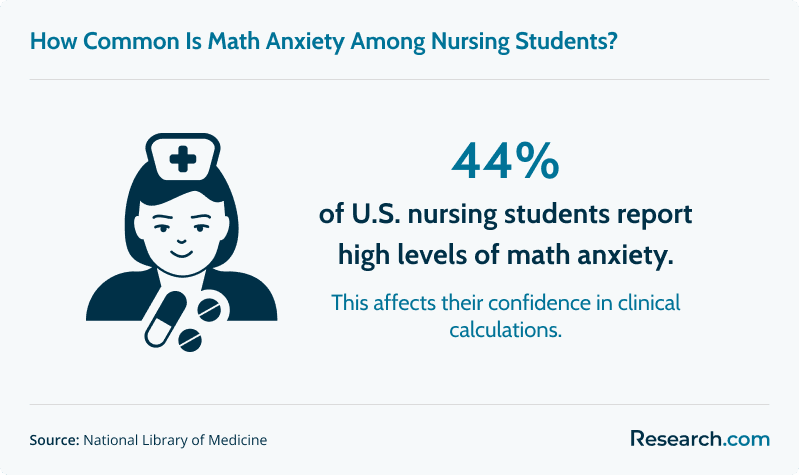
- Students who are anxious about math should begin early, use nursing-specific practice problems, label units, seek tutoring, and confirm requirements before applying.
- The best program is not necessarily the one with the easiest math requirement. It is the one that fits your current readiness, offers academic support, meets professional standards, and keeps future BSN or MSN options open.
Other Things You Should Know About Nursing Program Math Requirements in CURRENT_YEAR
Nursing programs in 2027 generally require completion of courses in algebra and statistics. Some programs may also require courses in calculus or mathematical reasoning to ensure students possess the quantitative skills necessary for nursing coursework and clinical practice.
For 2027 entry into nursing programs, students typically need to demonstrate proficiency in college-level math, such as statistics or algebra. Requirements may vary by institution, but a solid foundation in math is essential due to calculations in medication dosages and data analysis in healthcare settings.


