
2027 Director of Nursing Careers: Skills, Education, Salary & Job Outlook

Co-Founder and Chief Data Scientist
Becoming a Director of Nursing is a career decision about more than moving into management. It means shifting from direct bedside care to leading the people, systems, budgets, policies, and quality standards that shape care across a unit, facility, or healthcare organization.
The path can be confusing because expectations vary by employer and setting. Some facilities may consider experienced registered nurses with an Associate Degree in Nursing, while many prefer or require a BSN, graduate education, management experience, and leadership-focused certifications. At the same time, the role can offer strong job stability, broad influence, and salaries often exceeding $160,000 in some regions.
This guide, developed with a career-advising perspective informed by over a decade of advising experience, explains what Directors of Nursing do, the skills and credentials employers look for, how to enter the field, what the work environment is like, and how to decide whether this leadership path fits your goals.
Key Things You Should Know About Director of Nursing Career
- The typical earning potential for a director of nursing is around $108,675 per year, with salaries ranging between $83,000 and $125,500 and top earners reaching $151,000 annually.
- This field is stable and growing, with strong demand and active hiring especially in long-term care and skilled nursing facilities, plus a solid 4.07% salary increase projected for 2025.
- A Bachelor of Science in Nursing (BSN) is becoming the standard qualification, though many current directors hold an associate degree; a Master of Science in Nursing (MSN) is often required for advanced leadership roles.
- Success relies on leadership, healthcare administration, regulatory compliance, financial management, strategic planning, staff development, clinical expertise, communication, and problem-solving under pressure.
- Career advancement can move from staff RN to charge nurse, then into clinical nurse leader or assistant director of nursing roles, progressing to director of nursing and beyond to patient care director or chief nursing officer positions with significant salary growth.
What do Directors of Nursing do?
Directors of Nursing oversee nursing operations and are accountable for the quality, safety, staffing, and performance of nursing care within a healthcare organization. They translate clinical standards and organizational goals into daily practice, making sure nurses have the guidance, resources, and policies needed to care for patients effectively.
The role sits at the intersection of clinical leadership and administration. A Director of Nursing may not provide bedside care every day, but their decisions affect patient outcomes, staff workload, compliance performance, and the overall culture of care.
A day in the life of Directors of Nursing
A typical day can include reviewing staffing levels, meeting with nurse managers, responding to patient or family concerns, preparing for inspections, analyzing quality metrics, approving schedules, handling performance issues, and coordinating with physicians, executives, and department leaders.
The work is often fast-moving and interruption-heavy. A Director of Nursing may start the day focused on strategic planning and quickly shift to a staffing emergency, infection-control concern, regulatory question, or urgent personnel matter. Success depends on staying organized while making sound decisions under pressure.
What are the key responsibilities of Directors of Nursing?
Directors of Nursing are responsible for making nursing departments safe, compliant, adequately staffed, and aligned with the organization’s care standards. The exact scope depends on the setting, but most roles combine people management, operational oversight, regulatory accountability, and quality improvement.
- Lead nursing staff: Oversee hiring, scheduling, evaluations, coaching, disciplinary action, and professional development.
- Maintain care standards: Set expectations for clinical practice, monitor patient care quality, and respond when performance falls short.
- Manage staffing and resources: Balance patient acuity, staffing ratios, supplies, equipment, and budget limits.
- Ensure regulatory compliance: Implement policies that align with healthcare laws, accreditation requirements, and facility standards.
- Develop and update procedures: Revise nursing protocols as clinical evidence, organizational goals, and regulations change.
- Coordinate across departments: Work with administrators, physicians, therapists, human resources, compliance teams, patients, and families.
- Track performance: Use patient outcomes, incident reports, staff turnover, satisfaction data, and audit results to improve operations.
The most challenging vs. the most rewarding tasks
The most difficult part of the job is often balancing staffing shortages, rising patient acuity, budget constraints, and regulatory pressure at the same time. Directors must protect patient safety while also preventing nurse burnout, resolving conflict, and making decisions that may not satisfy everyone.
The most rewarding part is the ability to improve care at scale. Instead of helping one patient at a time, a Director of Nursing can strengthen an entire nursing team, develop future leaders, improve safety processes, and create a better environment for patients and staff.
For nurses preparing for leadership, additional credentials can help demonstrate specialized expertise. Researching certifications for jobs that pay well can be useful when comparing options that support advancement.

What are the key skills for Directors of Nursing?
Directors of Nursing need strong clinical judgment, but clinical expertise alone is not enough. Employers look for leaders who can manage people, budgets, quality metrics, compliance risks, and difficult conversations without losing sight of patient care.
The strongest candidates usually combine bedside credibility with administrative discipline. They understand what nurses face in daily practice and can also make organization-wide decisions about staffing, policy, performance, and resources.
Key hard skills
- Medical knowledge: Needed to evaluate care standards, understand patient safety risks, and guide evidence-based nursing practice.
- Healthcare administration: Used to manage staffing plans, budgets, policies, reporting, and operational priorities.
- Regulatory compliance: Essential for meeting healthcare regulations, accreditation standards, documentation requirements, and internal policies.
- Data analysis: Important for interpreting patient outcomes, quality indicators, incident trends, satisfaction results, and staffing metrics.
Key soft skills
- Leadership: Helps build trust, set expectations, hold teams accountable, and guide nurses through change.
- Communication: Required for clear direction, conflict resolution, executive reporting, patient-family communication, and interdisciplinary teamwork.
- Problem-solving: Supports quick, practical decisions when staffing, patient safety, or workflow problems arise.
- Active listening: Builds credibility with staff and helps leaders identify issues before they become larger problems.
The one overlooked skill that separates the good from the great
Strategic planning is often what separates competent Directors of Nursing from exceptional ones. A strong director does not only respond to problems; they anticipate them. That may include preparing for seasonal volume changes, identifying retention risks, planning for regulatory updates, or aligning nursing initiatives with the organization’s broader goals.
For example, a director who expects staffing pressure during a seasonal flu outbreak can adjust schedules, cross-train staff, review supply levels, and communicate early with department leaders. That kind of planning can reduce last-minute decisions, protect care quality, and control avoidable costs.
These skills are especially valuable in complex settings such as the General Medical and Surgical Hospitals sector, the highest-paying industry for this career. Nurses comparing education options to build these capabilities can review college admission open resources to understand accessible program pathways.
Director of Nursing Careers: A Step-by-Step Guide to Getting Started
The path to becoming a Director of Nursing usually takes several years because employers want leaders who understand both patient care and nursing operations. The goal is to build clinical credibility first, then add formal leadership preparation and management experience.
- Complete nursing education. Start with an approved nursing program that prepares you for registered nursing practice.
- Earn RN licensure. Obtain registered nurse licensure so you can practice professionally and begin building clinical experience.
- Gain hands-on nursing experience. Work in patient care roles that develop clinical judgment, communication skills, and an understanding of real workflow challenges.
- Move into early leadership. Seek charge nurse, supervisor, nurse manager, department head, or committee leadership opportunities.
- Advance your education. Consider a BSN, MSN, MHA, DNP, or related leadership-focused program depending on your current degree and career target.
- Build management evidence. Document experience with staffing, budgeting, quality improvement, compliance, staff development, and performance management.
- Apply strategically. Target Director of Nursing roles in settings where your experience fits, such as hospitals, long-term care facilities, outpatient centers, or residential care organizations.
The essential steps to become a Director of Nursing are to earn RN licensure, gain clinical experience, pursue advanced education when needed, and build a record of leadership responsibility. The strongest applicants can show not only that they understand nursing care, but that they can improve systems and lead teams.
What education, training, or certifications are required?
Most Director of Nursing roles require registered nurse licensure and substantial clinical experience. A Bachelor of Science in Nursing (BSN) is commonly preferred and often treated as the standard degree foundation. An Associate Degree in Nursing (ADN) may be accepted by some employers when paired with significant experience, but it can limit competitiveness for larger systems or senior leadership roles.
RN licensure is essential and is obtained by passing the NCLEX-RN. Many employers also value leadership-focused credentials, including Director of Nursing Services - Certified (DNS-CT) from the American Association of Directors of Nursing Services, Certified Director of Nursing (CDONA/CDON), or Nurse Executive Certification (NE-BC). Requirements vary by employer, state, and care setting, so candidates should review job postings carefully before investing in a credential.
On-the-job preparation is also critical. Many Directors of Nursing have at least 2 to 3 years of managerial or clinical leadership experience, often as a nurse manager, assistant director, supervisor, or department head.
Are advanced degrees or niche certifications worth the investment?
Advanced degrees can be worthwhile when they match your target role. A Master of Science in Nursing (MSN), Master of Health Administration (MHA), or Doctor of Nursing Practice (DNP) in executive nursing administration can strengthen leadership, finance, policy, quality improvement, and systems-management skills. These credentials may be especially useful for nurses aiming for executive roles, larger hospitals, multi-site systems, or competitive urban markets.
However, advanced education does not replace management experience. A graduate degree may help you qualify for interviews, but employers still look for evidence that you can lead teams, manage conflict, improve outcomes, handle budgets, and maintain compliance.
Before enrolling, compare tuition, time commitment, accreditation, employer tuition assistance, certification eligibility, and the kinds of roles graduates typically enter. If your goal is nursing leadership with strong compensation potential, reviewing best paid bachelor degrees can help you place the BSN and related pathways in a broader education-and-earnings context.
What is the earning potential for Directors of Nursing?
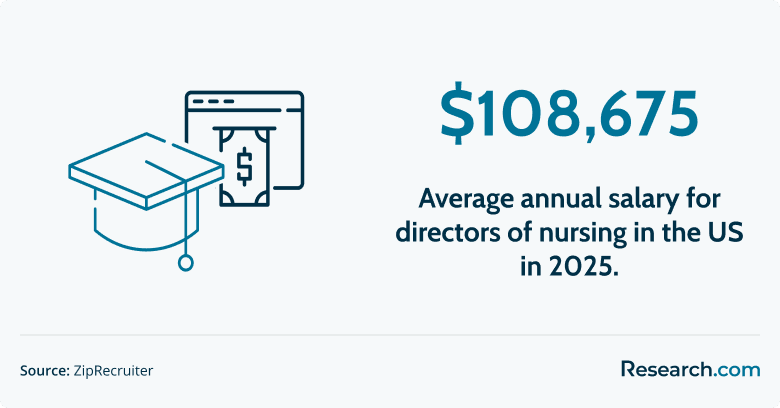
The Director of Nursing salary range 2025 shows a median annual salary of $108,675. Entry-level Directors can expect to start around $83,000 per year, while seasoned professionals in senior roles can earn up to $151,000 annually. Actual pay depends on location, facility type, employer size, education, certifications, leadership scope, and years of experience.
The highest paying states for Director of Nursing often reflect a combination of local healthcare demand, cost of living, competition for experienced leaders, and the presence of large health systems or urban medical centers. A director overseeing a large hospital department may have a different compensation profile than one leading nursing operations in a smaller clinic or residential care facility.
When comparing offers, look beyond base salary. Benefits, retirement contributions, bonus eligibility, continuing education support, tuition reimbursement, relocation assistance, staffing resources, and leadership support can significantly affect the total value and sustainability of the job.
What is the job outlook for Directors of Nursing?
The Director of Nursing role is projected to grow by 18% to 28% from 2018 to 2028, which is significantly faster than the average growth rates of 5% for all occupations and 6% for all management jobs. This outlook reflects the continuing need for healthcare leaders who can manage nursing teams, improve care quality, and maintain compliance in complex care environments.
The key factors shaping the future outlook
Several forces support demand for Directors of Nursing. A growing and aging population increases demand for healthcare services, especially in hospitals, long-term care, residential care, and outpatient settings. As patient needs become more complex, organizations need experienced nursing leaders who can coordinate care, manage staff capacity, and protect safety standards.
Healthcare organizations are also operating under greater regulatory, financial, and quality-performance pressure. Directors of Nursing help bridge the gap between executive priorities and frontline nursing practice, making them important to both clinical outcomes and operational performance.
Educational expectations may continue to rise. Some employers increasingly favor advanced degrees, including the Doctor of Nursing Practice (DNP), for senior leadership roles. Nurses considering doctoral study can compare flexible options, including 1 year doctoral programs, while remembering that program length, accreditation, clinical requirements, and employer recognition should be reviewed carefully.
What is the typical work environment for Directors of Nursing?
Directors of Nursing work in hospitals, outpatient clinics, nursing homes, long-term care facilities, residential care settings, and other healthcare organizations. Many split time between an administrative office and clinical areas, moving throughout the facility to observe operations, speak with staff, review issues, and respond to urgent needs.
The culture is usually collaborative, high-accountability, and fast-paced. Directors interact with nurses, physicians, administrators, human resources staff, compliance officers, patients, and families. They are expected to communicate clearly with frontline staff while also reporting performance, risks, and resource needs to senior leadership.
A typical schedule often extends beyond the standard 40 hours per week. Evenings, weekends, holidays, and night shifts may be necessary when staffing shortages, emergencies, inspections, patient-safety concerns, or operational issues arise. Remote work is typically limited because the role requires visible leadership, on-site problem solving, and direct engagement with care teams.
What are the pros and cons of Director of Nursing careers?
A Director of Nursing career can be highly meaningful, but it is not a low-pressure advancement option. The role suits nurses who want broad influence, are comfortable making difficult decisions, and can lead through conflict, change, and uncertainty.
Pros
- Large-scale impact: Directors influence care quality and patient safety across entire teams or facilities.
- Leadership growth: The role develops executive skills in staffing, budgeting, compliance, policy, and quality improvement.
- Team development: Directors can mentor nurses, build stronger managers, and improve workplace culture.
- Strategic influence: Nursing leaders help shape policies, workflows, and care-delivery standards.
- Career mobility: Experience as a Director of Nursing can support advancement into senior operations or executive roles.
Cons
- High stress: Staffing problems, patient safety issues, compliance expectations, and budget limits often compete at the same time.
- Reduced direct patient care: Some nurses miss bedside practice after moving into administration.
- Staffing and retention pressure: Recruitment, turnover, morale, and burnout can become constant concerns.
- Long or irregular hours: Directors may need to respond outside standard business hours.
- Accountability without full control: Leaders are responsible for outcomes even when resources, market conditions, or policy changes are difficult to control.
This career is best for nurses who find purpose in systems-level improvement and people leadership. If you prefer quieter, less socially demanding work, compare this path with good jobs for an introvert before committing to a high-interaction management role.
What are the opportunities for advancement for Directors of Nursing?
Director of Nursing roles can lead to broader administrative, executive, consulting, education, and specialized leadership opportunities. Advancement usually depends on performance outcomes, facility size, graduate education, certifications, and the ability to lead across departments rather than only within nursing.
Clear promotion pathways for nursing directors
- Move from RN to charge nurse or supervisor. This stage builds early leadership credibility and exposes nurses to staffing and workflow decisions.
- Advance to nurse manager or assistant Director of Nursing. These roles develop experience in scheduling, evaluations, budgeting, quality initiatives, and staff development.
- Step into the Director of Nursing role. Directors take on broader accountability for department performance, compliance, care quality, and leadership strategy.
- Progress to senior leadership. Experienced directors may become Senior Director, Chief Nursing Officer (CNO), Vice President of Nursing, or healthcare operations executive.
Specialization areas to broaden impact
- Long-Term Care & Geriatrics: Lead nursing homes, skilled nursing facilities, and elder care programs.
- Acute Care/Hospital Administration: Oversee hospital-based nursing operations, quality, safety, staffing, and compliance.
- Nursing Informatics & Technology: Use health data, electronic systems, and workflow tools to improve care delivery.
- Education & Staff Development: Design onboarding, competency programs, continuing education, and leadership training.
- Compliance, Risk Management & Accreditation: Guide organizations through audits, regulatory readiness, patient safety initiatives, and risk reduction.
To keep advancement options open, document measurable outcomes. Examples include improved retention, reduced incidents, better survey results, stronger training completion, budget improvements, or successful accreditation preparation.
What other careers should you consider?
If you are interested in nursing leadership but are unsure whether Director of Nursing is the right fit, compare related roles by how much you want to focus on operations, direct patient coordination, policy, education, or technology.
- Nurse Administrator: Focuses on healthcare operations, budgets, staffing models, policies, and organizational performance.
- Clinical Nurse Manager: Manages a unit or department while staying closer to daily clinical operations and frontline staff needs.
- Nurse Case Manager: Coordinates care plans, transitions, resources, and communication for patients with complex needs.
- Health Policy Nurse: Applies nursing knowledge to policy development, advocacy, public health, regulation, or organizational reform.
- Informatics Nurse: Connects nursing practice with data systems, electronic health records, workflow improvement, and healthcare technology.
Choose based on the kind of problems you want to solve. If you enjoy staff leadership and operational accountability, Director of Nursing may fit well. If you prefer patient coordination, policy work, education, or technology, one of the adjacent paths may offer a better match.
Here's What Professionals Say About Their Director of Nursing Careers
-
: "
Leading a team that keeps person-centred care at the center of every decision has shaped how I approach this role. Working closely with patients, families, and healthcare professionals builds trust, but it also reminds me that compassion and attention to detail cannot be optional. The resilience I see in patients and staff motivates me to maintain high standards every day. — Laila
"
-
: "
In a high-pressure military intensive care environment, I had to navigate sensitive conversations with families and staff during critical decisions. Supporting a colleague through a patient’s organ donation process showed me how much compassionate leadership matters. Guidance from my Chief Nursing Officer helped me stay grounded, and it reinforced that empathy is essential when the work tests both professionalism and humanity. — Marcus
"
-
: "
I remember the many times community members expressed gratitude for the care my team provided. Those stories create a deep sense of pride and responsibility. They remind me that nursing leadership is not only about schedules, policies, and routines; it is about the real impact those systems have on patients and families. — Amina
"
Key Findings
- Directors of Nursing lead nursing operations, staff performance, care quality, regulatory compliance, and resource planning.
- The role typically requires RN licensure, significant clinical experience, and often a BSN, with advanced degrees and certifications improving competitiveness.
- The Director of Nursing salary range 2025 shows a median annual salary of $108,675, with entry-level Directors around $83,000 per year and senior professionals earning up to $151,000 annually.
- The role is projected to grow by 18% to 28% from 2018 to 2028, faster than the average growth rates of 5% for all occupations and 6% for all management jobs.
- The career offers strong leadership impact but also high stress, long hours, staffing challenges, and significant accountability.
- Strong candidates combine clinical credibility with leadership, communication, regulatory knowledge, data analysis, and strategic planning skills.
Other Things You Should Know About Director of Nursing
A Director of Nursing in 2027 should have strong leadership, communication, and problem-solving skills. They should be proficient in healthcare regulations and adept with the latest nursing technologies. Strategic planning and staff management expertise are essential for maintaining both patient care quality and operational efficiency.
Directors of nursing frequently encounter ethical challenges involving staff management, patient care prioritization, and resource allocation. They often must reconcile patient safety needs with staffing shortages and budget limits. Ethical concerns also arise in addressing workplace violence and ensuring fair and respectful treatment of all staff members, which affects both care quality and team well-being.
Directors of nursing rely on established frameworks like the American Nurses Association (ANA) Code of Ethics and the Institute of Medicine's recommendations for leadership. They employ quality improvement models such as Lean and Six Sigma alongside workforce management software and data analytics. These tools help optimize staff performance, improve patient outcomes, and drive organizational efficiency.
In 2027, Directors of Nursing need strong leadership, organizational, and communication skills. They should also be adept at strategic planning and possess a deep understanding of healthcare policies and regulations to effectively manage nursing teams and improve patient care outcomes.
References
- Nursing Careers & Specialties: What Are My Options? https://www.registerednursing.org/nursing-careers/
- How to Become a Nursing Director https://www.wgu.edu/career-guide/healthcare/nursing-director-career.html
- 13 Pros and Cons of Being a Nursing Administrator [2025] https://www.careerherd.com/pros-and-cons-of-nursing-administrator/
- 8 Nurse Leader Skills to Master | West Coast University https://westcoastuniversity.edu/blog/8-nurse-leader-skills-to-master
- What Are the Qualities of a Great Director of Nursing? - NurseRegistry https://www.nurseregistry.com/blog/top-director-of-nursing-qualities/
- Job Roles Detail | Myskillsfuture.gov.sg https://www.myskillsfuture.gov.sg/content/student/en/preu/world-of-work/occupation/occupation-detail.Director%20of%20Nursing%20(Management)-110723.html
- Aligning Your Nursing and Unit Goals to the Organizational Strategic Plan https://www.healthlinx.com/blog/aligning-your-nursing-and-unit-goals-to-the-organizational-strategic-plan/
- Impact of Nurse Leaders Behaviors on Nursing Staff Performance: A Systematic Review of Literature https://pmc.ncbi.nlm.nih.gov/articles/PMC10265372/
- Star Nurses Share Their Nursing Career Stories | Lakewood Ranch Medical Center https://www.lakewoodranchmedicalcenter.com/about/blog/star-nurses-share-their-nursing-career-stories
- What Does It REALLY Take to Become a Director of Nursing? | Rasmussen University https://www.rasmussen.edu/degrees/nursing/blog/director-of-nursing/


