
2027 Top Qualities of a Good Nurse Leader: Skills, Roles & Responsibilities & Leadership Styles

Co-Founder and Chief Data Scientist
Fifty-three percent (53%) of registered nurses work in leadership or supervisory roles at some point in their careers. Nurse leaders oversee staff, manage resources, and implement policies. They also foster collaboration and support professional growth. This role is ideal for nurses seeking structured career advancement.
To qualify and succeed in this role, nurses must develop essential skills and understand what it takes to lead effectively. In this article, we’ll explore the top qualities, key responsibilities, and most effective leadership styles for nurse leaders in 2027.
Key Things to Know About Becoming a Nurse Leader
- Leadership roles open pathways to executive positions such as Chief Nursing Officer or Director of Nursing.
- Clinical nurse leaders earn an average of $127,421 per year.
- Most nurse leaders practice in hospitals, ambulatory care settings, nursing homes, and community health..
- What are the most effective leadership styles in nursing? Leadership Styles
- What are the typical roles and responsibilities of a nurse leader? Roles and Responsibilities
- What education, training, and experience are required for nurse leadership? What education, training, and experience are required for nurse leadership?
- Which certifications for nurse leaders are most valued by employers in 2027? Certifications
- How much leadership experience do employers expect for nurse manager roles? How much leadership experience do employers expect for nurse manager roles?
- What is the typical career progression from staff nurse to chief nursing officer? What is the typical career progression from staff nurse to chief nursing officer?
- What is the average salary of nurse leaders in the U.S. in 2027? Average Salary
- What are the biggest challenges nurse leaders face in 2027? Challenges
- How is AI and digital health changing the nurse leader’s role in 2027? How is AI and digital health changing the nurse leader’s role in 2027?
What are the essential skills of a good nurse leader in 2027?
Nurse leaders are expected to bridge the gap between bedside care and organizational decision-making. While bedside nurses and staff nurses excel in clinical care, nurse leaders need higher-level skills that go beyond direct patient care. These are unique because they blend management, policy, and system-wide perspectives that frontline nurses typically do not require:
Some essential skills every nurse leader must demonstrate include:
Financial and resource management
Nurse leaders oversee unit or departmental budgets, staffing allocations, and cost-effectiveness strategies. According to a recent study, 30% of nurse leaders identified financial resource availability as a significant challenge. This emphasizes the importance of financial management in their roles.
Policy influence and advocacy
Leaders are involved in shaping hospital policies and even influencing health policy at regional or national levels. Nurse leaders are increasingly sought for board and committee roles because of their ability to link bedside realities to organizational decisions.
Management and system innovation
Nurse leaders play a key role in managing teams and organizational processes. They oversee quality-improvement initiatives, implement evidence-based practices, and guide change within the healthcare system. Studies show that management training significantly improves decision-making skills, leading to better outcomes in 88% of cases.
Talent development and succession planning
Nurse leaders are expected to mentor, coach, and develop future leaders. Developing this skill involves gaining experience in team management, providing guidance on career growth, and learning how to identify and nurture leadership potential in others.
What are the most effective leadership styles in nursing?
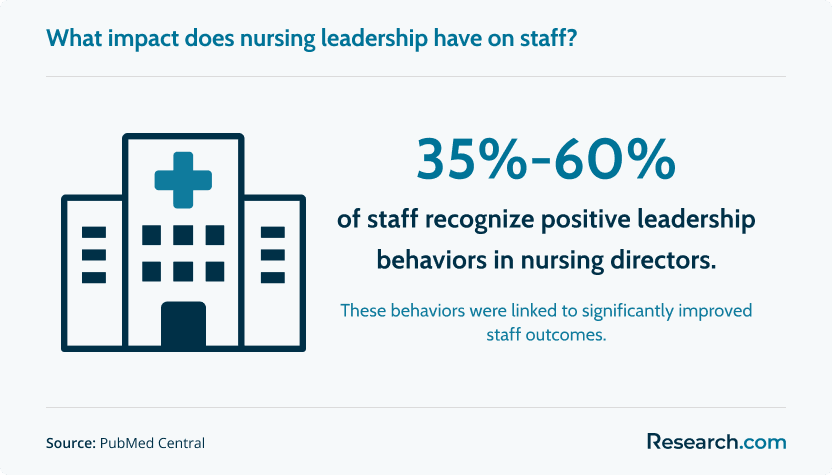
Leadership styles shape both staff and organizational outcomes. Research shows that transformational leadership is especially effective during periods of change or when motivating teams toward innovation. It is linked to higher job satisfaction and lower burnout among nurses.
Other approaches also bring unique strengths, and the best online nurse leadership DNP programs help prepare nurses to apply them effectively.
Transformational Leadership
This style focuses on inspiring and motivating the nursing team by setting a clear vision, encouraging innovation, and empowering staff. Evidence shows that transformational leadership significantly improves job satisfaction, work environment, and quality of care.
A systematic review of five studies between 2019 and 2024 found that transformational leadership “significantly enhances job satisfaction among nurses.”
Servant Leadership
Servant leadership emphasizes serving the staff first: focusing on their growth, well-being, and engagement. Unlike transformational leadership, servant leadership focuses on supporting staff growth rather than primarily inspiring organizational change.
Servant leadership is most effective when staff development and well-being are prioritized to improve engagement and reduce burnout. Servant leadership showed buffering effects on workplace stressors, decreasing burnout, and improving satisfaction.
Situational Leadership
In this style, leaders adapt their approach depending on the maturity, readiness, and needs of their team and the situation. Evidence indicates that training programs in situational leadership and emotional intelligence significantly boost managerial effectiveness. In one program, head nurses’ situational leadership skill levels rose from 8.9% (pre-training) to 73.3% (follow-up) after the intervention.
What are the typical roles and responsibilities of a nurse leader?
Unlike staff nurses, who focus on bedside care, nurse leaders navigate broader responsibilities that connect clinical practice to administrative strategy. Their responsibilities go beyond clinical expertise, requiring them to oversee teams, manage resources, and align nursing practice with healthcare goals—much like how different types of therapists balance patient care with specialized approaches to mental health and wellness.
Here are the typical roles and responsibilities that define the work of nurse leaders:
- Setting strategy, policies, and organizational goals: Nurse leaders help develop and execute nursing strategies that align with the broader mission and vision of their healthcare organization. They also contribute to creating or revising policies related to patient care, safety, and regulatory compliance.
- Overseeing quality and patient outcomes: They monitor performance metrics like patient safety, readmission rates, infection control, and patient satisfaction. Based on that data, they lead quality improvement initiatives to enhance care.
- Managing resources and budget: Nurse leaders are responsible for staffing, allocating supplies, controlling costs, and ensuring that their units or departments operate within budget constraints.
- Staff development and mentorship. They train, mentor, and evaluate nursing staff; support professional growth. Nurse leaders foster a positive work environment to retain talent.
- Communication and coordination across departments: Nurse leaders serve as a liaison between clinical staff, physicians, administration, and sometimes external stakeholders. They ensure information flows, collaborate in multidisciplinary settings, and coordinate interventions.
- Decision-making: They must be able to make timely decisions, adapt to shifts in healthcare, solve problems, and guide teams through uncertainty.
What education, training, and experience are required for nurse leadership?
In 2027, becoming a nurse leader generally requires a mix of formal education, specialized training, and hands-on experience. Here are the key components of education, training, and experience required:
- Bachelor’s degree (BSN): Almost all nurse leaders begin with a BSN. Many institutions and roles expect this as the minimum educational requirement.
- Advanced degree: For director-level and executive roles, a doctoral degree is often required or strongly preferred.
- Leadership training and certification: Participation in leadership training programs helps build management, communication, and strategic planning skills. Examples include the American Organization for Nursing Leadership (AONL) Nurse Manager Fellowship and certification programs like the Certified Nurse Manager and Leader (CNML), LPN specialty certification, or Certified in Executive Nursing Practice (CENP).
- Substantial clinical and leadership experience: Nurse leaders commonly have three to more than five years of experience in clinical practice plus additional years in charge nurse roles or equivalent.
In a study of 144 nurse leaders, 50.7% held an MSN, 16% a doctoral degree, and 18.8% had only a BSN. Most also had at least 3–5 years of leadership experience. This shows that aspiring nurse leaders should plan for graduate education.
They should also seek early supervisory roles, since both advanced degrees and practical experience are key to moving into these positions.
Which certifications for nurse leaders are most valued by employers in 2027?
In 2027, employers will prioritize specific certifications for nurse leaders to ensure effective leadership and quality patient care. These credentials not only validate advanced skills but also open doors to better career opportunities.
For example, pursuing advanced practice roles can be financially rewarding. DNP women’s health salary is often very ideal, so many nurses seek certifications that help them qualify for these positions while also building leadership capacity.
The following certifications are among the most valued by employers:
- Nurse Executive-Board Certified (NE-BC): This certification is recognized as a standard for nurse executives. It demonstrates a nurse's ability to oversee the daily operations and development of a facility’s nursing staff. It prepares them for executive-level roles such as CNO.
- Certified Nurse Manager and Leader (CNML): This certification is designed for nurses in management roles. It recognizes the leadership qualities of nurses in nurse management positions. Having a CNML credential corroborates that a nurse can effectively oversee nursing departments and liaise with facility executives.
- Clinical Nurse Leader (CNL): The CNL certification is for nurses aiming to practice across the continuum of care within any healthcare setting. CNLs oversee care coordination, provide direct patient care in complex situations, and ensure patients benefit from the latest innovations in care delivery.
How much leadership experience do employers expect for nurse manager roles?
Employers typically expect nurse managers to have 2 to 5 years of leadership or management experience.
For example, roles such as charge nurse, unit coordinator, or assistant nurse manager are ideal candidates for DNP PNP jobs because they give nurses supervisory experience and exposure to administrative duties. This prepares them for the added responsibilities that come with leadership.
A report by the AONL found that 50% of nurse managers had 3.5 or fewer years of management experience. This shows that many employers are willing to hire candidates with relatively recent leadership backgrounds.
However, the same report noted that turnover is highest in the first four years of leadership. This suggests that while employers may accept less-experienced candidates, they also recognize the challenges and risks that come with early leadership transitions. Exploring top geoscience career paths can offer insight into long-term career planning and growth opportunities in specialized fields.
What is the typical career progression from staff nurse to chief nursing officer?
The typical career progression from staff nurse to CNO involves several key steps, each requiring a combination of clinical experience, advanced education, and leadership development.
- Staff Nurse (RN): Nurse leaders typically begin their careers by earning a BSN and obtaining Registered Nurse licensure. They then gain 2-5 years of foundational clinical experience to build essential patient care skills and understand healthcare delivery systems.
- Charge Nurse or Nurse Manager: At this stage, nurses transition into leadership roles such as charge nurse or nurse manager. They oversee nursing teams, manage patient care delivery, and ensure compliance with healthcare standards. This experience is crucial for developing supervisory and administrative skills.
- Director of Nursing or Assistant CNO: In these roles, nurse leaders take on responsibilities such as strategic planning, budgeting, and policy development. At this stage, many nurses consider advanced credentials such as a Doctor of Nursing Practice (DNP). They often ask "why pursue a DNP?" and find that it strengthens leadership credibility and decision-making authority.
- Chief Nursing Officer: The culmination of this career path is the Chief Nursing Officer role. In this executive position, the nurse leader oversees the entire nursing division, collaborates with other senior leaders, and drives initiatives to improve patient care and nursing practice across the organization.
Typically, it takes 5 to 10 years for a staff nurse to reach formal leadership roles, such as charge nurse, nurse manager, or director of nursing. Early-career nurses usually spend 2-5 years gaining clinical experience before moving into supervisory positions.
Advancing to mid- or senior-level leadership roles often requires another 3–5 years of management experience, along with a graduate degree (MSN or DNP) and leadership certifications such as NE-BC or CNML. For those considering alternative technical paths, exploring jobs for biomedical engineers highlights potential career options outside traditional clinical nursing leadership.
What is the average salary of nurse leaders in the U.S. in 2027?
The average hourly wage for nurse leadership roles in the United States is approximately $39. This equates to an annual salary of about $80,321. Employment in larger, urban hospitals or national healthcare systems often comes with higher salaries. Nurse leaders in urban facilities and national health systems are more likely to earn salaries of $120,000 or more per year.
Nurse leaders with advanced degrees, such as an MSN or DNP, often command higher salaries. Additionally, those with extensive leadership experience are typically compensated at the upper end of the salary range.
Nurse leaders with advanced degrees, such as an MSN or DNP, often command higher salaries. Many pursue online DNP AGPCNP programs to strengthen their qualifications and improve their earning potential. Additionally, those with extensive leadership experience are typically compensated at the upper end of the salary range.
Salaries also differ across states and cities due to variations in the cost of living and regional demand for healthcare professionals. For instance, in Washington, D.C., the average salary for nursing leadership is $54.09 per hour, or $112,517 per year, which is notably higher than the national average.
What are the biggest challenges nurse leaders face in 2027?
In 2027, nurse leaders face a complex healthcare landscape that tests both their clinical and managerial skills. They must navigate persistent staffing shortages, rising workplace violence, financial constraints, and widespread burnout among their teams.
These pressures impact patient care and force nurse leaders to maintain team stability, morale, and organizational performance.
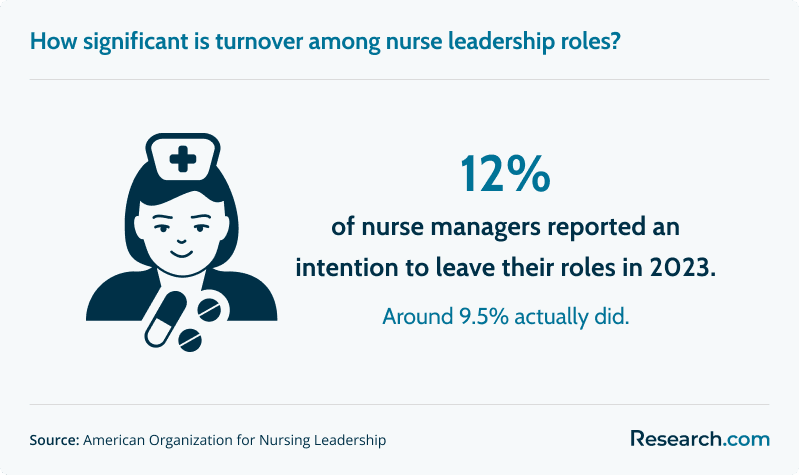
- Staff Recruitment and Retention: A 2027 study revealed that the current nursing shortage is expected to continue at least until 2030. Additionally, approximately 29% of hospital nursing leaders anticipate leaving their positions within the next 12 months, exacerbating the leadership gap.
- Workplace Violence: Nurse leaders report increasing incidents of workplace violence, including physical assaults and verbal abuse. A survey in Texas found that nearly 75% of nurses experienced some form of violence or harassment in the past year. This environment contributes to burnout and job dissatisfaction among nursing staff.
- Financial Constraints: Budget limitations continue to hinder the ability of nurse leaders to implement necessary staffing and resource strategies. Despite the critical need for additional staff and resources, many healthcare facilities face financial pressures that restrict their capacity to meet these demands.
- Emotional Well-being of Staff: While there has been some progress in addressing the emotional health of nursing staff, challenges persist. Nurse leaders report that burnout, stress, and emotional fatigue remain prevalent among their teams, affecting overall morale and productivity.
How is AI and digital health changing the nurse leader’s role in 2027?
Artificial intelligence and digital health tools are helping nurse leaders make faster, more informed clinical decisions in 2027. Predictive analytics, for example, can identify patients at higher risk for complications such as sepsis, enabling proactive interventions that improve outcomes.
In U.S. hospitals, 64% of nurses want more AI tools incorporated into their work. This growing demand places responsibility on nurse leaders to ensure AI insights are applied safely and effectively in patient care.
AI-powered platforms are also streamlining nurse leaders' administrative tasks. For instance, Cedars-Sinai Medical Center’s CS Connect platform has served over 42,000 patients since its launch, providing 24/7 virtual care and reducing routine workload for nursing staff. By automating scheduling, documentation, and routine reporting, nurse leaders can dedicate more time to strategic planning, mentoring staff, and improving care quality.
Here’s What Nursing Leaders Have to Say About Their Careers
- Eve: "Being a nurse leader is a fulfilling yet challenging career. Overseeing a unit means balancing staff strengths with patient needs, and the complexity keeps me engaged daily. When I implemented a new infection-control protocol that reduced errors by 12% last quarter, I saw how leadership decisions ripple through both staff and patients."
- Faith: "During the Leadership in Nursing course, I led a simulated outbreak response team, which tested my decision-making under pressure. The detailed modules on budgeting and compliance made me realize how much strategy goes into patient care beyond the floor. It gave me real confidence stepping into a nurse manager role."
- Marie: "I never expected that my cohort would become such a practical resource. Weekly case-study discussions with faculty and alumni showed me how to handle understaffing crises and workflow bottlenecks in real hospitals. Those lessons are what I still reference when scheduling my team."
Key Things
- A good nurse leader combines clinical expertise with strong communication skills to guide teams effectively.
- Their role extends beyond patient care to shaping policies, mentoring future nurses, and driving healthcare innovation, which is essential as the U.S. is projected to need over 200,000 new registered nurses annually through 2031.
- Critical leadership skills include emotional intelligence, conflict resolution, and strategic decision-making, and 77% of healthcare workers report higher job satisfaction when their leaders demonstrate high emotional intelligence.
- Effective nurse leaders adapt their leadership style, such as transformational or servant leadership, to fit team and organizational needs, with transformational leadership shown to improve nurse retention by 15%.
- Studies show that strong nurse leadership can reduce patient mortality rates by up to 20%.
References:
- American Association of Colleges of Nursing. (2023, September 25). Rounds with leadership: Following nursing workforce trends, part I. https://www.aacnnursing.org/news-data/all-news/article/rounds-with-leadership-following-nursing-workforce-trends-part-i
- American Organization for Nursing Leadership. (2024, January). Longitudinal nursing leadership insight study 5 report (v5.0). https://www.aonl.org/system/files/media/file/2024/01/AONL-Longitudinal-Nursing-Leadership-Insight-Study-5-Report_v5_0.pdf
- American Organization for Nursing Leadership. (2025, March). Nursing leadership insight study 2025. https://www.aonl.org/system/files/media/file/2025/03/AONL-Nursing-Leadership-Insight-Study-2025.pdf
- American Organization for Nursing Leadership. (2023, October 10). Laudio and AONL release new report on nurse manager retention [Press release]. https://www.aonl.org/press-release/Laudio-and-AONL-Release-New-Report-on-Nurse-Manager-Retention
- Clinical Advisor. (2023, December 15). Hospital nurse leaders: Key trends and challenges. Clinical Advisor. https://www.clinicaladvisor.com/news/hospital-nurse-leaders/
- Heat Treat Today. (2022, August 3). Why management training is a must. https://www.heattreat.net/news/why-management-training-is-a-must
- McKinsey & Company. (2023, September). The pulse of nurses: Perspectives on AI in healthcare delivery. https://www.mckinsey.com/industries/healthcare/our-insights/the-pulse-of-nurses-perspectives-on-ai-in-healthcare-delivery
- PubMed Central. (2025). Leadership styles in nursing: A comparative review [Review of the article]. National Center for Biotechnology Information. https://pmc.ncbi.nlm.nih.gov/articles/PMC12278974/cf
- Salary.com. (2025). Clinical nurse leader salary. https://www.salary.com/research/salary/recruiting/clinical-nurse-leader-salary
- Southern New Hampshire University. (2023, November 14). 5 leadership styles in nursing. https://www.snhu.edu/about-us/newsroom/health/5-leadership-styles-in-nursing
- Texas Department of State Health Services. (2024). Workplace violence against nurses: individual survey report. https://www.dshs.texas.gov/sites/default/files/chs/cnws/Workplace%20Violence/2024/2024_Final_WPVAN_Individual%20Survey_Report_Accessible.pdf
- World Health Organization. (2025, May 12). Nursing workforce grows, but inequities threaten global health goals. https://www.who.int/news/item/12-05-2025-nursing-workforce-grows--but-inequities-threaten-global-health-goals
- ZipRecruiter. (2025). Chief nursing officer salary. https://www.ziprecruiter.com/Salaries/Chief-Nursing-Officer-Salary
- Zogheib, S. (2022). Leadership styles in healthcare: A focused analysis. Egyptian Journal of Health Care, 13(3), 1–12. https://journals.ekb.eg/article_274561_3d6bbf1a870d370f45d8b03915e68b03.pdf
Other Things You Should Know About Becoming a Good Nurse Leader in CURRENT_YEAR
Junior nurses can develop leadership competencies by pursuing continuous education, seeking mentorships, gaining experience through diverse roles, engaging in professional networking, and attending leadership workshops. These steps equip them with the skills needed for success in leadership roles within healthcare settings.
In 2027, transformational leadership, emphasizing inspiration and change, and servant leadership, focusing on the growth of team members, are key styles for nurse leaders. Both foster strong team dynamics, improve patient care, and adapt well to the evolving healthcare environment.


