
2027 What Can You Do with an Associate Degree in Early Childhood Education?

Co-Founder and Chief Data Scientist
Choosing a career path after high school can feel overwhelming, especially when you want a clear route to a stable and fulfilling profession. Many are turning to early childhood education—with over 30,000 degrees awarded last year—and the associate's degree is a powerful and efficient entry point into this important field.
To help you make a confident decision, our career planning experts with more than 10 years of experience have created this definitive guide. Here, we'll provide a clear, data-driven analysis of the early childhood education degree, covering the jobs it unlocks, the salary you can expect, and the career's long-term value.
Key Things You Should Know About Associate Degrees in Early Childhood Education
- The national median salary for preschool teachers is $37,120, providing a stable income for an entry-level position.
- The field has an estimated 65,500 job openings each year, indicating strong and consistent demand for qualified professionals.
- You can start your career affordably, as the median in-state public tuition for this degree is just $6,582.
- The degree is a two-year program, allowing you to enter the workforce and start earning much faster than a traditional four-year path.
- Graduates are qualified for key roles like preschool teacher, teacher assistant, and childcare worker right after graduation.
- What is an associate degree in early childhood education? Degree Overview
- What can you do with an associate degree in early childhood education? What can you do with an associate degree in early childhood education?
- What's the difference between an associate and a bachelor's degree in this field? What's the difference between an associate and a bachelor's degree in this field?
- Where do early childhood education professionals typically work? Work Environment
- What is the typical salary for an associate early childhood education degree? Salary
- What is the job outlook for graduates of associate's in early childhood education degree programs? Job Outlook
- What skills will I learn in an associate's in early childhood education degree program? Skills
- How much does an associate degree in early childhood education cost? Program Cost
- How do I choose the right associate's in early childhood education degree program? How do I choose the right associate's in early childhood education degree program?
- What are the next steps for career advancement after earning an associate's in early childhood education degree? What are the next steps for career advancement after earning an associate's in early childhood education degree?
- Can Advanced Online Programs Accelerate My Early Childhood Education Career? Can Advanced Online Programs Accelerate My Early Childhood Education Career?
- Who is a good fit for a career in early childhood education? Who is a good fit for a career in early childhood education?
- Is an associate's in early childhood education degree worth it? Is an associate's in early childhood education degree worth it?
Associate Degree in Early Childhood Education: What It Is, What It Leads To, and How to Decide
An associate degree in early childhood education is usually one of the fastest college-based routes into paid work with infants, toddlers, preschoolers, and young children. It is designed for students who want a practical, affordable credential that can lead to entry-level classroom and childcare roles, while also keeping the door open to a bachelor's degree later.
This guide is for prospective students, career changers, childcare workers who want a formal credential, and high school graduates comparing education pathways. You will learn what the degree covers, which jobs it can support, how much graduates may earn, what the job outlook looks like, how to compare programs, and when this path is or is not worth the investment.
Quick answer: Is an associate degree in early childhood education useful?
Yes, an associate degree in early childhood education can be useful if your goal is to enter the early childhood workforce quickly, qualify for preschool or childcare roles, reduce college costs, and potentially transfer credits into a bachelor's program later. It is not usually enough for public elementary teaching roles or higher-level leadership positions, which often require a bachelor's degree or graduate education.
| Best fit | What the degree can help you do | Important limitation |
| Students seeking a short, career-focused education path | Prepare for preschool, childcare, and teacher assistant roles | Some school systems and states may require additional credentials |
| Working childcare employees | Build formal knowledge in child development, safety, and curriculum | Advancement may require more education |
| Students planning to transfer later | Complete lower-division coursework before pursuing a bachelor's degree | Credits transfer best when the school has clear articulation agreements |
What can you do with an associate degree in early childhood education?
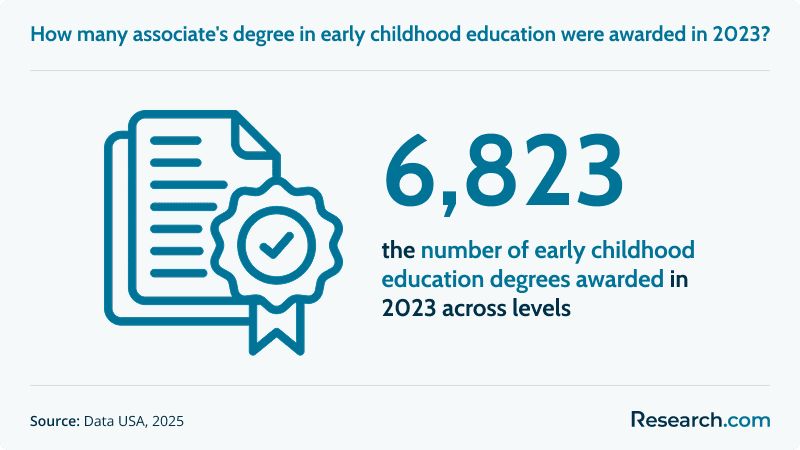
With an associate degree in early childhood education, you can pursue hands-on roles that support young children's learning, safety, behavior, social development, and school readiness. In 2023, 6,823 of these specific degrees were awarded, showing that this remains a common academic route into the field.
The degree is most useful for people who want direct interaction with children rather than policy, administration, or research roles. Common options include:
- Preschool teacher: You may help lead classroom routines, create age-appropriate activities, introduce early literacy and math concepts, support social-emotional growth, and prepare children for kindergarten.
- Teacher assistant: You may work under a lead teacher, supervise small groups, help with classroom transitions, provide individual support, and assist with instructional activities.
- Childcare worker: You may care for children in daycare centers, private homes, early learning programs, or after-school environments while maintaining a safe, structured, and nurturing setting.
The associate degree is a starting credential, not the final step for every educator. If your long-term goal is senior leadership, doctoral-level specialization, or research-informed administrative work, reviewing the best online EdD programs in early childhood education can help you understand how far the education pathway can extend.
| Role | Typical focus | When this path makes sense |
| Preschool teacher | Early learning, classroom routines, school readiness, child development | You want to lead activities and work directly with preschool-age children |
| Teacher assistant | Instructional support, classroom supervision, small-group help | You want classroom experience before becoming a lead teacher or pursuing more education |
| Childcare worker | Daily care, safety, play-based learning, family communication | You want a childcare-centered role in a daycare, home-based, or community setting |
Associate vs. bachelor's degree in early childhood education: which should you choose?
The main differences between an associate and bachelor's degree are program length, cost, transfer value, and career ceiling. An associate degree is usually the faster and lower-cost option. A bachelor's degree generally supports broader teaching, leadership, and graduate school opportunities.
| Factor | Associate degree | Bachelor's degree |
| Typical length | Two-year program | Four-year program |
| Cost profile | Often more affordable, especially at community colleges | Usually requires a larger financial commitment |
| Career scope | Entry-level preschool, childcare, and assistant roles | More access to lead, licensed, leadership, and school-based pathways |
| Strategic value | Can be a stackable credential if credits transfer | Can support graduate study and higher-level roles |
| Degree volume | 6,823 degrees awarded in 2023 | 12,709 bachelor's degrees awarded in 2023 |
Choose the associate degree if you want to enter the workforce quickly, test whether early childhood education is right for you, or keep college costs low while earning transferable credits. Choose the bachelor's degree if you already know you want broader teaching eligibility, leadership options, or graduate education.
Students comparing education pathways sometimes evaluate other structured degree-completion routes as well. For example, healthcare students can review RN to BSN class requirements to see how another profession maps required coursework for advancement.
Why a bachelor's degree matters for advancement
A bachelor's degree is often the academic foundation for roles such as program director, curriculum specialist, or licensed teacher in settings that require more advanced preparation. It is also the usual prerequisite for graduate study. That is why the answer to the question can you get a master's degree in education without a bachelor's degree is generally no.
Where do early childhood education graduates work?
Early childhood education professionals work in childcare centers, preschools, elementary schools, Head Start programs, nonprofit agencies, faith-based organizations, and community programs. Your work setting affects your schedule, responsibilities, benefits, pay, and career mobility.
- Child care services: This is the largest employment sector for preschool teachers, with over 316,820 preschool teachers. Roles may be found in private, nonprofit, and corporate childcare centers. The median wage in this sector is $52,810 annually.
- Elementary and secondary schools: Nearly 75,000 professionals work in these settings, including public and private schools with pre-kindergarten programs. These jobs may follow a school-year calendar and have a median wage of $50,610.
- Individual and family services: More than 12,000 educators work in organizations such as Head Start programs and community nonprofits. This setting may appeal to students who want to combine education with family support and social services.
- Religious and community organizations: Faith-based programs, local government initiatives, and community learning centers also hire early childhood professionals, often with a strong local-service mission.
| Work setting | What to expect | Good fit if you want... |
| Childcare center | Year-round care, structured routines, close family interaction | Consistent direct work with young children |
| Public or private school | School calendar, pre-K programming, more formal academic structure | A classroom environment connected to K-12 education |
| Head Start or nonprofit program | Education plus family support and community services | Mission-driven work with children and families |
| Faith-based or community program | Local service, values-based programming, community relationships | A smaller or community-centered workplace |
If you are comparing education careers with healthcare roles that also involve high-responsibility daily routines, this overview of what it is like to work as a psychiatric mental health nurse practitioner provides a useful cross-field example of how work settings shape professional life.
How much can you earn with an associate degree in early childhood education?
The national median salary for preschool teachers is $37,120 per year. That figure is best understood as a benchmark, not a guarantee. Actual pay depends on your employer, state, local labor market, experience, job title, credentials, and whether the role is full time, part time, year-round, or school-year based.
Location can make a noticeable difference. Nebraska has a median wage of $50,270, New Jersey has a median wage of $46,570, and California has a median wage of $45,880. Employer type also matters, with some private childcare centers and school-based programs offering more competitive compensation than smaller community programs.
| Salary factor | Why it matters | What to ask before enrolling |
| State and local market | Pay often reflects local demand, funding, and cost of living | What do graduates typically earn in my area? |
| Employer type | Schools, private centers, nonprofits, and community programs may pay differently | Where do recent graduates get hired? |
| Credentials and licensure | Some roles require state-specific credentials beyond the degree | Does this program meet requirements for my state or target employer? |
| Transfer pathway | A bachelor's degree may support advancement later | Will my credits transfer into a four-year program? |
Salary planning should include both your expected income and your total cost of attendance. Students who are also exploring healthcare helping professions can compare skill expectations by reading about the qualities that make a good mental health nurse.
What is the job outlook for associate degree graduates in early childhood education?
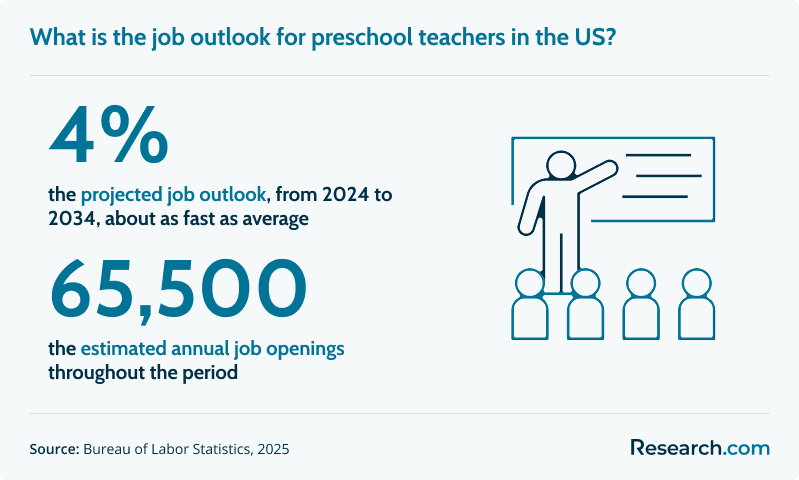
The job outlook for preschool teachers is projected to grow 4% by 2034, which is about as fast as average. For students planning a career, the more practical figure may be the estimated 65,500 job openings each year. Openings can come from new positions, retirements, turnover, and workers moving into different roles.
This outlook suggests a stable labor market rather than a field with explosive growth. That matters for decision-making: an associate degree can help you enter a profession with recurring hiring needs, but you should still research local job postings, employer requirements, and wage levels before choosing a program.
Where demand may be stronger
Job opportunities vary widely by state, metro area, public funding, childcare demand, and employer type. If you are open to relocating, researching states with high demand for teachers can help you identify regions where hiring needs may be stronger.
| Labor market signal | What it tells you | How to use it |
| Job postings near you | Which roles employers are actively filling | Check titles, pay ranges, degree requirements, and required credentials |
| State licensing rules | Whether the associate degree is enough for your target role | Verify requirements before enrolling |
| Employer type | Where graduates are most likely to work | Compare childcare centers, schools, nonprofits, and Head Start programs |
| Transfer options | Whether you can advance later without starting over | Favor programs with clear bachelor's transfer agreements |
What will you learn in an associate degree in early childhood education program?
An associate program in early childhood education teaches the knowledge and practical skills needed to support young children's development in safe, organized, and engaging learning environments. The coursework usually goes beyond basic supervision and introduces students to child development, classroom practice, health and safety, curriculum design, and family communication.
- Child development: You will study how young children grow physically, cognitively, socially, emotionally, and linguistically.
- Curriculum and lesson planning: You will learn how to create age-appropriate activities that support early literacy, numeracy, play, creativity, and social development.
- Classroom management: You will practice strategies for routines, transitions, behavior guidance, engagement, and positive classroom climate.
- Health and safety: You will learn procedures related to nutrition, hygiene, supervision, injury prevention, and emergency preparedness in early childhood programs.
- Family communication: You will develop skills for working professionally with parents, guardians, colleagues, and administrators.
Foundational preparation vs. advanced study
The associate degree focuses on classroom-ready skills and foundational theory. A bachelor's program typically expands that base with deeper work in educational psychology, assessment, diverse learners, research, and leadership. If you want to see how the next academic level builds on the associate curriculum, compare the courses in a bachelor's in early childhood education program.
How much does an associate degree in early childhood education cost?
Cost varies by school type, residency status, delivery format, fees, books, transportation, technology needs, and whether you attend full time or part time. The median cost for in-state public tuition is $6,582, while the median for out-of-state private tuition is $30,530.
For many students, a community college associate program is the most affordable route. It can provide career preparation while limiting debt, especially if the program has transfer agreements with nearby four-year institutions.
Do not compare programs by tuition alone. The better question is total value: Will the school prepare you for the role you want, meet employer or state requirements, include field experience, and allow you to transfer credits if you continue?
| Cost item | Why it matters | How to reduce the risk |
| Tuition | The largest visible cost | Compare in-state public options first |
| Fees and materials | Can increase the real cost of attendance | Ask for a full cost breakdown before enrolling |
| Transportation or technology | Campus and online programs have different hidden costs | Budget for commuting, childcare, software, and internet access |
| Transfer loss | Nontransferable credits can make a later bachelor's degree more expensive | Choose a school with written transfer agreements |
| Financial aid | Can reduce the amount you pay out of pocket | Submit the FAFSA and ask about grants and scholarships |
How do you choose the right associate degree in early childhood education program?
The right program should be accredited, affordable, connected to real classroom practice, aligned with your state's employment requirements, and designed so credits can transfer if you later pursue a bachelor's degree. A low price is not enough if the credential is not recognized or if credits do not apply toward future study.
- Confirm regional accreditation: Accreditation helps ensure the institution meets accepted academic standards and is more likely to be recognized by employers, licensing bodies, and transfer schools.
- Look for fieldwork: A practicum, observation, or internship gives you supervised experience with children before you graduate.
- Check transfer agreements: Written articulation agreements can protect your credits if you plan to complete a bachelor's degree later.
- Review state and employer requirements: Early childhood roles may have different requirements depending on your state, school system, or childcare setting.
- Compare support services: Advising, tutoring, career placement, online student support, and help arranging fieldwork can affect whether you finish on time.
Questions to ask before enrolling
| Question | Why it matters |
| Is the institution regionally accredited? | Accreditation affects transfer, employer recognition, and eligibility for many types of aid. |
| Does the program include supervised field experience? | Classroom practice helps you build confidence and apply what you learn. |
| Will the degree meet requirements for the roles I want in my state? | Requirements can vary by state, employer, and setting. |
| Which bachelor's programs accept these credits? | Transfer planning can save time and money later. |
| What are the total costs beyond tuition? | Fees, books, transportation, background checks, and technology can change affordability. |
| Where do graduates work after finishing? | Graduate outcomes help you judge whether the program connects to real opportunities. |
Plan early if you may continue beyond the associate degree
If you think you may eventually move into teaching credentials, administration, or advanced education roles, choose a program with transfer in mind from the beginning. A strong associate-to-bachelor pathway can later support options such as combined master's and teaching credential programs.
How can you advance after earning an associate degree in early childhood education?
Career advancement usually comes from combining work experience, additional credentials, and further education. The associate degree can help you enter the field, but lead teacher, director, curriculum, and public school pathways may require a bachelor's degree, state certification, or graduate-level preparation.
| Career stage | Typical next move | Why it helps |
| Entry level | Work as a childcare worker, teacher assistant, or preschool teacher | Build practical classroom experience and professional references |
| Early advancement | Earn additional state-required credentials or specialized training | Qualify for broader responsibilities or employer pay steps |
| Bachelor's completion | Transfer associate credits into a four-year program | Open more teaching, leadership, and graduate school options |
| Leadership preparation | Pursue advanced study or administrative training | Prepare for director, curriculum, or system-level roles |
The field often supports a stackable credential strategy: earn the associate degree, work in the field, transfer credits, and continue education while employed. This approach can be especially helpful for students who cannot afford to pause work for a full-time bachelor's program.
Long-term academic pathway
Educators who want senior roles may eventually pursue graduate credentials after completing a bachelor's degree. For those considering advanced education leadership, it may be useful to understand the benefits of an EdS degree for teachers.
Can advanced online programs accelerate an early childhood education career?
Advanced online programs can support career growth after an associate degree, but they are not a shortcut around required experience, bachelor's-level preparation, licensure rules, or employer expectations. They are most useful for working educators who already know they want to move toward leadership, curriculum design, teacher education, administration, or specialized research-informed practice.
Online study may help working professionals continue earning income while advancing academically. For educators looking far ahead to doctoral-level leadership, fast-track online EdD programs can show how advanced education pathways are structured for experienced professionals.
Who is a good fit for early childhood education?
Early childhood education is a strong fit for people who are patient, observant, emotionally steady, organized, and genuinely interested in how young children learn. Enjoying children is important, but it is not enough by itself. The work requires professionalism, stamina, communication skills, and the ability to guide behavior calmly.
- Patience and empathy: Young children are still learning how to communicate, manage emotions, follow routines, and interact with others.
- Creativity and flexibility: Strong educators can turn simple materials into meaningful activities and adjust quickly when a plan does not work.
- Emotional resilience: The job can involve noise, conflict, accidents, difficult family conversations, and challenging behaviors.
- Communication skills: You will need to speak clearly with children, families, coworkers, supervisors, and sometimes outside agencies.
- Organization: Lesson planning, documentation, safety procedures, classroom materials, and schedules all require attention to detail.
Who should consider a different path?
This may not be the right field if you want high earnings immediately, prefer independent desk-based work, dislike frequent communication with families, or are uncomfortable with physical, emotional, and behavioral demands. It may also be a poor fit if you are not willing to meet state-specific childcare requirements, background checks, or continuing training expectations.
| You may be a strong fit if... | You may want another path if... |
| You enjoy hands-on work with young children | You prefer limited interaction or independent technical work |
| You can stay calm during difficult moments | You become easily overwhelmed by noise or unpredictable behavior |
| You value meaningful work even when pay is modest | Your main goal is rapid salary growth |
| You are open to further education for advancement | You want the associate degree to qualify you for every teaching role |
Is an associate degree in early childhood education worth it?
An associate degree in early childhood education can be worth it for students who want a relatively fast, affordable route into a stable helping profession and who have realistic expectations about pay and advancement. The value is strongest when the program is accredited, includes field experience, aligns with local job requirements, and transfers smoothly into a bachelor's degree.
The financial case depends on cost control. A public in-state option with a median tuition of $6,582 is very different from an out-of-state private option with a median tuition of $30,530. When compared with the preschool teacher national median salary of $37,120 and the estimated 65,500 annual job openings, the degree can be a practical investment for students who choose carefully and avoid unnecessary debt.
The degree is less compelling if you enroll in a costly program without transfer value, assume it will qualify you for public elementary teaching, or expect salary outcomes that are not supported by the local labor market. The best decision is to compare programs, verify requirements, and calculate your likely return before committing.
Common mistakes to avoid when choosing this degree
| Mistake | Why it can hurt you | Better approach |
| Choosing a school without checking accreditation | Your credits or credential may not be recognized as expected | Verify institutional accreditation before applying |
| Looking only at tuition | Fees, books, transportation, and lost transfer credits can raise total cost | Compare full cost of attendance and transfer outcomes |
| Assuming every online program meets local requirements | State and employer rules may differ | Ask whether the program aligns with your state's early childhood requirements |
| Ignoring field experience | You may graduate with limited practical classroom preparation | Choose a program with practicum, observation, or internship opportunities |
| Assuming the associate degree is the end of the path | Leadership and licensed teaching roles may require more education | Plan a stackable pathway from associate to bachelor's if advancement matters |
| Relying only on rankings or advertising | A highly promoted program may not be the best local or financial fit | Compare accreditation, cost, outcomes, transfer agreements, and employer recognition |
Graduate perspectives on associate degrees in early childhood education
- : "When my previous position disappeared, I needed a realistic way to start over without committing to four years of school. The associate program gave me a clear route back into the workforce, and the online format made it possible to study while handling family responsibilities. I now have work that feels steady and meaningful. — Isla"
- : "I wanted to leave retail but did not want to take on a large amount of debt. A local associate program gave me an affordable option, and I was able to move into a teacher assistant role soon after finishing. The biggest benefit was gaining a career path where my work matters. — Joselle"
- : "After high school, the idea of choosing a four-year university felt overwhelming. The associate degree gave me a simpler plan: take the required courses, build classroom skills, and qualify for jobs in about two years. That structure helped me feel more confident about my future. — Chloe"
References
- Bureau of Labor Statistics. (2025). Occupational employment and wage statistics. U.S. Department of Labor. Retrieved September 27, 2025, from BLS occupational employment and wage statistics.
- Bureau of Labor Statistics. (2025). Preschool teachers. U.S. Department of Labor. Retrieved September 27, 2025, from BLS preschool teachers profile.
- Data USA. (2025). Early childhood education & teaching. Retrieved September 27, 2025, from Data USA early childhood education and teaching profile.
Key Insights
- An associate degree in early childhood education is best for students who want a two-year, career-focused route into preschool, childcare, or teacher assistant roles.
- The degree can be a smart first step, but it does not automatically qualify graduates for every teaching job. State rules, employer requirements, and licensure expectations matter.
- Cost control is central to value. The median in-state public tuition of $6,582 offers a very different return than the median out-of-state private tuition of $30,530.
- The national median salary for preschool teachers is $37,120, but pay varies by state and employer. Nebraska, New Jersey, and California show higher listed median wages.
- The job outlook is steady, with projected growth of 4% by 2034 and an estimated 65,500 openings each year.
- The best programs are accredited, include practical fieldwork, and have clear transfer agreements with four-year schools.
- This degree is most worth it when you want meaningful work with young children, understand the salary realities, and choose a program that supports both immediate employment and future advancement.
Other Things You Should Know About Associate Degree in Early Childhood Education Programs
In 2027, individuals holding an associate degree in early childhood education can advance to roles such as lead teacher or assistant director. Further education can lead to positions like educational coordinator or director at childcare centers. Additional credentials or a bachelor's degree may enhance career development.
An associate degree in early childhood education typically requires completing around 60 credit hours. In 2027, this includes courses in child development, education psychology, and curriculum planning. Exact requirements can vary by institution, so it's essential to check specific program details.


