
2027 Best RN to BSN Programs in Texas: Online & Campus

Co-Founder and Chief Data Scientist
Registered nurses in Texas often reach a point where an associate degree or nursing diploma is no longer enough for the roles they want next. Hospitals, specialty units, public health employers, and graduate nursing programs increasingly favor nurses with a Bachelor of Science in Nursing (BSN), especially for leadership, care coordination, education, and advanced practice pathways.
An RN to BSN program is built for licensed registered nurses who want to complete the bachelor's-level nursing coursework without starting over. In Texas, these programs are especially relevant because healthcare employment in the state is expected to grow by 19% through 2030, creating strong demand for nurses who can combine bedside experience with stronger skills in evidence-based practice, population health, informatics, and team leadership.
This guide explains how RN to BSN programs in Texas work, what they cost, how long they take, how online and campus formats compare, what to check before applying, and how the degree may affect your career options and salary potential.
Quick Answer: Is an RN to BSN Program in Texas Worth It?
For many working registered nurses in Texas, an RN to BSN program is worth considering if they want broader job options, stronger eligibility for leadership roles, or a foundation for graduate nursing study. The degree is not a replacement for RN licensure; it builds on it. The best choice is usually an accredited program that fits your work schedule, accepts your transfer credits, supports local clinical or practicum requirements, and has a total cost you can manage without overborrowing.
Key Benefits of RN to BSN Programs in Texas
- Flexible study options: Many Texas RN to BSN programs are online or hybrid, allowing nurses to complete coursework around shifts, family responsibilities, and clinical practice while pursuing a degree that can increase salary by up to 20%.
- Practical learning close to home: Strong programs often let students complete practicum or project-based experiences through local healthcare organizations, community settings, or approved workplace sites instead of requiring relocation.
- Better long-term mobility: BSN-prepared nurses may be more competitive for charge nurse, supervisor, public health, specialty, and graduate-school pathways, with job growth for BSN-prepared nurses cited as 15% faster than for nurses with only an ADN.
- What is an RN to BSN program and how does it work in Texas?
- What courses are included in RN to BSN programs in Texas?
- What are the admission requirements for RN to BSN programs in Texas?
- How long does it take to earn an RN to BSN degree in Texas?
- How much does an RN to BSN program cost in Texas?
- What are the pros and cons of online vs. on-campus RN to BSN programs in Texas?
- How do RN to BSN programs in Texas support clinical placements?
- Which accrediting bodies approve RN to BSN programs in Texas?
- What career opportunities are available to RN to BSN graduates in Texas?
- What is the average RN to BSN salary increase in Texas?
What is an RN to BSN program and how does it work in Texas?
An RN to BSN program in Texas is a bachelor’s degree completion pathway for registered nurses who already have an associate degree in nursing or a nursing diploma. Instead of repeating entry-level nursing preparation, students receive credit for prior RN education and focus on upper-division BSN coursework.
The curriculum usually moves beyond direct bedside tasks and emphasizes professional nursing judgment, leadership, healthcare systems, quality improvement, community health, research, ethics, and informatics. This makes the degree useful for nurses who want to move into roles that require broader decision-making, coordination across teams, or preparation for graduate nursing education.
Most Texas RN to BSN students continue working while enrolled. Online and hybrid formats are common because many applicants are already licensed RNs with rotating shifts. However, “online” does not always mean there are no practice-based requirements. Some programs include capstone projects, community health experiences, leadership projects, or approved clinical activities that must be completed in Texas or another approved location.
The degree is a good fit for nurses who want to qualify for more competitive hospital positions, strengthen their promotion prospects, prepare for an MSN or DNP, or explore specialties such as public health, case management, informatics, or nursing education. Nurses comparing longer-term options can also review how advanced roles differ in guides such as FNP vs. DNP career pathways.
| Question | What Texas RNs should know |
| Who is it for? | Licensed registered nurses with an ADN or nursing diploma who want to complete a bachelor’s degree. |
| Does it replace RN licensure? | No. Students must already be licensed or meet the program’s RN licensure rules. |
| Can working nurses enroll? | Yes. Many programs are designed for employed nurses and offer online, hybrid, full-time, part-time, or self-paced study. |
| What does the degree support? | Career mobility, leadership readiness, public health roles, specialty practice, and eligibility for many graduate nursing programs. |
What courses are included in RN to BSN programs in Texas?
RN to BSN coursework in Texas usually builds on what nurses already learned in ADN or diploma programs. The goal is not to reteach basic nursing care; it is to strengthen clinical reasoning, leadership, population-focused care, research use, communication, and systems-level thinking.
Common course areas include the following:
- Health Assessment Across the Lifespan: Students refine assessment techniques for patients at different life stages and learn to recognize subtle changes that may affect care decisions.
- Research and Evidence-Based Practice: This course teaches nurses how to evaluate studies, interpret evidence, and apply research-supported practices to improve patient outcomes.
- Community and Public Health Nursing: Students examine prevention, health promotion, population needs, and community-based interventions outside the traditional hospital bedside.
- Leadership and Management: Coursework often covers delegation, interprofessional communication, conflict management, staffing issues, quality improvement, and healthcare operations.
- Nursing Informatics and Technology: Students learn how electronic health records, data systems, digital workflows, and information tools support safer and more efficient care.
- Legal and Ethical Issues in Healthcare: This area focuses on patient rights, confidentiality, professional accountability, healthcare regulation, and ethical decision-making.
- Health Promotion Across the Lifespan: Students study wellness education, chronic disease prevention, and strategies for helping different age groups make healthier choices.
- Transition to Professional Nursing Practice: This course helps RNs connect prior clinical experience with the expanded expectations of BSN-level nursing practice.
- Public and Global Health Policy: Students review healthcare systems, policy decisions, advocacy, and the ways laws and financing affect access to care.
- Clinical Practicum or Capstone Experience: Many programs require a culminating project or applied experience that connects coursework to a real healthcare setting, workplace problem, or community need.
Many Texas RN to BSN programs also require general education or core curriculum credits. Nursing major requirements commonly include around 30-32 upper-level nursing credits, although the total number of credits you must complete depends on transfer credit, prior coursework, and the school’s graduation rules.
If your BSN is part of a longer plan to enter advanced practice, use your RN to BSN coursework to build a strong academic record. Nurses interested in women’s health, for example, can start by learning how to become a women’s health nurse practitioner after completing the required graduate preparation.
What are the admission requirements for RN to BSN programs in Texas?
Admission requirements vary by school, but most Texas RN to BSN programs look for the same core evidence: you are a licensed RN, you completed recognized nursing preparation, and you can handle upper-division college coursework.
- Active RN license: Applicants typically need a current Registered Nurse license from Texas or a Compact state. Some programs may allow conditional admission while licensure is being finalized, but clinical or practicum participation usually requires active licensure.
- Associate degree or nursing diploma: Most schools require an accredited ADN or approved nursing diploma so they can award transfer credit for prior nursing education.
- Minimum GPA: Many programs set a cumulative GPA requirement between 2.0 and 2.5, and some apply higher standards to science or nursing coursework.
- Official transcripts: Students usually must submit transcripts from every college attended so the school can evaluate prerequisites, transfer credits, and remaining degree requirements.
- Prerequisite courses: Common prerequisites include anatomy, microbiology, and statistics, often with a grade of C or better. Some Texas programs may also require completion of the Texas Core Curriculum.
- Professional references: Some schools request recommendations from supervisors, faculty, or clinical leaders who can speak to the applicant’s professionalism and readiness.
- Background, health, and compliance documentation: Before practice-based experiences, students may need a background check, drug screening, immunization records, CPR certification, and other clinical compliance items.
- English proficiency: Applicants whose prior education was not in English may need to submit an approved English proficiency score such as TOEFL, unless the school grants an exemption.
- Application materials and fees: Most programs require an application, fee, transcripts, and sometimes an advising session, orientation, or program-specific form.
| Before applying | Why it matters | What to ask |
| RN license status | Programs need proof that you are eligible to practice as an RN. | Can I apply before my license is active, or must I wait? |
| Transfer credits | Accepted credits can reduce time and cost. | How many ADN, diploma, general education, and prior college credits will transfer? |
| Prerequisites | Missing courses can delay graduation. | Which courses must be finished before admission, and which can be completed during the program? |
| Clinical or capstone rules | Online students may still need approved local experiences. | Can I complete practice requirements at my current workplace or in my community? |
| Accreditation | Accreditation affects employer recognition and future graduate study. | Is the nursing program accredited by CCNE or ACEN and approved as required in Texas? |
If you already know you want an advanced practice role later, check whether your RN to BSN program’s accreditation and GPA expectations align with graduate nursing admissions. For example, future acute care applicants may want to compare options such as online acute care nurse practitioner programs after completing the BSN.
How long does it take to earn an RN to BSN degree in Texas?
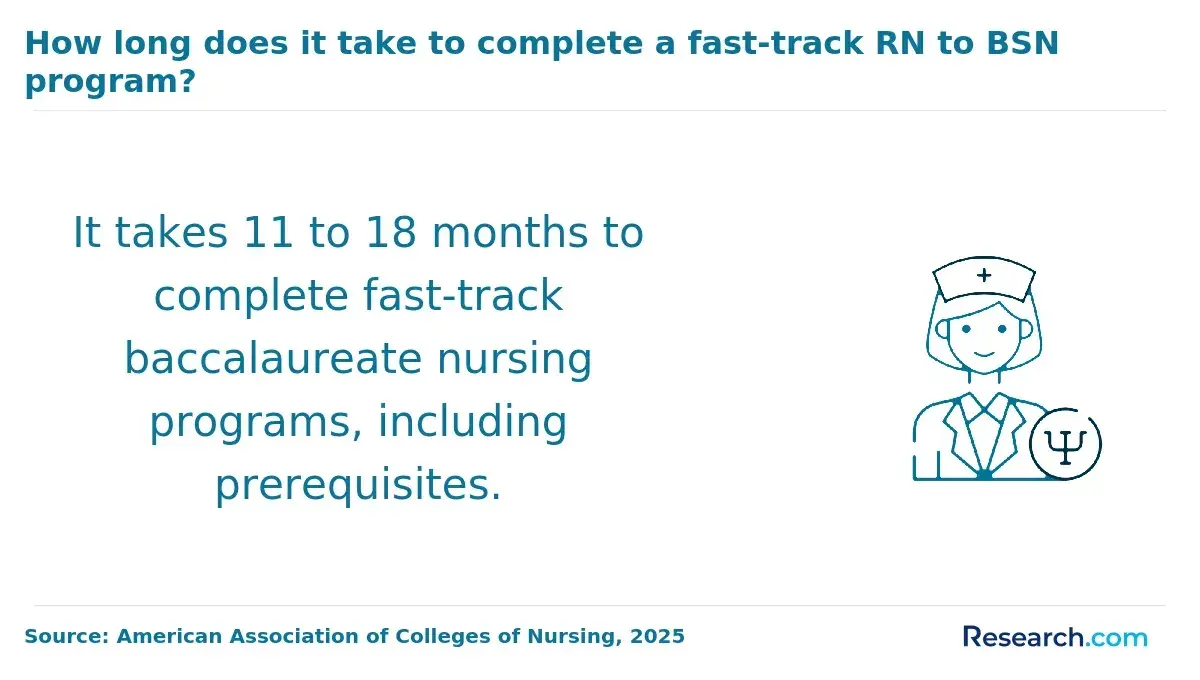
Completion time depends on enrollment pace, transfer credits, general education requirements, and how many courses you can manage while working. Texas RN to BSN programs are often shorter than traditional BSN programs because students enter as licensed nurses with prior nursing credits.
- Full-time enrollment: A full-time plan is commonly completed in 10 to 12 months. This route works best for nurses who can handle a concentrated course load alongside work or who can reduce work hours temporarily.
- Part-time enrollment: Part-time study usually takes about 18 to 24 months. This option is often more realistic for nurses with full-time employment, rotating shifts, caregiving duties, or limited study time.
- Self-paced formats: Some programs allow students to move through competency-based or flexible coursework at different speeds. Experienced nurses may progress faster in familiar areas, while others may slow down during demanding work periods.
- Hybrid and campus-based formats: Programs that combine online coursework with in-person meetings, labs, or campus sessions often take between 12 and 24 months, depending on scheduling and course sequencing.
| Program pace | Typical completion time | Best for | Main trade-off |
| Full-time | 10 to 12 months | RNs who want the fastest route and can manage a heavier academic load | Less flexibility during busy work or family periods |
| Part-time | 18 to 24 months | RNs balancing employment, family, and school | Longer time before degree completion |
| Self-paced | Varies by student | Independent learners with strong time-management skills | Requires discipline and careful planning |
| Hybrid or on-campus | 12 to 24 months | Students who want structure and some face-to-face interaction | Less schedule freedom than fully online study |
How much does an RN to BSN program cost in Texas?
The cost of an RN to BSN program in Texas depends on tuition, transfer credits, residency status, fees, textbooks, technology charges, and how long you stay enrolled. The advertised tuition price is only part of the picture, so compare total program cost before choosing a school.
- Tuition per credit hour: Tuition is usually the largest expense. Depending on the institution, format, and residency status, programs may charge around $300 to $700 per credit hour.
- Total program cost: Many Texas RN to BSN programs require between 30 to 40 credit hours, which can place the full tuition range between $9,000 and $28,000.
- Program fees: Online students may pay technology, course material, exam proctoring, or platform fees. Campus students may see facility, activity, parking, or campus service fees.
- Financial aid and employer benefits: Scholarships, grants, payment plans, and employer tuition reimbursement can reduce out-of-pocket costs. Nurses should ask their human resources department and school financial aid office about deadlines and eligibility.
| Cost factor | Why it matters | How to control it |
| Transfer credit | More accepted credits can reduce the number of courses you must pay for. | Request an unofficial transfer evaluation before enrolling. |
| Residency status | Some public institutions charge different rates for in-state and out-of-state students. | Confirm the exact tuition rate that applies to you. |
| Fees | Technology, testing, clinical, and campus fees can add several hundred dollars. | Ask for a complete fee schedule, not just tuition per credit. |
| Enrollment pace | Taking longer may affect fees, financial aid timing, and opportunity cost. | Choose a pace that you can finish without stopping out. |
| Employer reimbursement | Hospitals and healthcare systems may help pay for BSN completion. | Ask whether reimbursement requires minimum grades, continued employment, or an approved school. |
- : "A Texas nurse who completed a hybrid RN to BSN program described the cost as manageable but not automatic. “Tuition was about $400 per credit hour, and the program required about 35 credits,” he said. “The total felt intimidating at first, but a scholarship and employer tuition reimbursement made it possible. Spreading the payments across terms helped, and the flexible schedule allowed me to keep working while I finished the degree.”"
What are the pros and cons of online vs. on-campus RN to BSN programs in Texas?
The right format depends on how you learn, how predictable your nursing schedule is, how much structure you need, and whether the program’s practice requirements can be completed near you. Online programs are often the most practical for working RNs, while campus-based programs may offer more direct interaction and routine.
| Format | Advantages | Limitations | Best fit |
| Online | Flexible coursework, no commuting, easier to schedule around shifts, often strong fit for working nurses | Requires self-discipline, fewer spontaneous in-person connections, may still include local practicum requirements | RNs with variable schedules, family responsibilities, or long commutes |
| Hybrid | Combines online convenience with some face-to-face learning or campus engagement | Campus dates or synchronous meetings may conflict with work | Students who want flexibility but still value periodic in-person contact |
| On-campus | Structured schedule, direct faculty access, stronger in-person networking, campus resources | Less flexible, commuting time, possible higher living or travel costs | Students who learn best with routine, classroom interaction, and local campus access |
Online or Hybrid RN to BSN Programs
- Pro: Asynchronous or flexible coursework can make degree completion possible without leaving a nursing job.
- Pro: Some online options have tuition between $5,000 and $15,000, and students may save on transportation, parking, and housing.
- Con: Students may need to work harder to build faculty relationships, find peer support, and stay on schedule without regular classroom meetings.
On-Campus RN to BSN Programs
- Pro: Set meeting times and in-person instruction can help students stay organized and connected.
- Pro: Campus attendance can improve access to faculty, classmates, advising, and professional networking.
- Con: Fixed class times, commuting, and campus-related costs may be difficult for nurses working nights, weekends, or rotating shifts.
Either format can support career advancement if the program is accredited, affordable, and realistic for your schedule. Nurses who plan to continue into advanced practice may later compare graduate options such as online FNP programs.
How do RN to BSN programs in Texas support clinical placements?
RN to BSN clinical requirements are usually different from prelicensure nursing clinicals. Because students are already RNs, many programs focus on community health, leadership, quality improvement, care coordination, or capstone projects rather than basic bedside skill development. Still, students should ask exactly what in-person or site-based work is required before enrolling.
- Healthcare partnerships: Some programs maintain relationships with hospitals, clinics, community organizations, and healthcare systems that can support approved learning experiences.
- Preceptor or mentor support: Students may be paired with experienced nurses, managers, educators, or community health professionals who can guide applied projects.
- Workplace-based options: Certain programs allow employed RNs to complete approved experiences at their current workplace, provided the site and activity meet program requirements.
- Clinical coordination: Faculty members or clinical coordinators may help students understand paperwork, site approval, compliance documentation, timelines, and learning objectives.
- : "One Texas RN to BSN graduate said the placement process was less stressful because the school gave clear guidance. “I was concerned about fitting the required hours around my job,” she explained. “The program approved my hospital as a site, and the clinical coordinator helped me keep the paperwork on track. That support let me focus on the project instead of worrying about logistics.”"
Which accrediting bodies approve RN to BSN programs in Texas?
Accreditation is one of the most important factors when choosing an RN to BSN program. It signals that the nursing curriculum, faculty qualifications, student support, and outcomes have been reviewed against recognized standards. It may also affect employer recognition, tuition reimbursement, graduate school eligibility, and transferability.
- Commission on Collegiate Nursing Education (CCNE): CCNE is a national nursing accreditor for baccalaureate and graduate nursing programs, including RN to BSN tracks. CCNE-accredited programs must demonstrate appropriate curriculum quality, faculty preparation, and student outcome measures.
- Accreditation Commission for Education in Nursing (ACEN): ACEN accredits nursing programs across multiple education levels. ACEN accreditation indicates that a program has been evaluated for educational quality, faculty standards, curriculum design, and program effectiveness.
- Texas Board of Nursing (TBON): The Texas Board of Nursing provides state-level oversight for nursing education and nursing practice requirements in Texas. Students should confirm that a program’s status supports their academic and professional goals in the state.
How to Verify Accreditation Before You Apply
- Find the program’s accreditation statement on the school’s official nursing website.
- Confirm whether the nursing program itself, not only the institution, is accredited by CCNE or ACEN.
- Check whether the school is appropriately recognized for Texas nursing education requirements.
- Ask graduate nursing programs you may apply to later whether they accept degrees from the RN to BSN program you are considering.
- Get clarification in writing if an advisor says a program will meet employer, reimbursement, or graduate-school requirements.
What career opportunities are available to RN to BSN graduates in Texas?
A BSN does not guarantee a promotion or a specific salary, but it can make an RN more competitive for roles that require stronger leadership, education, public health, coordination, or specialty preparation. In Texas, BSN-prepared nurses may pursue opportunities in hospitals, outpatient clinics, schools, home health agencies, public health organizations, telehealth companies, and healthcare systems.
- BSN-prepared staff nurse: Many graduates remain in direct patient care but qualify for units, employers, or advancement tracks that prefer bachelor’s-prepared nurses.
- Charge nurse or nurse supervisor: The BSN can support movement into roles that coordinate staff, manage patient flow, assist with quality initiatives, and guide team communication.
- Home health nurse: BSN coursework in assessment, patient education, care coordination, and independent decision-making can be valuable for nurses providing care in patients’ homes.
- Specialty nurse: Nurses interested in areas such as critical care, pediatrics, oncology, emergency care, or perioperative nursing may benefit from the broader professional preparation of a BSN.
- Remote or telehealth nurse: Telehealth roles may involve patient triage, education, follow-up, chronic disease coaching, and virtual care coordination.
- Nurse educator or clinical instructor: Some healthcare organizations use BSN-prepared nurses to train staff, mentor students, support onboarding, or assist with continuing education.
- Advanced Practice Registered Nurse with further education: A BSN is commonly a stepping stone to MSN or DNP study for nurses pursuing nurse practitioner, nurse educator, nurse leader, or other advanced roles. Nurses considering women’s health can compare whether online women’s health nurse practitioner programs are affordable before committing to graduate school.
| Career direction | How the BSN helps | Next step to consider |
| Hospital advancement | Strengthens eligibility for BSN-preferred roles and internal promotion pathways. | Ask your employer which units or titles require or prefer a BSN. |
| Leadership | Builds skills in delegation, communication, quality improvement, and systems thinking. | Seek charge nurse experience, committees, or unit-based projects. |
| Public or community health | Emphasizes prevention, health education, population needs, and community assessment. | Look for local public health, school health, or community outreach opportunities. |
| Graduate nursing education | Provides the bachelor’s degree usually needed for many MSN or DNP programs. | Maintain a strong GPA and confirm prerequisite expectations early. |
What is the average RN to BSN salary increase in Texas?
Salary gains after completing an RN to BSN depend on location, employer, specialty, experience, shift differentials, union or system policies, and whether the nurse moves into a higher-responsibility role. A Texas RN without a BSN is cited as earning around $83,800 per year on average, but individual outcomes vary widely.
- ADN and BSN pay differences: BSN-prepared nurses may earn more than ADN-prepared nurses in employers that reward bachelor’s-level education or prefer BSN credentials for advancement.
- Healthcare setting: Large hospital systems, specialty departments, and urban labor markets such as Houston and Dallas may offer stronger pay opportunities than some rural or long-term care settings.
- Experience and role level: A BSN can help nurses compete for charge nurse, supervisor, educator, case management, or leadership roles that may pay more than staff RN positions.
- Long-term career path: The largest financial benefit may come over time through promotions, graduate school eligibility, tuition reimbursement, and access to specialized roles.
Common Mistakes to Avoid When Choosing a Texas RN to BSN Program
| Mistake | Why it can hurt you | Better approach |
| Choosing only by tuition | A low per-credit rate may not include fees, missing prerequisites, or limited transfer credits. | Compare total program cost after a transcript evaluation. |
| Ignoring accreditation | An unaccredited nursing program can create problems with employers, reimbursement, or graduate school. | Verify CCNE or ACEN accreditation and relevant Texas approval. |
| Assuming online means no in-person work | Some online programs still require approved practicum, community, or capstone activities. | Ask exactly where and how practice-based requirements are completed. |
| Overloading while working full time | Too many courses can lead to burnout, lower grades, or withdrawal. | Select a realistic pace based on your shifts, family obligations, and study time. |
| Relying only on rankings or advertising | A highly promoted program may not be the best fit for your schedule, budget, or goals. | Compare accreditation, cost, graduation requirements, support, and employer recognition. |
| Not asking about employer reimbursement rules | You may miss funding or choose a program your employer will not reimburse. | Confirm reimbursement limits, grade requirements, and approved school lists before enrolling. |
Here's What RN to BSN Graduates in Texas Have to Say About Their Degree
- Texas Woman's University’s online RN to BSN program gave me a workable path to finish my degree while caring for my family and staying employed. Remote coursework helped me keep moving forward without feeling that I had to choose between school and work. After graduation, I took a position in a local school and used my stronger clinical background to support student health more effectively. The degree broadened my career options and strengthened my interest in nursing education and community care. Amina
- Baylor University's hybrid RN to BSN program pushed me to grow academically while still giving me a schedule I could manage. The combination of online learning and in-person engagement helped me connect with classmates and faculty. When I began working in a local school, I felt prepared to respond to a wide range of student health needs. The program’s focus on leadership and evidence-based practice also encouraged me to keep building my nursing career in Texas. Josef
- The on-campus RN to BSN program at the University of Texas at Austin changed the way I approached nursing practice. Campus-based learning, rigorous assignments, and frequent interaction with peers helped me improve my communication and critical thinking. Starting my career in a local school setting allowed me to use those skills to promote health awareness among students. The program’s reputation in Texas also helped me feel more confident about future advancement. Lakisha
Key Insights
- An RN to BSN program in Texas is designed for licensed RNs who want to complete bachelor’s-level nursing education without repeating entry-level RN preparation.
- The strongest programs are accredited, transparent about total cost, generous with appropriate transfer credits, and clear about clinical, practicum, or capstone expectations.
- Online RN to BSN programs can be a practical fit for working nurses, but students should confirm whether any in-person or site-based experiences are required.
- Program length commonly ranges from 10 to 12 months for full-time students to about 18 to 24 months for part-time students, depending on credits and schedule.
- Costs vary widely, with tuition often around $300 to $700 per credit hour and total program costs commonly falling between $9,000 and $28,000.
- A BSN can support advancement into leadership, specialty, community health, telehealth, education, and graduate nursing pathways, but salary gains are not automatic and depend on employer, experience, role, and location.
- Before enrolling, ask schools about accreditation, transfer credit, total cost, employer reimbursement, practicum placement, graduation timeline, and support for working nurses.
Related Articles for Nearby States
- 2027 Best RN to BSN Programs in Louisiana: Online & Campus
- 2027 Best RN to BSN Programs in Oklahoma: Online & Campus
- 2027 Best RN to BSN Programs in Arkansas: Online & Campus
- 2027 Best RN to BSN Programs in New Mexico: Online & Campus
- 2027 Best RN to BSN Programs in Kansas: Online & Campus
- 2027 Best RN to BSN Programs in Missouri: Online & Campus
- 2027 Best RN to BSN Programs in Colorado: Online & Campus
- 2027 Best RN to BSN Programs in Mississippi: Online & Campus
- 2027 Best RN to BSN Programs in Tennessee: Online & Campus
- 2027 Best RN to BSN Programs in Arizona: Online & Campus
References:
- RN to BSN https://nursing.uth.edu/programs/bsn/rn-bsn/
- RN to BSN Program https://www.wtamu.edu/academics/college-nursing-health-sciences/department-nursing/programs/undergraduate/nursing-rn-program.html
- Registered Nurse Salary in Texas https://nurse.org/education/nurse-salary-texas/
- 2025 RN Salary Guide: State-by-State Pay https://nursa.com/salary/rn
- Online BSN Program - University of Texas at Arlington https://academicpartnerships.uta.edu/healthcare-nursing-online-programs/bachelor-of-science-nursing/
- 2025 RN to BSN Salary – Learn How Much RN to BSN Graduates Earn? https://www.nursingprocess.org/rn-to-bsn-salary/
- Average Nurse Salary by State in 2025: Which US States With the Highest LPN, RN and APRN Salaries? https://nightingale.edu/blog/nurse-salary-by-state.html
- RN vs BSN: Take the Next Step with an Online Degree https://online.txst.edu/degrees/healthcare/rn-to-bsn/now-is-the-time-to-enroll/
- Nursing Student Placement and Support | Texas Children's https://www.texaschildrens.org/health-professionals/for-nursing-professionals/nursing-professional-development/nursing-student
- Bachelor of Science in Nursing (B.S.N.) Major in Nursing (R.N. to B.S.N. Online Completion Program) https://mycatalog.txstate.edu/undergraduate/health-professions/st-davids-nursing/rn-to-bsn/
Other Things You Should Know About RN to BSN Programs in Texas
The top RN to BSN programs in Texas for 2027 include The University of Texas at Arlington, Texas A&M University-Corpus Christi, and The University of Texas at Tyler. These programs are highly recognized for their flexible online coursework, experienced faculty, and strong support networks for students.
Enrolling in an online RN to BSN program in Texas for 2027 offers flexibility, allowing nurses to balance work and study schedules. It often provides access to diverse resources and faculty, aligns with busy professionals’ lifestyles, and can be completed at one's own pace, broadening career opportunities and enhancing skills.
In 2027, RN to BSN programs in Texas typically require students to complete a set number of clinical hours in a healthcare setting. Texas programs usually involve around 70 to 90 clinical hours, offering hands-on practice and exposure to real-world healthcare environments.


