
2027 Best RN to BSN Programs in Illinois: Online & Campus

Co-Founder and Chief Data Scientist
Illinois stands as a beacon for nursing advancement, with over 140,000 registered nurses shaping its healthcare landscape. In a state where 70% of RN roles increasingly demand a BSN, upgrading credentials is no longer optional but essential for career growth and competitive edge. Pursuing an RN to BSN program here merges the rich urban and suburban diversity with evolving healthcare challenges that demand deeper knowledge and leadership skills.
This article unfolds the intricate world of RN to BSN paths in Illinois, contrasting the dynamics of online versus on-campus study options. Crafted by career planning experts, it guides readers through program expectations, critical decision points, and strategic choices, empowering a clear vision for the future of nursing education in Illinois.
Key Benefits of RN to BSN Programs in Illinois
- Illinois boasts flexible RN to BSN programs with 100% online options, perfect for working nurses seeking career growth without pausing life's rhythm.
- Graduates experience a 15% salary boost on average, driven by Illinois healthcare employers valuing bachelor-prepared nurses for leadership roles.
- With over 30 accredited programs statewide, Illinois offers diverse learning environments-urban campuses and virtual classrooms-catering to every learning style and schedule.
- What is an RN to BSN program and how does it work in Illinois?
- What courses are included in RN to BSN programs in Illinois?
- What are the admission requirements for RN to BSN programs in Illinois?
- How long does it take to earn an RN to BSN degree in Illinois?
- How much does an RN to BSN program cost in Illinois?
- What are the pros and cons of online vs. on-campus RN to BSN programs in Illinois?
- How do RN to BSN programs in Illinois support clinical placements?
- Which accrediting bodies approve RN to BSN programs in Illinois?
- What career opportunities are available to RN to BSN graduates in Illinois?
- What is the average RN to BSN salary increase in Illinois?
What is an RN to BSN program and how does it work in Illinois?
An RN to BSN program in Illinois is a specialized educational route designed for licensed registered nurses holding an associate degree or diploma who aim to elevate their nursing expertise to a Bachelor of Science level. This program fortifies nursing knowledge and cultivates leadership, critical thinking, and evidence-based practice skills, ultimately broadening the roles RNs can fill in healthcare settings. It works flexibly to accommodate working professionals by offering both online and on-campus options, ensuring coursework fits around demanding schedules. Accredited RN to BSN programs in Illinois meet rigorous standards set by national bodies, assuring quality and professional relevance. This pathway not only enhances clinical competence but also positions nurses for increased career opportunities and potential salary growth within the state's evolving healthcare landscape.
The RN to BSN program requirements in Illinois cater to a diverse group of practicing nurses eager to expand their clinical expertise or transition into leadership, teaching, research, or specialized roles. It supports those seeking fresh professional challenges, renewed engagement with nursing, or credentials vital for advanced graduate studies. Whether a nurse wishes to climb administrative ladders or deepen patient care contributions, this degree unlocks those doors. Moreover, the program aligns with employer preferences for BSN-prepared staff, ensuring graduates remain competitive. Nurses interested in exploring future possibilities, like understanding family nurse practitioner job requirements, find this degree foundational to their growth.
What courses are included in RN to BSN programs in Illinois?
This section offers an insightful glance into the core and specialized nursing courses that shape the RN to BSN curriculum in Illinois, advancing registered nurses' expertise in clinical care, leadership, and professional growth. Let's explore some standout courses and focus areas that breathe life into nursing courses for Illinois RN to BSN programs, designed to refine skills and open new horizons for nursing careers.
- Health Assessment and Communication: This course sharpens the art of comprehensive patient evaluation and clear communication, empowering nurses to connect deeply with patients and healthcare teams through advanced interview techniques and precise documentation.
- Professional Nursing Concepts: Delving into the evolution of nursing roles and ethics, this course cultivates a strong professional identity, preparing nurses to embrace leadership in diverse clinical environments with confidence and integrity.
- Nursing Research and Evidence-Based Practice: Here, students unlock the power to decipher and apply cutting-edge research, turning data into superior patient care strategies and igniting a lifelong passion for evidence-based learning.
- Nursing Informatics: Navigating the digital realm of healthcare, this course equips nurses with skills to manage electronic records securely and leverage technology for smarter, data-driven clinical decisions.
- Caring Theory in Professional Practice: Emphasizing empathy and holistic care, students explore frameworks that inspire compassionate, patient-centered nursing, weaving ethics and kindness into every interaction.
- Population-Focused Nursing Care: Broadening the scope beyond individual care, this course trains nurses to tackle community health challenges, champion vulnerable groups, and design preventative strategies rooted in public health knowledge.
- Health Promotion: Empowering nurses as educators and advocates, this course builds expertise in risk assessment and wellness strategies that energize healthier lifestyles across communities.
- Leadership and Management in Nursing: Preparing nurses for the helm, this course covers essential leadership skills including conflict resolution, staffing, and resource management, positioning graduates as catalysts for positive change.
- Healthcare Quality and Safety: Focused on minimizing risks and enhancing care standards, nurses learn to implement safety protocols and foster quality improvements that directly impact patient outcomes and healthcare policy.
- Issues in Nursing Practice: This integrative course challenges students to engage with contemporary dilemmas such as legal concerns, cultural competence, and health inequities, nurturing critical thinking and advocacy at the bedside and beyond.
For those curious about expanding their nursing career path into specialized areas, it's worth exploring related opportunities such as how can I start as a psychiatric nurse practitioner, which complements the broad nursing foundation strengthened in RN to BSN programs in Illinois.
What are the admission requirements for RN to BSN programs in Illinois?
To navigate the landscape of RN to BSN program admissions in Illinois, you'll want to know exactly what qualifications and documents you need to assemble to put your best foot forward. Below is a detailed rundown of the common admission requirements that aspiring students encounter, offering a roadmap to what will unlock your entry into these programs.
Admission standards blend professional credentials with academic proof points and personal documentation, ensuring candidates are ready for the next level of nursing education. Here's what you typically need:
- Active RN License: Holding a current, unencumbered Registered Nurse license in Illinois is a non-negotiable passport. This credential not only legalizes your practice but affirms you've met rigorous state standards, grounding your eligibility in proven professionalism.
- Graduation from an Accredited Nursing Program: Completion of a state-approved associate degree in nursing (ADN) or a diploma program is the foundation upon which your application stands. Some programs also consider foreign credentials equivalent to these, bridging international experience with local requirements.
- Official Transcripts: Schools require transcripts from every post-secondary institution you've attended. These documents are vital for verifying completed coursework and assessing transferable credits, helping tailor your academic journey ahead.
- Minimum GPA: Most programs set a GPA bar between 2.0 and 2.75, but some may demand higher, such as 3.0 at certain Illinois universities. This threshold ensures you're academically prepared to handle advanced nursing material.
- Completion of Prerequisite Courses: While some programs waive strict prerequisite demands, many expect a solid background in sciences like anatomy, microbiology, chemistry, and supporting courses like nutrition and English composition, usually with a grade of C or better. This scaffold supports your success in upper-level classes.
- Proof of Recent Nursing Practice or Graduation: Maintaining clinical relevance is often required, either by recent graduation or documented RN practice within five years, guarding against skill atrophy.
- Application and Supplemental Materials: Beyond the formal form, schools may request resumes, personal statements, or recommendation letters. These components offer a window into your personal story, ambitions, and readiness for the RN to BSN program prerequisites in Illinois.
- Background Check and Health Requirements: Patient safety and legal compliance mean background screenings, immunization records, and health insurance documentation are typically mandatory before clinical courses begin.
- English Language Proficiency (for International Students): If English wasn't the language of your prior education, you'll likely need to prove proficiency through standardized tests to ensure smooth academic communication.
For those curious about what follows a BSN, exploring the best rated BSN to NP degree programs can illuminate the advanced career paths unlocked by this vital credential.
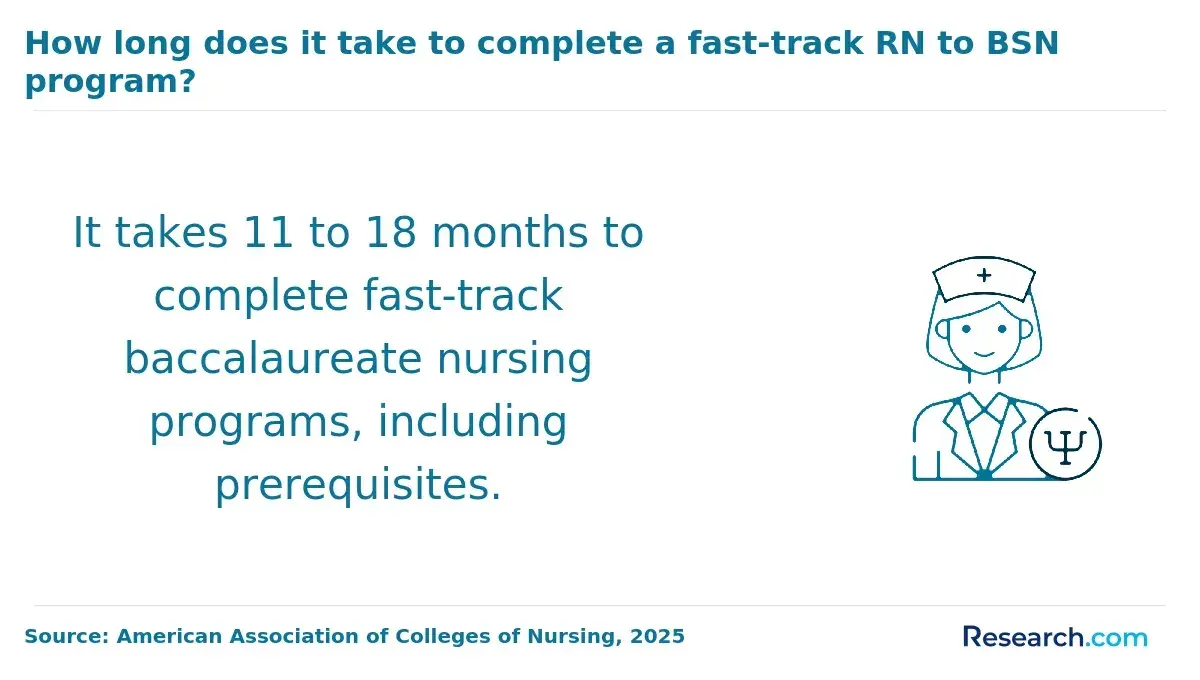
How long does it take to earn an RN to BSN degree in Illinois?
The timeline to earn an RN to BSN in Illinois unfolds differently depending on your rhythm and lifestyle; here's a breakdown of how these program durations slalom around various learner needs and schedules.
Consider these typical program lengths as a map to navigate your educational journey:
- Full-Time Programs: Most full-time tracks zip through the curriculum in about 12 to 16 months, designed for nurses ready to dive deep and move swiftly-balancing study with work or even life's other demands while maintaining focus.
- Part-Time Programs: Stretching comfortably over 18 months to 2 years, part-time options let you savor the process; ideal if you're juggling a heavy work schedule or family life while still inching steadily toward that BSN badge.
- Accelerated/Self-Paced Options: Some programs accelerate the race to as short as 12 months, perfect for driven professionals who can leverage prior credits and a laser-focused pace, transforming months of sacrifice into a sprint to success.
- On-Campus vs. Online Delivery: Most programs now breathe online freedom, letting you learn anywhere and often on your schedule, while campus-based pathways keep the classic rhythm but require face-to-face engagement, both fitting various learning styles and time constraints.
How much does an RN to BSN program cost in Illinois?
To offer clear insight into the financial landscape of RN to BSN programs in Illinois, it helps to break down the key cost components that influence what students actually pay. Below is a focused rundown of critical expenses to weigh when choosing between online and on-campus RN to BSN options in Illinois.
Consider these main cost factors carefully:
- Tuition per credit hour: On-campus programs often charge a higher rate per credit due to campus facilities and in-person resources, typically ranging from $300 to $500 per credit. Online programs may have slightly lower rates or flat fees but sometimes include technology fees to support virtual learning environments.
- Total program cost: The full cost can vary widely, from approximately $15,000 to over $35,000, depending on the institution and program length. Hybrid programs may fall in between, balancing tuition with reduced commuting costs.
- Additional fees: Online RN to BSN students might encounter fees for software platforms, proctoring exams, or library access. On-campus learners often pay campus activity fees, parking, and lab fees that can add up but offer a different value experience.
- Financial aid and employer assistance: Many students tap into scholarships, grants, or employer tuition reimbursement programs, which can significantly offset costs. Eligibility and availability vary, so checking with financial aid offices and employers is essential.
When I spoke with a nurse from Illinois who completed a hybrid RN to BSN program through a nearby university, his reflections painted a vivid picture beyond the numbers. He shared how the tuition alone was around $22,000, but budgeting for fees and books bumped the total closer to $25,000. "It felt overwhelming at first," he admitted, "balancing work, study, and finances." Yet employer tuition assistance covered a big chunk, easing the burden and making the investment feel worthwhile. The hybrid format let him reduce commuting expenses and keep a steady income, creating a manageable rhythm during his studies. "Looking back, it was a tough but rewarding journey," he said, "and understanding the costs upfront helped me plan better and stay motivated through the program."
What are the pros and cons of online vs. on-campus RN to BSN programs in Illinois?
Choosing between an online or hybrid RN to BSN program and a traditional campus RN to BSN program in Illinois comes down to your lifestyle rhythms, wallet size, and what kind of learning vibe suits you best. If your days whirl with work and family, or you crave the freedom to study wherever inspiration hits, online RN to BSN program flexibility in Illinois might be your ally. But if you feed off face-to-face energy and structured classrooms, you'll want to lean into the traditional campus RN to BSN program benefits in Illinois. Below is a snapshot comparing these paths to help you navigate your next steps:
Online or Hybrid RN to BSN Programs
- Pro: Flexibility for Busy Lives - Study anytime, anywhere, fitting coursework seamlessly into your chaotic schedule, perfect if juggling work or family is a must.
- Pro: Cost-Effective Education - Often less costly overall, online programs cut out commuting and campus fees, easing financial pressure.
- Con: Limited Personal Connection - Missing the buzz of in-person interaction means building your own motivation and tech savvy to stay engaged.
On-Campus RN to BSN Programs
- Pro: Rich Networking and Support - Real-time classes foster instant feedback, peer bonds, and access to vibrant campus resources that energize learning.
- Pro: Clear-Rhythm Learning - Fixed schedules and face-to-face teaching keep you accountable and grounded in a structured academic environment.
- Con: Time and Cost Demands - Commuting and strict class times reduce flexibility and can hike expenses, challenging working nurses balancing multiple demands.
For those curious about which nursing specialty might align with their goals post-BSN, exploring what are the easiest nurse practitioner specialty programs to get into can provide insightful direction.
How do RN to BSN programs in Illinois support clinical placements?
This section explores how RN to BSN programs in Illinois actively support students in gaining hands-on clinical experience and fulfilling essential requirements for advancing their nursing careers. Below are key ways these programs facilitate clinical placements, blending practical opportunities with personalized guidance to empower learners on their journey.
- Partnerships with Local Healthcare Facilities: Programs forge strong connections with diverse healthcare sites, ensuring students experience a breadth of clinical environments-from pediatric units to mental health clinics-enhancing their skills across varied patient care scenarios.
- Preceptor or Mentor Matching: One-on-one pairing with seasoned nurse preceptors offers tailored mentorship and direct supervision, enriching clinical rotations with expert feedback and boosting student confidence in advanced nursing practices.
- Flexibility for Working RNs: Many programs recognize that students are practicing nurses, enabling them to complete clinical hours at their current workplaces, reducing scheduling friction while maintaining rigorous learning standards.
- Faculty and Clinical Coordinator Guidance: Dedicated professionals assist with managing compliance, paperwork, and placement logistics, smoothing the path through clinical requirements and addressing individual student needs.
Reflecting on these supports, a nurse who completed an RN to BSN program from Illinois shared how challenging balancing shifts and school seemed at first. "The program helped me use my hospital as my clinical site, which was a game-changer," she said. Navigating paperwork with faculty guidance and having a mentor who understood her specialty made her clinical experience less daunting and more enriching. She described feeling supported every step, turning obstacles into milestones on her path to a BSN degree-and greater professional growth.
Which accrediting bodies approve RN to BSN programs in Illinois?
Accreditation acts as the silent guardian ensuring that RN to BSN programs in Illinois truly deliver top-tier nursing education recognized by employers and licensing boards alike, guaranteeing quality and credibility in every credit earned. To navigate this landscape, keep the following main national and state-level accrediting organizations in mind, as their approval seals the program's value and trustworthiness.
- Commission on Collegiate Nursing Education (CCNE): This powerhouse of nursing accreditation focuses solely on baccalaureate and higher-level nursing programs. Its stamp means the curriculum, faculty, and outcomes meet rigorous national standards, offering graduates an edge in career growth and school admissions.
- Accreditation Commission for Education in Nursing (ACEN): ACEN casts a wider net, accrediting everything from practical to doctoral nursing programs. Their approval reflects solid educational practices and opens doors to federal aid and professional respect, especially favored by various Illinois colleges.
- Higher Learning Commission (HLC): While not nursing-specific, HLC assesses the overall institutional quality of Illinois colleges, ensuring they are legitimate degree-granting and federal aid-authorized institutions. Programs often hold dual CCNE or ACEN and HLC accreditation to reinforce their credibility.
- Illinois Department of Financial and Professional Regulation (IDFPR): This state-level authority enforces nursing licensure standards and program approvals, safeguarding that graduates satisfy Illinois' legal requirements to practice, anchoring local recognition alongside national accreditation.
What career opportunities are available to RN to BSN graduates in Illinois?
Navigating the vibrant landscape of career advancement for BSN nurses in Illinois reveals a tapestry of specialized roles and leadership prospects awaiting RN to BSN graduates. These opportunities blend clinical expertise with strategic influence, broadening horizons far beyond bedside care; here are some standout positions that showcase the vast BSN RN job opportunities in Illinois:
- Registered Nurse (RN): Maintaining a foothold in bedside care, BSN-prepared RNs bring enhanced critical-thinking and leadership skills that employers highly value in hospitals and community health environments.
- Charge Nurse: Leading nursing teams with strong communication and organizational skills honed through RN to BSN programs, charge nurses orchestrate patient care with precision on hospital units.
- Nurse Manager: Steering entire departments, these leaders manage staffing, policies, and budgets, embodying the increased responsibility and strategic mindset fostered by a BSN education.
- Nurse Case Manager: Coordinating complex long-term care scenarios, case managers bridge hospitals, insurance, and community agencies to ensure seamless patient experiences.
- Clinical Nurse Educator: Shaping the next generation of nurses, these educators develop training programs and uphold clinical excellence within various healthcare and academic settings.
- Public Health Nurse: Championing population health, they engage in education and outreach, leveraging the broader public health perspective gained in BSN courses.
- Preparation for Advanced Practice and Graduate Study: A BSN opens doors to advanced specialties like nurse practitioner or clinical nurse specialist, with many Illinois programs offering direct pathways to graduate degrees and increased earning potential.
- Remote and Non-Traditional Nursing Roles: Embracing telehealth and consulting, BSN training enables nurses to pivot into flexible, innovative roles that respond to evolving healthcare demands.
For those seeking affordable pathways to these dynamic careers, exploring the most affordable online RN to FNP degree program options can be a strategic move to combine cost-efficiency with career growth.
What is the average RN to BSN salary increase in Illinois?
The average salary for a registered nurse (RN) in Illinois without a Bachelor of Science in Nursing (BSN) degree is approximately $87,650 per year, and earning a BSN can significantly elevate registered nurses' salaries by unlocking new career pathways and enhanced earning potential. Exploring the financial horizon reveals distinct salary outcomes for nurses holding an associate degree (ADN) compared to those with a BSN:
- Average Salary Comparison (ADN vs. BSN): Nurses with a BSN commonly command higher salaries than ADN-prepared peers, with BSN nurses in Illinois earning around $91,130 annually, reflecting their advanced skills and qualifications.
- Salary Differences by Healthcare Setting: The healthcare environment plays a key role, as BSN nurses in hospitals or specialty care settings generally receive superior compensation compared to those in community health or long-term care facilities.
- Impact of Experience and Leadership Roles: As BSN nurses gain experience and take on leadership roles such as nurse managers or educators, their salaries can exceed $100,000, highlighting the rewards of professional growth.
- Long-Term Earning Potential: A BSN degree opens avenues to advanced degrees and specialized roles like nurse practitioners, promising even greater financial and career satisfaction over time.
Here's What RN to BSN Graduates in Illinois Have to Say About Their Degree
- Completing the online RN to BSN program at Northern Illinois University was a game changer for me. The flexibility allowed me to balance my family life and coursework seamlessly while gaining advanced clinical knowledge. The support from instructors and peers truly enhanced my learning experience, and I felt well-prepared to start my nursing career in a local school setting. Now, I feel more confident making an impact on student health and wellness. This degree has opened doors for leadership opportunities I hadn't imagined before. Jamir
- The hybrid RN to BSN program at Loyola University Chicago provided a perfect blend of in-person engagement and online flexibility, which suited my busy schedule. Pursuing my degree here helped me grow personally and professionally, especially in understanding community health dynamics in Illinois. Starting my career in a local school after graduation, I've been able to contribute meaningfully to children's well-being, which has been deeply rewarding. The program also enhanced my skills in patient education and advocacy, essential for school nursing. Ellie
- Attending the on-campus RN to BSN program at University of Illinois Chicago challenged me in all the right ways. The rigorous curriculum pushed me to sharpen both my clinical and critical thinking skills, preparing me well for the fast-paced environment of a local school nurse. This experience reinforced my dedication to making a positive difference in the lives of youngsters through health promotion and education. The community connections I built during the program continue to support my career growth and development. Miles
Related Articles for Nearby States
- 2027 Best RN to BSN Programs in Indiana: Online & Campus
- 2027 Best RN to BSN Programs in Wisconsin: Online & Campus
- 2027 Best RN to BSN Programs in Iowa: Online & Campus
- 2027 Best RN to BSN Programs in Missouri: Online & Campus
- 2027 Best RN to BSN Programs in Kentucky: Online & Campus
- 2027 Best RN to BSN Programs in Michigan: Online & Campus
- 2027 Best RN to BSN Programs in Minnesota: Online & Campus
- 2027 Best RN to BSN Programs in Ohio: Online & Campus
- 2027 Best RN to BSN Programs in Tennessee: Online & Campus
- 2027 Best RN to BSN Programs in Arkansas: Online & Campus
References:
- How Long is an RN-to-BSN Program? Length of ADN to BSN Programs https://www.onlineeducation.com/nursing/faqs/how-long-is-an-rn-to-bsn-program
- Online vs Hybrid vs Campus Learning in Healthcare: Which Is Right for You? https://www.edumed.org/articles/online-vs-hybrid-vs-campus/
- RN to BSN program | St. John's College of Nursing https://www.hshs.org/st-johns-college/academics/undergraduate-nursing-programs/rn-bsn
- Nursing - Accelerated RN to BS (Option) https://www.siue.edu/academics/undergraduate/degrees-and-programs/nursing/accelerated-rn-bs/
- EIU Department of Online RN to BSN Degree Program https://www.eiu.edu/rnbsn/requirements.php
- Best Online RN to BSN Degree Programs for 2026 https://www.registerednursing.org/rn-to-bsn/
- Nursing (RN to BSN) https://nursing.illinoisstate.edu/academics/rn-bsn/
- B.S. in Nursing (RN to BS) | Online Programs | Northern Illinois University https://www.niu.edu/online/undergraduate-programs/bs-nursing.shtml
- RN to BSN https://onlinenursing.uic.edu/online-programs/rn-bsn/
- Bachelor of Science in Nursing (RN to BSN Online) Degree https://www.mckendree.edu/academics/info/nursing-health/nursing/bsn.php
Other Things You Should Know About RN to BSN Programs in Illinois
In 2027, most RN to BSN programs in Illinois require around 70 to 90 hours of clinical practice. These hours are crucial for hands-on experience and are often completed in local healthcare settings approved by the program.
Yes, it is possible to complete an RN to BSN program in Illinois while working full-time, especially through many flexible online and hybrid programs designed with working nurses in mind. These programs often offer part-time enrollment options and asynchronous coursework, allowing students to balance job responsibilities with their studies. Additionally, some campus-based programs provide evening or weekend classes to accommodate full-time workers. Careful time management and choosing a program that fits your schedule are key to successfully earning your BSN without pausing your nursing career.
In 2027, RN to BSN programs in Illinois generally require a valid RN license, completion of an associate degree or diploma in nursing, a minimum GPA (often around 2.5 to 3.0), and specific prerequisite courses like anatomy and microbiology. Some programs may also require professional references and a personal statement.


