
2027 Easiest STEM Degree Programs

Co-Founder and Chief Data Scientist
Do you feel like a stable, high-paying STEM career is locked behind a door—one that requires a 'math genius' to open? It's a common anxiety, the belief that you aren't cut out for a field that seems to be all abstract theory.
This guide, created by career planning experts with over 10 years of experience, proves that isn't true. Finding the easiest STEM degree to get is about choosing an accessible path that values your practical skills. With STEM employment projected to grow nearly 3x faster than other fields, it's a door worth opening.
What are the benefits of getting a STEM degree?
- You achieve greater job security, as STEM employment has proven more resilient during economic downturns.
- You can earn a significantly higher salary: the median salary for STEM occupations is $103,580, compared to just $40,000 for non-STEM fields.
- You gain a versatile, analytical skill set that prepares you for the future of work across any industry.
What can I expect from a STEM degree?
You can expect a curriculum focused on hands-on projects and systematic problem-solving. The goal is to prepare you for the workforce from day one.
A lot of people hear “STEM” and immediately picture four years of abstract, theoretical math. That’s not what these programs are about. The challenge here isn’t about memorizing formulas; it’s about applying practical knowledge to solve real-world challenges.
So, how do you know a program teaches the right skills? You look for accreditation. Think of it as a guarantee from the industry itself. Accrediting bodies like ABET ensure that a program’s curriculum is relevant and respected by employers.
This is why finding the easiest STEM degree to get has nothing to do with low standards. It’s about choosing an accredited program that values your practical skills and gives you a clear, direct path to a great career.
Where can I work with a STEM degree?
You can work in almost every economic sector, far beyond the typical image of a lab or a big tech company. Many of the most in-demand STEM jobs are in places people rarely think to look.
Consider industries like environmental management, modern agriculture, and construction technology. These fields are hungry for graduates with applied science skills.
New sectors are also creating entirely new types of jobs. For instance, over half of the private-sector space economy comprises STEM occupations. The growing green economy is another area with massive demand for technical experts. The opportunities are much broader than you might think.
How much can I make with a STEM degree?
STEM occupations offer a significant salary premium. The median salary for STEM jobs is $103,580, more than double the median of $40,000 for non-STEM fields.
While your specific entry-level salary will depend on your field and location, the most important factor is long-term potential. The growth trajectory for wages in STEM is typically much steeper than in other sectors.
This means you're not just investing in a good starting salary; you're investing in a career with a much higher ceiling for future earnings.
- List of the Easiest STEM Degree Programs for 2027 List of Programs
- How long does it take to complete a STEM degree program? Completion Time
- What is the average cost of a STEM degree program? Program Costs
- What are the financial aid options for students enrolling in a STEM degree program? Financial Aid
- What are the prerequisites for enrolling in a STEM degree program? What are the prerequisites for enrolling in a STEM degree program?
- What courses are typically in a STEM degree program? What courses are typically in a STEM degree program?
- What types of specializations are available in a STEM degree program? Specializations
- How to choose the easiest STEM degree program? How to choose the easiest STEM degree program?
- What career paths are available for graduates of a STEM degree program? Career Paths
- What is the job market for graduates of a STEM degree program? Job Market
- Should I Pursue Advanced Degrees After a STEM Degree? Should I Pursue Advanced Degrees After a STEM Degree?
List of the Easiest STEM Degree Programs for 2027
How do we rank schools?
Recognizing that paying for a degree is a significant investment, our ranking methodology ensures that students can make informed decisions based on comprehensive and transparent information. The ranking draws upon reliable sources such as the IPEDS database, Peterson's database, the College Scorecard database, and The National Center for Education Statistics.
These sources provide a robust foundation of data to evaluate and rank DEGREE programs. For more details on our methodology, please visit Research.com’s methodology page.
1. Arizona State University - Online BS in Information Technology
Arizona State University offers a flexible online program that equips you with practical skills for today's tech industry. You will learn to design and manage solutions in high-demand areas like cybersecurity, information systems, and networking, preparing you for a variety of real-world IT challenges.
- Program Length: 4 years
- Concentrations: Cybersecurity/Security; Information Systems; and Networking
- Required Credits to Graduate: 120
- Cost per Credit: $763
- Accreditation: Accreditation Board for Engineering and Technology (ABET)
2. Purdue University - BS in Animal Sciences
Purdue University provides an animal sciences program that blends rigorous scientific study with vital, hands-on experience. You can customize your education for a specific career by choosing from five distinct concentrations, from pre-veterinary medicine to agribusiness, for a truly practical degree.
- Program Length: 4 years
- Concentrations: Animal Agribusiness; Animal Production and Industry; Behavior/Well-Being; Biosciences; and Pre-Veterinary Medicine
- Required Credits to Graduate: 120
- Cost per Credit: $347.85 (In-State), $948.30 (Out-of-State)
- Accreditation: Higher Learning Commission (HLC)
3. University of Kentucky - BS in Agricultural Economics
The University of Kentucky provides a modern business degree focused on the entire "farm-to-fork" food system. This program moves beyond farming to cover environmental policy, market analysis, and global supply chains, with a required internship to ensure you gain practical, career-ready experience.
- Program Length: 4 years
- Tracks: Agribusiness Management and Food Marketing; Agricultural Economics; and Advanced Studies
- Required Credits to Graduate: 120
- Cost per Credit: $570.50 (In-State), $1,455.50 (Out-of-State)
- Accreditation: Southern Association of Colleges and Schools Commission on Colleges (SACSCOC)
4. University of Florida - Online BA in Biology
The University of Florida offers a flexible online biology degree designed for interdisciplinary careers in fields like science journalism or environmental law. This program provides a broad life sciences education from a top-tier university, making it an excellent choice if you're not pursuing medical school.
- Program Length: 4 years
- Required Credits to Graduate: 120
- Cost per Credit: $129.18 (In-State), $552.62 (Out-of-State)
- Accreditation: Southern Association of Colleges and Schools Commission on Colleges (SACSCOC)
5. Montana Technological University - BS in Occupational Safety and Health
Montana Technological University prepares you for an in-demand career protecting workers by applying science and engineering to control workplace hazards. The program emphasizes hands-on learning in a state-of-the-art safety lab. It is highly regarded by the industry, ensuring you graduate career-ready.
- Program Length: 4 years
- Required Credits to Graduate: 122
- Estimated Annual Tuition: $8,770 (In-State); $26,570 (Out-of-State); $12,220 (WUE Advantage)
- Accreditation: Applied and Natural Science Accreditation Commission of ABET (ANSAC/ABET)
6. University of Alabama - Online BS in Food and Nutrition
The University of Alabama provides a direct path toward becoming a registered dietitian through its 100% online nutrition program. You will gain a deep understanding of the relationship between food and human health, preparing you for careers in medical centers, public health, and consulting.
- Program Length: 4 years
- Required Credits to Graduate: 120
- Cost per Credit: $399
- Accreditation: Accreditation Council for Education in Nutrition and Dietetics (ACEND)
7. University of Central Florida - BS in Environmental Engineering
The University of Central Florida trains you to apply engineering principles to solve critical environmental challenges, from water treatment to air pollution control. This program is ideal for students who want a direct role in protecting the environment and improving the community's quality of life.
- Program Length: 4 years
- Design Specializations: Environmental Engineering Wastewater Design; Air Pollution Control Design; and Environmental Engineering Water Treatment Design
- Required Credits to Graduate: 122
- Cost per Credit: $212.28 (In-State), $802.54 (Out-of-State)
- Accreditation: Accreditation Board for Engineering and Technology (ABET)
8. New Mexico State University - Online BS in Geomatics
New Mexico State University's fully online geomatics program trains you in the high-tech science of precise spatial measurement. It's a direct path to professional licensure. It prepares you for key roles in land surveying, modern construction, and geospatial intelligence.
- Program Length: 4 years
- Required Credits to Graduate: 120
- Cost per Credit: $434.40
- Accreditation: Accreditation Board for Engineering and Technology (ABET)
9. University of West Alabama - Online BA/BS in Environmental Sciences
The University of West Alabama offers a flexible online degree for students passionate about solving urgent environmental problems. With both BA and BS tracks and a required internship, the program provides the scientific knowledge and hands-on experience needed for a successful career in environmental science.
- Program Length: 4 years
- Required Credits to Graduate: 123
- Cost per Credit: $325
- Accreditation: Southern Association of Colleges and Schools Commission on Colleges (SACSCOC)
10. Colorado State University Global - Online BS in Computer Science
Colorado State University Global delivers a career-focused, 100% online computer science degree designed for maximum flexibility. The program prepares you for industry certifications and allows you to specialize in high-growth areas like artificial intelligence, cybersecurity, or cloud computing.
- Program Length: 4 years
- Specializations: Artificial Intelligence; Cybersecurity; and Cloud Computing
- Required Credits to Graduate: 120
- Cost per Credit: $375
- Accreditation: Higher Learning Commission (HLC)
How long does it take to complete a STEM degree program?
A bachelor's degree is typically a four-year program for a full-time student. But it's a mistake to think of that timeline as rigid. The right pace depends entirely on your personal and professional goals.
Think of your timeline as a strategic choice. For some, an accelerated three-year path using transfer credits is the best way to enter the job market quickly.
The standard four-year path is often the most balanced. It provides ample time to absorb the material and, just as importantly, to secure internships that build your resume and professional network.
For working professionals or those in co-op programs, a five-year or part-time path is a smart, strategic option. It allows you to earn a valuable credential without losing income. The best timeline is the one that sets you up for long-term success.
What is the average cost of a STEM degree program?
Based on our research, the average total tuition for a STEM bachelor's degree ranges from approximately $47,500 at in-state public universities to over $81,000 at out-of-state universities.
While that is a significant number, it's crucial to view it as an investment, not just a cost. Finding the easiest STEM degree to get is a strategic financial decision that pays for itself over time.
Calculating ROI in High-Growth 'Hidden' STEM Economies
The return on this investment comes from the powerful salary premium you can earn. The median salary for STEM occupations is $103,580, compared to just $40,000 for non-STEM fields. This advantage is evident in emerging sectors; for example, there are many high-paying jobs with a degree in space studies that didn't even exist a decade ago.
When you look at the numbers, the degree is a direct pathway to greater earning potential and long-term financial stability. The chart below illustrates this powerful financial advantage.
What are the financial aid options for students enrolling in a STEM degree program?
The primary financial aid options include federal grants like the Pell Grant, federal student loans, university-sponsored scholarships, and work-study programs. You should always start by filling out the Free Application for Federal Student Aid (FAFSA), as this is the gateway to most forms of aid.
Finding STEM-Specific Funding
Here is the crucial piece of advice: the high demand for STEM professionals has created a wealth of targeted funding. Don't just look for general scholarships; you need to look for STEM-specific opportunities.
For example, government agencies like the National Institutes of Health (NIH) and the National Science Foundation (NSF) offer undergraduate scholarships. Professional organizations, such as the Society of Women Engineers or the National Society of Black Engineers, also provide significant funding.
Many private companies, from tech startups to major corporations, offer scholarships to cultivate future talent. There are also funds available for non-traditional students and career-changers, which is excellent news for anyone looking to upskill.
What are the prerequisites for enrolling in a STEM degree program?
Most programs require a high school diploma with a solid foundation in math and lab sciences. While specific requirements vary, a typical competitive application includes:
- Math: Four years, often through pre-calculus.
- Lab Science: Three years, with courses in biology, chemistry, and physics.
- English: Four years of non-ESL courses.
- Social Sciences: Two years, including one year of American history.
It's important to remember that "a solid foundation" doesn't always mean you need to be a calculus expert. Many accessible programs are more focused on your overall academic record.
Strategic Pathways to Admission
So, what if your high school transcript doesn't quite line up? This is a common situation, and it is not a dead end.
The most common and effective strategy is the community college bridge. You can enroll, take the specific math and science courses you need at a much lower cost, and then transfer to a four-year university. This is a mainstream path; in fact, about two-fifths of students start at a community college.
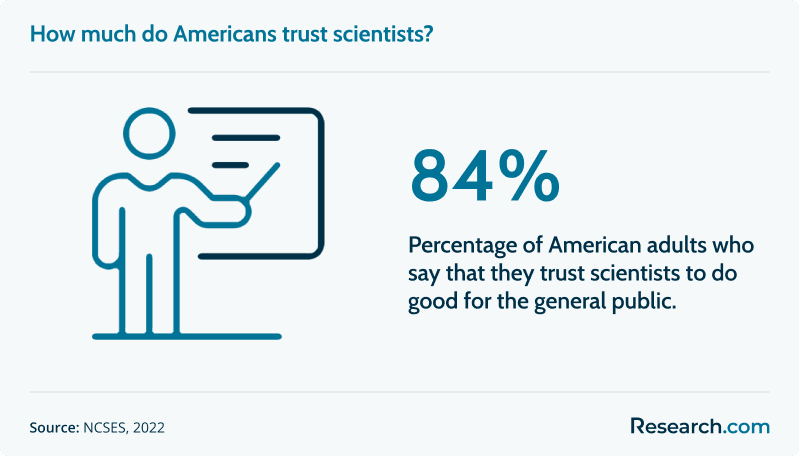
This path leads to a highly respected profession. A recent study found that 84% of American adults trust scientists to act in the public's best interest. The graphic below highlights this high level of public confidence.
What courses are typically in a STEM degree program?
A typical curriculum blends foundational science, specialized major courses, and general education requirements. The focus is on practical application, with course titles that often reflect real-world tasks.
Instead of abstract theory, you're more likely to see courses like:
- Introduction to UNIX Utilities
- Community Nutrition
- Construction Surveying
These courses are designed to give you marketable skills, but the curriculum also teaches you more than just technical know-how.
Beyond Technical Skills: The Professional Advantage
There's a stereotype that technical experts can be poor communicators, and research sometimes supports it. This is where applied STEM programs give you a professional superpower. Because the curriculum is built around hands-on projects and teamwork, these programs are often better at developing the communication and leadership skills that employers value most.
This is also true when distinguishing between related fields; for example, while Geomatics focuses on precise measurement, an online geography degree often emphasizes spatial analysis, requiring different communication skills.
These applied programs make up a significant part of the higher education landscape, conferring hundreds of thousands of degrees annually, as the chart below shows.
What types of specializations are available in a STEM degree program?
Most programs offer specializations that allow you to customize your degree for a specific career path. This gives you a broad, versatile foundation while also building deep expertise in an area that interests you.
For example:
- Information Technology: You could specialize in a high-demand area like Cybersecurity or focus on the infrastructure side with Networking.
- Animal Sciences: You could pursue a business-focused track like Agribusiness or prepare for further study with a Pre-Veterinary Medicine concentration.
- Psychology: If you are interested in advanced study and analysis, you might look into research careers in psychology, which require a specialized academic track.
Choosing the easiest STEM degree to get often means picking a broad field and then specializing in what truly motivates you.
Specializing in Technical Roles
A degree in a foundational science can also be the perfect launchpad for a more technical career. Think of it as a strategic first step.
For example, many students with a background in environmental science go on to pursue an environmental engineering online degree to gain the credentials for more advanced design and implementation roles. This shows how a general degree can open doors to a highly specialized and in-demand profession.
How to choose the easiest STEM degree program?
The “easiest” program is the one that best aligns with your natural aptitudes and career goals. It’s not about finding the path of least resistance; it’s about finding the most direct route to success.
Here is a simple, four-step framework to guide your decision:
- Assess Your Aptitude. Are you a “Tinkerer” who loves hands-on problem-solving, or a “Theorist” who enjoys abstract concepts? Be honest about your strengths.
- Align with Career Goals. Research the specific jobs you find interesting and identify the degrees that lead to those roles. For instance, if you are looking into advanced nursing, you should investigate AGACNP jobs to see if that career aligns with your goals.
- Investigate Curricula. Look at the course lists for your top 2-3 programs. Do the classes sound engaging and relevant to your goals?
- Verify Accreditation. This is the most crucial step. Ensure your chosen program is accredited by a recognized body.
Accreditation and Professional Pathways
This final step is non-negotiable. Accreditation is your guarantee that a program meets industry standards and that your degree will be respected by employers. It’s the bridge between your education and your career.
Think of it this way: about 46% of all STEM workers hold a professional certification, license, or educational certificate. Accreditation ensures your degree prepares you for these crucial credentials. Organizations like ABET exist to ensure your education directly translates into the skills the workforce demands, de-risking your investment in your future.
What career paths are available for graduates of a STEM degree program?
Graduates can pursue a wide range of technical, consulting, and managerial roles across many industries. The versatility of a STEM degree means you are not locked into a single, narrow career path, much like how many experts explore alternative careers for occupational therapists.
Depending on your specialization, you could pursue job titles like:
- Network Administrator
- Food Scientist
- Geospatial Analyst
- Safety Manager
- Environmental Consultant
Pathway to Leadership
A STEM degree is also a direct path to leadership. The skills you gain in systematic problem-solving and project management are exactly what companies look for in managers. In fact, about 1.4 million STEM jobs are in managerial occupations, demonstrating a clear trajectory for advancement.
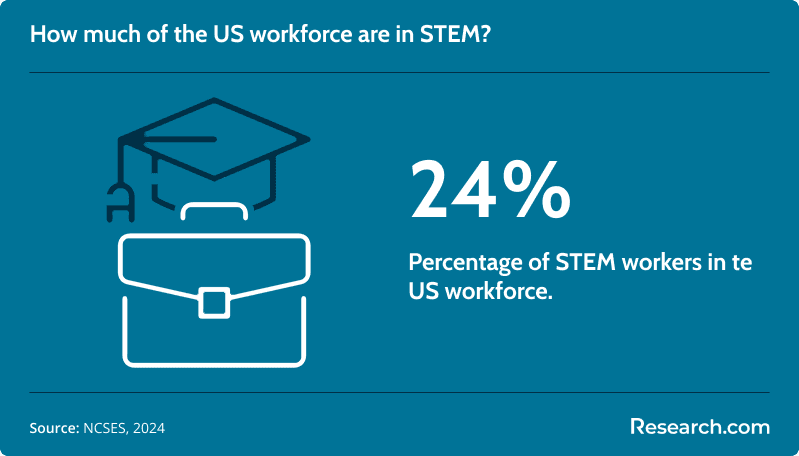
Emerging sectors are creating entirely new career paths. For example, there is a strong demand for jobs for environmental science majors in areas such as renewable energy, sustainable agriculture, and corporate responsibility. As the graphic below shows, STEM professionals make up a significant portion of the entire U.S. workforce, and that share is growing.
What is the job market for graduates of a STEM degree program?
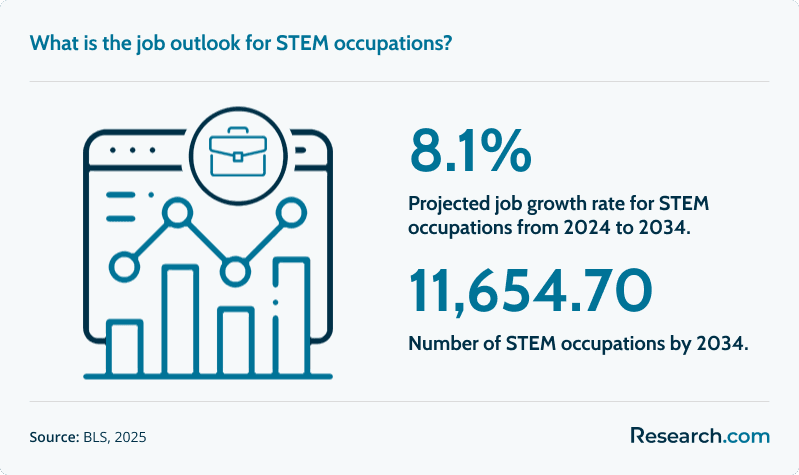
The job market for STEM graduates is excellent, with occupations projected to grow by 8.1% over the next decade. This growth rate is significantly faster than in non-STEM fields, translating directly into greater job security and more career options after graduation. This growth parallels other lucrative fields, such as those that involve a business law degree careers. Choosing the easiest STEM degree to get is a strategic move that positions you for a stable career in this high-demand field.
A Field Built for the Future
Many people worry about AI and automation, but for graduates with applied skills, this is an opportunity. As routine tasks become automated, the value of professionals who can manage, implement, and oversee these complex systems increases dramatically.
This is especially true in fields that require a human touch. For instance, there is a stable and growing demand for entry level nutrition jobs where experts guide real people toward better health outcomes. This trend confirms that a STEM degree prepares you for a resilient, future-proof career.
Here’s What Graduates Have to Say About Their STEM Degree Program
- Pearl: "I almost didn't apply because I was convinced my math skills weren't good enough for a real STEM program. The truth is, this degree was about logic and practical problem-solving, not abstract theory. Studying online let me work at my own pace through the tougher subjects, and now I have a career I never thought was possible for me. It completely changed how I see my own abilities."
- Amara: "Honestly, I had a very narrow view of what a "STEM job" was before starting this program. I thought it was all coding or lab coats. My coursework opened my eyes to the huge demand for environmental and safety specialists, which I found I was passionate about. I switched my focus and landed an amazing job in a field I didn't even know existed two years ago."
- Bao: "The biggest benefit for me was learning how to communicate technical information effectively. The program was built on team projects, which forced me to explain complex ideas clearly to others. That skill has been more valuable in my career than any single piece of code I've ever written; it's what gets you noticed and respected."
Should I Pursue Advanced Degrees After a STEM Degree?
For STEM graduates ready to expand their leadership potential and interdisciplinary skills, advanced education can be a strategic investment. Pursuing further studies not only deepens technical expertise but also hones research methodologies and management practices that are critical in evolving industries. In sectors that bridge technology and education, exploring opportunities such as accelerated EdD programs may facilitate a smooth transition into leadership roles or academic contributions without compromising practical experience.
Key Findings
- The job market for STEM occupations is projected to grow by 8.1% over the next decade, creating a high-demand environment for qualified graduates.
- STEM professionals earn a median salary of $103,580, which is more than double the $40,000 median for non-STEM occupations, demonstrating a powerful return on educational investment.
- A significant portion of the American public —84%—trusts scientists to act in the public's best interest, reflecting the high regard for the profession.
- The U.S. workforce is increasingly reliant on technical expertise, with 24% of all workers employed in STEM fields.
- The average total tuition for an in-state public STEM degree is approximately $47,500, a cost that is often offset by targeted financial aid and high future earning potential.
- The business and health professions are the two largest fields for bachelor's degrees, but applied science and engineering programs offer a direct, often faster path to specialized, high-growth careers.
References:
- ABET. (2020). The value of accreditation. Retrieved October 14, 2025, from ABET.
- Goldman, D., Balakrishnan, M., & Highfill, T. (2025). The U.S. space economy workforce and STEM occupations. U.S. Bureau of Economic Analysis. Retrieved October 14, 2025, from BEA.
- National Center for Education Statistics. (2024). Bachelor's degrees conferred by postsecondary institutions, by field of study. Condition of Education. Retrieved October 14, 2025, from NCES.
- National Center for Science and Engineering Statistics. (2022). The STEM Labor Force of Today: Scientists, Engineers, and Skilled Technical Workers. In Science and Engineering Indicators 2022. National Science Board. Retrieved October 14, 2025, from NCSES.
- National Center for Science and Engineering Statistics. (2024). Diversity and STEM: Women, Minorities, and Persons with Disabilities 2024. National Science Board. Retrieved October 14, 2025, from NCSES.
- Tyson, A., & Kennedy, B. (2024, November 14). Public Trust in Scientists and Views on Their Role in Policymaking. Pew Research Center. Retrieved October 14, 2025, from Pew Research Center.
- U.S. Bureau of Labor Statistics. (n.d.). Green jobs: Measuring green jobs. Retrieved October 14, 2025, from BLS.
- U.S. Bureau of Labor Statistics. (2025). Table 1.10 STEM occupations, projected 2024–34. Retrieved October 14, 2025, from BLS.
- Watson, M. (2025). Which occupations are in STEM? An analysis of the STEM occupational landscape. Beyond the Numbers, 14(3). U.S. Bureau of Labor Statistics. Retrieved October 14, 2025, from BLS.
Other Things You Should Know About STEM Degree Programs
Several universities offer online STEM degree programs that are considered easy in 2027. These include degrees in Environmental Science and Information Technology, allowing flexibility for students who prefer remote learning while maintaining accreditation standards set by educational bodies.
In 2027, some of the easiest STEM degree programs are often considered to be Information Technology, Environmental Science, and Software Development. These fields typically offer flexibility in course requirements and a balance between theoretical and practical learning, making them attractive to students seeking manageable workloads.


