2027 School Social Work Careers: Roles, Certifications, and Job Outlook

Co-Founder and Chief Data Scientist
School social work is a career path for people who want to help students succeed when mental health concerns, trauma, disability, poverty, family conflict, attendance problems, or unsafe environments interfere with learning. For career changers with a non-social-work bachelor’s degree, the path can be especially confusing because schools often require both social work licensure and education-specific credentials.
This guide explains what school social workers do, what education and field training are typically required, how licensure and certification work, what to look for in an accredited program, and how salary and job prospects can vary by state, district, experience, and credential level. Use it to decide whether school social work fits your goals and to plan the next step toward qualifying for roles in public, private, or community-connected school settings.
Key Things You Should Know
- School social workers support students' mental health and academic success, with demand projected to grow 11% from 2024 to 2034, faster than average for all occupations.
- Certification usually requires a master's degree in social work (MSW) and state licensure, with specialized training in child development, counseling, and education law.
- In 2025, median annual salaries range between $50,000 and $65,000, varying by region, school district funding, and experience level.
What is school social work?
School social work is a specialized area of social work focused on helping students overcome social, emotional, behavioral, family, and community-related barriers to learning. School social workers operate at the intersection of education, mental health, child welfare, family support, and community services. Their goal is not only to respond to crises but also to help schools build safer, more supportive learning environments.
In practice, school social workers may provide short-term counseling, crisis intervention, attendance support, behavioral assessment, family outreach, and referrals to community agencies. They also work with teachers, administrators, school counselors, psychologists, nurses, and parents to support students through Individualized Education Programs (IEPs), behavior plans, safety plans, and reentry plans after hospitalization, suspension, trauma, or prolonged absence.
The role is different from school counseling, though the two often overlap. School counselors typically focus on academic planning, college and career readiness, and general student counseling. School social workers bring deeper training in family systems, poverty, trauma, community resources, child protection, and social service coordination. In many districts, they are the professionals who connect what happens at school with what students face at home and in the community.
Common school social work responsibilities include:
- Assessing barriers that affect attendance, behavior, safety, and academic progress
- Providing individual or group support for students experiencing grief, anxiety, bullying, family disruption, or trauma
- Coordinating services with child welfare agencies, housing organizations, healthcare providers, and mental health clinics
- Helping families understand school policies, special education processes, and available supports
- Supporting schoolwide prevention efforts related to bullying, substance abuse, conflict resolution, and mental health awareness
Certification and licensure requirements vary by state, but many school social work positions require a Master of Social Work (MSW), state social work licensure, and sometimes a school-specific credential. Additional recognition, such as the National Certified School Social Work Specialist (NCSSWS), may strengthen professional credibility, depending on employer expectations.
The U.S. Bureau of Labor Statistics predicts a 6% growth in social worker employment from 2024 to 2034, reflecting broader demand for social services and mental health support. Professionals who want to move into advanced practice, leadership, teaching, or research may also compare graduate options such as online doctorate of social work programs.
What roles do school social workers perform?
School social workers perform direct student support, family engagement, crisis response, special education collaboration, and systems-level advocacy. Their work is broad because student challenges rarely fit into one category. A student’s attendance problem, for example, may be tied to anxiety, transportation barriers, housing instability, caregiving responsibilities, bullying, or unmet disability needs.
At the student level, school social workers assess needs, provide counseling or skill-building support, monitor risk factors, and help students build coping strategies. At the family level, they communicate with caregivers, explain school processes, and connect families to services such as counseling, healthcare, food assistance, housing support, or child welfare resources. At the school level, they help teams design interventions that are realistic, culturally responsive, and legally appropriate.
Core roles in a school setting
- Student counseling and support: Conducting individual and group counseling sessions for issues such as grief, peer conflict, anxiety, trauma, or adjustment difficulties.
- Crisis intervention: Responding to bullying, suspected abuse, suicidal ideation, community violence, family emergencies, or traumatic events affecting the school community.
- Attendance and engagement support: Identifying why students are missing school and coordinating plans with families, teachers, and community agencies.
- Behavioral intervention: Creating behavior management plans, de-escalation strategies, and support plans for students with behavioral or emotional needs.
- Special education collaboration: Participating in IEP meetings, helping evaluate social-emotional needs, and supporting students with disabilities.
- Family-school liaison work: Facilitating communication between families and school staff, especially when cultural, language, economic, or trust barriers exist.
- Prevention and education: Leading workshops or groups on conflict resolution, substance abuse prevention, mental health awareness, and healthy relationships.
- Equity advocacy: Supporting students with disabilities, English language learners, students experiencing homelessness, and other marginalized groups in accessing appropriate services.
Specific responsibilities vary by district, grade level, staffing model, and state law. In some schools, the role is highly clinical. In others, it is more focused on attendance, family outreach, resource coordination, or special education support. Candidates should review job postings carefully because the same title can involve different daily responsibilities.
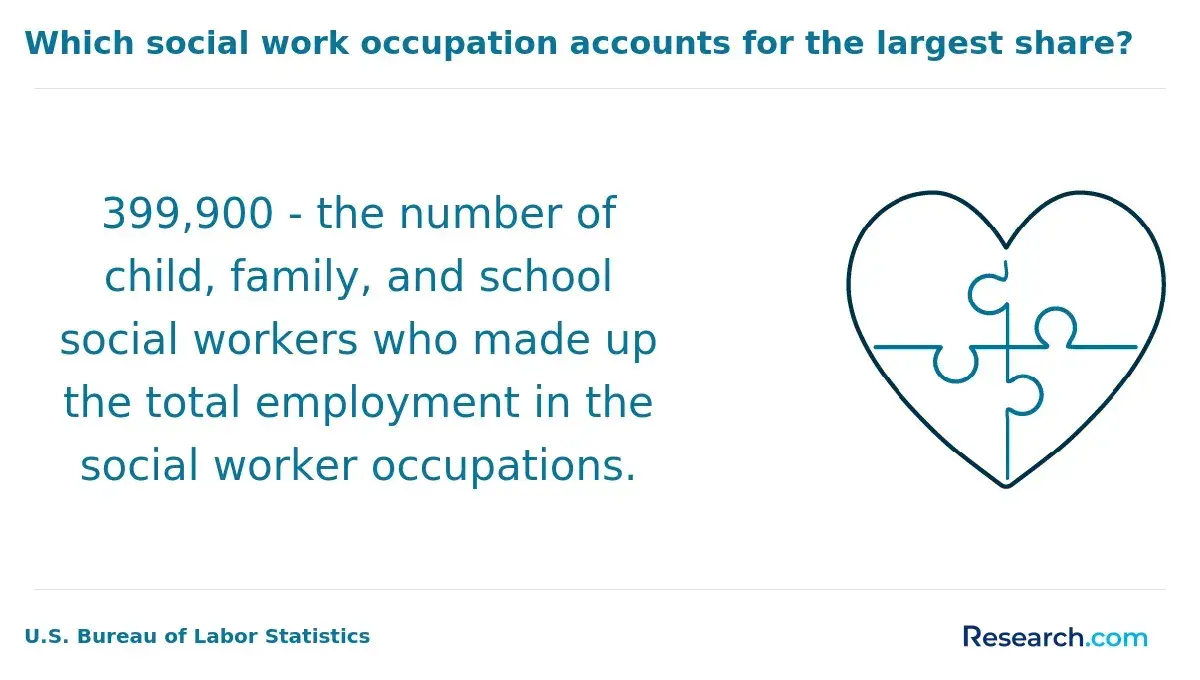
In 2020, child, family, and school social workers numbered 335,300 nationwide, showing the scale of the workforce serving children and families across educational and community settings. If you are comparing graduate pathways, review how much does a masters in social work cost before committing to a program.
What education is required for school social work careers?
Most school social work careers require graduate-level social work training, usually a Master of Social Work (MSW). A bachelor’s degree may help applicants enter related human services roles, but school social workers who provide counseling, case management, crisis intervention, special education support, or independent services typically need an MSW and the appropriate state license or school credential.
The MSW is important because it includes advanced training in assessment, ethics, human behavior, child and adolescent development, mental health, social policy, family systems, and supervised field practice. Many states and districts also expect school social workers to complete fieldwork in a school or child-serving setting before they qualify for school-based roles.
In 2020, 33,455 master's degrees in social work were awarded, compared to 21,204 bachelor's degrees. This difference reflects the profession’s reliance on graduate education for licensure-eligible and higher-responsibility roles.
Typical education pathway
- Bachelor’s degree: A Bachelor of Social Work (BSW), psychology, education, sociology, human services, or a related degree can prepare students for graduate admission. A BSW from a CSWE-accredited program may qualify some students for advanced standing MSW options.
- Master of Social Work: The MSW is the common professional degree for school social workers and is often required for state licensure and school-based practice.
- Field education: Students usually complete supervised internships or practicums. Candidates targeting schools should look for placements in public schools, alternative schools, child welfare agencies, youth mental health programs, or community organizations serving students.
- Licensure and school credentialing: After graduation, candidates must meet state licensing requirements and, in some states, obtain a separate education department credential for school employment.
For students who already have a bachelor’s degree in another field, an MSW can still be a viable route. However, they may need to complete foundation social work coursework before advancing into specialized practice. Online and hybrid options can help working adults manage the transition, and prospective students can compare MSW programs online if flexibility is a priority.
Common requirements for school social work preparation include:
- Holding an MSW from an accredited institution
- Completing supervised internships or fieldwork relevant to schools, children, families, or mental health
- Passing a state social work licensure examination when required
- Obtaining additional school social work certification or a School Social Work Specialist credential when required or available
Because requirements are state-specific, candidates should check both the state social work licensing board and the state education agency. A program that qualifies graduates in one state may not automatically satisfy every school credential requirement in another.
What certifications and licenses are needed for school social workers?
School social workers usually need a combination of a CSWE-accredited social work degree, state social work licensure, and, in some states, a school-specific certification issued by the education department. The exact credential names differ by state, so applicants should verify requirements before enrolling in a program or accepting a field placement.
A Master of Social Work (MSW) from a program accredited by the Council on Social Work Education (CSWE) is a foundational requirement in many school social work pathways. Over 94% of licensed social workers possess this advanced education. CSWE accreditation matters because many licensing boards use it to determine whether a degree meets professional standards.
Common license and credential categories
- Licensed Social Worker (LSW) or Licensed Master Social Worker (LMSW): These credentials often apply to master’s-level social workers who have met education and examination requirements but may not yet hold independent clinical authority.
- Licensed Clinical Social Worker (LCSW): This advanced clinical license may be preferred or required for roles involving therapy, diagnosis-related work, or independent clinical services. Roughly 59% of licensed social workers hold clinical licenses.
- School-specific certification: Some states require an education department credential for public school employment, such as a school social worker certificate or pupil services credential.
- Specialized national credentials: Credentials such as the National School Social Work Credential (NSSWC) can demonstrate school-focused expertise, though they do not replace state licensure unless a state explicitly recognizes them.
Clinical licensure commonly requires supervised post-graduate experience and an exam. Licensure typically involves completing 2,000 to 3,000 supervised clinical hours and passing a state-recognized exam, though the exact number, supervision rules, and approved work settings vary.
Before choosing a program, prospective students should ask three questions: Does the degree meet state social work licensing requirements? Does it include or allow school-based field placement? Does it satisfy the state education agency’s school social work credential requirements? These questions are especially important for online students planning to work in a different state from the school they attend.
Accessible graduate options, including an easiest MSW online program, may help students enter the field, but admission convenience should not outweigh accreditation, field placement quality, and state licensure alignment.
What are the best degree programs for school social work?
The best degree program for school social work is typically a CSWE-accredited MSW program that offers strong preparation in children, youth, families, mental health, trauma-informed practice, special education collaboration, and school-based fieldwork. A Bachelor of Social Work (BSW) can be a strong starting point, but the MSW is usually the degree that opens the door to licensure and higher-responsibility school roles.
Accreditation should be the first filter. Programs accredited by the Council on Social Work Education (CSWE) are designed to meet national social work education standards and are commonly required for licensure. Students should be cautious about programs that sound relevant to student support but are not social work degrees, because those may not qualify graduates for social work licensure.
Features to prioritize
- CSWE accreditation: Essential for most state licensure pathways and employer recognition.
- School or child/family concentration: Helpful for students who want coursework in school systems, child welfare, youth mental health, and family engagement.
- School-based field placements: One of the most important factors for employability because it gives students supervised experience in real educational settings.
- Licensure alignment: The program should clearly explain which state licenses or school credentials its curriculum supports.
- Clinical and crisis training: Useful for roles involving student mental health, suicide risk, trauma, behavioral intervention, and family instability.
- Local district partnerships: Strong relationships with school districts can improve practicum quality and networking opportunities.
Students should also compare whether a program prepares them for the state where they intend to work. Some states require credentials tied to public school employment, such as the Pupil Personnel Services credential in some states. If a program is online, confirm that it can place students in approved field sites in the student’s state.
California's expected 14% job growth in social worker roles through 2033 highlights the increasing need for trained professionals, including those prepared to address student mental health and family support needs. Programs that emphasize clinical skills, trauma-informed care, culturally responsive practice, and school-community partnerships are often better aligned with these workforce demands.
- Look for degrees that integrate current educational policy, child and adolescent mental health, and community partnerships.
- Choose schools with clear field placement support in school districts or child-serving agencies.
- Prioritize CSWE-accredited programs to protect licensure eligibility and professional credibility.
What does school social work curriculum cover?
School social work curriculum combines social work theory, child and adolescent development, mental health practice, education systems, policy, ethics, and supervised field learning. The goal is to prepare graduates to assess student needs, intervene appropriately, collaborate with school teams, and connect families with services.
Core coursework often covers human behavior, social welfare policy, research methods, diversity and oppression, assessment, counseling methods, crisis intervention, child development, family systems, and educational law. Students learn how trauma, poverty, disability, racism, family instability, community violence, housing insecurity, and health challenges can affect attendance, behavior, and learning.
Common curriculum areas
- Child and adolescent development: How developmental stages influence behavior, learning, identity, relationships, and risk factors.
- Mental health and behavioral assessment: How to recognize concerns such as anxiety, ADHD, depression, trauma responses, and behavioral disorders within the limits of the school social work role.
- Counseling and intervention skills: Individual support, group facilitation, de-escalation, motivational interviewing, and brief intervention approaches.
- Crisis response: Procedures for responding to abuse disclosures, suicidal ideation, violence, bullying, grief, and traumatic school events.
- Special education and IEP collaboration: How to work with multidisciplinary teams and support students with disabilities.
- Family and community engagement: Strategies for building trust with families and coordinating resources outside school.
- Cultural competence and ethics: Professional decision-making, confidentiality, mandated reporting, equity, and respectful practice with diverse communities.
- Data and program evaluation: Tracking attendance, behavior, service outcomes, and intervention effectiveness.
Fieldwork is a central part of preparation. In a strong placement, students do more than observe. They learn to document services, participate in team meetings, communicate with families, support intervention plans, and understand how school policies shape practice. Because schools operate differently from clinics or agencies, school-based field experience can be especially valuable.
According to the University of the Pacific, the mean annual salary for child, family, and school social workers is projected to be $75,138, with the top 10% earning as much as $105,248. Salary outcomes depend on factors such as state, district salary schedule, licensure level, union coverage, years of experience, and whether the role includes clinical or administrative responsibilities.
What are admission requirements for school social work programs?
Admission requirements for school social work programs depend on whether the applicant is entering a BSW, standard MSW, or advanced standing MSW pathway. For most career changers, the relevant option is a standard MSW program that accepts applicants with bachelor’s degrees in fields other than social work.
Applicants generally need a bachelor’s degree from an accredited institution. Many programs welcome majors such as psychology, education, sociology, human services, criminal justice, public health, or related fields. A BSW from a Council on Social Work Education (CSWE)-accredited institution may qualify applicants for advanced standing, which can shorten the MSW timeline, but it is not always required for standard MSW admission.
Typical application materials
- Official transcripts: Programs often look for evidence of academic readiness, with competitive GPAs usually 3.0 or higher on a 4.0 scale.
- Letters of recommendation: Most programs request two or three letters from academic instructors, supervisors, or professionals who can evaluate the applicant’s readiness for graduate social work training.
- Personal statement: Applicants usually explain why they want to pursue social work, what populations they hope to serve, and how their background has prepared them for the field.
- Resume or experience summary: Relevant work, volunteer service, internships, school-based experience, crisis hotline work, youth mentoring, child welfare exposure, or community service can strengthen an application.
- Prerequisite coursework: Some programs may require or recommend courses in statistics, psychology, sociology, human development, or social sciences.
- GRE scores: Some schools may ask for GRE scores, although many have waived this requirement.
Applicants who want to become school social workers should ask whether the program offers school-based field placements and whether it meets the licensing and school credential requirements in the state where they plan to work. Admission to an MSW program is only one step; the program must also support the credential path needed for employment.
Certification standards vary by state, but most school social work positions require a master's degree from a CSWE-accredited program and state licensure. Data from the National Association of Social Workers indicate that school social workers with master's degrees had median salaries around $60,000 in elementary and secondary education sectors as of 2015.
What is the job outlook for school social workers?
The job outlook for school social workers is supported by growing attention to student mental health, trauma, attendance problems, school safety, disability services, and family instability. Schools increasingly recognize that academic performance is connected to social and emotional conditions, which creates demand for professionals trained to address barriers beyond the classroom.
Demand can be strongest in districts serving students with high levels of poverty, housing instability, community violence, unmet mental health needs, or limited access to outside services. Rural districts and underserved urban districts may have significant need, although salaries and staffing resources can vary widely. Suburban districts may offer stronger compensation in some regions but can also be more competitive.
Key factors shaping employment opportunities include:
- Greater focus on integrated student support and school-based mental health services
- State and local funding decisions for social services, counseling, and student wellness
- Credential requirements that define who can serve as a school social worker
- Demand for specialized skills in crisis intervention, substance abuse prevention, special education, and trauma-informed practice
- District priorities related to attendance, discipline reform, family engagement, and equity
Experience can affect both job stability and pay. The National Association of Social Workers reports approximately a $419 annual salary increase per additional year of experience, which reflects the value of practice judgment, crisis skills, and familiarity with school systems.
Career advancement may include lead school social worker roles, district-level student support positions, clinical supervision, program coordination, attendance or family engagement leadership, or work in community mental health agencies that partner with schools. Advanced licensure, strong documentation skills, bilingual ability, and experience with special education processes can improve competitiveness.
Prospective school social workers should align their education, field placement, and licensure plan with the state and district where they intend to work. The strongest candidates usually combine accredited graduate training, school-based experience, state-required credentials, and practical knowledge of community resources.
What salary can school social workers expect?
School social worker salaries vary by licensure level, education, years of experience, district salary schedule, union contract, geographic region, and whether the role is classified as school-based, clinical, administrative, or community-agency supported. Candidates should treat salary figures as benchmarks rather than guarantees and should review local district pay scales whenever possible.
Licensed clinical social workers (LCSWs), the most advanced licensure level, earned a median annual salary of $95,790 as reported by the Association of Social Work Boards. This figure reflects the earning power of advanced clinical credentials, though not every LCSW works in a school and not every school role requires independent clinical licensure.
Entry-level school social workers holding bachelor's or master's degrees but lacking clinical licensure usually start between $45,000 and $60,000 per year. Urban school districts often offer higher wages, such as $70,000 to $85,000 annually, while smaller or rural districts may range from $50,000 to $65,000. Experienced LCSWs in school settings may earn over six figures, especially when they hold specialized or combined clinical and educational responsibilities.
What affects pay most?
- Licensure: Advanced credentials such as LCSW status can increase eligibility for higher-paying clinical, supervisory, or specialized roles.
- Experience: Public school salary schedules often reward years of service and advanced education.
- Location: Cost of living, state funding, local tax base, and district size can create major salary differences.
- Employer type: Public schools may offer stronger benefits and pension plans, while community agencies may use different compensation structures.
- Specialization: Skills in behavioral intervention, crisis response, special education, bilingual services, and trauma-informed practice can improve job prospects and, in some settings, pay.
Compensation should be evaluated as a full package. Public school positions may include health insurance, retirement contributions, paid leave, pension access, and a school-year calendar. These benefits can add significant value even when base salary is lower than some clinical or administrative roles.
How to choose an accredited school social work program?
To choose an accredited school social work program, start by confirming that the program is accredited by the Council on Social Work Education (CSWE). CSWE accreditation is the standard most state licensing boards use when evaluating social work degrees. Without it, graduates may face serious barriers to licensure, school employment, and clinical credentialing.
Accreditation should be verified directly through the school and the CSWE directory, not only through marketing language. This is especially important for online and hybrid programs. A distance-learning format can be a good option for working adults, but it must still meet the same accreditation and field education standards as campus-based programs.
Questions to ask before applying
- Is the program CSWE-accredited? This is the first requirement to confirm for most licensure pathways.
- Does it prepare students for school social work in my state? Ask whether the curriculum aligns with both social work licensure and education department credential rules.
- Can I complete a school-based field placement? Field placement quality is one of the strongest indicators of career readiness.
- Who arranges practicums? Some online programs help secure placements, while others expect students to identify sites themselves.
- What school-focused coursework is available? Look for child and adolescent mental health, crisis intervention, special education, trauma, family engagement, and education policy.
- What are the total costs? Compare tuition, fees, travel, technology costs, field placement requirements, and lost work time.
- What financial aid is available? Ask about scholarships, assistantships, employer tuition benefits, public service options, and payment plans.
Faculty expertise also matters. Programs with instructors who have experience in schools, child welfare, youth mental health, special education, or community-based services may offer more relevant advising and field connections. Partnerships with local school districts can make practicum placement and post-graduation networking easier.
Students should also examine workforce alignment. According to the National Association of Social Workers, social work roles focusing on mental health and substance use disorders are projected to grow 19% between 2016 and 2026. Programs that connect school social work with mental health practice, crisis response, and community services may better prepare graduates for evolving student needs.
Before enrolling, contact the state licensing board and, when applicable, the state education agency. Confirm in writing whenever possible that the program’s degree, coursework, and field placement structure can support the credential you need. Choosing the right program at the beginning can prevent costly delays after graduation.
Other Things You Should Know About Social Work
School social workers often encounter high caseloads, limited resources, and the need to balance administrative duties with direct student support. They must also navigate complex family dynamics and systemic issues affecting student well-being. These challenges require resilience and strong problem-solving skills to effectively advocate for students.
School social workers regularly collaborate with teachers, counselors, administrators, and external agencies to support student success. They participate in multidisciplinary teams to develop individualized education plans and coordinate services. Effective communication and teamwork are essential to address students' academic, social, and emotional needs.
Yes, school social workers can specialize in areas such as special education, mental health, substance abuse prevention, or crisis intervention. Specialization may involve additional training or certifications to better serve specific student populations. These focused roles enhance the ability to meet diverse and complex needs within the school setting.
In 2027, school social workers typically need a Master's in Social Work (MSW) and a state-specific social work license. Key roles include offering student counseling, coordinating with teachers, and developing intervention programs. Specializations such as mental health or child welfare might also enhance career prospects.
References
- NASW Practice Standards for School Social Workers https://www.socialworkers.org/Practice/NASW-Practice-Standards-Guidelines/NASW-Standards-for-School-Social-Work-Services
- School Social Worker Salary (May 2026) | NASW https://joblink.socialworkers.org/index.php/salary/school-social-worker
- Types of Social Workers: Exploring the Many Fields in Which They Serve https://www.umassglobal.edu/blog-news/types-of-social-workers
- How to become a social worker https://basw.co.uk/careers/how-become-social-worker
- How to Become a School Social Worker https://www.onlinemswprograms.com/careers/how-to-become-a-school-social-worker/
- Accredited Master of Social Work (MSW) Programs (2026 Update) - MasterofSocialWork.com https://www.masterofsocialwork.com/
- How to Become a Social Worker | 2026 Update https://teach.com/careers/counseling/social-worker/
- Social Worker Certifications: Best Credentials to Advance Your Career | Teal https://www.tealhq.com/career-paths/social-worker-certifications
- What Is a Certified Social Worker? https://www.webmd.com/mental-health/what-is-a-certified-social-worker
- Social Work Careers https://socialworklicensemap.com/social-work-careers/