2027 What Makes a Strong MSW Candidate for Graduate School?

Co-Founder and Chief Data Scientist
Applying to a Master of Social Work program is not just an academic admissions process. It is a fit decision: schools want evidence that you can handle graduate-level study, work ethically with vulnerable populations, and connect your goals to the profession’s commitment to service, equity, and human well-being.
This guide explains what MSW programs typically look for in applicants, including academic preparation, field experience, personal statements, recommendations, prerequisites, accreditation, curriculum, career paths, salary expectations, and program selection. It is especially useful for applicants who did not major in social work, career changers, working adults, military veterans, and students comparing online, part-time, accelerated, or traditional MSW options.
The strongest applications do more than list volunteer hours or career interests. They show readiness: a clear reason for pursuing social work, realistic understanding of the field, strong communication skills, respect for diverse communities, and the judgment needed for supervised practice.
Key Things You Should Know
- Strong MSW candidates demonstrate relevant field experience, with 70% of admitted students in 2025 having 1-3 years of social work-related volunteer or job experience.
- Effective communication and cultural competence are crucial, as 65% of programs prioritize applicants who show understanding of diverse populations and inclusion.
- Academic readiness, including a minimum 3.0 GPA and strong personal statements, remains key; 80% of schools reported these as decisive factors for admission in 2025.
What makes a strong MSW candidate?
A strong MSW candidate shows academic readiness, professional maturity, and a clear commitment to social work values. Admissions committees are not looking for one perfect background. They are looking for applicants who can explain why social work is the right path, how their experiences have prepared them, and what kind of communities or systems they hope to serve.
Core qualities admissions committees value
- Commitment to social work ethics: Applicants should understand that social work involves service, confidentiality, advocacy, cultural humility, and respect for client self-determination.
- Relevant experience: Volunteering, internships, paid work, military service, caregiving, community organizing, peer support, healthcare exposure, crisis work, or nonprofit experience can all strengthen an application when connected clearly to social work goals.
- Interpersonal skill: Programs value applicants who can listen carefully, communicate respectfully, handle disagreement, and work with people from different backgrounds.
- Resilience and self-awareness: Social work can be emotionally demanding. Strong candidates can reflect on challenges without oversharing or presenting themselves as needing the program for personal healing alone.
- Academic preparation: Many competitive applicants present a GPA above 3.0 and coursework in areas such as sociology, psychology, human services, statistics, or public policy.
Applicants with unrelated undergraduate degrees can still be competitive. The key is to translate prior experience into social work relevance. A teacher may emphasize family systems and student support; a healthcare worker may discuss care coordination; a business graduate may highlight nonprofit operations or program management; a veteran may discuss leadership, crisis response, and service to diverse populations.
Military veterans represented about 8% of graduates according to the CSWE 2022-2023 Annual Survey. Veterans and applicants with other distinctive life experiences should not assume their background is self-explanatory. Use the personal statement or diversity statement to show how that experience shaped your understanding of service, systems, trauma, leadership, or community responsibility.
What makes an application stand out?
| Application element | What strong candidates do | Common mistake to avoid |
| Personal statement | Connects past experience, career goals, and the program’s mission in a specific, coherent way. | Writing a broad essay about wanting to help people without explaining why social work is the right profession. |
| Recommendations | Uses recommenders who can speak to maturity, ethics, reliability, communication, and service orientation. | Choosing someone with an impressive title who does not know the applicant’s work well. |
| Experience | Shows meaningful exposure to people, communities, organizations, or systems relevant to social work. | Listing activities without explaining responsibilities, lessons learned, or population served. |
| Career goals | Identifies interests such as clinical social work, policy advocacy, school social work, healthcare, child welfare, or community practice. | Sounding uncertain about the field or treating the MSW as a general-purpose graduate degree. |
Applicants interested in advanced academic or leadership preparation after the MSW may eventually consider online doctoral programs in social work, but the immediate priority is choosing an MSW pathway that supports licensure, field learning, and career fit.
What are MSW admission requirements?
MSW admission requirements usually include a bachelor’s degree from an accredited institution, official transcripts, a personal statement, letters of recommendation, and evidence of readiness for graduate-level social work education. Many programs prefer or require a minimum GPA of 3.0, although policies vary by school and pathway.
Typical MSW application requirements
- Bachelor’s degree: Most programs require completion of an undergraduate degree before enrollment. A Bachelor of Social Work may qualify some applicants for advanced standing, depending on the school.
- Transcripts: Admissions teams review grades, academic trends, and coursework related to psychology, sociology, social policy, statistics, human services, or research.
- Personal statement: This is often the most important narrative component. It should explain motivation, career goals, relevant experience, and fit with the program.
- Letters of recommendation: Programs usually request two or three letters from academic, professional, or service-based references who can evaluate your readiness for graduate study and social work practice.
- Resume or CV: This should highlight employment, volunteer roles, internships, leadership, community engagement, and transferable skills.
- Interview: Some programs use interviews to assess communication skills, ethical reasoning, professional maturity, and fit.
- Test scores: Some programs require GRE scores, although this is becoming less common.
- International applicant materials: Applicants with non-U.S. degrees may need credential evaluations and English proficiency test scores such as TOEFL or IELTS.
Relevant field experience can make an application more convincing, especially for applicants with lower GPAs or undergraduate majors outside social work. Paid or volunteer work in human services, counseling support, healthcare, shelters, schools, advocacy groups, community outreach, behavioral health, or public agencies can demonstrate readiness for the profession.
According to the CSWE 2022-2023 Annual Survey, 82.3% of MSW graduates were female. Applicants should not treat this as an admissions requirement or predictor of admission; instead, it reflects one dimension of cohort composition. Programs continue to value diversity across gender, race, age, military background, first-generation status, professional experience, language ability, geography, and lived experience.
How to strengthen your admissions profile
- Match your goals to the program. If you are interested in school social work, clinical practice, healthcare, or policy, name that interest and explain why the program is a fit.
- Show ethical awareness. Discuss boundaries, confidentiality, cultural humility, or responsible service when relevant.
- Use specific examples. Replace vague statements such as “I care about people” with concrete examples of service, leadership, advocacy, or problem-solving.
- Address weaknesses professionally. If your GPA or transcript has weak points, explain context briefly and focus on evidence of growth.
- Confirm financial fit. Compare tuition, field placement expectations, work flexibility, and aid options before applying widely.
Students comparing cost-conscious options can review free online MSW programs and related affordable pathways, but they should verify accreditation, field placement support, and licensure alignment before enrolling.
Do MSW programs require specific prerequisites?
MSW programs generally require a bachelor’s degree, but they do not always require an undergraduate major in social work. Applicants from psychology, sociology, criminal justice, education, public health, human services, political science, and unrelated fields may be considered if they can show academic readiness and a strong reason for entering the profession.
Prerequisites vary by school. Some programs require or prefer foundational coursework before admission, while others allow students to complete needed content during the MSW curriculum.
Common prerequisite or recommended subject areas
- Human behavior: Courses in psychology, lifespan development, or human behavior can help prepare students for assessment and practice courses.
- Social welfare policy: Background in public policy, sociology, or social problems can support policy and advocacy coursework.
- Research or statistics: MSW students often evaluate evidence, interpret data, and apply research to practice.
- Ethics: Prior exposure to professional ethics, social justice, or applied ethics can be useful.
- Cultural competence: Coursework or experience related to diversity, inequality, race, gender, disability, migration, poverty, or community systems can strengthen preparation.
Many programs also use a minimum GPA, frequently around 3.0, as one indicator of academic readiness. A GPA below that level does not always end the possibility of admission, but applicants may need to provide stronger evidence through recent coursework, professional performance, recommendations, or a clear explanation of academic improvement.
Professional experience in social services can sometimes help offset limited formal coursework, but it rarely replaces every academic requirement automatically. Admissions committees typically evaluate this on a case-by-case basis.
Financial readiness is also part of practical preparation. According to the CSWE 2022-2023 Annual Survey, 34.6% of MSW graduates carry average loan debt of $38,500. Applicants should compare program length, tuition, field placement schedules, ability to work while enrolled, and aid options before committing.
Questions to ask before applying
- Does the program require specific undergraduate courses before admission?
- Can missing prerequisites be completed after admission?
- Does professional experience strengthen the application if coursework is limited?
- Are online, part-time, or evening options available for students completing prerequisites while working?
- Will the program’s structure support your licensure and career goals in your state?
Applicants who want a shorter timeline can compare a social work degree fast track with traditional and part-time options. Speed should not be the only factor; field placement quality, accreditation, advising, and licensure preparation matter just as much.
What accreditation should MSW programs have?
MSW programs should be accredited by the Council on Social Work Education (CSWE). CSWE accreditation is the key quality marker for MSW education in the United States because it evaluates curriculum, faculty qualifications, field education, assessment practices, and student learning outcomes.
Accreditation matters because it can affect licensure eligibility, employer acceptance, transfer options, and long-term career mobility. Graduating from a non-accredited program can create serious barriers, especially for students who plan to pursue clinical practice or state licensure.
Why CSWE accreditation matters
- Licensure preparation: State licensing boards commonly expect applicants to graduate from a CSWE-accredited MSW program. Requirements vary by state, so students should check the rules where they plan to practice.
- Employer confidence: Many healthcare systems, schools, government agencies, and social service organizations prefer or require graduates from accredited programs.
- Field education standards: Accreditation helps ensure that practicum experiences are integrated into the curriculum and supervised appropriately.
- Program quality: CSWE review helps confirm that a program teaches core social work competencies rather than offering a generic human services degree.
Prospective students should verify accreditation directly, especially when evaluating online, hybrid, new, or part-time programs. Do not rely only on marketing language such as “aligned with professional standards” or “designed for licensure.” Confirm the program’s official accreditation status and whether the specific MSW pathway you want is covered.
Accreditation checklist for applicants
| What to verify | Why it matters |
| CSWE accreditation status | Helps protect licensure eligibility and employer recognition. |
| Program format covered by accreditation | Online, hybrid, campus, and part-time pathways should be reviewed carefully. |
| Field placement support | Students need supervised placements that match program requirements and career goals. |
| State licensure alignment | Licensure rules vary, so students should compare program preparation with state requirements. |
| Specialization fit | Clinical practice, administration, policy, school social work, or community practice tracks should match your goals. |
States like Minnesota, Kentucky, and Illinois have strong networks of accredited schools, but applicants should still evaluate each individual program rather than assuming quality by location. Letters of recommendation, field placement quality, alumni networks, and specialization options can all influence admissions and career outcomes.
Students concerned about academic access can research online MSW programs with low GPA requirements, but accreditation should remain nonnegotiable.
How long does an MSW program take?
An MSW program generally takes two years of full-time study. This timeline usually includes foundation courses, advanced practice courses, electives, and supervised field education. Part-time students often take three or four years, depending on course load, field placement scheduling, and program design.
Students with a qualifying social work background may be eligible for accelerated or advanced standing pathways that can be completed in about one year. These options can shorten time to graduation, but they are usually intensive and require careful planning around coursework and field placement hours.
Common MSW timelines
| Program format | Typical timeline | Best for | Trade-offs |
| Full-time traditional MSW | Generally two years | Students who can prioritize school and field placement | Less flexible for full-time workers |
| Part-time MSW | Often three or four years | Working adults, caregivers, and students needing a slower pace | Longer time before graduation and potential licensure progress |
| Accelerated or advanced standing MSW | About one year | Students with relevant bachelor’s preparation who meet eligibility rules | Heavy workload and compressed field expectations |
| Online or hybrid MSW | Usually within two to five years | Students needing location or schedule flexibility | Field placements still require in-person planning in most cases |
Program length is not only a matter of calendar time. Field placement availability, prerequisite gaps, course sequencing, GPA requirements, transfer policies, and whether you can reduce work hours during practicum periods can all affect your actual completion timeline.
The Council on Social Work Education's 2022-2023 Annual Survey noted a rise in PhD social work program acceptance rates to 47.8% from 26%. While this figure concerns doctoral education rather than the MSW itself, it reflects the importance of understanding admissions trends and academic expectations across the broader social work education pipeline.
How to choose the right pace
- Choose a faster route only if you can manage an intensive schedule and field placement demands.
- Choose part-time study if you need to maintain employment or caregiving responsibilities.
- Ask whether field placements are available during evenings or weekends if you work traditional hours.
- Confirm whether falling below required academic performance can delay progression.
- Compare total cost, not just time to completion.
What is the MSW curriculum like?
The MSW curriculum combines classroom learning with supervised field education. Students study human behavior, social welfare policy, research methods, ethics, diversity, assessment, intervention, and practice with individuals, families, groups, organizations, and communities.
Most programs begin with a generalist foundation and then move into advanced practice. The advanced portion may focus on clinical social work, community organizing, healthcare, school social work, child welfare, administration, policy, or another concentration depending on the program.
Typical MSW curriculum areas
- Human behavior and the social environment: Examines development, identity, family systems, institutions, trauma, oppression, and social context.
- Social welfare policy: Teaches students how laws, benefits, public systems, and institutional decisions affect individuals and communities.
- Research methods: Builds skills for evaluating evidence, measuring outcomes, and applying research to practice.
- Practice courses: Cover assessment, engagement, intervention planning, documentation, advocacy, and professional judgment.
- Ethics and professional responsibility: Focus on boundaries, confidentiality, mandated reporting, dual relationships, and ethical decision-making.
- Diversity, equity, and cultural competence: Prepare students to work across race, class, gender, disability, age, immigration status, religion, sexual orientation, and other identities.
- Field education: Places students in supervised practice settings where they apply classroom learning.
Field internships usually total 900 to 1,200 hours and are a central part of MSW training. Placements may occur in schools, hospitals, mental health agencies, child welfare systems, community organizations, courts, shelters, veteran services, or policy organizations. Students should evaluate how a program secures placements and whether placement options match their career goals.
Diversity and cultural competence are integral to MSW education, with over 85% of programs requiring coursework on systemic racism, equity, and underserved communities. This matters because social workers often serve people affected by poverty, discrimination, trauma, disability, housing instability, family separation, illness, and unequal access to care.
Clinical versus macro curriculum focus
| Focus area | Curriculum emphasis | Common career direction |
| Clinical practice | Assessment, diagnosis-related concepts, therapy skills, crisis response, treatment planning, and supervised direct practice. | Mental health, healthcare, substance use, private practice pathways, community agencies. |
| Macro practice | Policy analysis, advocacy, program development, community organizing, leadership, and systems change. | Nonprofits, government agencies, policy organizations, community development, administration. |
| School or child welfare practice | Family systems, child development, educational settings, safety planning, collaboration with schools or public systems. | Schools, child welfare agencies, youth programs, family services. |
Students should expect emotionally complex material and supervised exposure to real client or community needs. Strong programs help students process ethical dilemmas, manage professional boundaries, use evidence-based practices, and adapt to technologies such as digital documentation and telehealth.
What are MSW career paths and job roles?
An MSW can lead to direct practice, clinical, policy, administrative, school-based, healthcare, and community leadership roles. The best path depends on your specialization, field placements, state licensure requirements, population interests, and willingness to pursue supervised experience after graduation when required.
Common MSW career paths
- Clinical social worker: Provides assessment, counseling, therapy-related services, crisis intervention, and treatment planning in settings such as community mental health agencies, hospitals, integrated care organizations, or private practice pathways.
- Medical social worker: Helps patients and families navigate illness, discharge planning, care coordination, grief, insurance barriers, and psychosocial stressors in healthcare environments.
- School social worker: Supports student well-being, attendance, crisis response, family engagement, special education collaboration, and connections to community resources.
- Child welfare specialist: Works with children and families involved in safety, permanency, family preservation, foster care, or reunification systems.
- Substance abuse counselor or behavioral health social worker: Supports individuals and families affected by substance use, co-occurring conditions, relapse risk, and recovery needs.
- Gerontological social worker: Serves older adults and families through care planning, elder services, long-term care, hospice, and aging-related advocacy.
- Policy analyst or advocate: Works on legislation, public benefits, housing, health equity, criminal justice reform, child welfare policy, or other systems-level issues.
- Community organizer: Builds coalitions, mobilizes residents, develops programs, and addresses structural barriers at the neighborhood or community level.
- Program manager or nonprofit leader: Oversees teams, grants, budgets, service delivery, compliance, and organizational strategy.
Many MSW graduates pursue licensure-connected roles, especially in clinical practice. Licensure rules vary by state, so students should check requirements early and choose field placements that support their intended pathway.
Policy and advocacy roles may not always require clinical licensure, but they do require strong writing, systems thinking, data interpretation, coalition-building, and public communication. Students interested in these careers should seek macro field placements, policy electives, research projects, or dual-degree options.
According to the CSWE 2022-2023 Annual Survey, top MSW dual-degree programs often combine social work with public health. This combination can be useful for students interested in population health, health equity, prevention, community-based research, program evaluation, or public-sector leadership.
How to align your MSW with a career goal
| If your goal is... | Prioritize programs with... |
| Clinical or therapy-focused work | Clinical concentrations, strong supervision, mental health placements, and licensure advising. |
| Healthcare social work | Hospital, hospice, integrated care, public health, or medical case management placements. |
| School social work | School social work certificates, education-system partnerships, and local district practicums. |
| Policy or advocacy | Macro practice tracks, policy faculty, government or nonprofit placements, and research opportunities. |
| Leadership or administration | Management coursework, program evaluation, grant exposure, and organizational field placements. |
What is the MSW salary outlook?
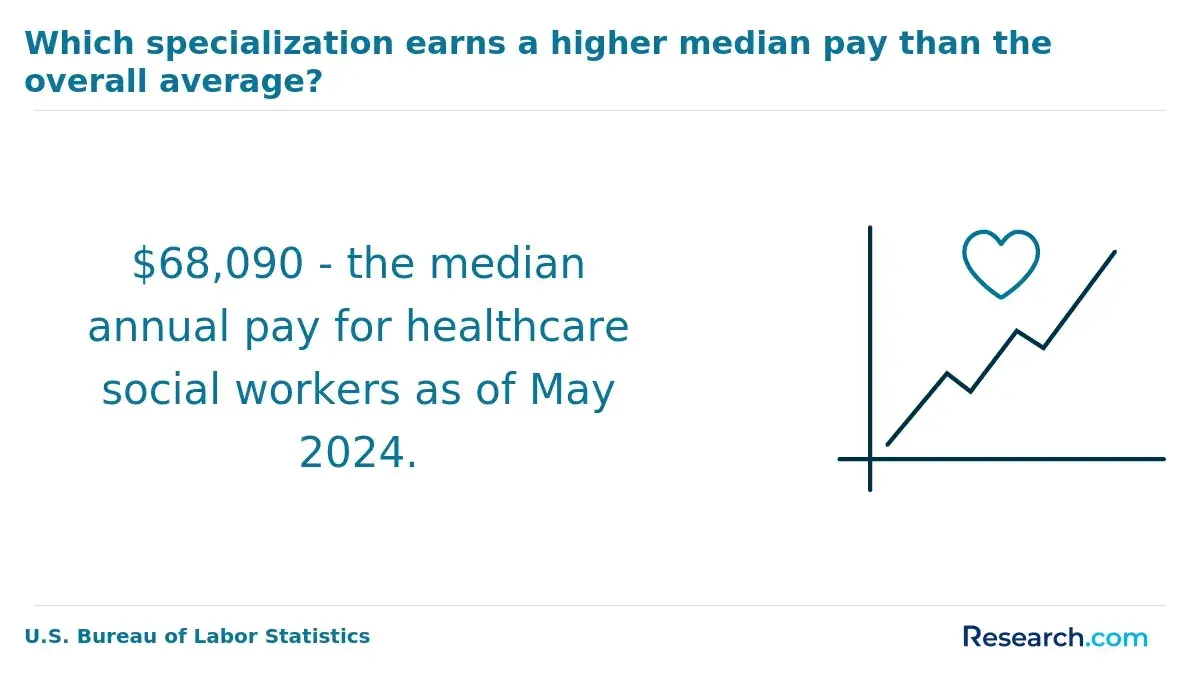
The MSW salary outlook depends on role, licensure status, employer type, location, specialization, and experience. Median annual salaries for social workers with a master's degree generally range between $60,000 and $65,000. Entry-level roles in public agencies or nonprofits typically start near $50,000, while experienced professionals, especially those in healthcare, schools, or government, may earn over $75,000.
Specialized areas such as clinical or healthcare social work often offer higher pay than some community-based or child welfare positions. However, higher-paying roles may also require additional supervision, licensure steps, high caseloads, crisis work, or specialized experience.
Salary factors to compare
- Licensure: Clinical licensure can improve access to certain roles, but requirements vary by state.
- Sector: Healthcare, schools, government, nonprofits, research, academia, and private practice pathways can have different compensation patterns.
- Location: Urban centers and high-cost states like California and New York frequently offer 10-20% higher wages than rural areas, though cost of living may also be higher.
- Experience: Supervisory, clinical, grant management, program evaluation, and leadership experience can improve earning potential.
- Specialization: Mental health, healthcare, school social work, substance use, gerontology, and policy roles may differ significantly in pay and advancement.
Roles in research or academia usually start with lower salaries but can provide opportunities for advancement, funding, teaching, publication, and policy influence. Interest in social work research has grown, as reflected by the sharp increase in PhD applications for social work research roles.
How to think about return on investment
Applicants should compare expected earnings with tuition, debt, field placement demands, local job availability, and licensure requirements. A lower-cost accredited program with strong field placements may be a better financial decision than a more expensive program with weak advising or limited local employer connections.
The best salary strategy is not simply choosing the highest-paying specialization. It is choosing a path where your interests, credentials, field experience, licensure plan, and local labor market align.
What is the job demand for MSW graduates?
Job demand for MSW graduates is strong and projected to grow steadily through 2026, driven by needs in healthcare, mental health, child welfare, aging services, schools, substance use treatment, crisis response, and community development. Employers continue to need professionals who can combine direct service skills with documentation, care coordination, cultural competence, and systems awareness.
Graduates work in hospitals, schools, government agencies, behavioral health organizations, nonprofits, community programs, correctional settings, veteran services, and advocacy organizations. Demand is often strongest for candidates who have relevant field placements, licensure eligibility, trauma-informed practice skills, and experience with evidence-based interventions.
According to the CSWE 2022-2023 Annual Survey, 59% of PhD students enroll in public institutions. While this figure refers to doctoral students, it underscores the role of public institutions in the social work education pipeline and the importance of preparing strong applications, funding materials, and interviews for competitive academic and professional opportunities.
Skills that improve employability
- Clinical and crisis skills: Trauma-informed care, risk assessment, safety planning, and behavioral health documentation.
- Case management: Coordinating benefits, referrals, healthcare, housing, education, and family support services.
- Policy and advocacy: Understanding how systems affect clients and how to communicate needs to agencies, funders, and policymakers.
- Data-informed practice: Using outcomes, assessments, and program data to improve services.
- Cultural competence: Working respectfully with diverse communities and recognizing how structural barriers shape client experiences.
- Interdisciplinary teamwork: Collaborating with educators, nurses, physicians, attorneys, probation officers, case managers, and community partners.
Challenges job seekers should expect
Competition can be intense for desirable internships, funded placements, hospital roles, school district positions, and public-sector jobs. Applicants should prepare targeted resumes, practice interviews, and gather examples that show ethical judgment, reliability, and measurable impact.
The outlook is strongest for graduates who use the MSW strategically: choose field placements aligned with career goals, understand licensure requirements, build relationships with supervisors, and develop both people-centered and systems-level skills.
How to choose the best MSW program?
The best MSW program is the one that is accredited, affordable enough for your situation, aligned with your career goal, and capable of placing you in field settings that build the experience you need. Prestige alone is not enough. A strong fit depends on specialization, format, licensure preparation, advising, cost, and field education quality.
According to the CSWE 2022-2023 Annual Survey, school social work certificates are consistently among the most prominent MSW offerings. Students interested in educational settings should pay close attention to programs with school social work certificates, school-based practicums, and partnerships with local districts.
Key factors to compare
| Factor | What to look for | Why it matters |
| Accreditation | CSWE-accredited MSW program. | Supports licensure eligibility and employer recognition. |
| Specialization | Clinical, school, healthcare, child welfare, policy, administration, or community practice tracks. | Helps align coursework and field experience with your career goal. |
| Field placement support | Clear process for securing placements, strong agency partnerships, and advising. | Field education is central to skill development and employability. |
| Program format | Full-time, part-time, online, hybrid, evening, or accelerated options. | Determines whether the program fits work, family, and location constraints. |
| Licensure preparation | Advising on state requirements, clinical pathways, and supervised practice expectations. | Important for students planning clinical or regulated roles. |
| Cost and aid | Tuition, fees, scholarships, assistantships, employer benefits, and loan implications. | Protects long-term financial stability. |
| Student support | Academic advising, writing support, career services, disability services, and mentorship. | Can affect persistence, placement success, and graduation readiness. |
Questions to ask admissions teams
- Is the program CSWE-accredited, and does that accreditation cover my intended format?
- How are field placements assigned, and can students request placements in specific practice areas?
- What support is available for online or working students completing field requirements?
- How does the program prepare students for licensure in the state where I plan to practice?
- What certificates, concentrations, or electives are available in my area of interest?
- What are typical class sizes, advising structures, and student support resources?
- How should applicants with lower GPAs, career changes, or limited social service experience strengthen their applications?
Applicants should also tailor each personal statement to the program. Name the specialization, faculty strength, field placement setting, certificate, or mission element that genuinely fits your goals. A generic application is less persuasive than one that shows you understand what the program offers and how you plan to use it.
Choosing an MSW program is ultimately a career planning decision. Start with the role you want, confirm the licensure and accreditation requirements, compare costs honestly, and select the program that gives you the strongest path from classroom learning to competent social work practice.
Other Things You Should Know About Social Work
Social work students need to cultivate strong communication and interpersonal skills to effectively engage with clients from diverse backgrounds. Critical thinking and problem-solving abilities are essential for assessing client needs and developing intervention plans. Additionally, resilience and emotional intelligence help students manage the emotional challenges often encountered in the field.
Field placements in MSW programs typically take place in settings such as hospitals, schools, community agencies, mental health clinics, and child welfare organizations. These placements provide practical experience in case management, counseling, advocacy, and program development. They are crucial for students to apply classroom knowledge and develop professional competencies.
In 2027, MSW programs highly value a strong academic record, as it demonstrates commitment and a capacity for graduate-level work. Competitive GPAs and coursework in related fields can enhance an application, showcasing both dedication and an ability to handle rigorous social work studies.
Yes, many MSW programs offer opportunities to specialize in areas such as clinical social work, school social work, healthcare, mental health, or child welfare. Specializations enable students to develop focused expertise and skills tailored to specific populations or settings. These options often include targeted coursework and relevant field placements.
References
- Types of Social Work https://www.socialworkers.org/News/Facts/Types-of-Social-Work
- Preparing for Grad School https://www.mswhelper.com/apply
- Online MSW Programs No GRE Required - MasterofSocialWork.com https://www.masterofsocialwork.com/faqs/gre-requirements-online-msw-programs
- Social Work Masters Prerequisites: Discover 7 Critical Pieces - Prereqcourses https://www.prereqcourses.com/social-work-masters-prerequisites/
- Guide to Careers in Social Work https://www.onlinemswprograms.com/careers/
- Admission requirements https://socialwork.wayne.edu/msw/requirements
- How Long Does it Take to Become a Social Worker? https://socialworklicensemap.com/become-a-social-worker/how-long-does-it-take/
- Your Social Work Graduate School Application: 14 Tips to Help You Get an Acceptance Letter https://www.socialworker.com/feature-articles/education--credentials/Your_Social_Work_Graduate_School_Application%3A_14_Tips_to_Help_You_Get_an_Acceptance_Letter/
- MSW Career Outlook https://www.kysu.edu/academics/college-as/school-of-social-work/careers/msw-career-outlook.php
- High-demand social work roles in 2026: trends and opportunities https://socialwork.pacific.edu/blog/high-demand-social-work-roles-2026-trends-and-opportunities