
2027 Best Accelerated Online Associate Degree in Nursing (ADN) Programs

Co-Founder and Chief Data Scientist
Deciding on a nursing degree often brings pressure to choose a four-year path, creating doubt about faster, more direct options. Yet with about 194,500 RN openings projected annually, the need for qualified nurses is urgent. An Associate Degree in Nursing (ADN) is a powerful and strategic response to this demand.
To help you make this move with total confidence, our career planning experts with 10 years of experience built this guide. It's more than a list of the best online associate science in nursing programs; it’s a complete blueprint for your career.
What are the benefits of getting an accelerated online Associate Degree in Nursing (ADN) degree?
- Enter a high-demand career as a Registered Nurse quickly.
- Access a significant earning potential, with a median salary of $93,600 per year.
- Gain the flexibility of online learning for coursework while completing essential hands-on training.
What can I expect from an accelerated online Associate Degree in Nursing (ADN) degree program?
You can expect a rigorous and fast-paced online associate science in nursing programs that blend online coursework with mandatory, in-person clinical training. It’s a common misconception that online programs are less demanding; in reality, an accelerated format requires exceptional discipline.
Your theoretical courses, such as anatomy, pharmacology, and nursing ethics, will be delivered online. This provides flexibility in where you study, but not necessarily when. You’ll still have deadlines, assignments, and exams that require excellent time management.
The hands-on portion is non-negotiable. You will be required to complete a set number of clinical hours at hospitals or other healthcare facilities. This is where you translate theory into the practical, real-world skills needed to care for patients. Success in this kind of program depends on your ability to stay organized and committed from the very beginning.
Where can I work with an accelerated online Associate Degree in Nursing (ADN)?
With an ADN, you'll be qualified to work as a Registered Nurse in a wide range of healthcare settings. While options are diverse, the vast majority of RNs start their careers in hospital environments.
- Hospitals: State, local, and private hospitals are the largest employers of RNs, accounting for 58% of all jobs.
- Ambulatory Healthcare Services: This includes physicians' offices, outpatient care centers, and home healthcare services.
- Nursing and Residential Care Facilities: These roles focus on long-term care in skilled nursing facilities and rehabilitation centers.
- Government: Positions are available in federal, state, and local government agencies, including public health departments and military facilities.
You may have heard that some hospitals prefer nurses with a four-year degree. While this is a factor in certain specialized or Magnet-status hospitals, the intense demand for nurses means ADN graduates remain essential to the healthcare system and find strong employment opportunities across the country.
How much can I make with an accelerated online Associate Degree in Nursing (ADN)?
The median annual salary for a Registered Nurse is $93,600 per year. This powerful earning potential is a primary reason the ADN is considered such a strategic career move.
Of course, that figure is a national median. Your actual salary will vary based on your state, the type of facility you work in, and your level of experience.
Even with those variations, this number demonstrates the strong financial return possible. This earning potential is what makes online associate science in nursing programs such a powerful investment in your future.
Best Accelerated Online Associate Degree in Nursing (ADN) Programs for 2027
An accelerated online Associate Degree in Nursing can be one of the fastest practical routes to becoming a Registered Nurse, but it is not a fully online shortcut. The classroom portion may be delivered online or in a hybrid format, while labs, simulations, and clinical rotations still require in-person participation. For students comparing nursing school options, the real decision is not simply “online or campus.” It is whether the program is accredited, affordable, clinically viable in your area, and strong enough to prepare you for the NCLEX-RN.
This guide is designed for first-time nursing students, LPNs considering an RN bridge pathway, working adults comparing flexible formats, and applicants trying to balance speed, cost, licensure requirements, and career outcomes. You will find ranked program options, cost and timeline comparisons, admissions factors, financial aid guidance, and practical questions to ask before enrolling.
Quick Answer: What Is an Accelerated Online ADN Program?
An accelerated online ADN program is a fast-paced associate-level nursing program that prepares eligible graduates to take the NCLEX-RN and pursue Registered Nurse licensure. Most programs combine online theory courses with required in-person labs, simulations, and supervised clinical experiences. For students without prior nursing credentials, many accelerated ADN pathways take 18 to 24 months. LPN-to-ADN bridge options may be shorter for students who already hold an active practical nursing license.
The best program is not necessarily the shortest or cheapest one. A strong ADN program should have recognized accreditation, transparent NCLEX-RN outcomes, clear clinical placement expectations, reasonable total costs, and state approval for RN licensure where you plan to practice.
How We Selected These Accelerated Online ADN Programs
Because nursing school is a major financial and professional commitment, this ranking emphasizes decision-useful information rather than marketing claims. Research.com reviews available program data using established education and outcome sources, including the IPEDS database, Peterson's database, the College Scorecard database, and The National Center for Education Statistics.
These sources help evaluate program structure, institutional information, cost indicators, and student-facing details for accelerated online associate degree in nursing options. You can review the broader Research.com approach on the methodology page.
Ranked List of Accelerated Online ADN Programs
| Rank | School and Program | Program Length | Credits Required | Cost | Accreditation |
| 1 | Moberly Area Community College Associate Degree in Nursing | 24 months | 75 | $107.00 per credit | Accreditation Commission for Education in Nursing (ACEN) |
| 2 | Beal University Associate Degree in Nursing | 18 months | 69 | $42,305.00 total tuition | National League for Nursing Commission for Nursing Education Accreditation (NLN CNEA) |
| 3 | Rasmussen University Professional Nursing (ADN) | As few as 18 months | 102 quarter credits | $453.00 per credit | Higher Learning Commission (HLC) |
| 4 | Valencia College Associate in Science in Nursing | 20 months | 72 | $103.06 in-state; $390.96 out-of-state per credit | Accreditation Commission for Education in Nursing (ACEN) |
| 5 | ECPI University Associate Degree in Nursing | 18 months | 71 | $49,500.00 total tuition | Accreditation Commission for Education in Nursing (ACEN) |
| 6 | Herzing University Associate of Science in Nursing | 24 months | 72 | $925.00 per credit | Accreditation Commission for Education in Nursing (ACEN) |
| 7 | American Career College Associate Degree in Nursing | 20 months | 99 quarter credits | $78,552.00 total tuition | Accreditation Commission for Education in Nursing (ACEN) |
1. Moberly Area Community College - Associate Degree in Nursing
Moberly Area Community College offers an ADN pathway that combines nursing theory, lab preparation, and clinical learning to help students develop safe, patient-centered care skills. The program is structured to prepare graduates to coordinate patient care and work effectively within nursing teams across healthcare settings.
- Program Length: 24 months
- Required Credits to Graduate: 75
- Cost per Credit: $107.00
- Accreditation: Accreditation Commission for Education in Nursing (ACEN)
2. Beal University - Associate Degree in Nursing
Beal University provides an accelerated RN preparation route that blends online coursework with required clinical placements. The curriculum is built to strengthen clinical judgment, patient-care decision-making, and the problem-solving abilities nurses need in fast-moving care environments.
- Program Length: 18 months
- Required Credits to Graduate: 69
- Total Tuition: $42,305.00
- Accreditation: National League for Nursing Commission for Nursing Education Accreditation (NLN CNEA)
3. Rasmussen University - Professional Nursing (ADN)
Rasmussen uses a hybrid model with multiple annual start dates, which can help students begin without waiting for a traditional fall-only cohort. Students complete online coursework alongside in-person labs, simulations, and clinical experiences designed to support NCLEX-RN readiness and entry-level nursing practice.
- Program Length: As few as 18 months
- Required Quarter Credits to Graduate: 102
- Cost per Credit: $453.00
- Accreditation: Higher Learning Commission (HLC)
4. Valencia College - Associate in Science in Nursing
Valencia College offers a limited-access nursing program that connects classroom learning with substantial clinical exposure. The program is intended to prepare graduates for the licensure exam and for RN responsibilities in direct patient-care roles.
- Program Length: 20 months
- Required Credits to Graduate: 72
- Cost per Credit: $103.06 (in-state); $390.96 (out-of-state)
- Accreditation: Accreditation Commission for Education in Nursing (ACEN)
5. ECPI University - Associate Degree in Nursing
ECPI offers a year-round accelerated ADN option that can be completed in 18 months. The program emphasizes clinical reasoning, lab-based practice, and simulation-based learning to help students build the applied skills needed for safe patient care.
- Program Length: 18 months
- Required Credits to Graduate: 71
- Total Tuition: $49,500.00
- Accreditation: Accreditation Commission for Education in Nursing (ACEN)
6. Herzing University - Associate of Science in Nursing
Herzing provides online delivery for core nursing coursework while still requiring in-person clinical learning and on-site intensives. This structure may appeal to students who need flexibility but can also meet scheduled hands-on requirements.
- Program Length: 24 months
- Required Credits to Graduate: 72
- Cost per Credit: $925.00
- Accreditation: Accreditation Commission for Education in Nursing (ACEN)
7. American Career College - Associate Degree in Nursing
American Career College offers a blended ADN program that combines online and in-person instruction. Students study nursing fundamentals while completing clinical and practical training intended to prepare them for patient-care responsibilities as part of a healthcare team.
- Program Length: 20 months
- Required Quarter Credits to Graduate: 99
- Total Tuition: $78,552.00
- Accreditation: Accreditation Commission for Education in Nursing (ACEN)
How Long Does an Accelerated Online ADN Program Take?
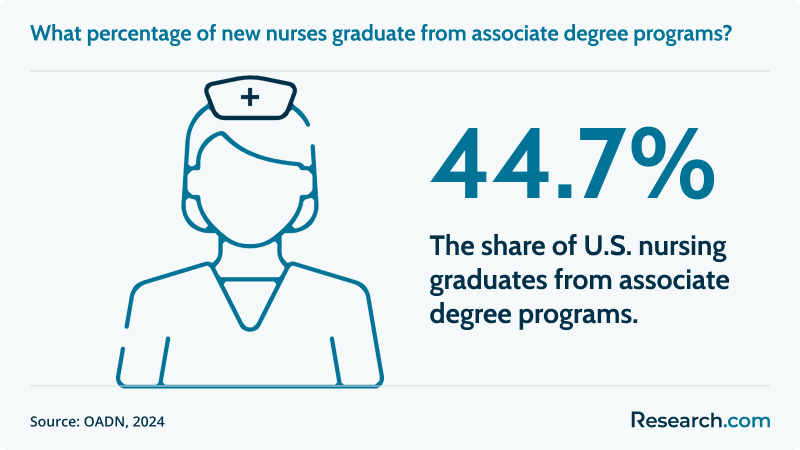
For students entering without an existing nursing license, most accelerated ADN programs take 18 to 24 months. That timeline makes the ADN one of the more time-efficient RN preparation options. Associate degree programs also remain a major RN pipeline, with nearly 45% of all new nursing graduates earning their degree through an associate program.
LPN-to-ADN Bridge Programs Can Shorten the Timeline
If you already work as a Licensed Practical Nurse, you may be able to move faster through an LPN-to-ADN bridge program. These programs are designed to credit or build on prior practical nursing preparation, so the timeline may be as short as 12 months. Students comparing bridge options can review the fastest LPN to RN program choices, but they should confirm state approval, clinical requirements, and whether the format fits their work schedule.
The ADN remains a central pathway into registered nursing because it allows many students to enter the workforce sooner than a traditional four-year route. The data below shows why associate degree preparation continues to play a large role in the nursing workforce.
Accelerated Online ADN vs. On-Campus ADN: What Actually Changes?
The most important outcome is the same: graduates of approved and accredited ADN programs must qualify for and pass the NCLEX-RN to become licensed Registered Nurses. Online ADN students still complete in-person clinical hours, labs, and skills training. The “online” component usually refers to theory-based coursework, not the entire nursing education.
The main difference is delivery. Online or hybrid programs may offer more flexibility for lectures, assignments, discussions, and exams, while campus-based programs may provide more face-to-face structure. Neither format is automatically better. The stronger choice depends on your schedule, learning style, location, and access to approved clinical sites.
| Factor | Accelerated Online or Hybrid ADN | On-Campus ADN |
| Course delivery | Many theory courses are completed online, often with scheduled in-person labs or intensives. | Most classroom instruction happens on campus at scheduled times. |
| Clinical training | Required in person through approved clinical sites. | Required in person through approved clinical sites. |
| Best for | Students who need flexibility and can manage independent learning. | Students who prefer regular face-to-face instruction and campus routines. |
| Key risk | Assuming “online” means no travel or no clinical scheduling conflicts. | Underestimating commuting time and fixed class schedules. |
| Licensure preparation | Must prepare students for NCLEX-RN eligibility if the program is approved for the student’s state. | Must prepare students for NCLEX-RN eligibility if the program is approved for the student’s state. |
Accreditation Is the Non-Negotiable Quality Check
Employers and state boards care far more about program approval, accreditation, clinical preparation, and NCLEX eligibility than whether lectures were delivered online. Accreditation bodies such as the Accreditation Commission for Education in Nursing (ACEN) and the National League for Nursing Commission for Nursing Education Accreditation (NLN CNEA) evaluate nursing education quality indicators such as curriculum, faculty preparation, clinical learning, and outcomes.
Before applying, verify both institutional accreditation and nursing program accreditation. Also confirm that the program meets RN licensure requirements in the state where you plan to sit for the NCLEX-RN and practice.
How Much Does an Accelerated Online ADN Program Cost?
ADN costs vary widely by institution type, residency status, and program structure. Based on the estimates used in this ranking, average total tuition is about $44,917, with costs ranging from as low as $8,025 to over $78,000. Public community college options often sit closer to the lower end, while private institutions may cost substantially more.
Tuition is only part of the budget. Students should also ask about textbooks, uniforms, background checks, drug screenings, immunizations, liability insurance, technology fees, testing fees, lab supplies, transportation to clinical sites, and NCLEX-RN preparation or exam-related expenses.
How to Think About Return on Investment
An ADN can make financial sense when the program is accredited, reasonably priced, and leads to RN licensure without excessive debt. The original cost comparison in this guide notes that a one-time investment of around $20,000 may lead to a career with a median salary of over $93,000 a year, but individual outcomes depend on location, employer, experience, shifts, and specialty area. Students focused on minimizing debt should compare accredited options on cost, completion time, and clinical access, including lists of the cheapest ADN online programs.
| Cost Factor | Why It Matters | Question to Ask |
| Tuition structure | Per-credit pricing and total tuition can produce very different final costs. | Is the published price per credit, per term, or total tuition? |
| Clinical travel | Students may need to travel to approved clinical sites or campus intensives. | Where are clinicals held, and how far might I need to travel? |
| Fees and supplies | Nursing programs often require items beyond tuition. | What mandatory costs are not included in tuition? |
| Time away from work | Accelerated schedules can limit work hours. | How many weekly hours should I reserve for classes, labs, study, and clinicals? |
| Licensure eligibility | A low-cost program is not a good value if it does not support RN licensure in your state. | Does this program meet requirements where I plan to practice? |
Financial Aid Options for Accelerated Online ADN Students
The first step is completing the FAFSA. This application is used to determine eligibility for federal student aid, and it may also be required for state aid, institutional grants, work-study, and federal loans.
Students should also search for scholarships from colleges, local healthcare employers, community foundations, nonprofit organizations, and professional nursing groups. Because RN demand remains high, some hospitals and health systems offer tuition support, scholarships, or employment-linked assistance programs. Read the terms carefully, especially if funding requires a work commitment after graduation.
Nursing-Specific Scholarship Sources
Professional organizations can be useful starting points for nursing scholarship searches. Examples include The American Nurses Association and the National Student Nurses' Association. Applicants should verify eligibility rules, deadlines, award amounts, and whether funds can be used for associate-level nursing programs.
Admissions Requirements and Prerequisites
Prerequisites depend on whether you are entering nursing for the first time or advancing from practical nursing. Competitive programs may also have limited seats, so meeting minimum requirements does not always guarantee admission.
- First-time nursing students: Applicants usually need a high school diploma or GED, required science coursework such as Anatomy and Physiology, a minimum GPA in specified prerequisites, and a qualifying score on an entrance exam such as TEAS or HESI. Students new to nursing can compare additional options through online ADN programs for non nurses.
- Licensed Practical Nurses: LPN applicants typically need an active and unencumbered LPN license. Bridge programs may waive or modify some standard requirements because applicants already have nursing education and patient-care experience.
What Courses Are Included in an Accelerated Online ADN Program?
Accelerated ADN curricula are focused and clinically oriented. Students study nursing theory, health assessment, medication safety, patient care planning, and evidence-informed practice while completing supervised clinical experiences. The goal is to prepare graduates for safe entry-level RN responsibilities.
- Pharmacology: Medication classifications, actions, interactions, adverse effects, and safe administration principles.
- Patient Assessment: Methods for collecting, interpreting, and documenting physical and psychosocial patient information.
- Nursing Ethics: Professional standards, patient rights, confidentiality, informed consent, and ethical decision-making.
- Medical-Surgical Nursing: Care for adult patients with acute and chronic health conditions, including patients recovering from surgery.
These courses are paired with required clinical rotations in real healthcare settings. Clinicals are not optional; they are essential for graduation, NCLEX-RN eligibility, and safe nursing practice.
ADN, ASN, and AAS: Do the Degree Titles Matter?
Associate-level RN programs may use different titles, including Associate Degree in Nursing, Associate of Science in Nursing, or Associate of Applied Science in Nursing. These labels can reflect differences in general education structure or institutional naming, but the core question is whether the program prepares graduates for NCLEX-RN eligibility and RN licensure. For a more detailed comparison, review this guide to ADN vs AAD vs AAS nursing degrees.
Hands-on readiness is especially important as the nursing workforce changes. The workforce age profile below helps illustrate why healthcare employers need new nurses who can develop clinical competence quickly and safely.
Can You Specialize in an Accelerated Online ADN Program?
Most ADN programs do not offer formal undergraduate specializations such as pediatrics, oncology, emergency nursing, or critical care. The degree is meant to build broad entry-level RN competence. Specialization usually begins after licensure through work experience, employer training, continuing education, and specialty certification.
That does not mean ADN students have no room for career direction. Clinical rotations can expose students to different settings, and early job choices can shape long-term specialization. If you are interested in a particular area, ask each program what clinical settings students typically experience.
Location Can Shape Your Nursing Opportunities
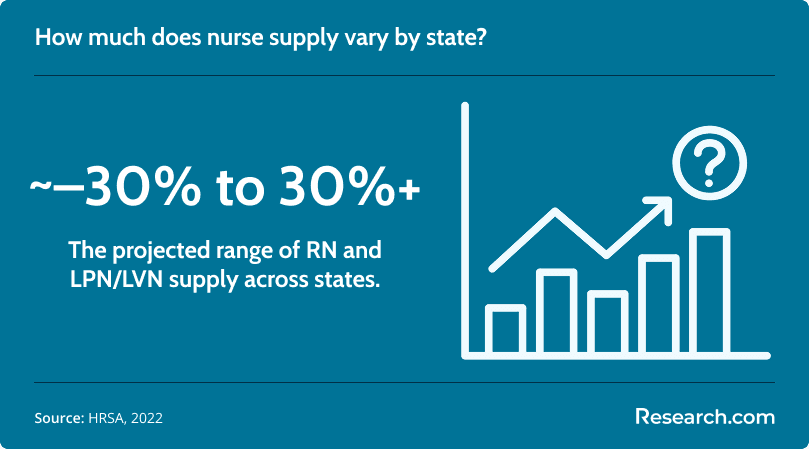
Nursing demand is not identical in every state or community. Some areas have stronger shortages, while others may be more competitive for new graduates. Where you complete clinicals, earn licensure, and apply for your first RN role can affect job availability and starting options.
Students who are flexible about location may find more openings in high-need regions. The data below shows how nurse supply projections can vary across geography, which makes location an important part of career planning.
How to Choose the Best Accelerated Online ADN Program
The right accelerated ADN program should match your licensing goal, budget, learning style, and clinical reality. Do not choose based only on speed. A program that looks fast can become expensive or impractical if clinical placements are hard to secure or if the program does not meet licensure requirements where you live.
- Confirm nursing accreditation and state approval: Look for recognized nursing accreditation such as ACEN or NLN CNEA where applicable, and verify RN licensure eligibility with your state board of nursing.
- Review NCLEX-RN pass rates: Pass rates show how well graduates perform on the licensure exam. Compare a program’s results with relevant benchmarks.
- Ask about clinical placement support: Find out whether the school assigns placements, helps students secure them, or expects students to locate sites independently.
- Compare total cost, not just tuition: Include fees, supplies, travel, lost work time, and exam-related expenses.
- Evaluate schedule intensity: Accelerated programs move quickly. Ask how many hours per week students typically spend on coursework, labs, study, and clinicals.
- Check bridge options if you are an LPN: LPNs should look for a dedicated bridge structure that recognizes prior training and avoids unnecessary repetition.
NCLEX-RN Outcomes Are a Critical Quality Signal
The NCLEX-RN is the licensure exam that determines whether graduates can enter practice as Registered Nurses. According to the data cited in this article, ADN graduates pass the licensure exam at a rate of 88.2%, compared with 89.5% for graduates from four-year BSN programs. That near-parity shows why program quality, clinical preparation, and student readiness matter more than degree label alone.
Applicants should still review each school’s own NCLEX-RN performance. A strong overall ADN pass-rate trend does not guarantee that every individual program performs equally well.
Common Mistakes to Avoid When Choosing an Online ADN Program
| Mistake | Why It Can Hurt You | Better Approach |
| Assuming the program is fully online | Nursing programs require in-person labs and clinical rotations. | Ask exactly when and where you must appear in person. |
| Checking institutional accreditation but not nursing accreditation | Program-level nursing accreditation can affect credibility, transfer options, and employer confidence. | Verify both institutional and nursing program accreditation. |
| Ignoring state licensure rules | A program may not meet RN requirements in every state. | Contact the state board of nursing before enrolling. |
| Comparing only tuition | Fees, supplies, travel, and unpaid clinical time can change the real cost. | Build a full cost-of-attendance estimate. |
| Choosing the shortest program automatically | A compressed schedule can be difficult if you work full time or have caregiving obligations. | Match the pace to your available weekly study and clinical time. |
| Overlooking clinical placement responsibility | Students may face delays if placements are not arranged in time. | Ask whether the school secures sites or expects student-led placement searches. |
Career Paths After an Accelerated Online ADN Program
An ADN can qualify graduates for entry-level Registered Nurse roles after they meet licensure requirements. Most new ADN-prepared RNs begin in direct patient-care positions, where they develop clinical judgment, communication skills, and confidence with real patient populations.
- Staff Nurse: Provides direct care to patients on a hospital unit or care team.
- Medical-Surgical Nurse: Cares for adult patients with varied medical conditions or post-surgical needs.
- Long-Term Care Nurse: Works with older adults or chronically ill residents in skilled nursing and long-term care settings.
- Clinic Nurse: Supports outpatient care through assessments, treatments, patient education, and coordination.
Does an ADN Limit Long-Term Advancement?
An ADN does not have to be the end point. It can be a practical first credential that allows students to enter RN practice and then continue their education while working. About 40% of nurses who begin with an associate degree go on to earn higher degrees.
Many employers offer tuition assistance for RNs who later pursue a BSN or graduate nursing education. Students with long-term goals in advanced practice, education, administration, or leadership can explore structured pathways such as ADN to MSN bridge programs.
ADN vs. Accelerated BSN Online Programs
ADN and accelerated BSN programs can both lead toward RN licensure, but they serve different students and career timelines. ADN programs generally emphasize faster entry into nursing practice through associate-level preparation. BSN programs add broader coursework in areas such as leadership, community health, and research, which may support long-term advancement or employer preferences in some settings. Students comparing degree routes can review accelerated BSN online programs to understand how the bachelor’s pathway differs.
| Factor | Accelerated ADN | Accelerated BSN |
| Primary goal | Faster preparation for entry-level RN practice through an associate degree. | RN preparation with additional bachelor’s-level coursework. |
| Typical fit | Students prioritizing speed, lower cost options, or a step-by-step nursing career path. | Students who want a bachelor’s credential earlier or are planning for leadership or graduate study. |
| Curriculum focus | Core nursing skills, direct patient care, clinical readiness, and NCLEX-RN preparation. | Nursing practice plus broader content such as leadership, public health, and research. |
| Long-term education path | Can continue later through RN-to-BSN, ADN-to-MSN, or other bridge options. | Can move more directly toward graduate nursing study if other requirements are met. |
Job Market for ADN Graduates
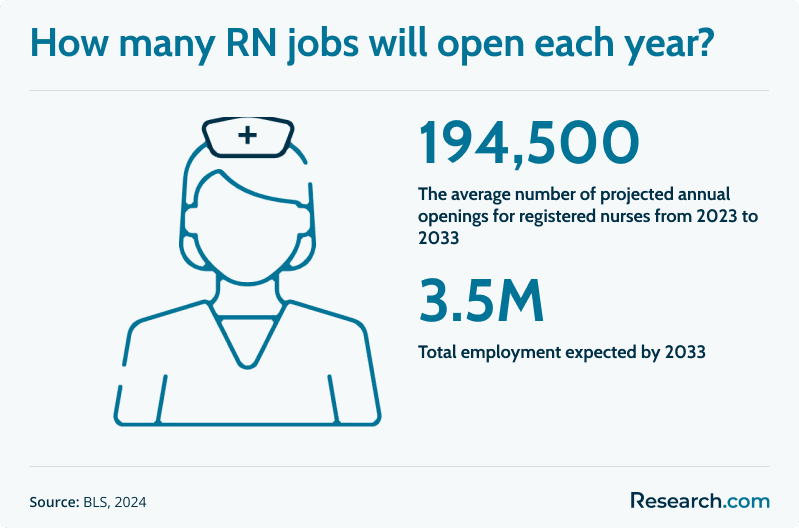
The RN labor market remains strong. The U.S. Bureau of Labor Statistics projects about 194,500 openings for Registered Nurses on average each year for the next decade. Demand is supported by healthcare needs, workforce turnover, and retiring nurses.
ADN graduates continue to matter because associate degree programs produce a large share of new RNs. With nearly 45% of new RNs entering through associate degree pathways, healthcare employers rely on ADN-prepared nurses to fill essential bedside and clinical roles.
Why ADN Graduates Remain Important to Healthcare Employers
Hospitals, clinics, long-term care facilities, and outpatient settings need licensed nurses who can provide safe, direct care. An ADN can position graduates for those roles quickly, especially when the program has strong clinical preparation and NCLEX-RN outcomes. However, job availability, pay, and advancement vary by state, employer, specialty, and whether a workplace prefers or requires BSN completion over time.
The chart below shows the scale of annual RN demand and why nursing remains a practical career consideration for students who are prepared for the academic and clinical intensity of the field.
How to Succeed in an Accelerated Online ADN Program
Accelerated online ADN programs require strong time management, academic discipline, and comfort with both independent study and hands-on performance. Students should build a weekly schedule that includes lectures, reading, assignments, skills practice, clinical preparation, care plans, exam review, and rest. Waiting until exams to study is rarely effective in a compressed nursing curriculum.
- Use a fixed weekly calendar: Block study time, assignment deadlines, lab days, clinical shifts, and commute time before the term begins.
- Practice NCLEX-style questions early: These questions test application and clinical judgment, not memorization alone.
- Stay connected with faculty and advisors: Ask for help quickly if grades, clinical performance, or schedule conflicts become a concern.
- Join a serious study group: Peer accountability can help, but only if the group stays focused on practice questions, concepts, and clinical reasoning.
- Prepare for clinicals professionally: Arrive organized, know your patient information, follow safety protocols, and request feedback.
- Plan your next step: If you may pursue a BSN or advanced degree later, compare transfer and bridge options early. Students exploring alternative bachelor’s pathways can review the easiest accelerated BSN program online options for context.
Questions to Ask Before You Enroll
- Is the nursing program accredited, and by which accreditor?
- Is the program approved for RN licensure in the state where I plan to practice?
- What are the most recent NCLEX-RN pass rates?
- Does the school arrange clinical placements, or must students find their own?
- Where are labs, simulations, and clinical rotations located?
- What is the full estimated cost, including fees, supplies, travel, and exam costs?
- How many hours per week should I expect to spend on school?
- Can I realistically work while enrolled in this accelerated schedule?
- Are transfer credits accepted, and how are science prerequisites evaluated?
- If I am an LPN, what credits or requirements may be waived through the bridge pathway?
Student Scenarios: How Different Learners Evaluate an Online ADN
- Esther: "I felt pressure to choose a four-year university, but the ADN route made more sense for my timeline. The program was focused, the instructors were accessible, and the NCLEX-RN outcomes helped me feel confident that I was choosing a serious path into nursing."
- Ben: "As an LPN, I did not want to repeat material I was already using at work. The bridge format respected my experience, let me keep working, and helped me move toward RN licensure. After completing the pathway, I saw a 40% pay increase."
- Kate: "Because I lived far from a university nursing school, a hybrid ADN option made the goal possible without relocating my family. I still had to attend clinicals in person, but I could complete much of the academic work from home."
Key Insights
- An accelerated online ADN is usually hybrid, not fully online. Expect online theory coursework plus in-person labs, simulations, and clinical rotations.
- Most accelerated ADN programs take 18 to 24 months. LPN-to-ADN bridge options may be shorter, sometimes as little as 12 months.
- Accreditation and state licensure eligibility matter more than format. Before enrolling, verify nursing accreditation, state board approval, and NCLEX-RN eligibility.
- Costs vary dramatically. The estimated average total tuition is about $44,917, with a range from as low as $8,025 to over $78,000, before additional fees and supplies.
- NCLEX-RN pass rates are one of the best program quality indicators. ADN graduates pass at 88.2%, close to the 89.5% rate for four-year BSN graduates, but applicants should still review each school’s own outcomes.
- An ADN can be a first step, not a ceiling. About 40% of nurses who start with an associate degree later earn higher degrees, and bridge options can support BSN or MSN progression.
- Clinical placement can make or break the experience. Ask whether the school secures placements and where students typically complete required hands-on training.
- The best program is the one that fits your state, budget, schedule, and career plan. Do not choose based only on speed, price, or the word “online.”
References:
- National Council of State Boards of Nursing. (n.d.). NCLEX pass rates. Retrieved August 16, 2025, from https://www.ncsbn.org/exams/exam-statistics-and-publications/nclex-pass-rates.page
- Organization of Associate Degree Nursing. (2024, June). OADN voices – June 2024 leadership message. Retrieved August 16, 2025, from https://oadn.org/news/oadn-voices-june-2024-leadership-message/
- Patel, K. K., Tsun, P. Y. T., Smiley, R. A., Jayawardena, P. P., & Sohoni, S. A. (2023). The 2022 National Nursing Workforce Survey. Journal of Nursing Regulation, 14(1), S1–S88. https://doi.org/10.1016/S2155-8256(23)00047-9
- U.S. Bureau of Labor Statistics. (n.d.). Occupational employment and wage statistics. Retrieved August 16, 2025, from https://data.bls.gov/oesprofile/
- U.S. Bureau of Labor Statistics. (2023, September 6). Registered nurses. Occupational Outlook Handbook. Retrieved August 16, 2025, from https://www.bls.gov/ooh/healthcare/registered-nurses.htm
Other Things You Should Know About Accelerated Online ADN Programs
In 2027, the top accelerated online ADN programs are designed to provide efficient pathways into nursing. These programs typically integrate rigorous online coursework with essential hands-on clinical experiences and are recognized for their strong support systems, comprehensive curriculum, and high NCLEX-RN pass rates. Institutions like Excelsior College, Rasmussen University, and Purdue University Global are highly recommended for their dynamic and accessible online ADN programs.
The 2027 best accelerated online ADN programs often require a high school diploma or GED, a minimum GPA, prerequisite courses in subjects like biology and chemistry, and passing scores on entrance exams. Some programs may also require healthcare experience or personal interviews.
The best accelerated online ADN programs in 2027 are typically accredited by recognized bodies like the Accreditation Commission for Education in Nursing (ACEN) and the Commission on Collegiate Nursing Education (CCNE), ensuring high-quality education standards for aspiring nurses.


