
2027 Best Accelerated Online Associate Science in Nursing (ASN) Programs

Co-Founder and Chief Data Scientist
For many aspiring nurses, the biggest worry isn't the coursework—it's being trapped in a theory-heavy program. With over 44% of new nurses starting with an associate degree, finding the right fit is crucial. While both an ADN and ASN lead to the same RN license, the ASN is often the ideal choice for those who learn best by doing, offering a more clinically-intensive curriculum.
To help you choose wisely, our career planning experts, with 10 years of experience, created this guide. It's designed to help you find the best online associate science in nursing programs that prioritize the clinical skills and practical confidence you need to succeed from day one.
What are the benefits of getting an accelerated online Associate Science in Nursing (ASN) degree?
- You can quickly enter the high-demand field of registered nursing to provide essential, hands-on patient care in hospitals, clinics, and other healthcare settings.
- The degree unlocks a powerful earning potential, with registered nurses earning a median salary of $93,600 per year.
- You can thrive in a program that, unlike a more general ADN, often places a greater emphasis on hands-on clinical skills to match your learning style.
What can I expect from an accelerated online Associate Science in Nursing (ASN) degree program?
You should expect a rigorous and fast-paced program that blends flexible online learning with essential hands-on training. All your foundational coursework—like anatomy, pharmacology, and nursing theory—is typically completed online at your own pace.
But the most critical part of your education, the clinical and lab work, is always done in person. This is where the ASN path often stands apart. Many of these programs, particularly those offered by vocational schools or hospitals, are designed with a curriculum that dedicates more hours to practical, hands-on training.
This structure allows you to spend more time in simulation labs and real healthcare settings, working directly with patients. It’s an educational model built for doing, making it an excellent fit for students who learn best through active engagement rather than lectures.
Where can I work with an accelerated online Associate Science in Nursing (ASN)?
An Associate of Science in Nursing prepares you to work in all the same settings as any other registered nurse. Your RN license is the key that opens every door to employment, and state licensing boards make no distinction between an ASN and an ADN.
This means you’ll find opportunities in a wide variety of environments, including hospitals, physicians' offices, outpatient clinics, and long-term care facilities. When hiring, employers are focused on one thing: finding a licensed, competent RN who is ready for patient care.
This gives you the freedom to choose a program that truly fits how you learn. You can be confident that your focus on hands-on skills won't limit your career options after you graduate.
How much can I make with an accelerated online Associate Science in Nursing (ASN)?
You can expect to earn the same strong salary as any registered nurse with an associate degree. The median annual pay for RNs is $93,600.
Your earning potential is tied to your RN license and your skills, not the specific title of your associate degree. Your salary will be shaped by factors like your geographic location, your chosen specialty, and your years of experience in the field.
Choosing an ASN is a financially sound decision. It puts you on a direct path to a secure and well-compensated career in a high-demand profession.
- What student support services are available in an accelerated online ASN program? What student support services are available in an accelerated online ASN program?
- How Can I Verify the Accreditation and Quality of My Accelerated Online ASN Program? How Can I Verify the Accreditation and Quality of My Accelerated Online ASN Program?
Best Accelerated Online Associate Science in Nursing (ASN) Programs for 2027
Choosing an accelerated online Associate Science in Nursing program is not just a question of speed. The real decision is whether a program can prepare you for RN licensure, place you in quality clinical settings, fit your schedule, and justify the cost. Because nursing is a hands-on licensed profession, “online” ASN programs are almost always hybrid: academic coursework may be delivered online, but labs, simulations, and clinical rotations must be completed in person.
This guide is for prospective nursing students, working adults, LPNs/LVNs considering an RN pathway, and career changers who want a faster route into registered nursing without committing to a four-year BSN from the start. You will find ranked program options, cost and timeline comparisons, admissions requirements, clinical training considerations, financial aid guidance, career outcomes, and practical questions to ask before applying.
Quick Answer: What Is the Best Accelerated Online ASN Program?
The best accelerated online ASN program is the one that is properly accredited, approved for RN licensure in your state, transparent about NCLEX-RN outcomes, and able to support your required in-person clinical training. Among the programs reviewed here, completion timelines range from 18 months to 24 months, with tuition varying widely by institution and residency status. Public community colleges are often the lowest-cost option, while private accelerated programs may offer more start dates or faster pacing at a higher price.
Research.com evaluates programs using data from trusted sources such as the IPEDS database, Peterson's database, the College Scorecard database, and The National Center for Education Statistics. These sources help provide a consistent basis for comparing accelerated online associate nursing pathways. You can review Research.com's ranking approach on the methodology page.
Top Accelerated Online Associate Science in Nursing Programs
The programs below offer accelerated or hybrid associate-level nursing pathways that prepare students for registered nursing licensure. Always confirm current tuition, clinical site availability, state authorization, and licensure eligibility directly with the school before applying.
| Rank | School and Program | Timeline | Credits | Tuition Information | Accreditation Listed |
| 1 | Moberly Area Community College - Associate Degree in Nursing | 24 months | 75 | $107.00 per credit | Accreditation Commission for Education in Nursing (ACEN) |
| 2 | Beal University - Associate Degree in Nursing | 18 months | 69 | $42,305.00 total tuition | National League for Nursing Commission for Nursing Education Accreditation (NLN CNEA) |
| 3 | Rasmussen University - Professional Nursing (ADN) | As few as 18 months | 102 quarter credits | $453.00 per credit | Higher Learning Commission (HLC) |
| 4 | Valencia College - Associate in Science in Nursing | 20 months | 72 | $103.06 in-state; $390.96 out-of-state per credit | Accreditation Commission for Education in Nursing (ACEN) |
| 5 | ECPI University - Associate Degree in Nursing | 18 months | 71 | $49,500.00 total tuition | Accreditation Commission for Education in Nursing (ACEN) |
| 6 | Herzing University - Associate of Science in Nursing | 24 months | 72 | $925.00 per credit | Accreditation Commission for Education in Nursing (ACEN) |
| 7 | American Career College - Associate Degree in Nursing | 20 months | 99 quarter credits | $78,552.00 total tuition | Accreditation Commission for Education in Nursing (ACEN) |
1. Moberly Area Community College - Associate Degree in Nursing
Moberly Area Community College offers an associate nursing pathway that combines classroom-based nursing theory with supervised clinical learning. The program is designed to help graduates provide safe, patient-centered care, coordinate responsibilities within a nursing team, and function in multiple healthcare environments.
- Program Length: 24 months
- Required Credits to Graduate: 75
- Cost per Credit: $107.00
- Accreditation: Accreditation Commission for Education in Nursing (ACEN)
2. Beal University - Associate Degree in Nursing
Beal University provides an accelerated RN preparation option that pairs online learning with required in-person clinical experiences. The curriculum emphasizes clinical judgment, nursing decision-making, and problem-solving skills students need before sitting for the NCLEX-RN.
- Program Length: 18 months
- Required Credits to Graduate: 69
- Total Tuition: $42,305.00
- Accreditation: National League for Nursing Commission for Nursing Education Accreditation (NLN CNEA)
3. Rasmussen University - Professional Nursing (ADN)
Rasmussen University uses a hybrid model with several annual start dates, which may appeal to students who want to begin nursing coursework without waiting for a traditional fall-only cohort. Students complete online coursework alongside campus-based lab simulations and clinical practice to prepare for RN licensure.
- Program Length: As few as 18 months
- Required Quarter Credits to Graduate: 102
- Cost per Credit: $453.00
- Accreditation: Higher Learning Commission (HLC)
4. Valencia College - Associate in Science in Nursing
Valencia College offers a limited-access Associate in Science in Nursing program that connects academic instruction with extensive clinical learning. The program is built to prepare graduates for the licensure exam and entry-level RN practice in real healthcare settings.
- Program Length: 20 months
- Required Credits to Graduate: 72
- Cost per Credit: $103.06 (in-state); $390.96 (out-of-state)
- Accreditation: Accreditation Commission for Education in Nursing (ACEN)
5. ECPI University - Associate Degree in Nursing
ECPI University offers a year-round associate nursing program structured for completion in 18 months. Students learn through nursing coursework, laboratory practice, simulations, and clinical experiences intended to develop clinical reasoning and patient care skills.
- Program Length: 18 months
- Required Credits to Graduate: 71
- Total Tuition: $49,500.00
- Accreditation: Accreditation Commission for Education in Nursing (ACEN)
6. Herzing University - Associate of Science in Nursing
Herzing University offers online delivery for core nursing coursework while still requiring in-person clinical and intensive learning components. The format may work well for students who need more flexibility but can travel to required hands-on training locations.
- Program Length: 24 months
- Required Credits to Graduate: 72
- Cost per Credit: $925.00
- Accreditation: Accreditation Commission for Education in Nursing (ACEN)
7. American Career College - Associate Degree in Nursing
American Career College offers an associate nursing program that blends online and face-to-face instruction. The curriculum is structured around foundational nursing knowledge, clinical skill development, and supervised patient care experiences.
- Program Length: 20 months
- Required Quarter Credits to Graduate: 99
- Total Tuition: $78,552.00
- Accreditation: Accreditation Commission for Education in Nursing (ACEN)
What Is an Accelerated Online Associate Science in Nursing Program?
An accelerated online ASN program is a prelicensure associate-level nursing program designed to prepare students for the NCLEX-RN exam and entry-level registered nursing practice. The accelerated part usually refers to a compressed schedule, year-round terms, fewer breaks, or a cohort model that moves students through courses quickly. The online part typically applies to theory-based coursework, not clinical training.
Students should be careful with the phrase “online nursing program.” No legitimate RN preparation program can be completed entirely online because state boards of nursing require supervised clinical education. A stronger way to evaluate these programs is to ask: Which parts are online, which parts require campus visits, and where will I complete clinical rotations?
How Long Does an Accelerated Online Associate Science in Nursing Program Take?
Most accelerated ASN programs for students without previous nursing credentials take about 18 to 24 months. That timeline is shorter than a traditional four-year BSN route and is one reason many students use the associate degree pathway to enter nursing sooner.
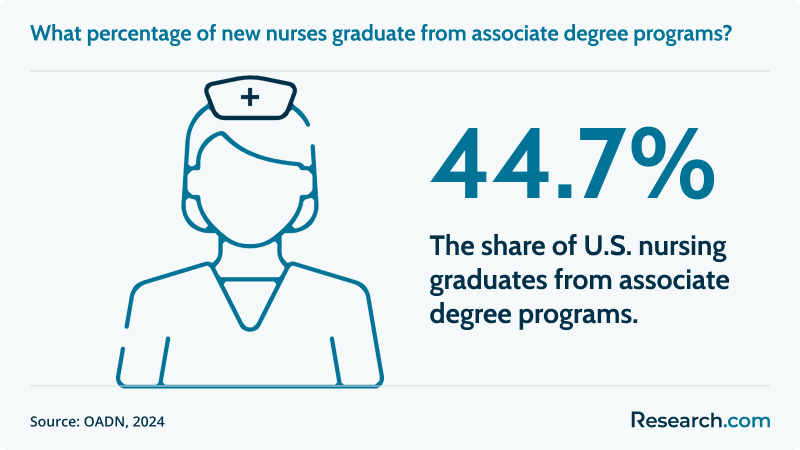
Associate degree nursing remains a major entry route into the RN workforce. Nearly 45% of all new nurses get their start with two-year online associate science in nursing programs. For students who want to qualify for RN licensure quickly, the ASN can be a practical first step.
Bridge Options for LPNs and LVNs
If you are already a Licensed Practical Nurse or Licensed Vocational Nurse, an LPN-to-ASN or LVN-to-ASN bridge may shorten your path. These programs are built around your prior clinical training and may allow you to complete the RN pathway in as little as 12 months. Nurses who want to move beyond the associate level can also compare bridge options such as the shortest online LVN to BSN programs.
| Student Background | Typical Path | What to Confirm Before Applying |
| No nursing license | Accelerated ASN or ADN pathway | Prerequisites, clinical schedule, state board approval, NCLEX-RN outcomes |
| Current LPN/LVN | LPN-to-ASN or LVN-to-ASN bridge | Credit for prior nursing coursework, bridge course requirements, clinical hour expectations |
| Already planning for BSN-level roles | ASN first, then RN-to-BSN; or direct BSN if time and cost allow | Transfer agreements, employer BSN preferences, tuition reimbursement options |
The data below shows the role associate-level pathways play in preparing future nurses.
Online ASN vs. On-Campus ASN: What Is the Difference?
The biggest difference is how the classroom portion is delivered. In an online or hybrid ASN program, lectures, discussions, assignments, and exams may happen through a learning platform. In a campus-based program, more of that work happens in person. In both formats, students must complete lab and clinical requirements face-to-face.
For many working adults, the hybrid model provides needed flexibility. However, it does not eliminate travel, scheduling demands, or hands-on requirements. Clinical rotations may occur during weekdays, evenings, weekends, or specific blocks depending on the school and local healthcare partners.
| Factor | Accelerated Online or Hybrid ASN | Traditional On-Campus ASN |
| Coursework | Many theory courses may be completed online | Most lectures and discussions happen on campus |
| Clinical training | Required in person at approved sites | Required in person at approved sites |
| Best for | Students who need flexibility but can meet clinical and lab obligations | Students who prefer scheduled classroom interaction and campus access |
| Main risk | Assuming “online” means no travel or fixed clinical schedule | Less flexibility for work or family obligations |
| What to ask | Who arranges clinical placements, and how far might I travel? | How often must I be on campus each week? |
Why Clinical Placement Quality Matters So Much
Clinical placement is one of the most important factors in any nursing program, but it is especially important for online students. Clinical rotations are where students practice assessment, medication administration, documentation, patient communication, teamwork, and decision-making under supervision.
Before choosing a program, ask whether the school assigns clinical sites or expects students to help secure placements. Also ask which hospitals, clinics, long-term care facilities, or simulation centers are commonly used. A convenient online platform cannot make up for weak clinical access.
How Much Does an Accelerated Online ASN Program Cost?
Based on the programs reviewed, estimated tuition for an Associate of Science in Nursing can range from about $8,000 to over $78,000, with an average total tuition of around $44,917. The difference is substantial, so students should compare total program cost rather than relying only on per-credit tuition.
Public community colleges and hospital-affiliated programs are often more affordable, especially for in-state students. Private accelerated programs may charge more but may also offer more frequent start dates, compressed schedules, or expanded support services. The right choice depends on cost, completion likelihood, clinical access, and licensure preparation.
Costs to Review Beyond Tuition
- Fees: Nursing programs may charge lab, simulation, technology, testing, and clinical fees.
- Books and supplies: Include digital platforms, textbooks, uniforms, shoes, stethoscope, and nursing equipment.
- Health and compliance costs: Background checks, drug screening, immunizations, CPR certification, and health documentation may be required.
- Travel: Clinical rotations may require commuting to different healthcare sites.
- Lost income: Accelerated programs can limit work hours, especially during clinical-heavy terms.
Financial Aid Options for Accelerated Online ASN Students
Students in eligible accredited nursing programs can often use the same financial aid tools available to other degree-seeking students. The most important step is to begin early, because nursing program deadlines, scholarship deadlines, and FAFSA timelines may not match.
- Federal student aid: Start with the Free Application for Federal Student Aid. The FAFSA is used to determine eligibility for federal grants, work-study, and federal student loans.
- Scholarships and grants: Nursing associations, community foundations, employers, and schools may offer awards that do not require repayment.
- Federal and private loans: Loans can help cover remaining costs, but students should compare interest rates, repayment terms, and borrowing limits carefully.
- Employer support: Hospitals and healthcare systems may offer tuition assistance, scholarships, or reimbursement for employees who commit to working after graduation.
How to Reduce the Cost of an ASN Program
- Compare total tuition and required fees, not only advertised per-credit rates.
- Ask whether prerequisite courses can be completed at a lower-cost community college.
- Check whether transfer credits are accepted before enrolling.
- Apply for nursing-specific scholarships before taking out loans.
- Ask local hospitals whether tuition reimbursement is available for future or current employees.
Admissions Requirements for Accelerated Online ASN Programs
Most accelerated ASN programs require a high school diploma or GED, a minimum GPA, prerequisite coursework, and satisfactory performance on a nursing entrance exam such as the TEAS. Because seats are often limited, meeting the minimum requirements may not guarantee admission.
Common prerequisites include anatomy and physiology, microbiology, and chemistry. Some ASN programs may place greater emphasis on science preparation than broader associate degree programs because nursing students must be ready for pharmacology, pathophysiology, assessment, and clinical decision-making early in the curriculum.
Why Nursing Admissions Can Be Competitive
RN programs are selective because clinical space, faculty availability, and patient safety requirements limit how many students can be trained at one time. Unlike some healthcare support roles, registered nursing requires a state license and a standardized licensure exam. If you are comparing healthcare careers, it may help to understand how licensing expectations differ from roles such as medical assisting; Research.com also explains whether you need a license to become a medical assistant.
Courses in an Accelerated Online Associate Science in Nursing Program
Accredited associate nursing programs generally cover similar core content because graduates must be prepared for the NCLEX-RN. Course names vary by school, but students can expect a mix of nursing theory, science, clinical practice, simulation, and general education.
| Course Area | What Students Learn | Why It Matters for RN Practice |
| Anatomy and physiology | Human body systems, structure, and function | Builds the foundation for assessment and clinical reasoning |
| Pharmacology | Medication classes, dosage principles, safety, and patient teaching | Supports safe medication administration |
| Adult health nursing | Care of adults with acute and chronic conditions | Prepares students for common hospital and clinical roles |
| Maternal-child nursing | Care of pregnant patients, newborns, children, and families | Introduces family-centered and developmental nursing care |
| Mental health nursing | Behavioral health, therapeutic communication, and crisis care | Helps nurses support patients with psychological and emotional needs |
| Clinical practice and simulation | Hands-on skills, patient interaction, documentation, and teamwork | Turns classroom knowledge into supervised practice |
How to Read a Nursing Curriculum Before You Apply
Do not judge a program only by course titles. Look at the official degree plan and compare clinical, lab, and simulation credits with general education credits. A program with strong hands-on components may be a better fit if your goal is to build practical confidence quickly.
This type of curriculum review is similar to evaluating requirements in other healthcare roles. Just as aspiring pharmacy technicians need to understand what is needed to become a pharmacy tech, nursing students should know exactly how much time they will spend in science, lab, and direct patient care preparation.
The following data illustrates why healthcare employers continue to need graduates who can transition from school to patient care settings effectively.
Do Accelerated Online ASN Programs Offer Specializations?
ASN programs prepare students for general RN practice rather than a formal specialty. After graduation and NCLEX-RN licensure, nurses may work in different settings and later pursue specialty certifications or advanced education in areas such as emergency nursing, critical care, oncology, pediatrics, geriatrics, or perioperative nursing.
For most students, the smarter question is not “Which ASN specialization should I choose?” but “Which clinical experiences will help me compete for the units or settings I want after graduation?” A program with strong rotations and simulation training can help students identify where they fit best.
Location Can Shape Your Early Nursing Options
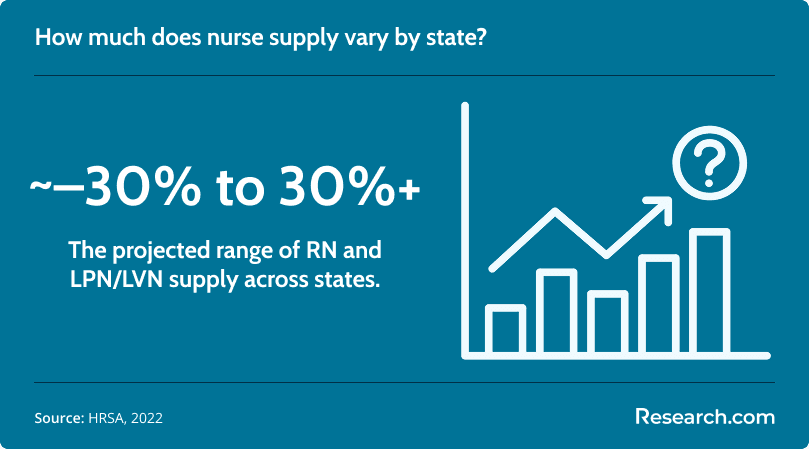
Healthcare hiring varies by region, facility type, and local workforce needs. This geographic variation is common across healthcare professions; Research.com’s guide to speech pathologist salary by state shows how location can influence opportunity and compensation in another licensed healthcare field.
The chart below highlights how the supply of nurses can vary by state.
How to Choose the Best Accelerated Online ASN Program
The best program is not always the fastest or cheapest. For nursing, the strongest choice is the program that meets licensure requirements, provides reliable clinical training, fits your life, and gives you a realistic chance of finishing. Use the checklist below before submitting an application or paying a deposit.
- Confirm accreditation and approval: Look for recognized institutional accreditation and nursing program accreditation where applicable, such as Accreditation Commission for Education in Nursing (ACEN) or Commission on Collegiate Nursing Education (CCNE). Also confirm state board approval for RN licensure.
- Review NCLEX-RN outcomes: Consistent first-time pass rates matter because the NCLEX-RN is required for licensure. Nationally, associate degree programs have an 88.2% first-time pass rate.
- Understand clinical placement: Ask who arranges clinical sites, how far students travel, and what happens if a local site is unavailable.
- Compare total cost: Include tuition, fees, supplies, testing, transportation, and lost income.
- Check schedule intensity: Accelerated does not mean easier. Make sure you can handle the pace while meeting work and family obligations.
- Ask about student support: Tutoring, advising, NCLEX preparation, technology help, and clinical coordination can affect whether you finish on time.
Questions to Ask Admissions Before Enrolling
| Question | Why It Matters |
| Is the program approved by the state board of nursing for the state where I plan to seek licensure? | State approval affects whether you can sit for the NCLEX-RN and become licensed. |
| Which organization accredits the nursing program? | Programmatic accreditation can affect transfer, employment, and future degree options. |
| What is the first-time NCLEX-RN pass rate? | This is one of the clearest indicators of licensure preparation. |
| Who secures clinical placements? | Students should know whether placement support is guaranteed or limited. |
| How often must I attend campus or clinical sites? | Online coursework does not remove in-person requirements. |
| What happens if I fail or withdraw from a nursing course? | Progression policies can affect timeline, cost, and graduation eligibility. |
| Will my credits transfer into an RN-to-BSN program? | Transferability matters if you plan to continue your education after licensure. |
The data below shows that associate degree pathways can lead to licensure, allowing students to focus on program quality, clinical strength, and personal fit.
Common Mistakes to Avoid When Choosing an Online ASN Program
- Assuming the program is fully online: RN clinical training must be completed in person.
- Choosing only by speed: A faster schedule can become a problem if you cannot manage labs, clinicals, exams, and work at the same time.
- Ignoring state licensure rules: A program may not meet requirements in every state.
- Looking only at tuition: Fees, supplies, testing, commuting, and reduced work hours can change the true cost.
- Skipping NCLEX pass-rate research: Licensure exam performance is a key measure of program effectiveness.
- Overlooking clinical placement details: Weak placement support can delay graduation or create unexpected travel burdens.
- Relying only on rankings: Rankings can help narrow options, but your final decision should also include accreditation, licensure eligibility, cost, schedule, and support.
Career Paths After an Accelerated Online ASN Program
After completing an approved ASN program and passing the NCLEX-RN, graduates can pursue registered nurse roles in hospitals, clinics, long-term care facilities, rehabilitation centers, community health settings, and other healthcare organizations. Employers hire based on RN licensure, clinical readiness, professionalism, and fit for the unit.
An ASN can also serve as a stepping stone. Many associate-prepared nurses continue working while completing additional education. About 40% go on to earn higher degrees. Some later enroll in RN-to-BSN programs, master’s programs, or advanced practice pathways. Nurses interested in graduate-level acute care roles can compare options such as the fastest online MSN in adult gerontology acute care NP programs.
| Career Direction | Typical Next Step | When It Makes Sense |
| Entry-level registered nurse | Pass the NCLEX-RN and apply for RN roles | You want to enter the workforce quickly after completing the ASN |
| BSN-prepared nurse | Complete an RN-to-BSN program | Your employer prefers or requires a bachelor’s degree for advancement |
| Specialty nurse | Gain experience and pursue specialty certification when eligible | You want to focus on a specific clinical area after building RN experience |
| Advanced practice nurse | Earn graduate nursing education after meeting prerequisites | You plan to move into advanced clinical practice, leadership, or specialized care |
Job Market for Accelerated Online ASN Graduates
The job market for registered nurses remains strong. According to the U.S. Bureau of Labor Statistics, there will be about 194,500 openings for registered nurses each year over the next decade. Graduates of accredited and state-approved online associate science in nursing programs can be competitive for RN roles after passing the NCLEX-RN and meeting state licensure requirements.
Still, students should be realistic. Some employers, especially larger hospital systems or magnet-designated organizations, may prefer or require a BSN for certain roles or advancement. That does not make the ASN a weak choice. For many students, it is an efficient entry point that allows them to become licensed, earn experience, and later continue their education while working.
What Student Support Services Should an Accelerated Online ASN Program Provide?
Student support can make a major difference in an accelerated program because the pace leaves little room for falling behind. Look for academic advising, nursing tutoring, technology support, online library access, skills lab access, clinical coordination, mental health resources, NCLEX-RN preparation, and career services.
If your long-term goal is a bachelor’s degree, ask whether the school offers transfer advising or RN-to-BSN pathways. Students comparing associate and bachelor’s routes may also want to review Research.com’s guide to the easiest accelerated BSN programs.
What Graduates Say About Accelerated Online ASN Programs
- Richard: "I wanted to become a nurse without spending four years before entering the field. The accelerated schedule was demanding, but the pace kept me focused. Finishing the program and moving into hospital work in less than two years confirmed that this route fit my goals."
- Vener: "I could not leave my job to attend a traditional full-time campus program. The online coursework gave me a way to keep working while preparing for RN licensure. I studied late, worked my clinic shifts, and eventually qualified for the promotion I had been aiming for."
- Mariel: "Passing the NCLEX and becoming an RN changed my career path immediately. My employer had a role ready with greater responsibility and better pay. The ASN was the bridge between the position I had and the nursing career I wanted."
How Can I Verify the Accreditation and Quality of an Accelerated Online ASN Program?
Start by confirming institutional accreditation, nursing program accreditation, and state board approval. Programmatic accreditation from organizations such as the Accreditation Commission for Education in Nursing (ACEN) can be important for quality assurance, transfer options, employer recognition, and future education.
Next, review the program’s clinical partnerships, NCLEX-RN pass rates, graduation outcomes, student support services, and complaint history if available through the state board of nursing. Ask direct questions before enrolling, and do not rely only on marketing language. Students comparing associate and bachelor’s options can also review accelerated BSN online programs accredited.
Current Trends Affecting Accelerated Online ASN Programs
- Hybrid nursing education is now common: Many programs use online platforms for theory while preserving required in-person labs and clinicals.
- Clinical placement capacity remains a key bottleneck: Even strong programs may be limited by local healthcare site availability, faculty supervision, and state requirements.
- Employers value licensure and readiness: Passing the NCLEX-RN is essential, but employers also look for communication, judgment, teamwork, documentation skills, and professionalism.
- Education progression matters: The ASN can start a nursing career, but many nurses later pursue BSN or graduate education for broader opportunities.
- Cost scrutiny is increasing: Because tuition varies widely, students are paying closer attention to total cost, transfer credit, employer reimbursement, and return on investment.
Key Insights
- An accelerated online ASN is usually a hybrid RN-preparation program: coursework may be online, but labs and clinical rotations must be completed in person.
- Program timelines commonly range from 18 months to 24 months, while LPN/LVN bridge students may finish in as little as 12 months.
- Tuition varies sharply, from about $8,000 to over $78,000, with an average total tuition of around $44,917 among reviewed programs.
- Accreditation, state board approval, NCLEX-RN outcomes, and clinical placement support are more important than speed alone.
- The ASN can be a practical entry point into registered nursing, especially for students who want to begin working sooner and pursue a BSN later.
- Before applying, ask who arranges clinical placements, whether the program meets licensure rules in your state, what the full cost will be, and how graduates perform on the NCLEX-RN.
References:
- National Council of State Boards of Nursing. (n.d.). NCLEX pass rates. Retrieved August 16, 2025, from https://www.ncsbn.org/exams/exam-statistics-and-publications/nclex-pass-rates.page
- Organization of Associate Degree Nursing. (2024, June). OADN voices – June 2024 leadership message. Retrieved August 16, 2025, from https://oadn.org/news/oadn-voices-june-2024-leadership-message/
- Patel, K. K., Tsun, P. Y. T., Smiley, R. A., Jayawardena, P. P., & Sohoni, S. A. (2023). The 2022 National Nursing Workforce Survey. Journal of Nursing Regulation, 14(1), S1–S88. https://doi.org/10.1016/S2155-8256(23)00047-9
- U.S. Bureau of Labor Statistics. (n.d.). Occupational employment and wage statistics. Retrieved August 16, 2025, from https://data.bls.gov/oesprofile/
- U.S. Bureau of Labor Statistics. (2023, September 6). Registered nurses. Occupational Outlook Handbook. Retrieved August 16, 2025, from https://www.bls.gov/ooh/healthcare/registered-nurses.htm
Other Things You Should Know About Accelerated Online ASN Programs
In 2027, students should seek programs with accreditation from reputable agencies like the Commission on Collegiate Nursing Education (CCNE) or the Accreditation Commission for Education in Nursing (ACEN). This ensures that the program meets national educational standards, enhancing eligibility for licensure and facilitating credit transferability.
Most 2027 accelerated online ASN programs require a high school diploma or GED, completion of prerequisite courses like biology and chemistry, and a minimum GPA of 2.5. Some programs might also require standardized test scores or completion of a CNA certification.


