
2027 Best ADN Nursing Programs in Delaware: Online & Campus

Co-Founder and Chief Data Scientist
Delaware's healthcare sector is projected to grow by 15% over the next decade, reflecting a rising demand for qualified nurses. Pursuing an associate degree in nursing (ADN), whether via online or on-campus formats, presents a practical pathway into this expanding field. The ADN offers a balance of theoretical knowledge and clinical practice, preparing students to enter the workforce efficiently while maintaining adaptable learning options. Choosing an ADN program in Delaware requires careful consideration of various factors that influence career readiness and licensure success.
This article, prepared by experts in career planning, aims to clarify what an ADN program in Delaware entails. It will help readers understand expectations, critical evaluation criteria, and how to navigate the decision-making process when selecting ADN options, fostering informed and strategic educational choices.
Key Benefits of ADN Programs in Delaware
- Delaware offers flexible ADN programs with both online and on-campus options, catering to diverse student schedules and improving accessibility without sacrificing quality.
- The state's ADN programs maintain strong NCLEX pass rates, often above the national average of 85%, indicating effective preparation for licensure.
- Delaware's growing healthcare sector creates ample clinical placement opportunities, enhancing hands-on experience essential for ADN students' career readiness.
- What is an Associate Degree in Nursing (ADN) in Delaware?
- What are the admission requirements for ADN programs in Delaware?
- How do ADN programs in Delaware prepare students for the NCLEX-RN?
- How long are ADN nursing programs in Delaware?
- How do online ADN programs in Delaware compare to traditional ones?
- How do I know if an ADN program in Delaware is accredited?
- How much does an ADN program cost in Delaware?
- What financial aid options are available for ADN students in Delaware?
- What can I do with an ADN in Delaware after graduation?
- How much do ADN nurses earn in Delaware?
What is an Associate Degree in Nursing (ADN) in Delaware?
An Associate Degree in Nursing (ADN) serves as a foundational pathway into the nursing profession, blending academic coursework with supervised clinical training to prepare students for Registered Nurse (RN) licensure. ADN programs in Delaware carefully integrate classroom instruction on nursing theory, general education, and evidence-based practice with hands-on clinical experiences, equipping students with crucial nursing skills to meet healthcare demands. This balance is essential for meeting ADN program requirements in Delaware and preparing candidates to succeed on the NCLEX-RN licensure exam.
The state offers several ADN program formats based on learning modalities to accommodate diverse student needs and schedules:
- On-Campus ADN Programs: These traditional programs, offered at institutions like Delaware Technical Community College, require attendance at physical campuses located in Newark, Dover, and Georgetown. Students partake in day or evening classes alongside supervised clinical rotations at healthcare facilities, typically across five semesters. This format suits those seeking a structured, in-person educational environment.
- Hybrid ADN Programs: Combining online coursework with mandatory in-person labs and clinical practice, hybrid programs provide flexibility without compromising on essential hands-on training. These are appealing for working adults or individuals with family obligations who need a balance between convenience and rigorous preparation.
- Online ADN Programs: Fully online options are limited due to Delaware's strict in-person clinical hour requirements. Although some non-clinical courses may be completed remotely, students must participate in on-site labs and clinical placements, preserving the practical training critical for RN readiness.
Prospective students should weigh these formats carefully to find the best match for their circumstances and goals. The combination of coursework and clinical practice ensures graduates are well-prepared to enter nursing fields, including highly specialized and well-compensated areas listed among the best paid nursing specialties.
What are the admission requirements for ADN programs in Delaware?
ADN programs in Delaware typically have selective admission processes to ensure that applicants are academically prepared and capable of handling the demands of nursing education. These requirements are designed to promote student success and readiness for both classroom and clinical experiences. The following are key admission criteria common to most ADN programs in Delaware:
- High School Diploma or GED: Applicants must provide proof of completing high school or earning a GED certificate, demonstrating the foundational academic skills necessary for college-level study in nursing.
- Minimum GPA Standards: Most programs require a minimum cumulative GPA, generally around 2.5 or higher, with some competitive programs setting the bar at 3.0. This helps ensure applicants have the academic consistency to manage challenging coursework.
- Completion of Prerequisite Courses: Candidates need to finish specific prerequisite classes such as Anatomy & Physiology I and II, Microbiology, and college-level English and math. A minimum grade, often a "B," in these courses signifies adequate preparation in essential scientific and critical thinking skills important for nursing.
- Entrance Exams (TEAS or HESI): Many ADN programs in Delaware require passing the TEAS or HESI exams, which assess proficiency in reading, math, science, and English-critical areas for nursing competence.
- Application Submission: Prospective students must submit a formal application, sometimes along with a non-refundable fee. The process may include general college admission and a competitive petition specific to nursing.
- Recommendation Letters or Personal Statements: Some programs ask for references from educators or healthcare professionals and/or a personal statement outlining the applicant's motivation. These materials help assess communication skills and dedication.
- Physical and Health Requirements: Proof of immunizations, physical exams, and in some cases, COVID-19 vaccination, are required to comply with clinical site policies and ensure student safety.
- Background Checks and Drug Screening: To meet regulatory standards and protect patients, nursing programs often mandate these screenings before clinical placements.
- Demonstrated College Readiness in English & Math: Applicants must prove proficiency through placement tests, SAT/ACT scores, or remedial coursework completion, ensuring they can handle technical nursing documentation and coursework demands.
While ADN education in Delaware is largely campus-based due to clinical training requirements, limited online coursework may be available. Students interested in integrating modern healthcare roles might explore how to become functional medicine nurse practitioner opportunities, enhancing their career pathways within nursing specialties.
How do ADN programs in Delaware prepare students for the NCLEX-RN?
ADN programs in Delaware are specifically designed to equip students with the knowledge, clinical skills, and critical thinking abilities needed to pass the NCLEX-RN and become licensed registered nurses. These programs combine academic rigor with practical experience to build a strong foundation for exam success and professional practice. Key components of ADN programs contributing to NCLEX-RN preparedness include the following:
- Comprehensive Nursing Coursework: Curricula integrate general education, foundational science, and nursing-specific courses to cover core concepts, patient care protocols, and ethical considerations. This breadth ensures familiarity with the extensive content areas assessed on the NCLEX-RN.
- Simulation Labs and Clinical Rotations: Hands-on practice through simulation scenarios and real-world clinical placements deepens students' application of theoretical knowledge. Exposure to diverse healthcare environments hones critical judgment and procedural competence essential for the exam and beyond.
- NCLEX-Style Test Preparation and Review Sessions: Regular exposure to practice exams and targeted review sessions helps students become comfortable with the test format and question style, fostering confidence and effective test-taking strategies.
- Evidence-Based Learning Strategies: Emphasizing critical appraisal of research encourages analytical thinking and problem-solving skills, which align with the higher cognitive demands of the NCLEX-RN.
- Faculty Mentorship and Academic Support: Personalized guidance and available tutoring support academic challenges and emotional resilience, essential for maintaining motivation through a rigorous curriculum.
When I spoke with a nurse from Delaware who graduated from a local ADN program, he reflected on the intense balance of coursework and clinical hours. He described how the simulation labs initially felt overwhelming, pushing him to think quickly and apply knowledge under pressure. However, those experiences became "the most valuable preparation," helping him navigate complex patient scenarios during the NCLEX-RN exam. He also appreciated the structured review sessions, which broke down difficult topics and reduced his anxiety. Despite moments of doubt, the faculty's consistent support provided reassurance, making the challenging process manageable. His journey highlights how Delaware ADN programs equip students not only with knowledge but also with the perseverance and confidence needed to succeed on the NCLEX-RN exam.
How long are ADN nursing programs in Delaware?
Most Associate Degree in Nursing (ADN) programs in Delaware typically take about two years of full-time study to complete, often structured across five semesters. This timeframe generally applies to both on-campus and hybrid formats offered by accredited institutions. However, the duration can vary based on whether students enroll part-time or full-time, as well as on the availability of accelerated tracks for those seeking to finish sooner. Conversely, some programs provide extended or flexible schedules to accommodate students balancing other responsibilities. These options reflect an effort to address diverse student needs without compromising the credential's rigor.
Several factors influence how long it takes to earn an ADN in Delaware. The requirement to complete prerequisite courses before full admission can lengthen the timeline, especially for students entering without prior science or healthcare coursework. Clinical training hours, which are essential and must be completed in person, also play a significant role in pacing the program, regardless of online or hybrid class delivery. Scheduling flexibility, including day or evening classes, plus the availability of bridge programs for LPNs or paramedics, further affect progress speed. Overall, the program design prioritizes balancing thorough academic instruction with hands-on clinical experience to ensure graduates are well-prepared for the NCLEX-RN licensure exam and professional nursing practice.
How do online ADN programs in Delaware compare to traditional ones?
Both online, hybrid, and traditional ADN programs in Delaware prepare students for RN licensure but differ in flexibility, learning format, and coursework delivery. These distinctions shape how students experience their nursing education and meet clinical requirements. Consider the following key comparisons:
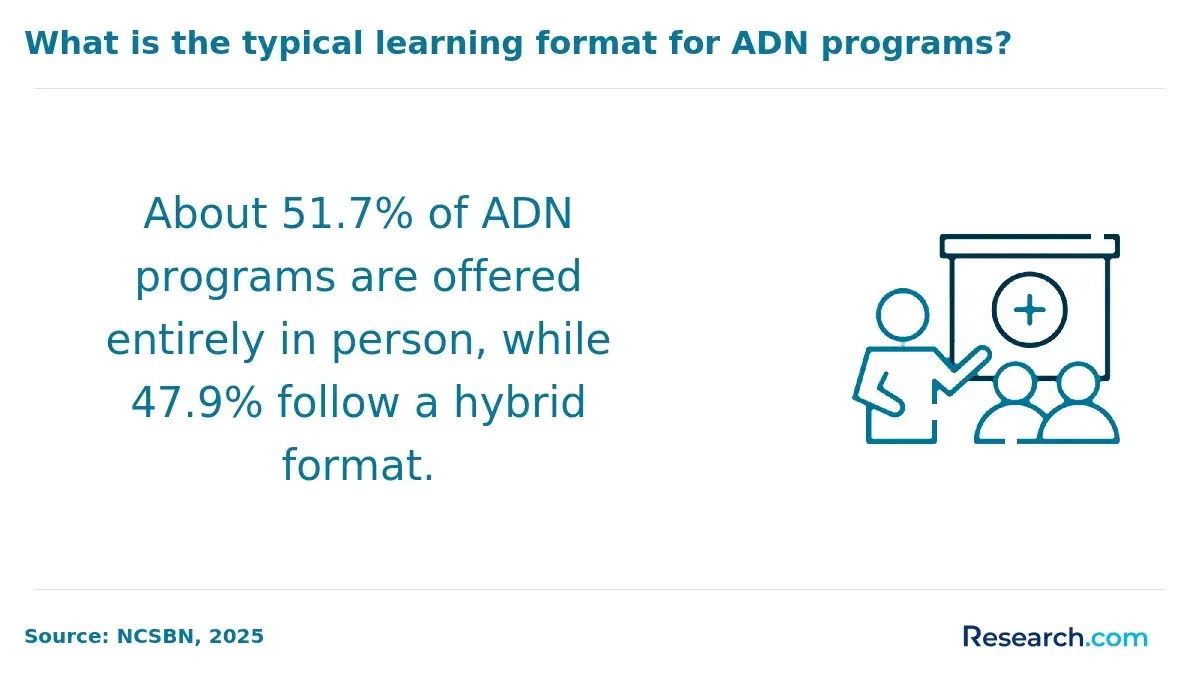
- Learning Format: Traditional programs emphasize in-person lectures and labs, suiting students who prefer structured, face-to-face learning. Hybrid programs blend online theory with required on-campus labs, ideal for self-directed learners seeking flexibility.
- Clinical Training: All formats mandate in-person clinical hours within Delaware, ensuring hands-on experience despite online coursework options.
- Scheduling Flexibility: Hybrid and online options allow coursework on a student's timetable, while traditional programs maintain fixed schedules, which may challenge working or family-oriented students.
- Student Interaction: Traditional students benefit from immediate, personal instructor support; online and hybrid learners rely more on virtual communication tools.
- Accessibility: Hybrid and online programs reduce travel needs, increasing access for those distant from campuses, but all must attend local clinical sites.
One nurse who completed a hybrid ADN program shared that balancing coursework remotely with family responsibilities was freeing but required strong time management. She appreciated the chance to study theory online but found the in-person labs crucial for building confidence and skills. "The hybrid format gave me control over my schedule without missing the hands-on practice that truly prepares you," she reflected. Navigating occasional feelings of isolation online, she valued virtual peer groups and instructor check-ins that bridged the gap from traditional classrooms, ultimately helping her transition smoothly into clinical work and licensure.
How do I know if an ADN program in Delaware is accredited?
Accreditation is essential for ADN programs in Delaware because it guarantees the program meets the educational standards required for RN licensure and prepares students for competent patient care. To ensure you choose a legitimate and quality program, consider these important verification steps:
- Check National Accreditation Databases: Use tools like the Accreditation Commission for Education in Nursing (ACEN) public search to confirm if the ADN program holds national accreditation. This confirms the program meets recognized quality benchmarks respected by employers and licensing boards.
- Confirm State Board of Nursing Approval: The Delaware Board of Nursing lists approved nursing programs, and graduates must come from these programs to qualify for RN licensure. Verifying program approval through the Board's resources prevents enrollment in institutions that do not meet state licensure criteria.
- Review the School's Official Website: Legitimate ADN programs typically display their accreditation status prominently, including details of their accrediting agencies. Up-to-date accreditation information and links to recent decisions provide transparency about program quality.
- Verify National and Regional Accreditation Agencies: Beyond nursing-specific accreditation, confirm the institution itself holds regional accreditation recognized by the U.S. Department of Education. Institutional accreditation assures overall educational quality and eligibility for federal aid.
- Contact Admissions or Program Directors: If accreditation details are unclear, requesting written confirmation from program officials can clarify the program's status. Reliable programs will provide documentation or direct you to official accreditation records.
How much does an ADN program cost in Delaware?
The cost of ADN programs in Delaware can vary depending on the type of school attended-whether a community college, public university, or private institution-as well as the program's length and whether the student pays in-state or out-of-state tuition. Several key factors combine to shape the overall expense of earning an Associate Degree in Nursing in the state.
- Tuition and Fees: Tuition is the largest expense and varies broadly based on institution type and residency status. Community colleges often provide lower rates for in-state students, while private schools and out-of-state tuition at public universities can significantly increase costs. Understanding ADN program tuition and fees in Delaware is essential for accurate financial planning.
- Books and Supplies: Required textbooks, digital platforms, and course materials can add thousands of dollars over the duration of the program. These costs fluctuate depending on the program's format and technology requirements, making it important for students to budget accordingly.
- Uniforms and Equipment: Clinical training requires specific uniforms, footwear, and tools like stethoscopes. These one-time or occasionally replaced items often range from a few hundred to several hundred dollars, contributing noticeably to total expenses.
- Clinical Expenses: Travel to clinical sites may add costs such as transportation, parking, and sometimes fees for background checks or health clearances. Programs differ on how these are billed, so prospective students should factor in an estimated range for these supplemental charges.
- Living or Transportation Costs: Whether residing on campus, commuting, or attending a hybrid or online program, students face costs for housing, food, and travel. These vary widely depending on lifestyle and program structure, yet are a crucial part of the cost of nursing schools in Delaware.
For prospective students weighing options, exploring financial aid and program accreditation can ease some costs and improve employment prospects. Additionally, researching the best adult gerontology acute care nurse practitioner program may offer insights into advanced pathways beyond the ADN level.
What financial aid options are available for ADN students in Delaware?
Financial aid can significantly reduce the cost of Associate Degree in Nursing (ADN) programs in Delaware by covering tuition and related educational expenses. Students have access to various financial assistance options tailored to different needs and eligibility requirements. Below are the main sources of aid available to ADN students in the state:
- Federal Student Aid: By completing the FAFSA, students may qualify for Pell Grants, Federal Supplemental Educational Opportunity Grants (FSEOG), and federal student loans. Pell Grants do not require repayment and are awarded based on financial need, while loans must be repaid after graduation, making it important to consider debt carefully.
- SEED Scholarship for ADN programs in Delaware: This state-funded scholarship provides full tuition coverage for eligible Delaware residents attending participating institutions like Delaware Technical Community College. Students must maintain a minimum GPA, meet residency requirements, and file the FAFSA. The Scholarship can extend up to 10 semesters, representing a substantial financial resource for qualifying students.
- Delaware nursing student loan programs: The Delaware Health Care Student Loan Program offers interest-free loans between $2,500 to $15,000 annually for residents enrolled in approved nursing programs. Recipients who commit to working in Delaware's healthcare system may have their loan interest waived, emphasizing the program's focus on retaining local healthcare professionals.
- Institutional Scholarships: Individual colleges often provide merit- or need-based scholarships with varied application processes and award sizes. Prospective students should engage with financial aid offices early to identify opportunities tailored to ADN candidates.
- Private Nursing Scholarships: These scholarships come from foundations and nursing organizations and often prioritize underrepresented groups or academic achievement. Eligibility can vary widely, commonly requiring separate applications and supporting documents.
- Employer Tuition Assistance: Some Delaware healthcare employers offer tuition reimbursement or assistance for employees pursuing nursing degrees, typically contingent on a post-graduation work commitment. This option can be especially valuable for current healthcare workers.
For students balancing work and study, exploring flexible options such as PMHNP programs may provide additional pathways to advance nursing education alongside ADN degree pursuits.
What can I do with an ADN in Delaware after graduation?
ADN graduates in Delaware are qualified to take the NCLEX-RN exam and pursue a variety of entry-level nursing positions across diverse healthcare environments. These roles provide foundational experience and opportunities for growth in the state's healthcare sector. Below are some notable career paths for individuals exploring ADN nursing jobs in Delaware:
- Registered Nurse in Hospitals: Hospital settings offer ADN-prepared nurses opportunities to work in various units like medical-surgical, emergency, and pediatrics. These roles involve direct patient care, medication administration, and collaboration with healthcare teams, often supported by tuition reimbursement for further education.
- Long-Term Care and Rehabilitation Facilities: Nurses in nursing homes or rehab centers care for elderly or chronically ill patients, managing medications and care plans. These positions build expertise in complex care and can lead to supervisory roles with experience.
- Outpatient Clinics and Physician Offices: Nursing in outpatient settings focuses on preventive care and patient education, offering more regular hours. Nurses assess patients, assist with minor procedures, and help coordinate care, which appeals to those seeking work-life balance and career advancement.
- Home Health Nursing: Providing care to patients at home, including post-surgical care and chronic disease management, home health nursing requires strong assessment skills and independence. This growing field serves as a stepping stone to advanced community health roles.
- Specialty and Pediatric Care: ADN holders can work in specialized units such as pediatrics or oncology within Delaware's health systems. These roles often require additional training but offer pathways to develop specialized expertise.
Many ADN graduates also pursue further education through RN-to-BSN programs supported by transfer agreements and employer incentives. For those curious about advanced nursing education options, asking what are the most affordable online RN to FNP degree programs provides valuable insights into affordable pathways beyond ADN. Exploring registered nurse career opportunities in Delaware requires balancing immediate employment goals with long-term advancement prospects.
How much do ADN nurses earn in Delaware?
The average median pay for ADN-prepared nurses in Delaware is approximately $69,615 per year, but this figure can vary widely depending on several factors including experience, geographic location, healthcare setting, and employer type. Understanding these variables is essential for prospective students and professionals considering ADN pathways. The following points highlight the key influences on ADN nurse salaries in Delaware:
- Level of Experience: Entry-level nurses typically earn lower wages, with hourly rates starting around $28.89, while those with extensive experience-20 or more years-can command rates exceeding $38, reflecting growth tied to clinical proficiency and expertise.
- Workplace Setting: ADN nurses employed in hospitals and government agencies generally receive higher salaries than those in nursing homes or outpatient clinics, with hospital positions often providing the most competitive compensation.
- Geographic Location: Salaries tend to be higher in urban centers such as Wilmington and Dover to offset cost of living, whereas rural areas may offer lower wages but different job market dynamics.
- Specialization: Nurses with certifications in areas like critical care or emergency nursing often earn premium pay, acknowledging the complexity and demand for specialized skills.
- Shift Differentials and Overtime: Working nights, weekends, or holidays and accruing overtime can substantially increase annual earnings, sometimes adding up to an additional $12,000 per year.
Here's What Graduates in Delaware Have to Say About Their ADN Degree
- Completing the ADN program online through Delaware Technical Community College allowed me the flexibility to balance work and family while pursuing my passion for nursing. The comprehensive virtual coursework combined with hands-on clinical experiences prepared me to confidently start my nursing career in a busy hospital setting here in Delaware. I really appreciated how the program emphasized patient-centered care, which has become the foundation of my approach as a nurse. The stability and growth opportunities in Delaware's healthcare field motivate me every day to continue learning and advancing. Andre
- Attending the hybrid ADN program at Goldey-Beacom College was a transformative experience that helped me grow both personally and professionally. The blend of on-campus labs and online theory classes fit perfectly with my busy schedule as a single parent. Starting my nursing career in a home health care organization gave me a deeper appreciation of community-based care and the critical role nurses play in supporting patient independence. This program opened doors for me not only in employment but also in continuing education possibilities in Delaware. Tanisha
- My time at Wilmington University in their on-campus ADN program was challenging but incredibly rewarding. Immersed in Delaware's academic health environment, I developed strong clinical skills and a commitment to community wellness that drives me as a nurse educator today. The connections I made with instructors and peers helped me grow philosophically about nursing's role beyond bedside care, focusing on preventative health for youth and underserved populations. Nurses with ADN degrees in Delaware are well-positioned to make significant impacts wherever they serve, including the academic sector where I work. José
Related Articles for Nearby States
- 2027 Best ADN Nursing Programs in Maryland: Online & Campus
- 2027 Best ADN Nursing Programs in New Jersey: Online & Campus
- 2027 Best ADN Nursing Programs in Pennsylvania: Online & Campus
- 2027 Best ADN Nursing Programs in Virginia: Online & Campus
- 2027 Best ADN Nursing Programs in West Virginia: Online & Campus
- 2027 Best ADN Nursing Programs in New York: Online & Campus
- 2027 Best ADN Nursing Programs in Connecticut: Online & Campus
- 2027 Best ADN Nursing Programs in Rhode Island: Online & Campus
- 2027 Best ADN Nursing Programs in North Carolina: Online & Campus
- 2027 Best ADN Nursing Programs in Ohio: Online & Campus
References:
- Best Delaware Nursing Schools and Programs | NursingEducation https://nursingeducation.org/state/delaware/
- LPN to RN/BSN Programs in Delaware | PracticalNursing.org https://www.practicalnursing.org/lpn-to-rn/delaware
- Top 10 Best Nursing Schools in Delaware https://nurse.org/education/top-10-best-nursing-schools-in-delaware/
- Best-Paying Nursing Jobs With An Associate Degree In Nursing (ADN) https://nursejournal.org/degrees/adn/best-paying-adn-jobs/
- Financial Aid Loan Program - Delaware Health Force https://dehealthforce.org/financial-aid-loan-program-expansion/
- Licensed Practical Nurse Salary in Delaware https://ceufast.com/nursesalaryguide/state/delaware
- Policies & Procedures | University of Delaware https://www.udel.edu/students/student-financial-services/policies/
- ADN to BSN https://www.online.drexel.edu/online-degrees/nursing-degrees/adn-bsn-concurrent/index.aspx
- Best Nursing Schools in Delaware for 2023 https://www.incrediblehealth.com/blog/best-nursing-schools-delaware/
- Online Accelerated ADN Programs: Inside Top Schools https://www.edumed.org/online-schools/associate-nursing-programs/accelerated-adn/
Other Things You Should Know About The Best ADN Nursing Programs in Delaware
Admission requirements for ADN programs in Delaware in 2027 typically include a high school diploma or GED, completion of prerequisite courses in biology and chemistry, a minimum GPA of 2.5, and passing scores in entrance exams like the TEAS. Specific requirements may vary by institution.
In 2027, the top ADN programs in Delaware include Delaware Technical Community College, known for its comprehensive curriculum and high NCLEX-RN pass rates, and Wesley College, which offers a supportive learning environment with flexible study options for aspiring nurses. These programs prepare students for successful careers in nursing.


