2027 Salary Growth Potential After Earning an MSW

Co-Founder and Chief Data Scientist
Deciding whether to earn a Master of Social Work (MSW) is partly a career decision and partly a financial one. For professionals who did not major in social work as undergraduates, the key question is not only whether an MSW can open the door to meaningful work, but whether the degree can support stronger earnings, licensure options, and long-term advancement.
An MSW can qualify graduates for roles that are usually out of reach with only a bachelor's degree, especially in clinical practice, healthcare, behavioral health, program leadership, and policy-focused work. However, salary growth is not automatic. It depends on accreditation, licensure, specialization, employer type, location, field experience, and how strategically a graduate uses the degree after completion.
This guide explains what MSW graduates can realistically expect in terms of salary growth, starting pay, job options, employment outlook, program cost, admissions, accreditation, and program selection. It is designed to help prospective students compare the investment against likely career outcomes before enrolling.
Key Things You Should Know
- Median salaries for MSW holders in 2026 are expected to grow by 5% annually, with clinical social workers earning up to 20% more than non-clinical roles.
- Advanced degrees open opportunities in leadership, policy, and specialized fields where pay scales rise faster than general social work positions.
- Geographic location significantly impacts salary growth, with urban and high-demand states offering 15-25% higher compensation for MSW graduates.
What is the salary growth potential after earning an MSW?
The salary growth potential after earning an MSW can be meaningful, but it varies widely by role, license status, specialization, employer, and region. The national median salary for social workers was $61,330, which reflects a mix of entry-level, mid-level, and experienced roles across different practice settings.
An MSW is most valuable financially when it leads to credentials or responsibilities that a bachelor's degree alone typically cannot provide. Graduates who move into clinical practice, healthcare social work, government roles, administration, or specialized behavioral health services often have stronger earning potential than those who remain in generalist or entry-level community roles.
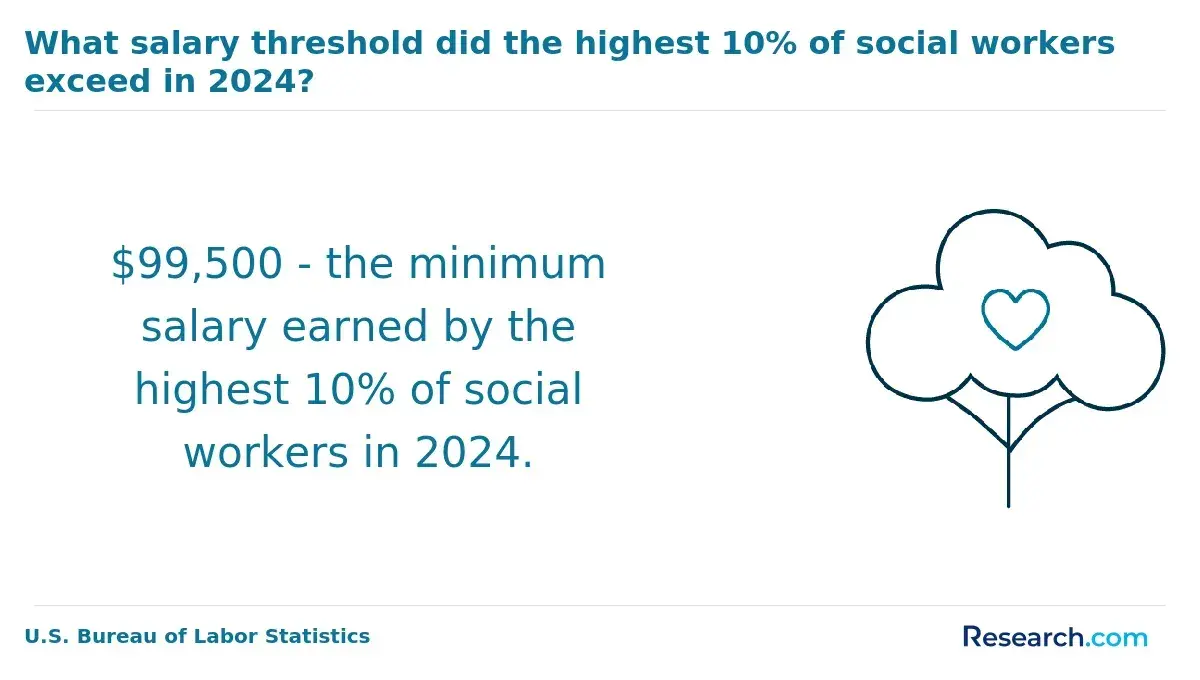
Top earners, particularly those in the upper 10%, make more than $99,500 annually. These salaries are usually associated with advanced experience, licensure, supervisory responsibilities, specialized practice areas, or leadership positions. Licensed clinical social workers (LCSWs), for example, may earn more because they can provide psychotherapy and may qualify for independent clinical practice depending on state rules.
What tends to increase MSW earnings?
- Licensure: Clinical licensure, especially the LCSW, can expand access to therapy, diagnosis, private practice, and insurance-billing roles where allowed by state law.
- Specialization: Healthcare, mental health, substance abuse, school social work, and gerontology can offer stronger demand than some general social service roles.
- Experience: Salary growth often improves after several years of supervised practice, especially when graduates qualify for independent or advanced roles.
- Leadership: Supervisory, program management, administrative, and director-level positions can raise income beyond direct-service pay.
- Location: Urban areas and higher-cost regions often pay more, though higher wages may be offset by cost of living.
Prospective students should view the MSW as a platform, not a guaranteed raise. The degree has the strongest financial return when paired with a clear licensure plan, a high-demand specialization, and field placements that connect directly to the type of work the student wants after graduation.
Graduates interested in long-term advancement beyond the MSW may also explore doctoral options, including an online doctorate social work program, particularly if their goals include higher education, advanced leadership, research, or policy work.
What jobs can you get with an MSW degree?
An MSW can qualify graduates for a wider range of social work roles than a Bachelor of Social Work (BSW), especially positions involving advanced practice, clinical assessment, therapy, supervision, program design, and policy analysis. The exact jobs available depend on state licensure rules, field placement experience, and whether the graduate chooses a clinical or macro-focused path.
MSW holders may pursue clinical social work positions, including licensed clinical social worker (LCSW) roles after meeting state requirements. These roles may involve therapy, counseling, behavioral health treatment, and assessment of mental health needs. Clinical practice generally requires supervised post-graduate hours and passing a licensing exam.
According to the U.S. Bureau of Labor and Statistics via the YU Wurzweiler blog, MSW degree holders earn a median salary of $50,400, compared to $41,000 for BSW holders. This difference reflects the advanced responsibilities and broader scope of practice often available to MSW graduates.
Common jobs for MSW graduates
- Clinical social worker: Provides therapy, counseling, assessment, and treatment planning, usually after meeting licensure requirements.
- Healthcare social worker: Supports patients and families in hospitals, clinics, rehabilitation centers, hospice, and long-term care settings.
- School social worker: Works with students, families, teachers, and administrators to address behavioral, emotional, attendance, and family-support needs.
- Child and family social worker: Supports families through child welfare, foster care, adoption, family preservation, and protective services systems.
- Mental health or substance abuse counselor: Helps clients manage behavioral health, addiction, trauma, and recovery-related challenges within the limits of state licensing rules.
- Program director or clinical supervisor: Oversees staff, budgets, services, compliance, and outcomes in agencies, hospitals, nonprofits, or government programs.
- Policy analyst or community organizer: Works on social policy, advocacy, systems reform, community development, and public program improvement.
- Criminal justice social worker: Supports individuals involved with courts, corrections, reentry, victim services, or diversion programs.
The highest paying MSW jobs are often not entry-level direct-service roles. They are more likely to involve licensure, specialized clinical skills, program management, healthcare systems, government employment, or consulting-related responsibilities.
Students should choose field placements carefully. A placement in a hospital, behavioral health clinic, school district, public agency, or policy organization can help build the experience and professional network needed for the target role after graduation. Cost-conscious students may also compare the cheapest accredited online MSW programs as they plan an affordable route into the field.
What is the job outlook for MSW graduates?
The job outlook for MSW graduates is positive because social workers are needed across healthcare, mental health, schools, aging services, child welfare, substance abuse treatment, and community support programs. Demand is shaped by aging populations, broader recognition of mental health needs, and continued reliance on social workers in public and nonprofit service systems.
Career growth potential is strongest for MSW graduates who use the degree to qualify for advanced or licensed roles. The Licensed Clinical Social Worker (LCSW) credential is especially important for graduates who want to provide therapy, diagnose mental health conditions where permitted, work more independently, or pursue clinical leadership roles.
Licensed Clinical Social Workers with an MSW typically earn a median annual salary of $53,000, according to the U.S. Bureau of Labor Statistics cited by YU Wurzweiler. Graduates without licensure may still find important roles in schools, child welfare, case management, community organizations, and public programs, but these positions may have lower median earnings and fewer independent-practice options.
Where demand is especially relevant
- Healthcare: Hospitals, clinics, rehabilitation centers, hospice programs, and long-term care facilities need social workers to coordinate care and support patients.
- Mental health: Behavioral health services continue to rely on clinically trained social workers for counseling, assessment, crisis intervention, and treatment planning.
- Substance abuse services: Demand is tied to treatment access, recovery support, and integrated behavioral health care.
- Schools and youth services: School social workers support students facing emotional, behavioral, family, attendance, and community-related challenges.
- Rural and underserved communities: These areas may have strong need, though salaries and resources can differ significantly from urban settings.
Geography matters. Urban and high-cost regions may offer higher pay, while rural areas may provide strong mission-driven opportunities and a need for broad generalist skills. Students should compare job postings in the state where they plan to practice and verify licensure rules early, since requirements vary by state.
For students who want to enter the field quickly, 16-month MSW programs online may offer an accelerated route, provided the program is properly accredited and still includes the required field education for professional preparation.
How much do MSW graduates earn starting out?
Starting salaries for MSW graduates in 2026 vary by specialization, employer, state, licensure pathway, and prior experience. New graduates should not assume that the median salary for all social workers reflects immediate first-year earnings, because median figures include workers at different stages of their careers.
Healthcare social workers, a leading specialty, report a national median salary of $68,090 according to the Bureau of Labor Statistics via Human Services Education. Entry-level incomes in this field typically range from $45,000 to $55,000 annually but vary by region and employer type. The top 10% in healthcare social work can earn up to $100,870, showing that earnings can rise substantially with experience, specialization, and responsibility.
Other areas, such as child welfare or school social work, generally offer starting salaries between $40,000 and $50,000. These roles may still provide strong career value, especially for students committed to children, families, education systems, or public service, but the salary path may differ from healthcare or clinical practice settings.
Factors that shape starting pay
- Geographic location: Urban centers and states with higher living costs usually provide better salaries, though expenses may also be higher.
- Employer type: Nonprofits and government agencies often pay less than private healthcare or corporate organizations, though benefits and job stability may vary.
- Specialization: Healthcare, mental health, geriatric care, and substance abuse services may offer stronger demand in many markets.
- Credentials: Additional certifications and a clear path toward clinical licensure or administration can improve early career positioning.
- Field placement quality: Strong internships can lead to job offers, references, and experience in higher-demand settings.
Graduates who want stronger starting salaries should target field placements and first jobs in settings where MSW-level skills are valued: hospitals, specialty medical facilities, behavioral health clinics, government agencies, and programs with advancement tracks. Early movement into supervisory or specialized functions can also increase earnings over time.
Students comparing access-friendly pathways may review easy MSW programs, but admission convenience should not outweigh accreditation, field placement quality, licensure preparation, or total cost.
What factors influence MSW salary growth?
MSW salary growth is influenced by specialization, experience, geographic location, licensure, and employment setting. The degree can improve career options, but the strongest salary growth usually comes when graduates intentionally build toward higher-responsibility roles.
Licensure and clinical authority
Licensure is one of the most important salary factors. Clinical social workers who hold licensure often earn more than those in entry-level community roles because they may qualify for therapy, assessment, diagnosis, independent practice, and clinical supervision roles depending on state regulations.
Specialization
Healthcare, clinical, and school social work can offer higher salaries than some general social service positions because these roles often require specialized knowledge, complex case coordination, or work within larger institutional systems. Advanced certifications in trauma-informed care or substance abuse counseling can also strengthen compensation potential.
Experience and leadership
Entry-level MSW graduates usually begin at lower salaries. Those with five or more years of experience and credentials like the Licensed Clinical Social Worker (LCSW) often see stronger increases. Supervisory, administrative, and director-level roles can also raise earning potential because they involve staff management, compliance, program outcomes, and budgets.
Location and employer type
Geography matters. Urban areas and states with higher living costs like California and New York generally provide better pay, while rural locations may offer fewer financial incentives despite a growing need. Employment settings also affect wages. Hospitals and government agencies typically pay more than nonprofit organizations or schools, though benefits, loan forgiveness eligibility, and job stability may influence the overall value of a role.
Job growth projections from the Bureau of Labor Statistics show a 6% increase in social work employment from 2024 to 2034, translating to 44,700 annual openings. This steady demand supports favorable salary trends, particularly for licensed professionals and graduates with skills aligned to high-need practice areas.
What accreditation is required for MSW programs?
The key accreditation for MSW programs in the United States is accreditation from the Council on Social Work Education (CSWE). For most students, this is non-negotiable. A CSWE-accredited MSW is commonly required for state licensure and is often expected by employers hiring for professional social work roles.
CSWE accreditation indicates that a program meets national standards for curriculum, field education, faculty qualifications, assessment, and institutional resources. It applies to both traditional MSW pathways and advanced standing or advanced generalist tracks when offered by accredited institutions.
Graduates from programs without CSWE accreditation generally cannot pursue licensure or advanced clinical certifications in most states. This can limit access to Licensed Clinical Social Worker (LCSW) credentials, clinical employment, independent practice pathways, and higher-paying roles tied to licensure.
How to verify accreditation before enrolling
- Check the program's official accreditation statement, not only general university accreditation.
- Confirm that the MSW program itself is CSWE-accredited.
- Review whether the format you plan to enter, including online, part-time, or advanced standing, is covered by the accredited program.
- Compare the program's curriculum and field placement requirements with licensure rules in the state where you plan to practice.
- Contact the state licensing board if you are unsure whether the degree will meet eligibility requirements.
Accreditation also matters for mobility. If a graduate later moves to another state, a CSWE-accredited degree is more likely to meet baseline educational requirements for licensure review. According to the NASW Nationwide Survey of 2017 Graduates, MSWs in urban areas earn notably more than those in rural settings, driven by demand in hospitals and government agencies. A CSWE-accredited degree helps graduates compete for these roles by satisfying employer and licensing expectations across labor markets.
What are MSW admission requirements?
MSW admission requirements vary by school, but most programs look for evidence that an applicant can handle graduate-level study and is prepared for professional social work practice. A bachelor's degree from a regionally accredited institution is usually required. Applicants may come from social work, psychology, sociology, human services, public health, criminal justice, or other fields.
Students without a social work background may need prerequisite coursework in areas such as human behavior, social welfare policy, and research methods. Applicants with a BSW from an accredited program may be eligible for advanced standing, depending on the school and the age and strength of their undergraduate record.
Common application requirements
- Bachelor's degree: Usually from a regionally accredited institution.
- Minimum GPA: Many programs expect around 3.0, though some offer conditional admission with lower GPAs.
- Prerequisite coursework: May be required for applicants without prior study in social work or related fields.
- Letters of recommendation: Most programs request two or three letters from academic or professional references.
- Personal statement: Applicants typically explain their motivation, relevant experience, career goals, and fit with the program.
- Experience: Volunteer work, internships, human services employment, advocacy, or community engagement can strengthen an application.
- GRE scores: Optional at many schools, but they might help some applicants demonstrate academic readiness.
- Field placement clearance: Background checks and drug screenings are standard before field education begins.
- International requirements: International applicants usually need English proficiency proof and credential evaluations.
Applicants should also assess affordability before applying. Entry-level social work salaries average $42,000 to $48,000, while student debt typically ranges from $40,000 to $70,000. Because graduate borrowing can affect career flexibility after graduation, students should explore scholarships, employer tuition reimbursement, assistantships, public service options, and financial aid early in the admissions process.
How long does it take to complete an MSW program?
A traditional MSW program usually takes two years of full-time study. This timeline combines graduate coursework with supervised field education, which is essential for professional preparation and may support later licensure eligibility.
Part-time MSW programs commonly take three or four years. These options can be better for working adults, caregivers, or students who need to spread tuition and fieldwork obligations over a longer period. Accelerated options may allow completion in as little as one year, but they are usually intensive and may require prior social work coursework or related experience.
Common MSW timelines
- Traditional full-time MSW: Usually two years.
- Part-time MSW: Often three or four years.
- Accelerated MSW: May take as little as one year, depending on the program structure and student eligibility.
- Advanced standing MSW: Often designed for students with a qualifying social work background, though requirements vary by school.
Coursework often includes advanced social work practice, research methods, policy analysis, ethics, human behavior, assessment, and specialized electives. Most programs mandate at least 900 hours of supervised practice, giving students applied experience in agencies, hospitals, schools, clinics, or community organizations.
Students should choose a timeline based on more than speed. Field placement hours can be difficult to balance with full-time work, and accelerated programs may leave little room for schedule disruptions. Online and hybrid MSW programs can add flexibility, but they must still meet accreditation and field education standards.
Demand for MSW graduates is especially relevant in behavioral health. According to the Bureau of Labor Statistics-cited by Human Services Edu-the mental health sector is projected to grow 10.6% through 2032, doubling the average growth rate for all occupations. Students who can complete an accredited program efficiently may be positioned to enter a growing labor market sooner.
What is the average cost of an MSW degree?
The cost of an MSW degree depends on the institution, residency status, format, program length, and whether the student qualifies for advanced standing or other tuition-saving options. Public universities generally charge between $10,000 and $30,000 annually for in-state students, while private schools often exceed $40,000 per year.
Total program expenses commonly range from $20,000 to $80,000. Public state university students may pay around $25,000, while private university attendees may face costs near $60,000 or more. These figures can change substantially once fees, books, commuting, technology, lost work hours, and living expenses are included.
Costs students should include in the budget
- Tuition and mandatory university fees
- Books, software, and course materials
- Transportation or relocation for field placement
- Reduced work hours during internships or practicum requirements
- Licensure preparation and exam-related expenses after graduation
- Living expenses, especially for full-time students
Online and part-time MSW programs may reduce relocation or housing costs, but they often maintain similar tuition charges. A lower-cost program is not automatically the best value if it has weak field placement support, limited specialization options, or poor alignment with licensure goals.
- MSW graduates often see salary increases and leadership opportunities.
- Community program administrators with an MSW average $57,950 annually, according to the U.S. Bureau of Labor Statistics via YU Wurzweiler.
- Financial aid such as scholarships, employer tuition reimbursement, and federal loans can help offset costs.
- Evaluating program accreditation and job placement rates is crucial for assessing program value.
Students should compare total cost against expected salary in their intended specialization and location. The best financial choice is usually an accredited program that supports licensure, provides strong field placements, and keeps borrowing at a level that future social work earnings can reasonably support.
How to choose the best MSW program?
The best MSW program is the one that fits your career goal, licensure plan, budget, schedule, and preferred practice setting. Prestige alone is not enough. Students should focus on whether the program can help them move into the role they want without taking on unnecessary cost or delaying licensure progress.
Start with accreditation
Prioritize programs accredited by the Council on Social Work Education (CSWE). Accreditation supports curriculum quality and is commonly required for professional licensure. Without it, the degree may have limited value for clinical practice and many advanced social work roles.
Match the specialization to your salary and career goals
Specialization affects both job fit and earning potential. Clinical social work, healthcare, behavioral health, school social work, policy advocacy, and administration can lead to different career paths. For example, federal government and consulting MSW roles have a mean salary of $83,694, with the top 10% earning as much as $137,613.
Evaluate field placements and employer connections
Field education is one of the most important parts of an MSW. Programs with strong relationships with hospitals, government agencies, schools, behavioral health providers, consulting organizations, or community agencies may give students better access to relevant internships and post-graduate job leads.
Consider format and flexibility
Part-time, online, and hybrid programs can help working professionals maintain income while studying. However, students should verify that online options have the same accreditation status, field placement support, faculty access, and licensure alignment as campus-based options.
Compare location and labor market outcomes
Location can affect both field placement access and salary after graduation. Urban centers and regions with strong public service sectors may provide more internship options and higher post-graduate salaries, though cost of living can also be higher.
Use a practical selection checklist
- Is the MSW program CSWE-accredited?
- Does it meet licensure requirements in the state where you plan to practice?
- Does it offer the specialization you want?
- Are field placements available in your target setting?
- Can you complete the program while managing work, family, and field hours?
- What is the total cost after fees, books, and reduced work time?
- Does the program have strong alumni, employer, and practicum networks?
- Will the expected salary path justify the debt you may need to take on?
Use accreditation, specialization, networking, flexibility, location, and affordability together when comparing programs. The strongest choice is not necessarily the fastest or cheapest program, but the one that gives you a credible path to licensure, employability, salary growth, and the type of social work you actually want to do.
Other Things You Should Know About Social Work
Yes, after completing an MSW program, graduates must obtain licensure to practice professionally as licensed clinical social workers (LCSWs) or other recognized titles, depending on the state. This typically involves completing supervised clinical hours and passing a state exam. Licensure requirements vary by state but are essential for career advancement.
Continuing education for social workers includes workshops, seminars, online courses, and conferences focusing on clinical skills, ethics, policy updates, and specialized practice areas. Many states require social workers to complete a set number of continuing education hours to maintain licensure. This ensures practitioners stay current with evolving standards and best practices.
Specializing in areas such as medical social work, school social work, or mental health can enhance job prospects and salary potential. Specializations allow social workers to develop expertise in specific populations or services, making them more competitive for advanced roles or leadership positions. Credentials or certifications in specialty areas can further improve professional opportunities.
References
- 8 Career Paths You Can Pursue with a Social Work Degree https://www.sacredheart.edu/news-room/news-listing/8-career-paths-you-can-pursue-with-a-social-work-degree/
- MSW Career Outlook https://www.kysu.edu/academics/college-as/school-of-social-work/careers/msw-career-outlook.php
- Best Affordable Master's Degree In Social Work https://www.psychology.org/social-work/best-affordable-masters-programs/
- Average Cost of a Master's Degree: 2025 Analysis https://educationdata.org/average-cost-of-a-masters-degree
- MSW Tuition: What to Expect | University of Nevada, Reno https://onlinedegrees.unr.edu/online-master-of-social-work/msw-tuition
- How Long Does it Take to Complete an MSW Program? Online or Campus https://www.onlineeducation.com/social-work/faqs/how-long-is-an-msw-program
- Social Worker Salary Guide 2025: What You'll Actually Earn by State - Social Work Education Center https://www.socialworkdegree.net/social-work-careers/social-worker-salary/
- Social Worker (LCSW, MSW) Salary Guide By State https://socialworklicensemap.com/social-work-careers/social-work-salary/
- High-demand social work roles in 2026: trends and opportunities https://socialwork.pacific.edu/blog/high-demand-social-work-roles-2026-trends-and-opportunities
- Socialwork https://socialwork.career