
2027 Best ABSN Programs - List of Accelerated BSN Programs in Washington: Online & Campus

Co-Founder and Chief Data Scientist
If you already have a bachelor's degree and want to become a registered nurse in Washington without starting college over, an accelerated Bachelor of Science in Nursing can be one of the fastest routes. These programs are built for second-degree students who are ready for a demanding, full-time nursing curriculum that combines classroom learning, simulation, clinical rotations, and NCLEX-RN preparation.
The decision is not simple. ABSN programs in Washington can be expensive, academically intense, and difficult to balance with work or family responsibilities. At the same time, Washington's healthcare sector has shown sustained need for nurses, with healthcare employment growing by approximately 15% over the past decade-surpassing the national average. This guide explains who ABSN programs are for, how admissions work, what the curriculum includes, how to compare online, hybrid, and campus formats, and what questions to ask before enrolling.
Quick Answer: Are Accelerated BSN Programs in Washington Worth Considering?
An accelerated BSN in Washington is worth considering if you already hold a non-nursing bachelor's degree, meet science prerequisite requirements, and can commit to an intensive nursing program that may take as little as 12 to 18 months. It is usually a better fit for career changers who want the broader preparation of a BSN rather than a shorter associate degree route. However, students should compare accreditation, clinical placement support, total cost, NCLEX-RN preparation, and schedule demands before choosing a program.
Key Advantages of Washington ABSN Programs
- Faster path to RN eligibility: Many Washington ABSN pathways are designed for students who already completed a bachelor's degree, allowing them to focus on nursing-specific coursework instead of repeating general education classes.
- Career-change structure: The accelerated format is built for adults moving from another field into healthcare, including recent graduates and working professionals seeking a more direct nursing pathway.
- Blended learning options: Some programs combine online coursework with in-person labs and clinical experiences, giving students more flexibility while still meeting hands-on nursing preparation standards.
- Strong employment context: Graduates enter a state nursing market where a 15% growth projection through 2030 supports continued demand for registered nurses.
- Who can apply for accelerated BSN programs in Washington?
- What are the admission requirements for accelerated BSN programs in Washington?
- Do accelerated BSN programs in Washington require entrance exams?
- What does the curriculum of an accelerated BSN program in Washington include?
- What accreditation should I look for in an ABSN program in Washington?
- How long does it take to complete an accelerated BSN in Washington?
- How much does an accelerated BSN program cost in Washington?
- What financial aid options are available for ABSN students in Washington?
- What career paths are available after earning an ABSN in Washington?
- What is the average salary for nurses with an ABSN degree in Washington?
- How should you decide whether an ABSN is the right path?
- What should you look for in graduate feedback?
- How does an accelerated BSN compare to an ADN program in Washington?
- Is an accelerated BSN a good step toward an MSN in Washington?
- What challenges do ABSN students commonly face?
- Can ABSN students work while enrolled?
- References
Who can apply for accelerated BSN programs in Washington?
Accelerated BSN programs in Washington are primarily intended for students who already earned a bachelor's degree in a field other than nursing. Instead of taking a traditional four-year BSN sequence, second-degree students complete a compressed nursing curriculum that builds on their previous college experience.
Good candidates are usually career changers, recent graduates from non-nursing majors, or professionals who want to move into a licensed healthcare role. A background in biology or health science can help, but it is not always required as long as the applicant completes the required prerequisites.
The best fit is not simply the student with the highest GPA. ABSN programs move quickly, so successful students tend to be organized, comfortable with heavy reading and testing, able to handle clinical feedback, and willing to treat the program like a full-time job. Students interested in long-term advanced practice can also review how nursing careers develop into specialized roles, including the highest paid nurse practitioner specialties.
| Applicant Type | Why an ABSN May Fit | What to Check First |
| Career changer with a completed bachelor's degree | The program avoids repeating a full undergraduate degree and focuses on nursing preparation. | Confirm prerequisite deadlines, clinical schedule expectations, and whether full-time availability is realistic. |
| Recent graduate from a non-nursing major | An ABSN can shorten the transition from college to RN licensure eligibility. | Ask whether your previous coursework satisfies anatomy, physiology, microbiology, chemistry, and other required courses. |
| Healthcare worker without an RN license | Prior patient-care exposure may help with clinical confidence and career clarity. | Do not assume work experience replaces academic prerequisites or admissions requirements. |
| Student needing a flexible schedule | Hybrid coursework may help with lecture access. | Clinical rotations and labs still require in-person attendance and may not follow a convenient schedule. |
What are the admission requirements for accelerated BSN programs in Washington?
Admissions requirements vary by school, but Washington ABSN applicants should expect a selective process. Programs need to see evidence that you can handle fast-paced science coursework, communicate clearly, and complete clinical training safely.
- Completed non-nursing bachelor's degree: ABSN tracks are usually reserved for students who already hold a bachelor's degree outside nursing.
- Prerequisite coursework: Common prerequisites include anatomy, physiology, microbiology, chemistry, and other science or health-related courses. Some schools require these courses to be completed within a specific time frame.
- Minimum GPA: Many programs use a minimum cumulative GPA, often around 3.0, but meeting the minimum does not guarantee admission.
- Official transcripts: Schools review previous college work to verify degree completion, grades, and prerequisite eligibility.
- Recommendation letters: Strong letters should speak to academic ability, professionalism, reliability, and readiness for patient care.
- Personal statement or essay: Applicants are often asked to explain why nursing, why now, and how they have prepared for the intensity of an accelerated program.
- Interview or admissions conversation: Some programs use interviews to evaluate communication skills, motivation, and realistic understanding of the nursing role.
Students who already know they want graduate-level nursing roles should also understand how undergraduate preparation connects to advanced practice. Research.com's guide on how to become a nurse practitioner explains the longer pathway beyond RN licensure.
Questions to Ask Admissions Before Applying
- Which prerequisites must be completed before applying, and which can be in progress?
- Is there a minimum grade required for each science prerequisite?
- How are repeated courses evaluated?
- Are online lab sciences accepted?
- How many clinical sites are available near where students live?
- What percentage of admitted students meet only the minimum GPA versus exceeding it?
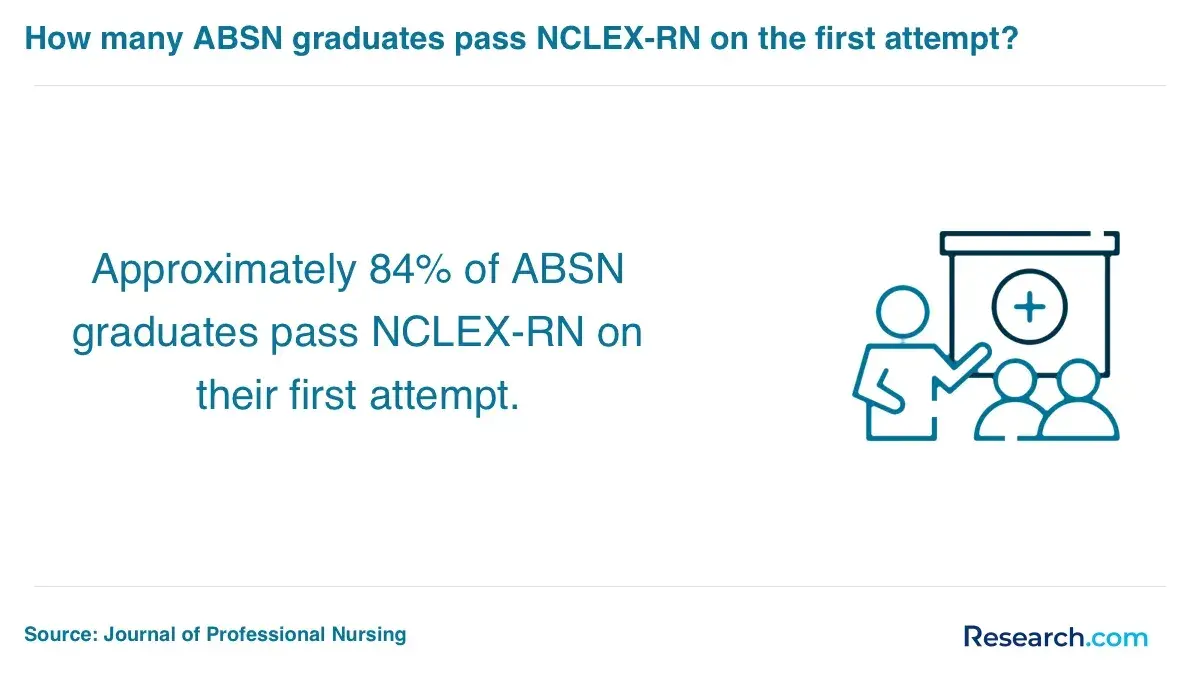
- Does the program publish recent NCLEX-RN pass-rate information?
Do accelerated BSN programs in Washington require entrance exams?
Some Washington ABSN programs require an entrance exam, while others do not. Policies are school-specific, so applicants should verify the current requirement directly with each nursing department before spending money on test preparation.
When exams are required, schools may use assessments such as the TEAS or HESI A2 to evaluate reading, math, science, and academic readiness. These exams do not measure compassion or bedside judgment, but they can help admissions teams identify whether applicants have enough foundational knowledge for a compressed nursing curriculum.
If a program does not require an exam, that does not mean admission is easier. The school may place more weight on GPA, prerequisite grades, essays, healthcare experience, references, or interviews. Applicants comparing programs should look at the full admissions rubric rather than focusing only on whether a test is required.
| Entrance Exam Policy | What It Means for Applicants | How to Prepare |
| TEAS or HESI A2 required | Your score may affect admissions competitiveness. | Review science, math, and reading early, especially if prerequisites were completed years ago. |
| Exam optional | A strong score may help, but it may not be necessary. | Ask whether submitting a score strengthens the application or is only used for advising. |
| No entrance exam | The school relies on other readiness indicators. | Strengthen transcripts, essays, recommendations, and evidence of healthcare exposure. |
What does the curriculum of an accelerated BSN program in Washington include?
An ABSN curriculum in Washington compresses core BSN content into a shorter schedule, often around 12 to 16 months. Students learn nursing theory, patient assessment, pharmacology, evidence-based practice, community health, leadership, and clinical decision-making while completing supervised hands-on practice.
- Foundational nursing content: Courses typically cover health assessment, pathophysiology, pharmacology, nursing fundamentals, adult health, maternal-child nursing, mental health nursing, pediatrics, and community health.
- Clinical rotations: Students practice under supervision in settings such as hospitals, clinics, long-term care facilities, and community health environments.
- Simulation labs: Simulation gives students a safe place to practice assessment, medication administration, emergency response, communication, and teamwork before working with patients.
- Professional nursing concepts: Programs often include ethics, health policy, quality improvement, cultural humility, informatics, and leadership.
- NCLEX-RN preparation: Many programs integrate practice questions, case-based learning, testing strategies, and readiness assessments throughout the curriculum.
Online, Hybrid, and Campus ABSN Formats
No ABSN program is entirely online in the practical sense because nursing education requires in-person labs and clinical hours. The difference is where didactic coursework takes place. Some programs deliver lectures online, while others require regular campus attendance for both coursework and labs.
| Format | Best For | Limitations |
| Campus-based ABSN | Students who want structured class time, in-person faculty access, and a predictable campus routine. | Less scheduling flexibility and possible commuting costs. |
| Hybrid ABSN | Students who can handle online coursework but still attend labs and clinicals in person. | Requires strong self-discipline and reliable transportation for required in-person components. |
| Mostly online didactic format | Students who prefer remote lectures and independent study. | Clinical placements, labs, and skills checkoffs still require physical attendance. |
What accreditation should I look for in an ABSN program in Washington?
Accreditation and state approval should be non-negotiable when comparing ABSN programs. These checks affect educational quality, financial aid access, transfer options, employer confidence, and eligibility to pursue RN licensure.
- Institutional accreditation: The college or university should hold recognized institutional accreditation. In Washington, students commonly look for accreditation connected to the Northwest Commission on Colleges and Universities.
- Nursing program accreditation: Programmatic accreditation from the Commission on Collegiate Nursing Education or the Accreditation Commission for Education in Nursing signals that the nursing curriculum has been reviewed against professional standards.
- Washington State Board of Nursing approval: State approval confirms that the program is authorized to prepare students for RN licensure in Washington.
- Clinical placement compliance: Approved programs must meet clinical education expectations, but students should still ask where placements occur and whether the school arranges them.
Before enrolling, verify accreditation and approval on official school and state board pages. Do not rely only on marketing language such as "recognized," "career-ready," or "aligned with nursing standards." Ask the program to state clearly whether graduates are eligible to apply for the NCLEX-RN and Washington RN licensure.
| Credential Check | Why It Matters | Question to Ask |
| Institutional accreditation | Supports academic legitimacy and may affect financial aid eligibility. | Which agency accredits the institution? |
| CCNE or ACEN nursing accreditation | Shows the nursing program has undergone external quality review. | Is the ABSN track specifically included in the accredited nursing program? |
| Washington State Board of Nursing approval | Connects the program to state licensure preparation. | Are graduates eligible to apply for RN licensure in Washington? |
| Clinical site agreements | Clinical access can affect graduation timelines. | Does the school secure placements, or must students find their own? |
How long does it take to complete an accelerated BSN in Washington?
Most accelerated BSN programs in Washington are designed for full-time study and may take about 12 months, while some structured pathways extend to 12 to 18 months depending on sequencing, prerequisites, term structure, and clinical scheduling. Students should evaluate the calendar carefully because a shorter program is not automatically better if it leaves too little time for work, caregiving, commuting, or studying.
- Full-time structure: ABSN programs are commonly built as intensive, cohort-based programs with little flexibility to slow down.
- Prerequisite completion: Missing science courses can add time before the nursing sequence begins.
- Clinical requirements: Students may complete between 450 and 700 hours of clinical practice, depending on program design and requirements.
- Course sequencing: Nursing courses often must be taken in a strict order, so failing or withdrawing from one course may delay graduation.
- Breaks between terms: Some accelerated calendars have limited breaks, which can affect stamina and planning.
| Timeline Factor | How It Can Affect Completion | What to Confirm |
| Prerequisites | Unfinished or expired courses may delay admission. | Application deadline, course expiration rules, and accepted online lab policies. |
| Clinical placement timing | Placements must fit site availability, faculty supervision, and required specialties. | Whether clinicals may occur evenings, weekends, or outside your local area. |
| Academic progression rules | One failed course can extend the timeline. | Remediation policies and the cost of repeating coursework. |
| Program calendar | Compressed terms reduce time for employment or personal obligations. | Weekly class, lab, simulation, and clinical expectations. |
How much does an accelerated BSN program cost in Washington?
The cost of an accelerated BSN program in Washington depends on the institution, length, delivery format, fees, clinical requirements, and living expenses. Some programs may charge around $69,700 for the full 16-month curriculum, while national ABSN costs often fall between $40,000 and $80,000. Students should calculate total cost, not just tuition.
- Tuition: Tuition is usually the largest expense, but advertised tuition may not include every program-related charge.
- Program and technology fees: Online platforms, testing systems, simulation labs, and student services may add to the total bill.
- Books and learning materials: Nursing textbooks, exam-prep tools, and digital resources can be required across multiple terms.
- Clinical expenses: Students may need uniforms, background checks, immunizations, drug screening, liability insurance, supplies, and transportation.
- Lost income: Because ABSN programs are intensive, many students reduce work hours or stop working temporarily, which should be part of the financial plan.
| Cost Category | Why Students Overlook It | How to Budget Smarter |
| Tuition | Schools may quote tuition differently by term, credit, or full program. | Ask for a full program cost sheet in writing. |
| Fees | Lab, technology, testing, and graduation fees may be listed separately. | Request an itemized estimate before accepting admission. |
| Clinical travel | Placements may not be near home or campus. | Plan for fuel, parking, transit, and possible schedule changes. |
| Licensure preparation | NCLEX-RN review and testing costs may not be bundled. | Ask what exam-prep resources are included in tuition. |
| Living expenses | The accelerated pace can reduce earning capacity during enrollment. | Build a monthly budget before choosing the fastest program. |
If your long-term plan includes advanced nursing practice, compare the ABSN cost with future graduate study as well. For example, students considering family practice roles may want to understand options such as 12-month FNP programs later in their education planning.
What financial aid options are available for ABSN students in Washington?
ABSN students in Washington may have access to federal, state, institutional, employer-based, and nursing-specific funding. Eligibility depends on the school, enrollment status, prior borrowing, financial need, and program approval. Because ABSN students already hold a bachelor's degree, they should ask specifically how second-degree status affects grant and loan options.
- Federal student loans: Students typically begin by completing the FAFSA. Loan availability depends on eligibility and borrowing limits.
- State and institutional grants: Washington College Grant funding and university grants may help eligible students, but availability varies by student and institution.
- Nursing scholarships: Professional associations and nursing organizations may offer awards for students entering the field.
- Employer tuition assistance: Healthcare employers such as Providence and MultiCare may provide tuition reimbursement, loan support, or education benefits for eligible employees.
- Loan repayment programs: Programs such as the Nurse Corps Loan Repayment Program may support nurses who work in qualifying shortage areas, but requirements should be reviewed carefully before relying on this option.
Ways to Reduce ABSN Costs
- Complete prerequisites at a lower-cost accredited institution if the ABSN program accepts them.
- Ask whether scholarships are available specifically for second-degree nursing students.
- Compare total program cost, not only the monthly payment or per-credit price.
- Check whether the school includes NCLEX-RN preparation, uniforms, supplies, and testing platforms in tuition.
- Consider employer partnerships only if the work commitment, location, and repayment terms fit your goals.
Students planning for advanced practice should also compare future graduate pathways, including online nurse practitioner programs, before borrowing heavily for the undergraduate stage.
What career paths are available after earning an ABSN in Washington?
After completing an ABSN, graduates must pass the NCLEX-RN and meet Washington licensure requirements before practicing as registered nurses. Once licensed, ABSN graduates generally compete for the same RN roles as traditional BSN graduates, though hiring depends on clinical performance, local labor demand, certifications, references, and employer preferences.
- Registered nurse: RNs assess patients, administer medications, coordinate care, document outcomes, educate patients, and collaborate with healthcare teams.
- Medical-surgical nurse: Many new graduates begin in medical-surgical or general acute care units because these roles build broad clinical judgment.
- Critical care or emergency nurse: Some graduates move into high-acuity settings after gaining experience or completing employer training programs.
- Public health nurse: Community clinics, health departments, and outreach programs need nurses who understand prevention, education, and population health.
- School or community-based nurse: Nurses may support student health, chronic condition management, immunization efforts, and care coordination.
- Nurse manager or educator: Leadership and teaching roles typically require experience and may require graduate education.
| Career Direction | Typical Starting Point | Possible Next Step |
| Hospital nursing | New graduate RN residency or staff RN role. | Charge nurse, specialty certification, ICU, emergency, or perioperative nursing. |
| Community health | Clinic, public health, or outreach nursing. | Public health leadership, care coordination, or graduate study. |
| Advanced practice | RN experience after BSN completion. | MSN or doctoral pathway for nurse practitioner, nurse educator, or leadership roles. |
| Behavioral health | Psychiatric, community mental health, or integrated care nursing. | Graduate preparation in psychiatric-mental health nursing, including options such as affordable online PMHNP degree programs. |
What is the average salary for nurses with an ABSN degree in Washington?
An ABSN itself usually does not create a separate salary category. Employers typically pay registered nurses based on RN licensure, role, experience, shift, union contract, specialty, location, and healthcare setting. A nurse who completed an ABSN and a nurse who completed a traditional BSN are often considered BSN-prepared RNs once licensed.
Salary can vary across Washington. Urban areas such as Seattle may pay differently from rural regions because of cost of living, employer budgets, staffing needs, and local competition. Specialty units, night or weekend differentials, leadership responsibilities, and certifications can also influence total compensation.
- Experience: New graduates usually start lower than nurses with several years of clinical experience.
- Employer type: Hospitals, outpatient systems, long-term care facilities, public health agencies, and schools may use different pay scales.
- Location: Compensation can differ between high-cost metro areas and smaller communities.
- Specialty: Critical care, emergency, perioperative, oncology, psychiatric, and other specialties may require additional training or certification.
- Education beyond the BSN: Graduate education can open doors to advanced practice, administration, informatics, or education roles, but outcomes are not guaranteed.
How should you decide whether an ABSN is the right path?
The right ABSN program is not always the fastest or the most visible in search results. The best choice is the program that meets licensure requirements, fits your learning style, offers reliable clinical placement, prepares students for the NCLEX-RN, and makes financial sense for your situation.
| Decision Factor | Choose an ABSN If... | Consider Another Route If... |
| Time to nursing career | You want a condensed second-degree route and can study full time. | You need a slower pace because of work, caregiving, or finances. |
| Academic intensity | You are ready for a heavy science and clinical workload with limited breaks. | You need more time to rebuild study skills or complete prerequisites. |
| Cost | You have a realistic plan for tuition, fees, supplies, and reduced income. | You would need to borrow heavily without a clear repayment strategy. |
| Career goals | You want BSN preparation and may pursue graduate nursing later. | You want the lowest-cost entry route and are comfortable starting with a different credential. |
| Clinical access | The school arranges appropriate placements and explains scheduling clearly. | The program gives vague answers about clinical sites or requires students to solve placement problems alone. |
Step-by-Step Checklist Before You Apply
- Confirm that your previous bachelor's degree meets the program's eligibility rules.
- List every prerequisite and identify which ones are missing, expired, or below the required grade.
- Verify institutional accreditation, nursing accreditation, and Washington State Board of Nursing approval.
- Ask for total program cost, including fees, supplies, clinical expenses, and exam preparation.
- Review the weekly schedule for classes, labs, simulation, clinicals, and study time.
- Ask how clinical placements are assigned and how far students may need to travel.
- Compare NCLEX-RN preparation and student support services.
- Speak with current students or recent graduates about workload, faculty responsiveness, and clinical organization.
- Build a financial plan that includes living expenses and reduced work hours.
- Apply only after confirming that the program aligns with your licensure and career goals.
What should you look for in graduate feedback?
Graduate reviews can be useful, but they should not replace verification. When reading student testimonials, look for specific details about clinical placement quality, faculty availability, simulation labs, scheduling transparency, NCLEX-RN preparation, and workload expectations. Be cautious with reviews that are overly general, outdated, or focused only on convenience.
- Helpful feedback: Specific comments about clinical sites, instructor communication, testing format, skills lab access, and transition-to-practice support.
- Less useful feedback: Vague statements that the program was "life-changing" or "flexible" without explaining what students actually experienced.
- Red flags: Repeated complaints about last-minute clinical changes, poor advising, unclear costs, or lack of support before licensure exams.
- Best practice: Ask the admissions team to connect you with recent graduates who completed the same format you are considering.
Related Articles for Nearby States
- 2027 Best ABSN Programs - Accelerated BSN Programs in Oregon: Online & Campus
- 2027 Best ABSN Programs - Accelerated BSN Programs in Idaho: Online & Campus
- 2027 Best ABSN Programs - Accelerated BSN Programs in Montana: Online & Campus
- 2027 Best ABSN Programs - List of Accelerated BSN Programs in California: Online & Campus
- 2027 Best ABSN Programs - Accelerated BSN Programs in Nevada: Online & Campus
- 2027 Best ABSN Programs - Accelerated BSN Programs in Utah: Online & Campus
- 2027 Best ABSN Programs - Accelerated BSN Programs in Wyoming: Online & Campus
- 2027 Best ABSN Programs - Accelerated BSN Programs in Arizona: Online & Campus
- 2027 Best ABSN Programs - Accelerated BSN Programs in Colorado: Online & Campus
- 2027 Best ABSN Programs - List of Accelerated BSN Programs in New Mexico: Online & Campus
How does an accelerated BSN compare to an ADN program in Washington?
Both an accelerated BSN and an associate degree in nursing can prepare students for RN licensure eligibility when completed through an approved program. The better choice depends on your previous education, budget, timeline, and long-term goals.
| Comparison Point | Accelerated BSN | ADN |
| Best suited for | Students who already have a non-nursing bachelor's degree. | Students seeking a community college pathway or a lower-cost entry route. |
| Credential earned | Bachelor of Science in Nursing. | Associate degree in nursing. |
| Program pace | Compressed and intensive. | Often less compressed, though still academically demanding. |
| Career positioning | May align better with employers that prefer BSN-prepared nurses. | Can be followed by an RN-to-BSN program later. |
| Cost considerations | Often higher upfront tuition and reduced ability to work. | May offer a lower initial cost, depending on the school. |
Is an accelerated BSN a good step toward an MSN in Washington?
An accelerated BSN can be a strong foundation for an MSN because it provides BSN-level nursing preparation and RN licensure eligibility. However, students should not choose an ABSN only because they want to become a nurse practitioner, nurse educator, or administrator later. Graduate programs often expect RN experience, strong academic performance, references, and a clear specialty goal.
If your long-term plan includes an MSN, ask ABSN programs how graduates perform after licensure, whether faculty advise students on graduate pathways, and whether the curriculum includes evidence-based practice, leadership, and population health content that supports advanced study.
What are the common challenges students face in ABSN programs in Washington?
ABSN programs are demanding by design. The biggest challenges are usually not intellectual ability alone, but time pressure, clinical scheduling, financial strain, and the emotional adjustment to patient care.
| Common Mistake | Why It Causes Problems | Better Approach |
| Choosing a program without verifying accreditation and state approval | Licensure eligibility and employer acceptance may be affected. | Confirm institutional accreditation, nursing accreditation, and Washington State Board of Nursing approval before applying. |
| Comparing only tuition | Fees, supplies, travel, testing, and lost income can change affordability. | Use a full cost-of-attendance estimate. |
| Assuming online means fully remote | Nursing programs require in-person labs and clinical practice. | Ask how often and where you must attend in person. |
| Underestimating clinical schedules | Rotations may begin early, run long, or occur outside preferred hours. | Plan for schedule variability before enrollment. |
| Relying only on rankings or advertising | Marketing does not prove fit, support, or outcomes. | Compare admissions transparency, clinical placement, NCLEX-RN preparation, and graduate feedback. |
| Assuming salary outcomes are guaranteed | Pay depends on employer, location, specialty, shift, and experience. | Research local RN postings and ask employers what they value in new graduates. |
Current Trends Affecting ABSN Students
- Hybrid nursing education: More programs use online learning for theory, but clinical competence still depends on in-person practice and simulation.
- Technology in nursing: Students should expect electronic health records, digital testing platforms, simulation technology, and clinical decision-support tools.
- Employer focus on readiness: Hospitals and clinics want graduates who can communicate clearly, prioritize care, use evidence, and transition safely into practice.
- Financial pressure: Accelerated formats can reduce time in school, but they may also limit work income during enrollment.
Can ABSN students work while completing their degree in Washington?
Some ABSN students work limited hours, but full-time employment is rarely realistic during an accelerated nursing program. The schedule can include lectures, labs, simulation, clinical rotations, studying, group work, exams, and skills practice. Clinical schedules may also change based on site availability.
If you must work, ask the program for a sample weekly schedule before enrolling. Also ask whether clinical rotations can occur on weekends, evenings, or at locations far from campus. A part-time job may be possible for some students, but the safer assumption is that the ABSN will require near full-time availability.
Key Insights
- An accelerated BSN in Washington is designed for students who already hold a non-nursing bachelor's degree and want a faster route to RN preparation.
- Program quality depends on accreditation, Washington State Board of Nursing approval, clinical placement support, and NCLEX-RN preparation-not just speed.
- ABSN programs may take as little as 12 to 18 months, but the compressed schedule can make full-time work difficult.
- Total cost should include tuition, fees, supplies, clinical travel, licensure preparation, and lost income; some programs may charge around $69,700, and national ABSN costs often fall between $40,000 and $80,000.
- Online coursework does not eliminate in-person requirements. Labs, simulation, and clinical rotations remain essential parts of nursing education.
- An ABSN can be a strong platform for future MSN or nurse practitioner study, but students should first focus on licensure, clinical competence, and realistic debt planning.
- The best program is the one that fits your timeline, finances, learning style, clinical access needs, and long-term nursing goals.
References:
- George Washington University School of Nursing accreditation information: https://nursing.gwu.edu/accreditation
- Student discussion on working during an ABSN program: https://allnurses.com/can-i-work-absn-program-t695318/
- PLU ABSN discussion of nursing school difficulty: https://absn.plu.edu/blog/is-nursing-school-hard/
- Trusted Health salary guide for Washington, D.C. nursing salaries: https://www.trustedhealth.com/nurse-salary-guide/washington-d-c
- ScienceDirect article on an Accelerated Bachelor of Science in Nursing program as a second career: https://www.sciencedirect.com/science/article/abs/pii/S0260691722000119
- CSP Global ABSN tuition and fees page: https://absn.csp.edu/admissions/tuition/
- Georgetown University ABSN frequently asked questions: https://nursing.georgetown.edu/degree-programs/accelerated-bachelor-of-science-in-nursing-program/accelerated-bachelor-of-science-in-nursing-faq/
- ABSN and ADN comparison resource: https://www.absnprograms.org/resources/absn-vs-adn/
- CareRev guide to nurse pay in Washington State: https://www.carerev.com/blog/how-much-nurses-make-in-washington-state
- Nurse.org overview of ABSN programs and value considerations: https://nurse.org/education/what-is-absn/
Other Things You Should Know About Becoming a Nurse in Washington
To apply for an ABSN program in Washington in 2027, you typically need a bachelor's degree in any field, a competitive GPA, and completion of prerequisite courses in areas like anatomy and microbiology. Be sure to check individual program requirements for specific details.
In 2027, Washington ABSN programs typically require students to complete 700 to 800 hours of clinical experience in diverse healthcare settings. These experiences are often supervised by licensed professionals and are designed to ensure students gain hands-on skills critical for nursing practice.


