
2027 Wind Turbine Technician Salary by State

Co-Founder and Chief Data Scientist
Wind turbine technician pay is not the same everywhere. A technician maintaining turbines in a high-demand coastal market, a large onshore wind corridor, or a travel-heavy contractor role may see a very different paycheck than someone working in a smaller local market. For anyone considering this trade, the real question is not only “How much do wind turbine technicians make?” but also “Where can this career pay best, and what choices raise earning potential?”
The answer matters because wind energy continues to expand while employers compete for technicians who can safely inspect, repair, troubleshoot, and maintain increasingly complex turbine systems. A 2024 study by the U.S. Department of Energy’s (DOE) National Renewable Energy Laboratory (NREL) projected that the wind energy sector could face a worker shortfall of about 124,000 employees by 2030.
This guide explains wind turbine technician salary by state, national wage ranges, pay by experience level, regional salary differences, education and certification factors, advancement options, and the practical steps that can help technicians earn more over time.
Quick Answer: What Should You Know About Wind Turbine Technician Salary by State?
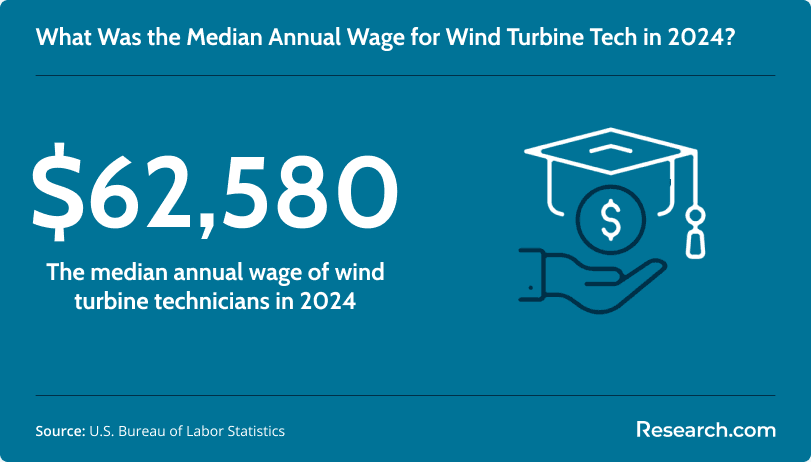
- Wind turbine technicians have a strong labor-market outlook, with employment projected to grow 60% over the next decade. The median annual salary is around $62,580, making this one of the stronger-paying skilled trade careers tied to clean energy.
- Typical entry-level pay is around $49,000-$55,000. Technicians with more than five years of experience often move into the $70,000-$90,000 range, while specialized, lead, or offshore roles can exceed $100,000 in certain markets.
- Published salary figures usually reflect base pay. Overtime, travel assignments, and per diem payments can substantially increase annual take-home income, especially for technicians who work away from home for extended periods.
- State and regional differences are significant. Offshore wind markets and high-demand coastal states often pay more, while established onshore wind regions in the Midwest can also offer competitive wages.
- A short technical certificate may be enough for some entry-level roles, but Global Wind Organization training, safety credentials, electrical and hydraulic skills, and manufacturer-specific training can improve job options and earning potential.
- What is the national salary range for wind turbine technicians?
- How much do junior, mid-level, and senior wind turbine technicians earn?
- Which states pay wind turbine technicians the most?
- Which states report the lowest wind turbine technician salaries?
- How does wind turbine technician pay differ by U.S. region?
- What factors have the biggest effect on wind turbine technician pay?
- Can an associate degree increase a wind turbine technician’s earnings?
- What advancement paths can help wind turbine technicians earn more?
- Which certifications can improve a wind turbine technician’s salary prospects?
- What is the long-term salary outlook for wind turbine technicians?
What is the national salary range for wind turbine technicians?
Nationally, wind turbine technician salaries typically fall between about $49,000 and $88,000 per year, depending on experience, employer, location, travel requirements, and specialization. Current wage figures from the U.S. Bureau of Labor Statistics and related sources show the following national benchmarks.
The broad national midpoint is:
- Median annual wage: $62,580 per year
- Median hourly wage: $30.09 per hour
The gap between entry-level and experienced technicians is meaningful. New technicians usually start with routine inspections, preventive maintenance, and supervised repairs, while high-earning technicians often handle advanced diagnostics, major component work, offshore assignments, or crew leadership.
| Pay group | Annual wage | Hourly wage |
| Lowest 10% (Entry-Level) | <$49,110/year | $23.61/hour |
| Lowest 25% | <$52,770/year | $25.37/hour |
| Highest 10% (Experienced) | >$88,090/year | $42.35/hour |
| Highest 75% | >$74,940/year | $36.03/hour |
When comparing jobs, candidates should look beyond the hourly rate. A role with moderate base pay may produce higher total income if it includes overtime, travel pay, per diem, strong benefits, or paid certification training.
How much do junior, mid-level, and senior wind turbine technicians earn?
Wind turbine technician pay usually rises as technicians gain field experience, learn more turbine systems, become trusted with independent troubleshooting, and qualify for more complex maintenance or leadership assignments. The following ranges show common salary expectations by career stage.
| Experience level | Typical salary range | What the role usually involves |
| Junior or entry-level technician | $49,000 - $55,000 | Assists senior technicians, performs basic inspections, follows safety procedures, learns turbine components, and completes supervised maintenance tasks. |
| Mid-level technician | $55,000 - $70,000 per year | Works more independently, completes preventive maintenance, diagnoses common faults, performs repairs, and supports documentation and site safety practices. |
| Senior or experienced technician | $70,000 - $90,000+ per year | Handles advanced troubleshooting, trains newer technicians, leads crews, supports planning, and may specialize in controls, hydraulics, blade repair, or offshore work. |
Junior/Entry-Level Wind Turbine Technician: $49,000 - $55,000
Entry-level technicians are usually building their foundation. Their work often includes climbing towers, using safety systems, assisting with inspections, documenting maintenance activity, and learning how electrical, mechanical, hydraulic, and control systems interact.
Mid-Level Wind Turbine Technician: $55,000 - $70,000 per year
Mid-level technicians are expected to solve more problems without constant supervision. At this stage, employers often value reliability, safe work habits, diagnostic ability, and the confidence to perform scheduled and unscheduled maintenance correctly.
Senior/Experienced Wind Turbine Technician: $70,000 - $90,000+ per year
Senior technicians often become the people site managers rely on for difficult repairs, training, safety leadership, and high-priority downtime issues. Technicians who add specialized capabilities, such as composite blade repair, advanced controls work, or offshore operations, may push earnings even higher.
Which states pay wind turbine technicians the most?
The highest-paying states for wind turbine technicians are often places where demand, project scale, cost of living, offshore development, or specialized maintenance needs raise wages. Based on the most recent data available in the source material, these states consistently appear among stronger-paying markets.
| STATE | SALARY RANGE |
| California | $84,000 to $94,000 |
| Kentucky | $78,,000 to $82,000 |
| Pennsylvania | $77,000 to $80,000 |
| New Jersey | $73,000 to $74,000 |
| North Carolina | $65,000 to $72,000 |
| Washington | $61,000 to $63,000 |
| North Dakota | $62,000 to $72,000 |
A higher listed salary does not always mean a better financial outcome. Housing, transportation, taxes, travel expectations, and benefits can change the value of a paycheck. For example, a larger salary in California may not stretch as far as a lower salary in a state with lower living costs.
Technicians should also separate average pay from top-end earning potential. A highly experienced technician with advanced troubleshooting skills may earn more than a state average almost anywhere, especially in roles that involve travel, offshore work, urgent repairs, or leadership responsibilities.
The U.S. wind energy sector is expected to keep creating technician demand. The following chart shows the projected increase in wind turbine technician opportunities over the next decade.
Which states report the lowest wind turbine technician salaries?
Some states report lower wind turbine technician salary ranges than the national midpoint or the highest-paying wind markets. Lower pay can reflect fewer wind projects, less intense hiring demand, different project types, or local labor-market conditions.
| STATE | SALARY RANGE |
| Florida | $40,000 to $50,000 |
| West Virginia | $41,000 to $42,000 |
| Arkansas | $44,000 to $45,000 |
| Georgia | $45,000 to $46,000 |
| Louisiana | $46,000 to $47,000 |
| Michigan | $47,000 to $48,000 |
| Oklahoma | $47,000 to $50,000 |
| South Dakota | $47,000 to $54,000 |
| Wyoming | $46,000 to $52,000 |
| New York | $51,000 to $61,000 |
Why some states pay less
- Limited local demand: States with fewer wind farms or slower development may not need as many technicians, which can reduce wage pressure.
- Lower cost of living: Some lower-paying states may also be less expensive to live in, so technicians should compare real purchasing power rather than salary alone.
- Labor and union conditions: Differences in union presence, contractor competition, and local energy labor markets can influence pay.
- Project mix: Smaller, older, or less complex wind projects may not pay the same as large-scale new construction, offshore work, or advanced maintenance operations.
- Candidate supply: If many qualified technicians are available in one area, employers may not need to raise wages as aggressively.
How does wind turbine technician pay differ by U.S. region?
Regional pay differences usually follow wind farm concentration, offshore development, state energy policy, employer competition, and local living costs. A region with many wind assets can provide more job openings, but wages still vary by employer and specialization.
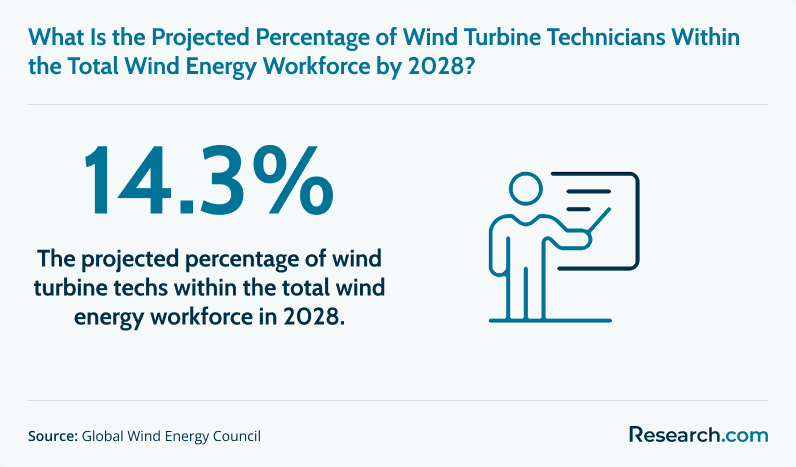
In 2018, wind turbine technicians represented only 2.6% of the total wind energy workforce, with 10,639 workers. By 2028, that number is projected to rise more than sevenfold to 76,181, accounting for 14.3% of the total workforce.
| Region | Salary range | What to know before choosing this market |
| Northeast Region | $70,000 - $75,000 | Offshore wind activity and strong renewable energy targets can support competitive pay. Pennsylvania, New Jersey, and New York are important markets to watch. |
| Midwest Region | $60,000 - $65,000 | The Midwest remains a major onshore wind region. Iowa, North Dakota, and Illinois have strong wind activity, and North Dakota can be especially competitive. |
| Southern Region | $55,000 - $65,000 | Pay varies widely. Texas has major wind capacity and competitive opportunities, while some other Southern states have smaller or less developed wind markets. |
| Western Region | $65,000 - $75,000 | California, Washington, Oregon, Colorado, and parts of the Mountain West offer established or growing wind energy opportunities, though cost of living can vary sharply. |
How to compare regions realistically
- Check whether roles are local, regional travel, national travel, or offshore rotation.
- Compare total compensation, not just base salary.
- Look at employer-paid certifications, tools, housing support, travel reimbursement, and overtime rules.
- Consider whether the region offers advancement into lead, trainer, quality, or site management roles.
What factors have the biggest effect on wind turbine technician pay?
Wind turbine technician salary is shaped by a combination of experience, location, employer type, safety credentials, technical depth, and willingness to travel. Understanding these factors helps new technicians choose training wisely and helps working technicians plan their next move.
Experience and field judgment
Experience is one of the clearest drivers of pay, especially among skilled trades that can lead to strong earnings. Technicians who can safely identify faults, reduce downtime, mentor others, and complete repairs efficiently are more valuable to employers.
- Entry-level technicians: Usually earn less because they are still building safety habits, turbine knowledge, and troubleshooting ability.
- Mid-level technicians: Often see pay improve once they can work independently and handle more maintenance tasks without close oversight.
- Senior technicians: Typically command higher wages when they can solve complex issues, lead crews, document work accurately, and support site reliability.
Location and project density
- State demand and policy environment: Areas with many wind projects, active development, and supportive renewable energy policies often have stronger technician demand.
- Cost of living: Higher wages may be partly offset by higher rent, transportation, and daily expenses, so technicians should compare net quality of life.
- Distance to wind assets: Workers near major wind corridors may have more local options, while those in less developed markets may need to travel to earn more.
Employer type
- Large utilities and operators: These employers may offer steadier schedules, broader benefits, structured advancement, and competitive base pay.
- Turbine manufacturers: Companies such as Vestas, GE Renewable Energy, or Siemens Gamesa may pay well for technicians who know their turbine platforms.
- Independent service companies and contractors: Compensation can vary. Some contractor roles pay strong hourly rates or travel premiums, but they may offer less predictability.
- Offshore employers: Offshore wind work generally pays more because it requires specialized safety practices, marine logistics, and tolerance for more demanding conditions.
Technical specialization and credentials
- GWO training: Global Wind Organization modules are widely recognized and often expected for turbine work, especially where employers prioritize standardized safety training.
- Specialized technical skills: Electrical troubleshooting, hydraulics, composite blade repair, rigging, controls, and advanced diagnostics can raise earning potential. Related technical training can also support movement into some of the higher-paying skilled trade roles.
- Formal education: A postsecondary non-degree credential is common, but an associate degree or advanced technical training can support faster progression in some companies.
Common mistakes that can limit salary growth
| Mistake | Why it hurts | Better approach |
| Choosing training only because it is short or inexpensive | The program may not include the safety or technical preparation employers expect. | Compare curriculum, hands-on practice, employer relationships, and recognized safety training. |
| Looking only at base pay | Overtime, per diem, travel rules, benefits, and certification support can change total compensation. | Ask employers for the full compensation structure before accepting an offer. |
| Ignoring physical and travel demands | Some higher-paying roles require climbing, weather exposure, rotating schedules, or long travel periods. | Match the job type to your health, family needs, and lifestyle preferences. |
| Assuming every wind job leads to offshore pay | Offshore work requires additional preparation and is not available in every region. | Build a deliberate path through safety training, onshore experience, and specialized skills. |
Can an associate degree increase a wind turbine technician’s earnings?
A postsecondary certificate or non-degree award is often enough to enter the field, but an associate degree can improve competitiveness, especially for technicians who want faster advancement, broader technical knowledge, or leadership roles. Employers do not all pay an automatic premium for the degree itself, but the skills and credibility that come with it can matter.
The Global Wind Energy Council forecast that the number of wind technicians in the construction and installation segment will reach 307,790 by 2028, including 251,109 onshore and 56,681 offshore. It also reported that 224,623 additional technicians are needed in operations and maintenance (O&M), including 205,123 onshore and 19,500 offshore.
Compared with shorter online trade courses, an associate degree may offer these advantages:
- Stronger starting profile: The BLS does not publish a specific wage gap between associate degree holders and certificate holders for this occupation, but employers may view an associate degree as evidence of deeper preparation in electrical, mechanical, and hydraulic systems.
- More room to advance: Degree holders may be better positioned for lead technician, supervisor, specialized technician, quality, or training roles when combined with strong field performance.
- Better troubleshooting foundation: Programs with deeper theory can help technicians diagnose complex faults rather than only follow routine maintenance procedures.
- Formal proof of preparation: A degree can be useful when applying to larger employers with structured hiring systems or when negotiating career progression.
An associate degree is not the only path into wind energy. Many technicians enter through certificates, military technical experience, apprenticeships, or related mechanical and electrical work. However, workers who want a broader long-term path in the rapidly expanding wind energy labor market may benefit from the added technical depth.
The following chart highlights projected national wind energy workforce needs by 2028 and shows why training pathways will remain important for both new and experienced workers.
What advancement paths can help wind turbine technicians earn more?
Wind turbine technicians can raise earnings by becoming more technically specialized, taking on leadership, moving into offshore or travel-intensive work, or transitioning into training, quality, or site operations. The best path depends on whether a technician prefers hands-on repair, people management, teaching, inspection, or operations oversight.
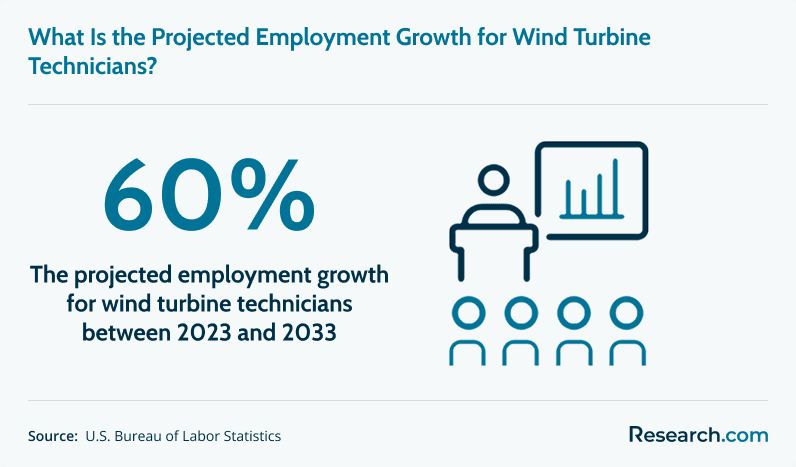
The wind turbine technician job market is expected to grow substantially, with projected employment growth of 60% between 2023 and 2033. That expansion is expected to create about 2,100 job openings each year during the decade.
| Career path | Typical annual salary | Best fit for |
| Lead Technician/Senior Technician | $70,000 - $95,000 | Experienced technicians who want to guide crews, solve difficult field problems, and support site leadership. |
| Specialized Technician Roles | $75,000 - $100,000 | Technicians who want to focus on blade repair, main component exchange, offshore work, controls, or other high-skill areas. |
| Site Supervisor / Site Manager | $80,000 - $120,000 | Workers who want responsibility for staffing, scheduling, contractors, budgets, safety, reporting, and operational performance. |
| Technical Trainer/Instructor | $65,000 - $90,000 | Experienced technicians with strong communication skills who enjoy teaching new hires or upskilling current workers. |
| Quality Control Inspector/Auditor | $70,000 - $90,000 | Detail-oriented technicians who want to verify repair quality, safety compliance, documentation, and process consistency. |
Lead Technician/Senior Technician
This is often the first major step up from mid-level work. Lead technicians supervise daily tasks, coordinate work plans, enforce safety procedures, troubleshoot difficult faults, and mentor newer workers. Related experience from mechanic school can be useful when it builds mechanical reasoning and repair discipline.
Specialized Technician Roles
Specialist roles can pay more because they require a narrower and more advanced skill set. Examples include composite blade repair technician, major component exchange technician, offshore technician, and advanced controls or electrical troubleshooting technician.
Site Supervisor / Site Manager
These roles move beyond individual repairs into full site performance. Responsibilities may include workforce planning, contractor coordination, budget tracking, operational reporting, and making sure maintenance work supports uptime and safety goals.
Technical Trainer/Instructor
Technicians who communicate clearly and enjoy teaching can move into training roles for manufacturers, wind farm operators, service providers, or technical schools. These jobs may be less physically demanding than field work but still require strong technical credibility.
Quality Control Inspector/Auditor
Quality roles focus on whether maintenance and repairs meet company, regulatory, and safety expectations. Inspectors and auditors may review completed work, check documentation, observe procedures, and identify process improvements.
Which certifications can improve a wind turbine technician’s salary prospects?
Certifications can strengthen a technician’s resume, improve safety readiness, and open doors to higher-responsibility work. Training from electrician trade schools can also be valuable when it builds electrical troubleshooting skills relevant to turbine systems.
| Certification or training type | Why it matters | How it can affect pay |
| Global Wind Organization (GWO) Certifications | GWO training is widely recognized across the wind industry and is often expected for turbine safety work. | It may help candidates qualify for jobs faster and support advancement when combined with experience and advanced modules. |
| OSHA Certifications | OSHA training shows broader knowledge of workplace safety expectations in the United States. | It can strengthen a candidate’s safety profile, particularly for employers with strict compliance requirements. |
| Specialized Technical Certifications | Training in electrical systems, hydraulics, controls, blade repair, rigging, or diagnostics can prepare technicians for specialist work. | Specialist credentials can support access to higher-paying assignments and more advanced job titles. |
| Manufacturer-Specific Training/Certifications | Manufacturers often train technicians on their own turbine platforms, components, software, and service procedures. | Platform-specific expertise can be valuable to employers operating those turbine models. |
Questions to ask before paying for certification training
- Do employers in my target region ask for this credential in job postings?
- Is the training recognized by wind farm operators, service contractors, or manufacturers?
- Does the program include hands-on practice, safety procedures, and documentation training?
- Will the employer reimburse the cost or require the certification after hiring?
- Does the credential help me qualify for the next role I want, or is it only a general add-on?
What is the long-term salary outlook for wind turbine technicians?
The long-term salary outlook is favorable because wind turbine technician demand is tied to renewable energy expansion, maintenance of existing turbine fleets, workforce shortages, and new technologies such as offshore wind. The median annual wage was around $62,580 in May 2024, and technicians with experience, advanced credentials, and specialized skills are likely to remain better positioned than entry-level workers.
Wind work is also one of the practical trades to consider for people who want faster career entry, but “quick to enter” does not mean easy. The job is physically demanding, safety-sensitive, and often requires climbing, travel, weather exposure, and careful documentation.
Offshore wind may create stronger earning opportunities for technicians who can meet its safety, travel, and technical requirements. These jobs usually involve more complex logistics and work environments, which is why they often command higher compensation than standard onshore maintenance roles.
Technicians who keep learning, build a clean safety record, gain advanced troubleshooting experience, and qualify for leadership or specialist assignments may reach or exceed $90,000 to $100,000 annually, especially when overtime and per diem are included.
How to improve your earning potential as a wind turbine technician
- Start with employer-aligned training. Choose a certificate, associate degree, or technical pathway that teaches turbine safety, electrical systems, hydraulics, mechanical systems, and troubleshooting.
- Build a strong safety record. Employers value technicians who follow procedures, document work, and reduce risk.
- Target high-demand regions. Compare states and regions based on wind farm density, offshore development, cost of living, and travel expectations.
- Add recognized certifications. Prioritize GWO, OSHA, technical, or manufacturer-specific training when it matches job postings in your target market.
- Seek responsibility early. Volunteer for documentation, troubleshooting, mentoring, and complex repairs when you are qualified and supervised appropriately.
- Compare total compensation. Ask about overtime, per diem, travel reimbursement, retirement benefits, health coverage, paid training, and promotion timelines.
How should you interpret salary stories from wind turbine technicians?
Individual salary stories can be useful, but they should not be treated as guarantees. A technician earning over $75,000 or over $90,000 may be working significant overtime, traveling often, holding advanced certifications, taking offshore assignments, or living in a higher-paying state. Another technician with the same job title may earn less because the employer, region, schedule, and project type are different.
When you hear salary examples from workers such as Alex, Michael, or David, use them as prompts for better questions: What state are they in? Are they paid hourly or salaried? How much overtime do they work? Do they receive per diem? Are they in a lead role? Do they travel? Are benefits included? Those details determine whether a salary is realistic for your situation.
References
- Associação Portuguesa de Energias Renováveis (APREN). (2024). GWEC global wind workforce outlook 2024–28 [PDF].
- Global Wind Energy Council. (2024). Global wind report.
- Global Wind Energy Council. (2024). Global wind workforce outlook 2024–2028.
- National Renewable Energy Laboratory. (2024). Workforce opportunities in the U.S. offshore wind industry (NREL/TP-5000-87670). U.S. Department of Energy.
- U.S. Bureau of Labor Statistics. (2024). Wind turbine technicians. Occupational Outlook Handbook.
Key Insights
- Wind turbine technician pay depends heavily on location. California, Pennsylvania, New Jersey, North Dakota, and other high-demand markets can pay more, but cost of living and travel requirements must be considered.
- The national median annual wage is around $62,580, with entry-level workers commonly starting around $49,000-$55,000 and experienced technicians moving into the $70,000-$90,000+ range.
- Base salary is only part of the compensation picture. Overtime, per diem, travel assignments, benefits, and employer-paid training can make one job financially stronger than another.
- Technicians who want higher pay should focus on safety performance, electrical and hydraulic troubleshooting, GWO and OSHA training, manufacturer-specific skills, and advancement into lead, specialist, offshore, quality, training, or site management roles.
- An associate degree is not always required, but it can improve long-term mobility by strengthening technical knowledge and making candidates more competitive for structured advancement paths.
- The career outlook is strong, with projected employment growth of 60% over the next decade and about 2,100 openings expected each year, but the job remains physically demanding and best suited to workers comfortable with heights, field conditions, safety procedures, and continuous learning.
Other Things You Should Know About Wind Turbine Technician Salary by State
The variation in wind turbine technician salaries across states in 2027 is influenced by factors such as cost of living, demand for renewable energy, presence of wind farms, and state-specific industry regulations. States with high energy demands and extensive wind farm developments typically offer higher salaries to attract skilled technicians.
Yes, state-specific certifications can impact salaries. For instance, Texas requires a Renewable Energy Systems Specialist certification, which can lead to higher wages. Certification requirements vary by state, affecting earning potential and job opportunities in each region.
In 2027, top-paying states for wind turbine technicians include California and Texas, where demand for renewable energy leads to competitive salaries. New York also ranks high due to its commitment to clean energy projects. These states offer salaries significantly above the national average.


