
World Online Ranking of Best Psychology Scientists – 2025 Report

Co-Founder and Chief Data Scientist
On May 13, 2025, Research.com released the 4th edition of its annual ranking of the world’s top psychology scientists. This year’s report seeks to raise the profile of accomplished psychologists and support the continued growth of this vital field.
We share these rankings to highlight standout achievements in psychology research across universities, countries, and institutions. This effort helps students, teachers, and researchers discover where leading experts focus their work. It also encourages new connections and collaborations while guiding institutions and policy-makers in tracking emerging research trends. We hope the report inspires readers to explore the exciting developments in psychology worldwide.
For the 2025 edition, researchers examined nearly 11,000 scientist profiles using trusted bibliometric sources. A range of indicators was used to decide which experts to include. These include how often a scientist’s work is cited, their productivity in psychology, and the lasting influence of their contributions. The result is a data-driven overview of today’s most respected psychology researchers.
To be considered for the ranking, a scientist needed a discipline-specific D-index of at least 30, with most of their work falling under psychology. The ranking also looked at how much of the scientist’s research focused on psychology, along with honors and accomplishments throughout their career. These factors helped shape the final report and spotlight the individuals making a difference in the field.
Latest discoveries in psychology research
A new study from Dell Medical School at The University of Texas at Austin has introduced a promising treatment for mood and anxiety disorders. Researchers used low-intensity focused ultrasound (tFUS) to target the amygdala, a brain region linked to emotions. Over three weeks, patients with depression, anxiety, and trauma-related disorders received daily sessions. The results showed significant symptom relief without the need for surgery or medication. This non-invasive approach could offer hope to those who haven't responded to traditional treatments.
In Japan, scientists have developed a virtual reality (VR) game that combines smell and sight to boost memory in older adults. Participants navigated a virtual world, identifying scents linked to visual cues. After just 20 minutes, they improved in tasks requiring spatial memory and attention. This innovative method taps into the brain's connection between smell and memory, offering a fun way to combat cognitive decline. With further development, such VR tools could become accessible options for supporting mental health in aging populations.
The key findings of the 4th edition of the best psychology scientists ranking
- The United States leads with 625 of the top 1,000 psychology scientists in 2025, making up 62.5% of the total list.
- King's College London has the highest number of top-ranked scientists by institution, with 31 scholars in the global top 1,000.
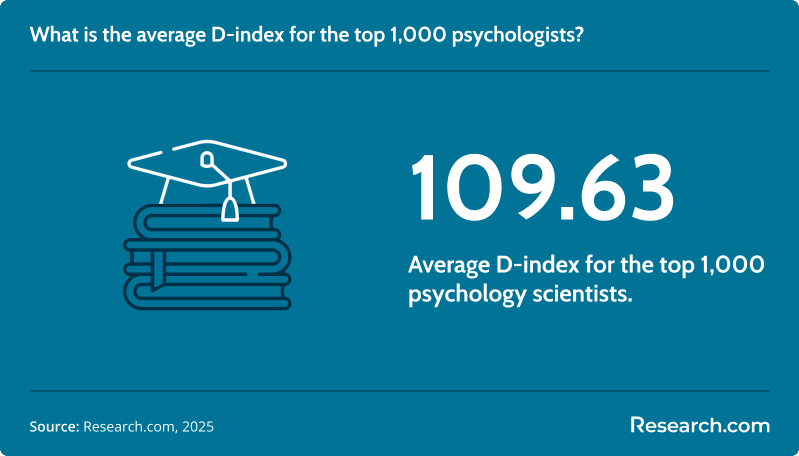
- The average D-index among the top 1% of scientists is 214.3, compared to 109.63 across the top 1,000 list.
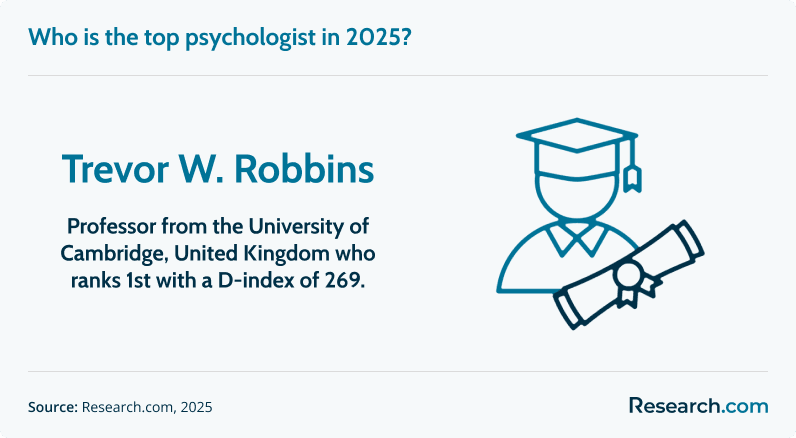
- Trevor W. Robbins from the University of Cambridge ranks #1 worldwide with a D-index of 269.
- The scientist with the lowest D-index in the 2025 ranking still met the threshold with a D-index of 30.
The full ranking for the 2025 list of the best psychology scientists can be found here:
BEST PSYCHOLOGY SCIENTISTS RANKING
Countries with the highest number of leading psychology scientists
The 2025 report confirms the continued global reach of psychology research, with scientists from 10 countries dominating the top 1,000 spots. The United States remains the clear leader, contributing 625 top psychology scientists this year. However, only three of the top 10 scholars are from the U.S. this time, suggesting a slight shift in global influence at the very top of the field.
The United Kingdom remains steady in second place with 119 scientists, just one more than last year. The Netherlands holds firm in third place with 52 experts, marking a slight rise from 50 in the previous report. Canada follows closely in fourth with 46 researchers, while Australia keeps its fifth place ranking with 42.
Germany has seen growth, increasing its representation from 33 to 38 scientists, securing the sixth spot. Belgium climbs to seventh place with 11 scientists, surpassing Italy, which now ranks ninth with 10. Sweden holds the eighth position, also with 10 scientists. Switzerland rounds out the top 10 with eight scientists.
Please note that the country associated with a scientist is based on their affiliated research institution according to MAG, not on their actual nationality.
Institutions with the highest number of leading scientists
In the 2025 ranking edition, King’s College London takes the top spot for the first time, with 31 scientists in the top 1,000. That’s a jump from 28 last year, moving the institution past Harvard University. Harvard now ranks second with 29 scientists, slightly dropping from 30 in 2024. These two universities account for about 6% of all scientists featured in this year’s list.
Stanford University, the University of California, Los Angeles (UCLA), and Yale University share the third position, each with 21 top scientists. UCLA drops slightly from its 2024 total of 23, while Stanford holds steady. Yale’s presence in this tier highlights its growing strength in psychology research.
The University of Cambridge follows with 18 scientists, maintaining its strong performance among U.K. institutions. Duke University ranks seventh with 17 scientists, while the University of California, San Diego, the University of Oxford, and the University of Toronto all tie for eighth place with 15 each.
Compared to 2024, the top 10 continues to be dominated by U.S. institutions—seven out of the top 10 are American, making up 70% of the group. The remaining three are from the U.K. and Canada. The University of Pittsburgh, which rejoined the top 10 last year with 14 scientists, now ranks 11th, tied with the University of Washington.
Strengthening psychology research through online universities
Online universities play an increasingly important role in shaping the future of psychology research. As demand for psychology degrees rises, more students turn to online education for flexibility and access. According to the latest data from the NCES, psychology makes up 6% of the 2 million bachelor's degrees awarded in the United States, making it one of the most popular majors nationwide. With more students starting their academic journey in this field, online programs are helping widen access to psychological training and research pathways.
The rise of online universities also supports the growth of global research by allowing learners from diverse locations to join rigorous academic programs without relocating. This expansion helps develop a broader network of future psychologists and researchers, some of whom go on to contribute to high-level studies or join faculty teams at leading institutions. As the rankings in this report show, excellence in psychology research is built on access, collaboration, and innovation—all of which are made easier by the growth of online education.
D-index ranking — leaders, averages, and distribution
For Europe, Professor Trevor W. Robbins from the University of Cambridge, United Kingdom, leads the global list at rank no. 1, with a D-index of 269.
For North America, Professor Terrie E. Moffitt from Duke University, United States, is the highest-ranked scientist in the region and 3rd in the world, with a D-index of 217.
In Oceania, Professor Richard M. Ryan from Australian Catholic University, Australia, holds the top spot regionally and is ranked 6th globally, with a D-index of 209.
For Asia, Professor Arthur F. Kramer from Northeastern University (China) is the highest-ranking scientist in the region, with a world ranking of 76th and a D-index of 147.
In South America, Professor Facundo Manes of Favaloro University, Argentina, leads the region with a D-index of 86, placing him 1,020th globally.
For Africa, Professor Sebastiaan Rothmann from North-West University, South Africa, is the top-ranked scientist on the continent with a D-index of 66, ranking 2,433rd worldwide.
The average D-index for the top 1% of scientists in the top 1,000 rankings is 214.3, while the overall average for all ranked scientists is 109.63.
The scholar with the lowest D-index in the 2025 report scored 30.
The top 1% of scientists have published an average of 821.9 discipline-specific articles compared to the overall average of 424.38.
Regarding impact, the top 1% averaged 233,641.5 citations, significantly higher than the overall average of 63,094.72 for the full ranking.
You can learn more about the methodology used to create this report here.
About Research.com
All research was coordinated by Imed Bouchrika, Ph.D., a computer scientist with a well-established record of collaboration on a number of international research projects with different partners from the academic community. His role was to make sure all data remained unbiased, accurate, and up-to-date.
Research.com is the number one research portal for science and educational rankings. Our mission is to make it easier for professors, research fellows, and students to progress with their research and find the top experts in a wide range of scientific disciplines. Research.com is also a leading educational platform that helps students find the best colleges, academic opportunities, and career paths.


