
Rising Stars of Science World Ranking 2025 (4th edition)

Co-Founder and Chief Data Scientist
On September 18, 2025, Research.com releases the 4th edition of its annual global ranking of rising stars of science. This report acknowledges a diverse group of early-career scientists from around the world who are making significant contributions to their respective fields. Like their senior counterparts, these individuals are developing innovative solutions and making discoveries that shape the global scientific landscape and inspire future research.
The 2025 ranking showcases a truly global cohort of emerging scientific leaders. The top 10 scientists alone represent eight different countries across four continents, underscoring that groundbreaking research knows no geographical boundaries. Their work spans critical fields such as Chemistry, Medicine, Materials Science, and Physics, demonstrating the breadth of innovation being driven by this new generation of researchers.
For the 2025 edition, 1,005 scientist profiles are assessed from a multitude of bibliometric data sources. Each profile is evaluated using several indicators, including the H-index, discipline-specific citations, and the number of publications, to determine inclusion in this prestigious ranking.
The inclusion criteria for scholars considered for the ranking are based on their discipline H-index, the proportion of their contributions within a given discipline, and their awards and achievements. The H-index threshold for a scholar to be considered is set at 30, with this edition only considering scientists who published their first paper less than 13 years ago.
Latest discoveries in science research
In the field of medicine, Canadian scientists uncover a surprising link between gut bacteria and diseases like type 2 diabetes. Their research identifies a molecule called D-lactate, which they successfully intercepted in mice using a polymer "trap," leading to lower blood sugar and improved liver health. This discovery opens a new therapeutic path focused on neutralizing harmful microbial byproducts before they can cause damage.
A potential cure for type 1 diabetes is on the horizon, following the first-ever implant of CRISPR-edited pancreas cells into a human patient. Developed by Sana Biotechnology, these cells were genetically modified to act in "stealth mode," allowing them to produce insulin for months while avoiding detection by the recipient's immune system. This breakthrough eliminates the need for anti-rejection drugs. It is being called a major milestone in the quest for a long-term treatment for the autoimmune disease.
The key findings from the rising stars of science ranking
- China leads the world with 317 scientists in the top 1,000, representing 31.7% of the ranked researchers.
- The Chinese Academy of Sciences is the top institution, with 18 of its scientists featured in the ranking.
- The top 10 scientists in the ranking come from eight different countries: Australia, China, the United States, Canada, Saudi Arabia, the United Kingdom, Italy, and Singapore.
- The average number of publications for the top 1% of scientists is 311.9, compared to 143 for the entire ranking.
- The top 1% of scientists in the ranking have an average H-index of 96.7, while the average for the entire list is 47.2.
- The average number of citations for the top 1% is 43,602.4, significantly higher than the overall average of 10,799.19.
The full ranking for the 2025 list of the world's rising stars of science can be found here:
RISING STARS OF SCIENCE RANKING
Countries with the highest number of scientific rising stars
China once again has the most significant representation in the 2025 ranking, reaffirming its position as a powerhouse for emerging scientific research. The nation is home to 317 of the world's top 1,000 rising stars, which, despite a decrease from last year's 358, still constitutes a dominant 31.7% of all scholars on the list.
The United States holds its second-place position and shows notable growth, increasing its representation to 162 scientists from 153 in 2024. This reverses a downward trend from the previous year, highlighting the country's continued strength in fostering new research talent.
The 2025 ranking sees significant shifts in the top five. Australia climbs to the 3rd spot with 54 scientists (up from 46), followed closely by the United Kingdom, which now ranks 4th with 53 scholars (up from 43). In a significant drop, Iran moves from 3rd place in 2024, with 48 scientists, to 6th place this year, with 36.
India continues its ascent, moving into the 5th position with 42 scientists, an increase from 36 last year. Germany also saw substantial growth, now tied with Iran for 6th place with 36 scientists, up from 26 in 2024. The top ten is rounded out by Italy (26), Canada (24), and Saudi Arabia, which enters the top 10 with 19 scientists.
Institutions with the highest number of leading scientists
The Chinese Academy of Sciences (CAS) remains the world's top institution for fostering rising scientific talent, with 18 of its scholars in the 2025 ranking. Although it holds the lead, this represents a decrease from the 23 scientists CAS had in the 2024 report. Hunan University follows, dropping from 12 scientists last year to 11 in 2025, while Tsinghua University saw a more significant drop from 12 scientists to 8.
The 2025 ranking continues to highlight the strength of Asian institutions, especially those in China. Out of the top 20 institutions, 14 are based in China, underscoring a strong national focus on research and development. New joiners to the top 10 list this year include the City University of Hong Kong (10 scientists) and Peking University (8 scientists).
Several international institutions also feature prominently in the top 10. The University of Technology Sydney (Australia) and Google (USA) both drop slightly from 10 scientists in 2024 to 8 and 9, respectively, while Nanyang Technological University (Singapore) joins the top rankings with 8 rising stars.
The overall distribution reveals a significant concentration of rising talent in Asia, with 15 of the top 20 institutions located on the continent. The remaining top spots are held by institutions in the United States (Stanford University, Google), Australia (University of Technology Sydney, University of Queensland), and Canada (University of Western Ontario), demonstrating a global, albeit concentrated, spread of scientific excellence.
Online universities advance research tradition
The continued growth of global research talent is increasingly supported by the accessibility of digital education. The rise of online universities and virtual learning platforms dismantles geographical barriers, allowing aspiring scientists from diverse backgrounds to access specialized knowledge. A 2025 report on the digital education market shows that STEM-related courses are the most popular, making up the vast majority of the market and underscoring how digital platforms are becoming central to scientific training.
This digital transformation in education does more than just widen the talent pool; it fosters a more interconnected and collaborative research environment. By offering flexible and advanced degree programs, online universities equip the next generation of innovators with the critical skills needed to tackle complex global challenges. This model ensures that the future of science is not limited by location, creating a more inclusive and dynamic community of rising stars.
H-index ranking—leaders, averages, and distribution
World Ranking Leaders
The 2025 scoreboard of emerging science stars showcases the rapid ascent of top researchers from across the globe. The leaderboard features both returning members and several scientists making their debut in the highest tier of the ranking.
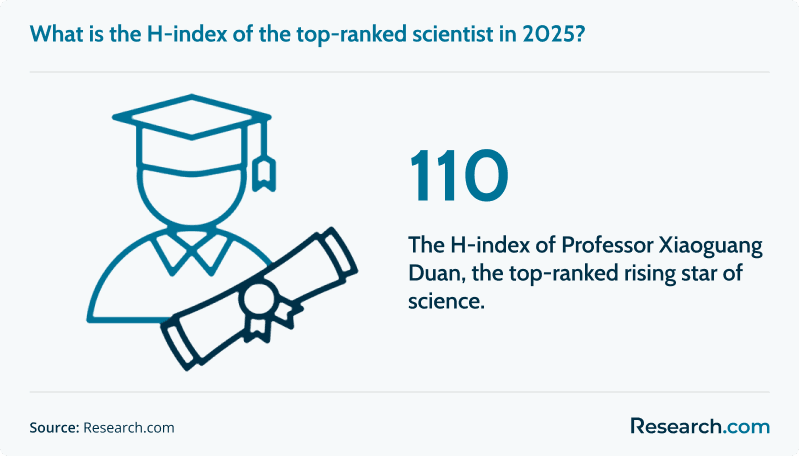
Leading the world ranking for 2025 is Professor Xiaoguang Duan from the University of Adelaide. For this year’s report, Professor Duan has an H-index of 110 with a total of 43,796 citations and 326 publications.
Securing the 2nd spot in our 2025 ranking is Professor Chen Zhang from Hunan University, China. With an H-index of 105, he has been cited 31,915 times by fellow research scholars and has 216 publications.
The 3rd position on the top 1,000 list is occupied by Professor Matthew D. Hellmann of the Memorial Sloan Kettering Cancer Center in the United States, with an H-index of 104. Professor Hellmann has a total of 82,413 citations and has completed 343 publications.
Professor Yaoyu Zhou from Hunan Agricultural University, China, is ranked fourth in the Rising Stars list with an H-index of 102 and 29,522 citations. Professor Zhou also holds 301 publications.
At the fifth spot is Professor Arivalagan Pugazhendhi from Cape Breton University, Canada, with an H-index of 99. Professor Pugazhendhi has amassed 32,594 citations and has the third-highest number of publications in the entire ranking, with 564 articles.
Continental Leaders
For Oceania, Professor Xiaoguang Duan from the University of Adelaide, Australia, is ranked first with an H-index of 110. He occupies the highest position in the global standings.
For Asia, Professor Chen Zhang from Hunan University, China, is listed first with an H-index of 105. He is second in the world ranking.
Leading North America is Professor Matthew D. Hellmann from the Memorial Sloan Kettering Cancer Center, United States, with an H-index of 104. He is third in the world ranking.
Europe is led by R. Robie from the University of Glasgow, United Kingdom, who has an H-index of 89. He holds the 7th spot in the world ranking.
The rising star holding the top spot for Africa is Professor Foad Abd-Allah from Cairo University in Egypt, with an H-index of 79. He is 29th in the world ranking.
For South America, the top rising star is Professor José C. S. dos Santos from the Universidade Federal do Ceará in Brazil, with an H-index of 61. He is number 156 in the world.
Averages and Distribution
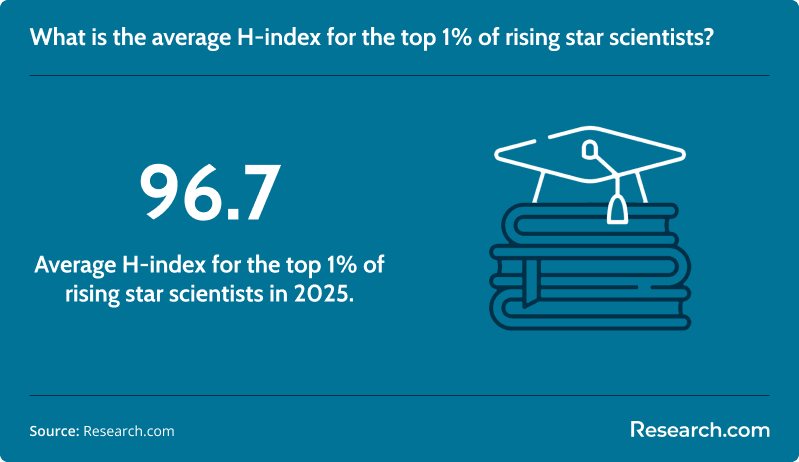
In the 2025 world ranking, the top 1% of the ranked young scientists have an average H-index of 96.7, while the average H-index for the top 1,000 is 47.26.
In terms of H-index distribution, one scientist has an index in the 110-119 range, three are in the 100-109 range, two are within the 90-99 bracket, 22 are in the 80-89 range, and the rest of the rising stars (972) garnered an H-index below 80.
As for citations, the average of the top 1% is 43,602.4, while the average of the top 1,000 scholars is 10,799.19. The scholar with the most citations in the 2025 world rankings is Professor Foad Abd-Allah of Egypt (177,188), followed by Felix Akpojene Ogbo of Australia (141,087), and Fares Alahdab of the United States (117,272).
Regarding publications, the average of the top 1% is 311.9 against an average of 143.3 for the top 1,000 rising stars. The scholar with the most publications is Professor Mohd. Shkir from King Khalid University, Saudi Arabia, with 586.
You can learn more about the methodology used to create the ranking here.
About Research.com
All research was coordinated by Imed Bouchrika, Ph.D., a computer scientist with a well-established record of collaboration on a number of international research projects with different partners from the academic community. His role was to make sure all data remained unbiased, accurate, and up-to-date.
Research.com is the number one research portal for science and educational rankings. Our mission is to make it easier for professors, research fellows, and students to progress with their research and find the top experts in a wide range of scientific disciplines. Research.com is also a leading educational platform that helps students find the best colleges, academic opportunities, and career paths.


