
World Online Ranking of Best Plant & Agronomy Scientists – 2024 Report

Co-Founder and Chief Data Scientist
Research.com’s 2024 ranking of leading plant science and agronomy scientists helps researchers, universities, students, funders, and industry partners identify influential scholars in a field that directly affects food systems, climate resilience, soil health, and sustainable agriculture. Published on April 30, 2024, this third edition highlights scientists whose work has had measurable research impact across plant science and agronomy.
This guide explains what the 2024 ranking shows, how to interpret the results, which countries and institutions have the strongest representation, and what the findings suggest for students and early-career researchers considering plant science, agronomy, crop science, soil science, or related academic paths.
Quick answer: what does the 2024 plant science and agronomy ranking show?
The 2024 Research.com ranking includes 1,000 leading scientists in plant science and agronomy. The United States has the largest number of listed scholars, with 277 scientists, while Rattan Lal of the Ohio State University ranks first globally with a D-index of 174. The U.S. Agricultural Research Service has the strongest institutional representation, with 26 scientists included in the ranking.
The ranking was developed after Research.com examined nearly 3,500 scientists identified through Google Scholar and Microsoft Academic Graph. Scientists were evaluated using multiple indicators, including citations, awards, and discipline-specific research output. To be considered, a scientist generally needed a D-index of at least 30 when most of their publications were in plant science and agronomy.
Why plant science and agronomy research matters now
Plant science and agronomy sit at the center of several urgent global challenges: improving crop productivity, protecting soil resources, adapting farming systems to changing climate conditions, and reducing the environmental pressure of agriculture. The field includes research on plant physiology, genetics, crop management, soil systems, pest resistance, water use, and sustainable production methods.
For students and professionals, the ranking is useful because it shows where influential research is being produced and which institutions have strong scientific communities. For universities and research organizations, it can support benchmarking, collaboration planning, faculty recruitment, and grant strategy. For policymakers and funders, it provides a clearer view of research leadership across regions and institutions.
How to use this ranking responsibly
A scientist ranking should not be treated as a complete measure of academic value. Citation-based indicators can reveal influence, but they do not capture every important contribution, such as teaching quality, mentoring, local agricultural impact, applied extension work, or emerging research that has not yet accumulated citations. The ranking is most useful when combined with other evidence, including publication quality, research relevance, collaboration history, and institutional priorities.
| Reader goal | How this ranking can help | What to check before making a decision |
| Find research collaborators | Identify highly cited experts and institutions active in plant science and agronomy. | Review recent publications, research focus, funding history, and collaboration fit. |
| Choose a graduate program or supervisor | Locate institutions with strong representation in the field. | Check advisor availability, lab resources, funding, curriculum, and graduate outcomes. |
| Benchmark a department | Compare institutional representation against peer organizations. | Use additional indicators such as research funding, field stations, extension programs, and student support. |
| Understand global research leadership | See which countries and regions have many influential scholars. | Remember that country assignment is based on institutional affiliation, not nationality. |
Latest discoveries and research directions in plant science and agronomy
Recent work in plant science continues to show how small biological adaptations can have major agricultural consequences. One example is research on root cortical aerenchyma, or RCA. RCA refers to air spaces that form inside plant roots. These structures can help plants cope with low-oxygen conditions in waterlogged soils, which may support the development of more resilient crop varieties.
Agronomy is also being shaped by the growing focus on regenerative agriculture. This approach emphasizes soil health through methods such as cover cropping, reduced or no tillage, and compost use. The goal is not only to support crop production but also to improve biodiversity, reduce erosion, and strengthen water retention in agricultural systems.
Together, these research areas show why plant science and agronomy are increasingly interdisciplinary. Progress depends on plant biology, soil science, data analysis, environmental science, genetics, and farm-level management working together.
Key findings from the 3rd edition of the plant science and agronomy scientist ranking
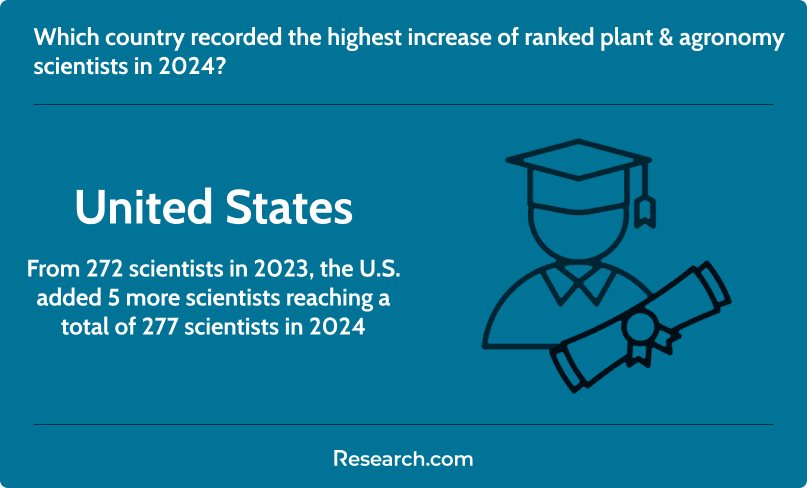
- The United States has the largest representation in the 2024 ranking, with 277 scholars included. That is five more scientists than in the previous year.
- Among the top 10 scientists, three are affiliated with institutions in Germany, two are affiliated with institutions in the United Kingdom, and two are affiliated with institutions in Australia. The United States has one scholar in the top 10, who also holds the number one position.
- The U.S. Agricultural Research Service again leads all institutions, with 26 scientists in the ranking. This is two scientists fewer than last year.
- Rattan Lal of the Ohio State University in the United States is ranked as the top scientist in plant science and agronomy.
- The average D-index among the top 1% of scientists is 142, compared with an average of 70.43 across all 1,000 ranked scientists.
The complete 2024 list is available here:
World’s best plant science and agronomy scientists ranking
Countries with the highest number of leading plant science and agronomy scientists
The United States leads the 2024 ranking with 277 scientists, up five from 2023. This represents 27.7% of all scientists included in the plant science and agronomy ranking.
The United Kingdom is second with 95 scientists, while Australia follows closely with 93 scientists. Both countries increased their representation compared with 2023: the United Kingdom added three scientists, and Australia added one.
Other countries with strong representation include Germany with 68 scientists, Canada with 55, China with 53, Spain with 40, and France with 34. Sweden, which ranked 10th in 2023, is no longer in the top 10. The Netherlands now holds that position with 25 scientists.
The country assigned to each scientist reflects the affiliated research institution listed in Microsoft Academic Graph, not the scientist’s nationality.
| Country | Number of ranked scientists | Context from the 2024 ranking |
| United States | 277 | Largest national representation; five more scientists than in 2023. |
| United Kingdom | 95 | Second overall; three more scientists than in 2023. |
| Australia | 93 | Third overall; one more scientist than in 2023. |
| Germany | 68 | Seven fewer scientists than last year, but strongly represented among the top 10. |
| Canada | 55 | One of the leading countries in the 2024 ranking. |
| China | 53 | One of the leading countries in the 2024 ranking. |
| Spain | 40 | One of the leading countries in the 2024 ranking. |
| France | 34 | One of the leading countries in the 2024 ranking. |
| Netherlands | 25 | Entered the top 10 country list in 2024. |
How policy and funding influence plant science and agronomy
Public funding and government policy shape what kinds of plant science and agronomy research move forward. Funding priorities can support long-term work on soil systems, crop resilience, food security, climate adaptation, and sustainable farming practices. Policies can also encourage collaboration between universities, public research agencies, private companies, and agricultural producers.
For students and professionals, funding priorities matter because they affect graduate assistantships, field research opportunities, laboratory capacity, and applied projects. Those looking for shorter, skills-focused training may also compare options such as affordable online graduate certificate programs, especially when they want to build expertise without committing immediately to a full degree.
Institutions with the highest number of leading scientists
The U.S. Agricultural Research Service remains the leading institution in the 2024 ranking, with 26 scientists included. That is two fewer scientists than in 2023.
The University of California, Davis ranks second with 24 scientists. Other institutions among the top five include the University of Western Australia with 19 scientists, Rothamsted Research with 17 scientists, Agriculture and Agriculture-Food Canada with 15 scientists, and the Swedish University of Agricultural Sciences with 15 scientists.
American universities account for 40% of the top 10 leading institutions in 2024. The remaining institutions in the top 10 are based in Australia, Sweden, China, the United Kingdom, Canada, the Netherlands, and France.
Within the top 1% of the ranking, only one scientist is affiliated with an American institution: Rattan Lal of the Ohio State University. Germany’s Max Planck Institute has the highest number of scientists in the top 1%.
Other institutions represented in the top 1% include the University of Birmingham and Rothamsted Research in the United Kingdom, Utrecht University in the Netherlands, the Chinese Academy of Sciences in China, and the Australian National University and Curtin University in Australia.
| Institution | Number of ranked scientists | What the result indicates |
| U.S. Agricultural Research Service | 26 | Highest institutional representation in the 2024 ranking. |
| University of California, Davis | 24 | Second-highest institutional representation. |
| University of Western Australia | 19 | One of the strongest institutional contributors in the ranking. |
| Rothamsted Research | 17 | Highly represented and also has scientists in the top 1%. |
| Agriculture and Agriculture-Food Canada | 15 | Among the top five institutions by ranked scientist count. |
| Swedish University of Agricultural Sciences | 15 | Among the top five institutions by ranked scientist count. |
Financial aid and education pathways for plant science and agronomy students
Students preparing for careers in plant science and agronomy should compare academic fit and affordability together. Scholarships, institutional grants, assistantships, and federal aid can all affect whether a program is realistic. Students considering online study should confirm that the institution is eligible for federal aid when that support is part of their plan. One practical starting point is reviewing online colleges that accept FAFSA.
Graduate students should also ask whether funding covers fieldwork, laboratory costs, conference travel, summer research, and data collection. A program with lower tuition may still be expensive if essential research expenses are not supported.
Online and hybrid research collaboration in plant science
Online and hybrid academic models can support plant science and agronomy research when they are paired with strong field, lab, and data systems. Remote collaboration makes it easier for researchers working in different climates, soil conditions, and production systems to compare findings and share data.
Technology also supports larger agricultural research projects. For example, universities can use cloud-based platforms, shared datasets, and remote communication tools to coordinate research activity across multiple sites. Colorado State University describes agricultural research initiatives that use technology to support large-scale research efforts.
However, students should be realistic: many plant science and agronomy pathways still require fieldwork, lab access, or in-person research experience. Online coursework can be useful, but it should not replace the hands-on training needed for many research and applied agricultural roles.
How emerging scientists can build a stronger career path
Early-career scientists can improve their trajectory by combining technical depth with practical research experience. Useful steps include joining active research groups, learning statistical and data tools, building field and laboratory skills, presenting at conferences, publishing with mentors, and developing expertise in a focused research area.
Students who are still exploring the field may begin with foundational study before committing to a bachelor’s or graduate program. For some learners, an online associate degree can provide an accessible way to build basic college-level preparation before transferring or specializing further.
| Career stage | Priority actions | Why it matters |
| Undergraduate student | Take biology, chemistry, statistics, soil science, ecology, and crop-related coursework when available. | Builds the scientific base needed for research or graduate study. |
| Research assistant or technician | Gain field, greenhouse, lab, and data-management experience. | Shows practical competence and strengthens graduate applications. |
| Master’s student | Choose a focused thesis topic and work with an advisor who publishes in the target area. | Creates a stronger research identity and publication record. |
| Doctoral student | Publish, present, collaborate, and build methods expertise. | Improves competitiveness for postdoctoral, academic, government, and industry roles. |
| Postdoctoral or early faculty researcher | Develop independent projects, pursue funding, and build interdisciplinary partnerships. | Supports long-term research visibility and leadership. |
Major challenges slowing innovation in plant science and agronomy
Several barriers can make it harder to move scientific discoveries into practical agricultural solutions. Funding limitations can delay long-term experiments, while fragmented international collaboration can slow the sharing of data and field results. Changing climate patterns, emerging pests, and shifting disease pressures also complicate crop and soil management.
Another challenge is training. Modern plant science and agronomy increasingly require skills across biology, soil science, data analytics, remote sensing, and environmental systems. Students from nontraditional backgrounds, including military-affiliated learners, may need flexible programs and support services. Comparing military-friendly online colleges can help those learners identify institutions designed for their needs.
Which major is best for plant science and agronomy?
There is no single undergraduate major that fits every plant science or agronomy career. Strong options often include plant science, agronomy, crop science, soil science, biology, environmental science, horticulture, agricultural science, or genetics. The best choice depends on whether the student wants to work in research, production agriculture, environmental management, biotechnology, extension, or graduate study.
Students should look beyond the major title and examine the curriculum. A strong program should include science fundamentals, statistics or data analysis, field or lab experience, and opportunities to work with faculty on research. Students still comparing academic paths can use resources on college major difficulty and fit to think realistically about workload, preparation, and long-term goals.
Can affordable online education support advancement in this field?
Affordable online education can help working professionals strengthen specific skills, especially in areas such as data analysis, environmental policy, project management, agricultural business, or scientific communication. It can also help learners complete prerequisites or earn credentials while remaining employed.
Still, prospective students should confirm whether an online program includes the hands-on components they need. Plant science and agronomy can require field trials, lab methods, greenhouse work, or supervised research. Working adults comparing flexible options may want to review affordable online colleges for working adults while also checking whether each program supports their specific career goals.
Future opportunities in plant science and agronomy
Future innovation in plant science and agronomy will likely depend on stronger integration between biological research, field management, environmental science, and data-driven tools. Precision agriculture, remote sensing, plant breeding, soil health research, and biotechnology are all relevant to improving productivity and resilience.
Students who want a strong return on their education should compare career outcomes, program requirements, research opportunities, and the level of credential needed for their target role. Broader guides to education paths that can lead to well-paying careers may help students think about options, but plant science and agronomy students should also factor in graduate education, research specialization, and geographic job markets.
D-index leaders, averages, and regional distribution
In North America, Professor Rattan Lal of the Ohio State University is the leading scientist. He also ranks first overall in the 2024 report and has a D-index of 174.
In Europe, Professor Mark Stitt of the Max Planck Institute of Molecular Plant Physiology in Germany is the region’s highest-ranked scientist. He is second overall, with a D-index of 157.
In Oceania, Professor Graham D. Farquhar of the Australian National University leads the region. He ranks sixth overall and has a D-index of 134.
In Asia, Professor Yong-Guan Zhu of the Chinese Academy of Sciences is the regional leader. He ranks fifth in the 2024 report and has a D-index of 135.
In Africa, Professor Michael J. Wingfield of the University of Pretoria in South Africa is the top-ranked scientist for the region. He ranks 27th globally and has a D-index of 113.
For the Middle East/North Africa region, Professor Mark Tester is the leading scientist. He is affiliated with King Abdullah University of Science and Technology in Saudi Arabia, ranks 112th overall, and has a D-index of 89.
In Latin America, Professor Klaus Winter of the Smithsonian Tropical Research Institute in Panama is the highest-ranked scientist. He ranks 138th overall and has a D-index of 87.
The average D-index for the top 1% of scientists is 142, while the average across all 1,000 ranked scientists is 70.43.
The top 1% of ranked scientists average 695.7 published articles, compared with 263.2 articles across all 1,000 scientists.
The top 1% of scientists average 80,124.1 citations, while the average for all 1,000 ranked scholars is 19,980.3 citations.
| Region | Leading scientist | Affiliation | Global rank or D-index detail |
| North America | Rattan Lal | Ohio State University | Ranks first overall; D-index of 174. |
| Europe | Mark Stitt | Max Planck Institute of Molecular Plant Physiology | Ranks second overall; D-index of 157. |
| Oceania | Graham D. Farquhar | Australian National University | Ranks sixth overall; D-index of 134. |
| Asia | Yong-Guan Zhu | Chinese Academy of Sciences | Ranks fifth overall; D-index of 135. |
| Africa | Michael J. Wingfield | University of Pretoria | Ranks 27th overall; D-index of 113. |
| Middle East/North Africa | Mark Tester | King Abdullah University of Science and Technology | Ranks 112th overall; D-index of 89. |
| Latin America | Klaus Winter | Smithsonian Tropical Research Institute | Ranks 138th overall; D-index of 87. |
You can review the ranking process in more detail on Research.com’s methodology page.
Common mistakes when interpreting scientist rankings
- Using rank as the only measure of quality: A ranking can show citation impact, but it should be considered alongside research fit, mentoring, facilities, funding, and current projects.
- Confusing affiliation with nationality: The country listed in this ranking is based on the scientist’s affiliated institution in Microsoft Academic Graph, not citizenship or national origin.
- Assuming a highly ranked institution is automatically the best student choice: A student’s best option depends on advisor availability, lab access, cost, funding, location, and career goals.
- Ignoring applied research and extension work: Some highly valuable agricultural contributions may not be fully reflected by citation-based indicators.
- Overlooking recent research direction: A scientist’s historical citation record is useful, but students and collaborators should also examine recent publications and active projects.
Questions to ask before choosing a plant science or agronomy program
- Does the program offer coursework in plant biology, soil science, statistics, crop systems, and environmental science?
- Are there opportunities for fieldwork, greenhouse research, laboratory training, or applied agricultural projects?
- Which faculty members are actively publishing in the area you want to study?
- Is funding available for research, tuition, assistantships, conference travel, or field expenses?
- Do graduates enter research, government, extension, industry, or doctoral programs?
- If the program is online or hybrid, how are hands-on requirements handled?
- Does the institution have partnerships with farms, research centers, government agencies, or agricultural companies?
Key insights
- The 2024 Research.com plant science and agronomy ranking includes 1,000 scientists selected from a broader review of nearly 3,500 scholars.
- The United States leads by total representation with 277 scientists, equal to 27.7% of the ranking.
- Rattan Lal of the Ohio State University ranks first globally and has a D-index of 174.
- The U.S. Agricultural Research Service has the most ranked scientists among institutions, with 26.
- The top 1% of scientists have substantially higher research impact metrics, including an average D-index of 142, compared with 70.43 across the full ranking.
- Students should use rankings as one decision tool, not as a substitute for checking curriculum, research fit, advisor support, funding, and hands-on learning opportunities.
- Plant science and agronomy careers increasingly reward interdisciplinary skills across biology, soil systems, data analysis, sustainability, and agricultural technology.
About Research.com
All research was coordinated by Imed Bouchrika, Ph.D., a computer scientist with an extensive record of collaboration on international academic research projects. His role was to help ensure that the data used in the ranking remained unbiased, accurate, and current.
Research.com is a research and education platform that publishes scientific rankings and resources for academics, students, and professionals. Its goal is to help users identify leading experts, compare academic opportunities, and make informed decisions about education, research, and career development.


