
Rising Stars of Science World Ranking 2023 (2nd edition)

Co-Founder and Chief Data Scientist
The 2023 Rising Stars of Science ranking identifies early-career researchers whose publications, citations, H-index performance, and field-level impact show unusually strong influence within a short research window. Published by Research.com on November 24, 2023, the ranking is designed for students, researchers, universities, funders, and science watchers who want to understand where high-impact young scholars are emerging and which countries and institutions are producing them.
This guide explains the major findings from the 2023 ranking, how the results should be interpreted, which countries and institutions stand out, and what aspiring scientists can learn from the educational and career patterns behind early research success. It also clarifies the limits of rankings: strong metrics can signal influence, but they do not capture every form of scientific contribution, mentorship, collaboration, or long-term research value.
Quick answer: What does the 2023 Rising Stars of Science ranking show?
The 2023 ranking shows that scientific impact among young researchers is globally distributed, with especially strong representation from Asia. China leads the top 1,000 with 353 ranked scientists, followed by the United States with 171 and Iran with 51. The highest-ranked rising star is Mohsen Sheikholeslami of Babol Noshirvani University of Technology in Iran, who has an H-index of 132.
Research.com evaluated over 166,880 scientist profiles for this edition. The ranking considered researchers who published their first paper less than 13 years ago and assessed their influence using indicators such as H-index, citations, awards, discipline-specific contribution share, and other relevant achievements. Each scientist’s country reflects the location of their affiliated institution rather than nationality.
How to read this ranking responsibly
A ranking of rising scientific talent can help readers spot research hubs, high-performing institutions, and scholars whose work is already shaping their fields. However, it should not be treated as the only measure of scientific quality. Publication patterns vary widely by discipline, and citation velocity can differ between fields such as medicine, computer science, chemistry, engineering, and mathematics.
The H-index thresholds used for inclusion were adjusted by discipline, often set at 30 or 40. This matters because a single universal cutoff would favor disciplines with faster publication and citation cycles. The ranking is therefore best used as a comparative research tool, not as a final judgment on a scientist’s complete career potential.
| What the ranking can help you evaluate | What it cannot fully measure |
| Which countries and institutions have many highly cited early-career researchers | The full originality, difficulty, or social value of every research contribution |
| Which young scientists have already built strong publication and citation records | Teaching quality, mentorship, leadership, or service to the scientific community |
| How research influence is distributed across continents and institutions | Long-term career trajectory, future discoveries, or eventual Nobel-level impact |
| Where aspiring researchers may find active scholarly ecosystems | Whether a specific university, lab, or program is the right fit for an individual student |
Education pathways for aspiring scientists: where accelerated programs fit
Early scientific productivity usually depends on more than speed. Strong mentorship, research access, statistical and methodological training, publication opportunities, funding, and collaboration networks often matter as much as the degree format. Still, accelerated programs can be useful for some students when they reduce unnecessary delays and preserve academic rigor.
Students considering faster pathways should compare curriculum depth, faculty research activity, lab or fieldwork access, transfer credit policies, and graduate school preparation. For learners who already know their target field and can manage a compressed schedule, accelerated online degree programs may help them reach advanced coursework or research training sooner. For students who need more exploration time, a traditional timeline may be the better academic choice.
Does a faster degree route support scientific achievement?
Accelerated education can support a research career when it builds a solid foundation without cutting essential training. A shorter program may help students enter laboratories, internships, graduate programs, or technical research roles earlier, but only if the program offers credible instruction, adequate academic support, and relevant coursework.
For some students, beginning with the quickest associates degree can provide an efficient entry point into college-level science, data, health, or technology coursework. This path is most useful when credits transfer cleanly to a bachelor’s degree or when the credential leads to a technical role that offers hands-on research exposure.
Key findings from the 2023 Rising Stars of Science ranking
- Mohsen Sheikholeslami of Babol Noshirvani University of Technology in Iran ranks first among the 2023 rising stars, with an H-index of 132.
- China has the largest number of rising stars in the 2023 ranking, with 353 scholars. The United States follows with 171, and Iran ranks third with 51.
- Among the top 20 scholars, China accounts for 10, while the United States, Iran, and Singapore each have two.
- Of the top 20 rising stars, 15 are affiliated with institutions in Asia, three are in North America, one is in Europe, and one is in Oceania.
- The Chinese Academy of Sciences has the highest number of scholars in the top 1,000, with 24. Hunan University and Tsinghua University follow with 12 each.
- The top 1% of rising stars have an average H-index of 91.7, compared with 43.32 for the leading 1,000 scholars.
- The top 1% average 39,354.9 citations, while the top 1,000 average 9,256.36 citations.
- The top 1% average 339.1 publications, compared with 137.47 for the top 1,000 scholars.
- Professor Xiangyu Zhang of Megvii in China has the highest citation count in the ranking, with 146,254 citations.
- Professor Simplice A. Asongu of the African Governance and Development Institute in Cameroon is listed with 1,190 citations in the summary and is also identified in the publication analysis as the scholar with the most publications.
Readers who want to explore the complete list can review the full Research.com ranking here:
Rising Stars of Science ranking
Countries with the most rising stars in science
China again has the strongest representation in the top 1,000. Its 353 ranked scientists represent 35.3% of the list, up from 344 in the 2022 ranking. China is also the only country with more than one scientist in the top 10, placing five scholars in that group.
The United States ranks second with 171 scientists, equal to 17.1% of the top 1,000. One U.S.-affiliated scientist appears in the top 10, and five are in the top 20. Although the count declined from 209 in 2022, the United States remains one of the most visible contributors to early-career scientific influence.
Iran places third with 51 ranked scientists, rising from 44 in the previous edition. The top-ranked scientist in the world is affiliated with an Iranian institution, and three Iranian scholars appear in the top 20.
The remaining countries in the top 10 are Australia with 48, the United Kingdom with 40, India with 36, Germany with 27, Singapore with 26, Canada with 19, and Italy with 18.
| Country | Number of rising stars in the top 1,000 | How to interpret the result |
| China | 353 | China has the largest presence in the ranking and dominates the top 10 more than any other country. |
| United States | 171 | The United States remains a major research hub despite a lower count than its 2022 total of 209. |
| Iran | 51 | Iran shows rising momentum and has the highest-ranked scientist in the 2023 list. |
| Australia | 48 | Australia has a strong presence relative to its population and research system size. |
| United Kingdom | 40 | The United Kingdom continues to appear among the leading countries for early-career research output. |
| India | 36 | India is represented among the top 10 countries by number of ranked young scientists. |
| Germany | 27 | Germany remains one of Europe’s most visible contributors in the top 1,000. |
| Singapore | 26 | Singapore has a concentrated research presence, including two scholars in the top 20. |
| Canada | 19 | Canada contributes a notable share of ranked researchers among North American institutions. |
| Italy | 18 | Italy rounds out the 10 countries with the highest representation. |
The regional pattern is clear: Asian institutions account for many of the young scientists in the ranking, suggesting that the continent’s research universities, laboratories, and funding ecosystems are producing a large share of high-impact early-career scholarship.
Can accelerated online doctoral programs help researchers move faster?
Accelerated doctoral study may help some experienced professionals reach advanced research training sooner, especially when they already have a focused research agenda and the discipline does not require extensive in-person laboratory work. However, speed should not outweigh dissertation quality, faculty fit, research supervision, or institutional credibility.
Prospective doctoral students comparing the shortest online PhD programs should ask whether the program supports publishable research, offers access to qualified advisors, and has clear expectations for methodology, ethics review, and dissertation completion. A shorter timeline is valuable only when it strengthens—not weakens—the researcher’s ability to produce rigorous work.
Can an associate degree be a starting point for research work?
An associate degree can be a practical first step for students who want technical training, lower upfront costs, or a bridge into a bachelor’s program. It is not usually enough for independent scientific research roles, but it can lead to laboratory assistant, data support, health technology, engineering technology, or applied science positions that build useful experience.
Students evaluating the highest-paying associate degrees should look beyond salary potential and ask whether the program includes science prerequisites, transferable credits, internship options, and exposure to research tools. For many future scientists, the best associate pathway is one that leads smoothly into advanced study.
Institutions with the highest number of scientific rising stars
The 2023 ranking shows that Asian institutions play a central role in developing highly cited young researchers. Seven of the top 10 institutions, and 15 of the top 20, are based in Asia. North America has three institutions in the top 20, while Oceania and Europe each have one.
The Chinese Academy of Sciences leads all institutions with 24 ranked rising stars, slightly below its 2022 total of 25. Hunan University and Tsinghua University share the next position with 12 each. Zhejiang University, the University of Technology Sydney, Huazhong University of Science and Technology, Nanyang Technological University, and Google in the United States each have 10 scholars, placing them together in the fourth through eighth positions.
Institutions based in China represent 50% of the top 20 organizations by number of ranked young scholars. Iran, Singapore, and the United States each have two institutions in the top 20, while Canada, Switzerland, Hong Kong, and Australia each have one.
| Institution or organization | Number of ranked rising stars | Why it matters |
| Chinese Academy of Sciences | 24 | It has the largest number of scholars in the top 1,000, showing broad early-career research strength. |
| Hunan University | 12 | It is tied for the second-highest institutional count in the ranking. |
| Tsinghua University | 12 | It is also tied for second and remains one of China’s most prominent research universities. |
| Zhejiang University | 10 | It is part of a group of institutions with 10 ranked young scholars. |
| University of Technology Sydney | 10 | It is one of the leading non-Asian-mainland institutions by count in this group. |
| Huazhong University of Science and Technology | 10 | It appears among the institutions with the strongest representation in the top 1,000. |
| Nanyang Technological University | 10 | It contributes to Singapore’s strong presence in the ranking. |
| Google, United States | 10 | Its presence shows that influential early-career research also comes from industry research organizations. |
Do certificates matter for long-term research careers?
Certificates can be useful when they teach a specific tool, method, or emerging technology that a researcher needs but did not study deeply during a degree program. Examples may include data analysis, research ethics, laboratory methods, machine learning, project management, or discipline-specific software. Their value depends on relevance, rigor, and whether the credential improves actual research capability.
Researchers considering online graduate certificate programs should choose programs that fill a clear skill gap rather than collecting credentials without a plan. A certificate is most valuable when it supports publications, grant applications, interdisciplinary collaboration, or transition into a new research specialization.
How graduate education shapes the path of rising scientists
Most high-impact researchers build their careers through advanced study, close mentorship, peer-reviewed publishing, and sustained participation in research communities. Graduate education can provide the structure for this development through advanced coursework, supervised research, seminars, conferences, and access to specialized facilities.
Students comparing different types of masters degrees should consider whether the program is research-based, professionally oriented, thesis-based, or designed as preparation for doctoral study. The right choice depends on the student’s goal: entering industry research, applying to a PhD program, improving technical expertise, or moving into applied scientific leadership.
Where military-friendly online colleges may support research-focused students
Military-affiliated learners often need programs with flexible scheduling, transfer credit options, online access, and support for interrupted enrollment. These features can make continued study more manageable, especially for students balancing service, employment, family responsibilities, or relocation.
Students who need this flexibility can compare top military friendly colleges while also checking whether the programs offer research methods training, faculty mentoring, and pathways into graduate education. Flexibility is important, but research preparation should still be part of the decision.
H-index results: leaders, averages, and distribution
Top global leaders in the 2023 ranking
The 2023 leaderboard changed noticeably compared with the 2022 ranking. Some scientists retained high positions, while others rose sharply or entered the top group for the first time. The top five illustrate how quickly citation influence and publication records can shift among early-career researchers.
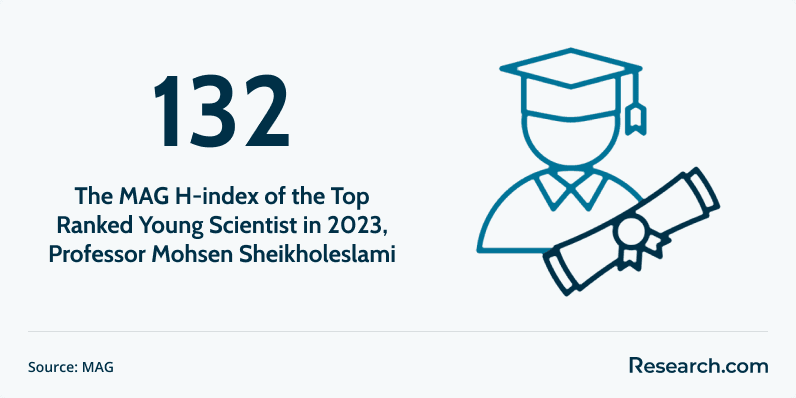
Professor Mohsen Sheikholeslami of Babol Noshirvani University of Technology returns to first place in the 2023 world ranking. His H-index increased from 126 in 2022 to 132, and he has 45,323 citations and 493 publications. He ranks first in both Asia and Iran.
Professor Bach Xuan Tran of Hanoi Medical University moves into second place after ranking third in 2022. He has an H-index of 93, along with 124,680 citations and 377 publications. He ranks second in Asia and first in Vietnam.
Professor Matthew D. Hellmann of Memorial Sloan Kettering Cancer Center is third after holding the second position in the previous ranking. His H-index is 91, with 57,924 citations and 343 publications. He ranks first in North America and first in the United States.
Professor Daqin Chen of Fujian Normal University ranks fourth after climbing 31 positions from 2022. His H-index rose from 73 to 90, and he has 22,597 citations and 307 publications. He ranks third in Asia and first in China.
Professor Muhammad Ijaz Khan of Riphah International University enters the ranking in fifth place. He has an H-index of 88, with 19,656 citations and 473 publications. He ranks fourth in Asia and first in Pakistan.
Continental leaders
Asia is led by Professor Mohsen Sheikholeslami of Babol Noshirvani University of Technology, whose H-index of 132 also places him first in the world ranking.
North America’s top-ranked rising star is Professor Matthew D. Hellmann of Memorial Sloan Kettering Cancer Center. He has an H-index of 91 and ranks third globally.
Europe’s leading rising star is Professor Giovanni Benelli of the University of Pisa in Italy. His H-index is 84, and he is ranked eighth in the world.
Oceania is led by Professor Xiaoguang Duan of the University of Adelaide in Australia. He has an H-index of 76 and holds the 22nd position globally.
Africa’s highest-ranked rising star is Professor Abdon Atangana of the University of the Free State in South Africa. His H-index is 67, and he ranks 52nd worldwide.
South America is led by Professor Felipe Barreto Schuch of Universidade Federal de Santa Maria in Brazil. A new entry in the 2023 ranking, he has an H-index of 49 and ranks 227th in the world.
Averages, citations, and publication patterns
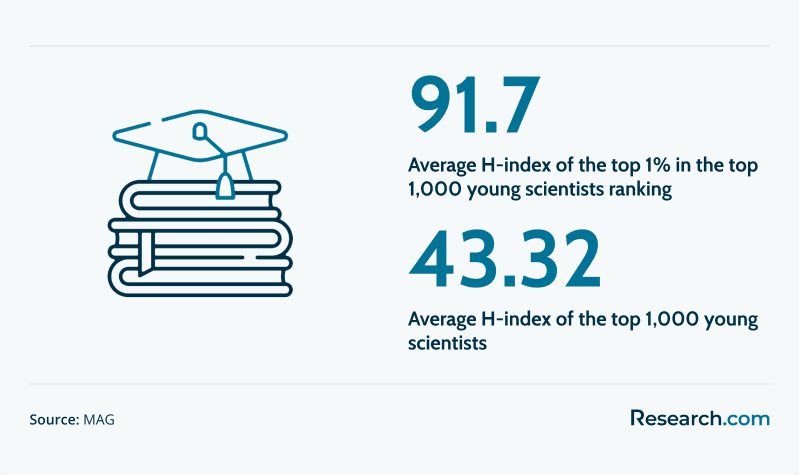
The top 1% of ranked young scientists in 2023 have an average H-index of 91.7, a decrease of 1.3 points from the previous year. This is more than twice the average H-index of 43.32 for the top 1,000 scholars. In the H-index distribution, one scientist falls in the 130-139 range, three are in the 90-99 range, 12 are in the 80-89 range, and the remaining ranked rising stars are below 80.
Citation counts also show a wide gap between the top 1% and the broader top 1,000. The top 1% average 39,354.9 citations, while the top 1,000 average 9,256.36. The most cited scholar in the 2023 world ranking is Professor Xiangyu Zhang of Megvii in China, with 146,254 citations. He is followed by Professor Bach Zuan Tran with 124,680 and Professor Amir Kasaeian with 120,990.
Publication volume follows a similar pattern. The top 1% average 339.1 publications, compared with 137.47 for the top 1,000 rising stars. Professor Simplice A. Asongu of the African Governance and Development Institute in Cameroon has the highest publication count, with 1,190. He is followed by Professor Yu-Ming Chu with 663 and Professor Kottakkaran Sooppy Nisar with 634.
Research.com’s methodology explains how profiles, metrics, and field-specific thresholds are evaluated. Readers can review the ranking process in the methodology section.
What aspiring scientists can learn from the ranking
The ranking highlights several practical lessons for students and early-career researchers. First, institutional ecosystem matters. Many ranked scientists are affiliated with universities, academies, medical centers, and research organizations that provide strong collaboration networks and publication infrastructure. Second, research fields differ in citation patterns, so students should not compare metrics across disciplines without context. Third, early productivity often comes from focused research agendas, strong coauthor networks, and consistent publication activity.
For students, the main takeaway is not to chase rankings blindly. Instead, use them to identify active research environments, potential mentors, and fields where your interests align with genuine scholarly opportunity.
| If your goal is... | Prioritize this | Avoid this mistake |
| Entering a research career | Programs with faculty-led research, lab access, and publication opportunities | Choosing a school only because it appears in a ranking |
| Preparing for graduate school | Strong methods courses, thesis options, faculty mentorship, and recommendation opportunities | Ignoring whether credits and prerequisites match future PhD or master’s requirements |
| Building technical research skills | Hands-on coursework in statistics, coding, instrumentation, fieldwork, or lab methods | Selecting the fastest program without checking skill depth |
| Reducing education costs | Transfer pathways, scholarships, assistantships, employer support, and public institutions | Comparing only tuition while overlooking fees, materials, relocation, or lost income |
| Choosing an online pathway | Accreditation, research support, faculty access, and fit with discipline requirements | Assuming every online program is suitable for laboratory-heavy or licensure-linked fields |
Common mistakes when using science rankings
- Treating one metric as a complete measure of excellence. H-index, citations, and publications are useful, but they do not capture every dimension of research quality.
- Comparing scholars across fields without discipline context. Citation norms vary substantially by research area.
- Assuming country affiliation equals nationality. In this ranking, the country reflects the scientist’s institutional affiliation.
- Choosing a school based only on institutional visibility. A famous institution may not have the right mentor, lab, funding, or research fit for a specific student.
- Prioritizing speed over preparation. Accelerated programs can help, but weak research training can slow a student down later.
- Ignoring accreditation and transfer rules. Students should verify institutional quality and whether credits support future academic goals.
Questions to ask before choosing a research-focused academic path
- Does the program offer direct access to faculty who publish in my area of interest?
- Are undergraduate or master’s students allowed to participate in research projects?
- Is there a thesis, capstone, lab, fieldwork, or independent research option?
- How often do students present at conferences or coauthor publications?
- Will credits transfer if I begin with an associate degree or accelerated pathway?
- Does the program prepare students for doctoral study, industry research, or technical roles?
- Are there assistantships, scholarships, grants, or employer benefits that can reduce cost?
- If the program is online, how does it provide mentoring, research supervision, and hands-on training?
About Research.com
The research process was coordinated by Imed Bouchrika, Ph.D., a computer scientist with extensive experience collaborating on international academic research projects. His role was to oversee the process so that the data remained unbiased, accurate, and current.
Research.com is a research and education platform focused on science rankings, academic discovery, college guidance, and career planning. The site helps professors, research fellows, students, and professionals identify leading experts, compare educational options, and make better-informed academic and career decisions.
Key insights
- The 2023 Rising Stars of Science ranking is based on over 166,880 scientist profiles and includes researchers who published their first paper less than 13 years ago.
- China leads the top 1,000 with 353 rising stars, followed by the United States with 171 and Iran with 51.
- Mohsen Sheikholeslami ranks first globally with an H-index of 132 and is also the top-ranked rising star in Asia and Iran.
- The Chinese Academy of Sciences has the most ranked scholars among institutions, with 24 in the top 1,000.
- The top 1% of rising stars substantially outperform the broader top 1,000 on average H-index, citations, and publications.
- Students should use rankings as a research tool, not a standalone decision-maker. Faculty fit, research access, program rigor, accreditation, cost, and career goals should guide academic choices.
- Accelerated and online pathways can be useful when they preserve quality and support research preparation, but speed alone does not create scientific impact.


