
Ranking of the Best Scientists in the World in 2025 (4th Edition)

Co-Founder and Chief Data Scientist
On September 19, 2025, Research.com released the 4th edition of its annual ranking of the world's top scientists. This report highlights the most influential scholars and their contributions across a wide range of scientific disciplines. The ranking serves as a key resource for identifying leading experts and emerging trends in global research.
A review of the top scholars reveals a significant concentration of talent within the United States. All of the top 10 scientists on the list are affiliated with American institutions. These include Harvard University, the Broad Institute, and the Massachusetts Institute of Technology (MIT).
This year's report is the result of a meticulous examination of 1,090 scientist profiles from around the world. The goal is to provide a reliable and comprehensive assessment of scholarly impact. This process ensures that the ranking reflects the current landscape of scientific achievement.
The criteria for inclusion require scholars to meet specific benchmarks. Scientists are evaluated based on their discipline H-index, the proportion of their work within a given field, and their awards. A discipline H-index of at least 30 is the primary threshold for consideration.
Latest discoveries in research
In medical research, a study in the August 2025 issue of Nature Medicine presents a significant advance in the fight against neurodegenerative diseases. Researchers detail a new blood test capable of detecting molecular signals of amyotrophic sclerosis (ALS) years before physical symptoms emerge. This breakthrough in proteomics and machine learning holds the potential to revolutionize early diagnosis and intervention for similar neurological conditions.
Chemists report a new synthetic pathway to recreate powerful molecules from guava plants that show promise against liver cancer. The work, published in the September 2025 issue of Angewandte Chemie, provides a low-cost and scalable method for producing these naturally occurring compounds. This innovation opens the door for developing more effective and accessible treatments for liver-related cancers.
The key findings for the 2025 edition of the best scientists ranking
- The United States is the leading country with 583 scientists in the top 1,000, representing 58% of the list.
- Harvard University is the top institution, with 70 of its scholars included in the ranking.
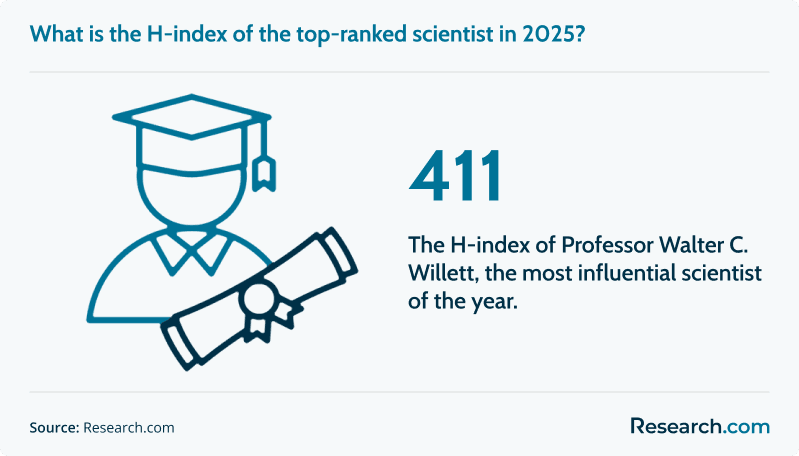
- Dr. Walter C. Willett of Harvard University retains his position as the world’s number one scientist.
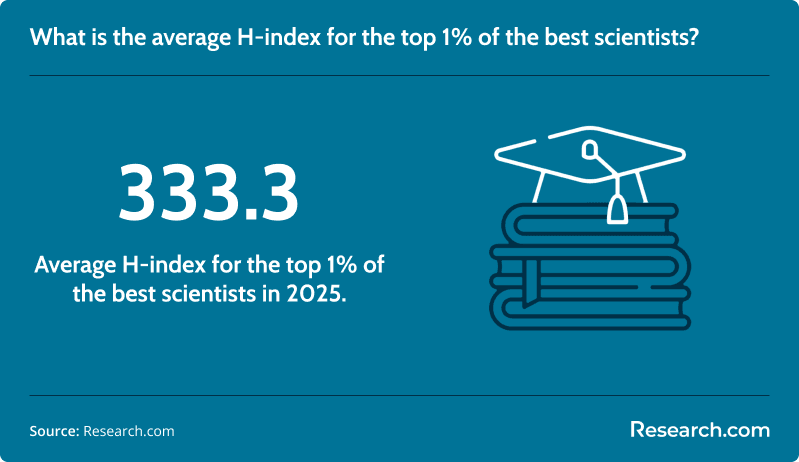
- The average H-index for the top 1% is 333 vs. the rest of the ranked 1,000 scientists at 191.
- All 1,000 scientists featured in the ranking have an H-index of at least 164.
WORLD'S BEST SCIENTISTS RANKING
Countries with the highest number of leading scientists
The United States continues to lead the world in scientific research, with 583 scholars in this year's top 1,000 ranking. This represents a slight decrease from the 606 scientists it had last year. Despite the drop, the U.S. is home to 58% of the world's leading researchers.
The United Kingdom remains in second place with 96 scientists, a decrease from 100 in the previous year. Germany holds the third spot with 52 scholars, an increase from 47 from last year's report. The Netherlands has seen a notable increase, rising to 30 scientists from 23 last year.
Australia rounds out the top five with 27 scientists, an increase from 24 in the prior year. China also shows growth with 27 top scientists, up from 22. The data suggests a stable but highly concentrated global research landscape, with North America and Europe as the dominant hubs.
Institutions with the highest number of leading scientists
Harvard University once again leads all institutions, with 70 top scientists affiliated with the university. This marks an increase from the 64 scholars it had in the previous year. The university is home to more than three times the number of top scientists as the next institution on the list.
Stanford University and the National Institutes of Health share the second position, each with 21 affiliated scientists. This number is unchanged for Stanford, which also had 21 scientists last year, while the NIH sees an increase from 20. MIT and the University of California, San Diego are tied with 18 scientists each.
American institutions dominate the top of the ranking, occupying the top six positions. The University of Cambridge is the highest-ranking non-U.S. institution, with 17 top scientists. Overall, 16 of the top 20 institutions are based in the United States, underscoring the nation's concentration of elite research talent.
Online universities advance academic research
The landscape of higher education is evolving, with new models for learning and research gaining prominence. This shift enables greater flexibility and increased access to academic resources. It also creates new avenues for scholarly collaboration across geographical boundaries.
Institutions are adapting to this new environment by expanding their digital offerings. According to National Center for Education Statistics (NCES) data, enrollment in exclusively distance education programs at four-year institutions grew by 5.9% in Fall 2023 compared to the previous year. Top-tier online universities now provide robust platforms for both students and faculty to engage in meaningful research projects.
The growth of online universities also contributes to the global research ecosystem by connecting scholars from diverse backgrounds. These platforms facilitate cross-institutional partnerships and help disseminate scientific knowledge more broadly. This trend suggests a more interconnected and accessible future for academic research.
H-index ranking—leaders, averages, and distribution
Professor Walter C. Willett of Harvard University leads the ranking for North America and the world. He holds the number one spot with an H-index of 411. This confirms his position as the most influential scientist globally.
Asia's leading scientist is Professor Shizuo Akira of Osaka University, Japan, who ranks 12th globally with an H-index of 307.
In Europe, Professor Guido Kroemer from Université Paris Cité in France is the top scholar, ranking 13th worldwide with an H-index of 297.
Professor Nicholas G. Martin of Australia's QIMR Berghofer Medical Research Institute is the top scientist in Oceania, placing 63rd in the world.
Africa's leading scholar is Professor Dan J. Stein from the University of Cape Town, ranked 433rd.
For South America, Professor Maria-Teresa Dova of the National University of La Plata in Argentina leads the continent with a world ranking of 620.
The average H-index for the top 1% of scholars is 333, compared to an average of 191 for the entire list of 1,000 scientists.
The minimum H-index to be included in this year's ranking is 164. This marks an increase from the minimum of 160 required in 2024.
The top 1% of scientists have an average of 2,007 publications and 480,712 citations. In comparison, the average for all 1,000 ranked scholars is 1,152 publications and 18,1006 citations.
The most cited scientist is Douglas G. Altman from the University of Oxford, United Kingdom, with 1,247,315 citations.
About Research.com
All research was coordinated by Imed Bouchrika, Ph.D., a computer scientist with a well-established record of collaboration on several international research projects with different partners from the academic community. His role was to make sure all data remained unbiased, accurate, and up-to-date.
Research.com is the number one research portal for science and educational rankings. Our mission is to make it easier for professors, research fellows, and students to progress with their research and find the top experts in a wide range of scientific disciplines. Research.com is also a leading educational platform that helps students find the best colleges, academic opportunities, and career paths. You can learn more about the methodology used to create this report here.


