
World Online Ranking of Best Social & Humanities Scientists – 2025 Report

Co-Founder and Chief Data Scientist
On May 23, 2025, Research.com released the 4th edition of its annual ranking of the best social sciences and humanities scientists. This yearly report aims to spotlight outstanding scholars and the impact of their work across academic disciplines. It also seeks to support the global academic community by helping institutions and researchers discover key contributors in these areas.
We share these rankings to highlight the valuable research led by the brightest minds in the humanities and social sciences. This report opens doors for scholars, students, policymakers, and professionals to explore the work and direction of leading researchers worldwide. It also creates a space to recognize their ongoing efforts and influence in shaping conversations and solutions in education, society, culture, and behavior.
For the 2025 edition, the team reviewed 6,144 researcher profiles using data from well-established bibliometric sources. The selection process examined publication records, citation impact, and research contributions. This careful review ensures the ranking reflects up-to-date insights into academic excellence.
For inclusion, researchers are required to have a discipline-specific D-index of at least 30, particularly those whose primary area of research is the humanities and social sciences. Beyond this, the ranking assesses the extent to which the scholar’s work focuses on the field and the honors and recognition they have received. These criteria ensure the scientists featured in the report are productive, deeply involved, and respected in their disciplines.
Latest discoveries in social science and humanities research
A recent study published in Humanities and Social Sciences Communications explored the creative capabilities of artificial intelligence (AI) in playwriting. Researchers compared an AI-generated play to one written by a human, assessing originality, fluency, flexibility, and effectiveness. The human-authored play scored higher across all metrics. Still, the AI-generated script demonstrated notable creative potential, approaching human proficiency in several areas. This suggests that while AI has not yet matched human creativity, it holds promise for contributing meaningfully to literary arts in the future.
In the realm of education, another study in the same journal examined the impact of virtual reality (VR) technology on fostering creativity among college students. The systematic review analyzed 16 articles published between 2014 and 2023, focusing on VR's role in enhancing learners' creativity. Findings indicated that VR was predominantly used in disciplines like art design, engineering, and education-related courses. While the use of VR to develop learning materials for college students remains relatively limited, the technology shows significant promise in providing immersive and interactive learning experiences that can stimulate creative thinking.
The key findings for the 4th edition of the best social and humanities scientists ranking
- The United States leads with 486 scientists in the top 1,000 ranking, making up nearly half of the total list.
- Harvard University tops all institutions with 35 scientists ranked among the top 1,000.
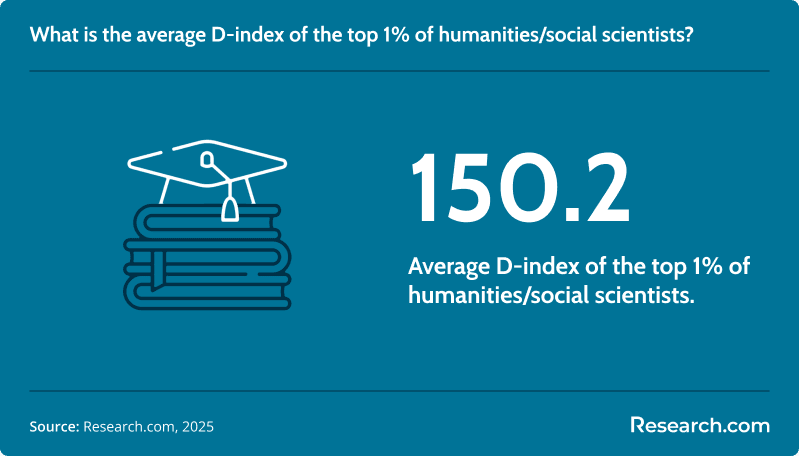
- The average D-index among the top 1% of scientists is 150.2, nearly double the overall average of 78.31.
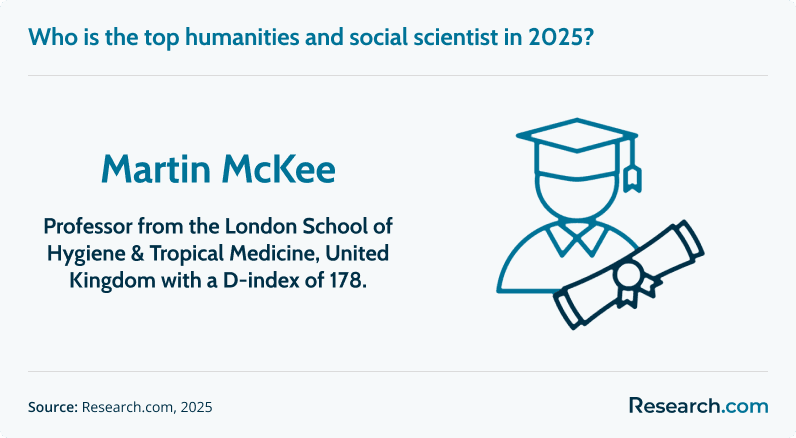
- Professor Martin McKee from the United Kingdom holds the top global ranking with a D-index of 178.
- The top 1% of scientists have published an average of 724.9 discipline-related articles, more than twice the overall average of 331.82.
- The average number of discipline citations among the top 1% is 194,030.7, while the full group averages 42,642.22.
The full ranking for the 2025 list of top humanities & social scientists can be found here:
TOP HUMANITIES & SOCIAL SCIENTISTS RANKING
Countries with the highest number of leading social and humanities scientists
In the 2025 report, the United States again leads with the highest number of top-ranking social and humanities scientists. A total of 486 U.S.-based researchers has appeared in the top 1,000 list. While this still places the country firmly in the lead, the number marks a slight decline from last year’s total of 506. Despite the drop, the U.S. remains the most significant contributor, accounting for nearly half of the scholars listed in this year’s global ranking.
The United Kingdom retains its second-place position, with 185 scientists featured, one more than in the previous year. Australia remains in third place, showing growth, with an increase in its presence from 68 scientists in 2024 to 74 in this edition. Canada also shows a slight increase, now represented by 59 scholars, up from 56. The Netherlands rises from 35 to 42 scientists, marking a steady improvement in its academic output and visibility in the field.
Germany, however, experiences a slight decline, dropping from 26 to 25 scientists. China holds steady with 13 scholars, while South Africa has 11, one fewer than last year. France enters the top ten with 10 researchers, down slightly from 11. Finland also keeps its spot in the top 10 with 10 scientists, up from 9 in 2024.
This year’s data reflect both consistency and small shifts. While the top countries remain largely unchanged, a few nations have edged forward or backward. These slight changes may indicate evolving research investments and growing academic visibility in emerging regions.
Please note that the country associated with a scientist is based on their affiliated research institution according to MAG, not on their actual nationality.
Institutions with the highest number of leading scientists
In the 2025 report, Harvard University remains the top institution with 35 scientists featured in the top 1,000, down from 37 in 2024. This 5.4% decrease still leaves Harvard well ahead of other institutions. The University of Michigan–Ann Arbor follows with 22 scientists, marking a 4.7% increase from 21 last year. University College London maintains third place with 17 scholars, showing no change compared to 2024.
U.S. universities dominate the list, holding 70% of the top 10 positions. The University of California, Los Angeles, the University of Oxford, and the University of Toronto each have 16 ranked scientists, reflecting growth for UCLA (from 14) and stability for the others. Stanford and Columbia Universities follow closely with 15 scientists each, while Johns Hopkins has 14.
Outside the U.S., the University of Oxford, University College London (U.K.), and the University of Toronto (Canada) remain strong contributors. Utrecht University (Netherlands) also ranks in the top 20, with 11 scientists. These non-U.S. institutions represent 25% of the top affiliations, underscoring their ongoing contributions to international research in the social sciences and humanities.
Some institutions experience a drop in ranking or scientist count compared to 2024. This shift suggests a rebalancing among research institutions and reflects changing trends in global scientific output.
How online universities are expanding research in the humanities and social sciences
Online universities are helping reshape how humanities and social sciences research is developed, shared, and accessed. By offering flexible and accessible education, these institutions create more inclusive research communities. Latest data from the NCES indicate that over 37,000 bachelor's degrees were awarded in the liberal arts and humanities, in addition to more than 151,000 in the social sciences. Many of these graduates earned their degrees through online programs. With digital platforms, students and scholars from diverse backgrounds—regardless of location—can engage in collaborative research, attend virtual conferences, and contribute to global discussions on culture, society, and human behavior.
Online universities also help scale access to research resources. Students enrolled in online social science or humanities programs benefit from digital archives, cloud-based collaboration tools, and real-time feedback from faculty and peers. These features are narrowing the gap between traditional and non-traditional research environments. As online universities grow in popularity, they're increasing enrollment numbers and expanding the scope and reach of academic inquiry. This trend helps ensure that research in the humanities and social sciences remains vibrant, adaptive, and inclusive in a fast-changing world.
D-index ranking — leaders, averages, and distribution
For Europe, Professor Martin McKee from the London School of Hygiene & Tropical Medicine, United Kingdom, leads the global ranking with a D-index of 178 and holds the 1st position worldwide.
For North America, Professor Dianne Neumark-Sztainer of the University of Minnesota, United States, ranks 2nd globally with a D-index of 156, making her the top scholar in the region.
In Asia, Professor Chin Chung Tsai from National Taiwan Normal University, Taiwan, is the highest-ranked scientist with a D-index of 112, ranking 31st globally.
Professor Carlos Augusto Monteiro from Universidade de São Paulo, Brazil, is the top-ranking scholar from South America, with a D-index of 105 and a global rank of 47.
For Oceania, Professor Rod Ellis from Curtin University, Australia, leads the region with a D-index of 104, holding the 50th spot in the overall ranking.
In Africa, Professor Rachel Jewkes from the South African Medical Research Council, South Africa, ranks highest with a D-index of 97 and is placed 85th globally.
The average D-index among the top 1% of scientists in the top 1000 list is 150.2, compared to an overall average of 78.31 for all included scholars.
The average number of discipline-specific publications for the top 1% is 724.9, while the overall average across all 1000 scientists is 331.82.
Regarding citations, the top 1% have an average of 194,030.7 discipline citations, significantly higher than the overall average of 42,642.22.
The scholar with the lowest D-index to make it into the 2025 ranking has an index of 30.
You can learn more about the methodology used to create this report here.
About Research.com
All research was coordinated by Imed Bouchrika, Ph.D., a computer scientist with a well-established record of collaboration on a number of international research projects with different partners from the academic community. His role was to make sure all data remained unbiased, accurate, and up-to-date.
Research.com is the number one research portal for science and educational rankings. Our mission is to make it easier for professors, research fellows, and students to progress with their research and find the top experts in a wide range of scientific disciplines. Research.com is also a leading educational platform that helps students find the best colleges, academic opportunities, and career paths.


