
World Ranking of Female Scientists in 2025 (4th Edition)

Co-Founder and Chief Data Scientist
On September 17, Research.com released the 4th edition of the annual online Ranking of Best Female Scientists in the World.
Women have always been at the forefront of scientific discovery, pushing the boundaries of human knowledge. To honor their invaluable contributions and inspire the trailblazers of tomorrow, we are proud to announce the release of our annual online Ranking of Best Female Scientists in 2025.
From the labs that pioneer life-saving medicines to the observatories that map distant galaxies, this report is more than just a ranking; it is a celebration of the brilliant minds shaping our future and a powerful beacon for the next generation of women and girls in STEM.
As we celebrate these remarkable achievements, we also take a moment to reflect on the landscape they navigate, one filled with groundbreaking progress and persistent challenges, and explore the path toward a more equitable and inclusive scientific community.
Key Findings from the 2025 World Ranking of Female Scientists
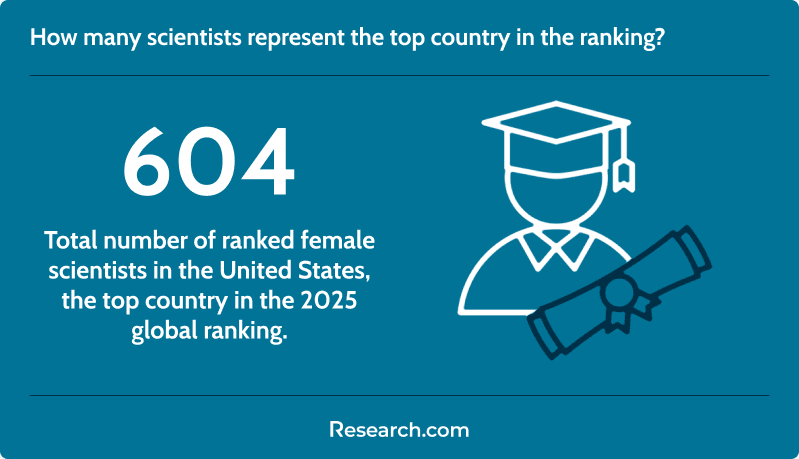
- Scientists from the United States dominate the top female scientists ranking with 601 scholars from this country being ranked in 2025 (60% of the whole ranking).
- Other countries leading the ranking are the United Kingdom (93 scientists or 93%), and Germany (42 scientists or 4.2%).
- Eight out of 10 female scientists in the top 1% are from the United States.
- Harvard University is the leader of the 2025 top female scientists ranking, with 39 leading female scholars affiliated with that institution.
- The best female scientist in the world is Professor JoAnn E. Manson from Harvard Medical School, known for her pioneering research in the fields of epidemiology, endocrinology, and women's health.
- 9 out of 10 institutions with the highest number of leading female scientists are based in the US, with the only other institution among them being the University of Oxford.
- The average number of publications for top female scientists is 625.
The full ranking for the 2025 list of top female scientists in the world can be found here:
TOP FEMALE SCIENTISTS IN THE WORLD 2025
The Female Scientist: Overcoming Systemic Hurdles
The path for women in science is often a steep climb. While we see the increased presence of women scientists, many systemic hurdles still stand in the way. Women are entering the field of research in greater numbers. They now make up 41% of researchers globally. Yet, this number shrinks at higher career levels. Only 27% of senior roles are held by women, a drop-off known as the "leaky pipeline." This means the proportion of women decreases with each qualification level.
Societal pressures add to the challenge. Women often carry a heavier load of family and domestic duties. This creates a difficult balancing act between professional and personal life. This imbalance is a key reason why many talented women leave science.
Speaking on the challenges limiting equal representation in STEM research, an interview with Prof Asifa Akhtar, Vice President of the Max Planck Society's Biology and Medicine section, Prof Akhtar says, "This leaky pipeline is just not simply solved by infrastructure because to solve it we must get rid of our inherent biases. By setting good examples, we can enable people to see that both roles - as a women and as a female scientist - are possible and should be nurtured.”
Bias remains a significant barrier. It can be seen in evaluation and promotion processes. It also appears in the gender pay gap. In the United States, Black and Hispanic women in STEM jobs earn about $33,000 less than their white male counterparts. These challenges show a clear need for systemic change to support and retain women in all stages of their scientific careers.
Countries with the Best Female Scientists
The presence of female scientists in the top 1,000 rankings differs widely from one country to another, highlighting variations in policies, cultural attitudes, and support systems that influence women’s participation in science.
The United States tops the list with 601 female scientists, a figure driven by its strong research infrastructure and substantial investment in science. This represents 60.1% of the entire ranking, down from 616 scientists in 2024.
The United Kingdom takes second place with 93 leading female scientists—one more than the previous year. Germany remains third with 42 scientists, an increase from 39 in 2024.
Australia ranks next with 35 female scientists, reflecting progress fueled by initiatives such as the Science in Australia Gender Equity (SAGE) program. Canada follows closely with 31, while France counts 31 as well.
The Netherlands holds steady with 27 female scientists but moves up to seventh place. Italy records 27 scientists this year, supported by European Union programs like Horizon 2020, which emphasize gender equality in research and innovation.
China shows steady growth with 15 female scientists through national efforts to advance gender equity in research. Spain rounds out the top 10 with 13 female scientists.
A Year of Remarkable Advancements
The year 2025 has been marked by extraordinary scientific achievements, with women leading the charge in diverse and critical fields. These breakthroughs not only advance human knowledge but also demonstrate the profound impact of women in science.
In South Africa, Professor Priscilla Baker is pioneering new ways to protect our health and environment. Her work in analytical chemistry has led to ultra-sensitive microsensors that can detect harmful contaminants in everything from our food and water to pharmaceuticals.
From Germany, Professor Claudia Felser is revolutionizing physics and green technology. Her visionary research has led to the creation of new magnetic materials. She has effectively sparked a new field known as "topological quantum chemistry," bridging fundamental science with real-world applications.
In the United States, we can all breathe a little easier because of Professor Barbara Finlayson-Pitts. Her groundbreaking research into atmospheric chemistry revealed the molecular processes that form air pollution and smog, which has directly shaped public policy and regulations.
This chart illustrates the global distribution of leading female scientists by country, showing which nations have the highest numbers of accomplished women in scientific fields. It is important to note that the country associated with a scientist is based on their affiliated research institution, not on their actual nationality.
Institutions with the Best Female Scientists
Several top institutions stand out for hosting large numbers of leading female scientists. Harvard University leads with 39 female scientists in the top 1,000 rankings, down from 42 in 2023. The National Institutes of Health follows closely with 33 female scholars.
Stanford University holds third place with 25 top female scientists, supported by its strong research programs and interdisciplinary focus. The University of California–San Francisco comes next with 22, down from 24 in 2023, underscoring its ongoing contributions to medical and biomedical research.
Columbia University rose from seventh place in 2024 to fifth this year with 17 scientists. The University of Oxford also counts 17—up from 16—making it the only non-U.S. institution in the top 10.
MIT, with 15 female scientists, climbed a notch from its previous ranking. The University of Pennsylvania follows in eighth place with 15, reflecting its wide-ranging research environment.
The University of Texas MD Anderson Cancer Center ranks ninth with 13 female scientists, while Yale University rounds out the top 10 with 13 as well, reinforcing its commitment to research excellence. Together, these institutions highlight how robust research cultures and supportive systems drive women’s success in science.
How do certificate courses improve the prospects of women aspiring to enter the science field?
Short-term and strategic certification programs are a powerful tool for women in general looking to get into the science field. These programs allow them to rapidly acquire essential technical and managerial skills, bridging knowledge gaps and fostering technical abilities in a dynamic job market. By integrating these specialized credentials, women can start gaining experience across disciplines and a competitive edge for institutional positions in the future. For example, pursuing 6 month certificate programs is an excellent way to start a career and build a more diverse professional profile later.
What are the best-paying emerging careers for female scientists?
Female scientists are increasingly finding diverse and impactful career paths outside of traditional academia. Industries like biotechnology, data science, and consulting are now offering lucrative roles that prize a blend of scientific knowledge and business skills. These positions provide not only higher financial compensation but also new avenues for leadership and innovation in fast-paced fields. By exploring a wider range of jobs for women, female scientists can discover opportunities that make the most of their technical expertise and offer significant professional growth.
The Growing Global Impact of Women Scientists Through Online Platforms
In the modern scientific era, the lone genius is a myth. Progress is driven by vast, interconnected teams, and increasingly, women are at the helm of these global collaborations, shaping the direction of entire fields. Recent years have seen women leading massive consortia via online universities to decode our very biology, chart the cosmos, and steer the future of artificial intelligence.
One of the most significant biological breakthroughs of the decade emerged in May 2023 with the publication of the first human pangenome. This monumental effort was co-led by a diverse group of scientists within the Human Pangenome Reference Consortium (HPRC), with figures like Dr. Karen Miga of UC Santa Cruz and Dr. Ting Wang of Washington University in St. Louis playing central roles.
Their collaboration was not a simple partnership but a masterclass in scientific orchestration, coordinating hundreds of researchers across dozens of online institutions.
Looking to the stars, the next decade of astronomy is being shaped by the leadership collaboration at the Vera C. Rubin Observatory. Dr. Željka Ivezić, the Observatory's Director, works in close concert with leaders like Sandra Charles, the Head of Commissioning and Science Verification.
Their collaboration is one of immense scale and complexity, involving the integration of the world's largest digital camera, a massive telescope, and a complex data system. This partnership among online universities ensures that when the Rubin Observatory begins its 10-year survey of the night sky, it will be ready to deliver an unprecedented cosmic movie, enabling discoveries for thousands of scientists worldwide.
In the field of AI, the work of researchers Dr. Timnit Gebru and Dr. Margaret Mitchell exemplifies a modern, distributed form of scientific partnership. Through their respective research institutes—Gebru's DAIR (Distributed AI Research) and Mitchell's work on AI ethics—they continue to collaborate on research, publications, and advocacy.
Their ongoing dialogue and shared research goals have created a powerful counter-narrative to the tech industry's rapid deployment of AI, forcing critical discussions on bias, harm, and societal impact at the highest levels of policy and industry. This collaborative effort is building the very foundations of a more responsible and ethical AI future.
H-Index Ranking: Leaders, Averages, and Distribution
In terms of the impact of a particular female scientist or the h-index, Professor JoAnn E. Manson from Harvard Medical School is at the top of the list for North America. She also leads the top 1000 list with an h-index of 320.
Professor Kay-Tee Khaw from the University of Cambridge tops the list for Europe, placing sixth in the world ranking with an h-index of 221.
For Oceania, Professor Louisa Degenhardt from the University of New South Wales in Australia leads the list of female scientists in the region. She holds rank 102 in the world ranking.
Professor Yi Xie from the University of Science and Technology of China in China tops the list for Asia with an h-index of 166. In the world ranking, she is at the 76th spot.
The top female scientist in Africa is Professor Linda-Gail Bekker from the University of Cape Town in South Africa. She is at number 672 in the top 1,000 list.
Finally, for South America, Professor Maria-Teresa Dova from the National University of La Plata in Argentina is the top scientist and is also ranked number 46 among female scientists across the globe.
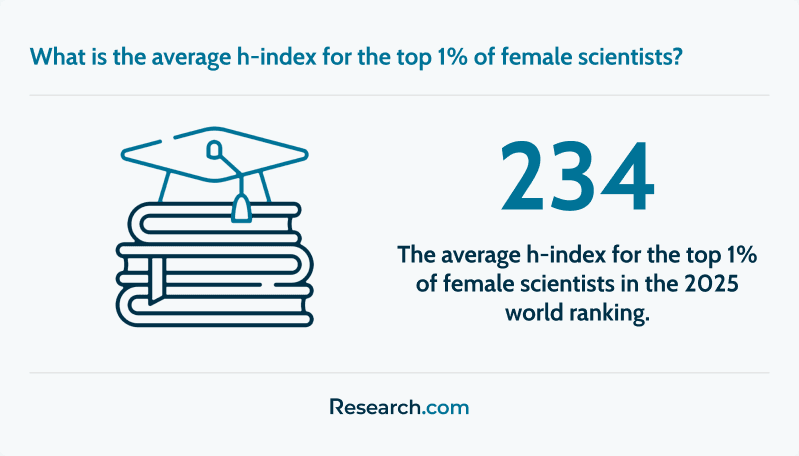
The average h-index for the top 1% of scientists is 234 against an average of 128 for the top 1000 female scientists included in the ranking. The scholar with the lowest index value who made it to the ranking in 2025 has an h-index of 106.
The average number of published articles for the top 1% of scientists in the ranking is 1248.7 against an average of 625 for the top 1000 female scholars.
For the top 1% of scientists, the average number of citations is 259,875.4 against an average of 79,198.08 for the top 1000 female scholars. The most frequently cited female scientist is Stacey Gabriel from Broad Institute in the United States with 462,589 citations.
The Power of Visibility: Why Role Models and Mentors Matter
You cannot be what you cannot see. This simple truth is a powerful force in science. For many young women in STEM, the path forward is unclear. They often lack mentors to guide them through career challenges. This absence is a key driver of the leaky pipeline. Talented women leave their fields not for a lack of skill, but for a lack of support and guidance.
For Ulrike Boenisch of the Max Planck Institute, mentorship is crucial. In an interview celebrating women in science, she underscored the role of mentors. "I can't help but wish I had been more discerning about the opportunities I pursued, looking for programs that offered more than just a position but also mentorship, peer support, and a definitive end point. It's crucial to ensure that you are gaining valuable experiences and not overstaying in your doctoral studies without clear progress. If I could give advice to my younger self, it would be to seek out environments that offer mutual growth, ensuring that while you contribute, you're also receiving something enriching in return."
Mentorship is a powerful antidote. It provides a crucial support system. It helps build confidence and navigate complex academic and corporate structures. Studies confirm this. Mentorship programs significantly improve both promotion and retention rates for women in science.
This is why celebrating success is so vital. Our World Ranking of Female Scientists is more than an honor roll; it is a source of inspiration. It makes success visible. Each scientist on the list, from pioneers in genetics to leaders in astrophysics, serves as a powerful role model. They show aspiring girls and young women what is possible. By celebrating these leaders, we are not just honoring their work. We are lighting the way for the scientists of tomorrow.
Building a More Inclusive Future
The story of women in science in 2025 is one of dual realities. It is a story of breathtaking achievement, of shattering long-standing barriers, and of leading humanity toward a brighter future. It is also a story of a persistent climb, marked by systemic hurdles that demand our attention and action.
Celebrating these remarkable women is vital, but celebration alone is not enough. We must translate inspiration into action. Building a truly inclusive scientific community requires a deliberate and sustained effort from everyone. The progress we see is not accidental; it is the result of focused work that must continue.
While programs like Million Women Mentors and Girls Who Can Code have successfully inspired women to enter STEM, a significant gender gap persists. In 2023, women made up only 28% of the global STEM workforce. This disparity is even more pronounced in specific regions, with women representing just 18% of the STEM workforce in the United States, 17% in the European Union, 16% in Japan, and 14% in India.
Institutions must lead the way. They can start by implementing policies that support a healthy work-life balance, such as flexible work arrangements and accessible childcare. Creating safe and respectful work environments, free from bias and harassment, is non-negotiable. This means robust reporting systems and clear accountability.
Investment is also critical. We must continue to fund mentorship programs that guide women through every stage of their careers. Furthermore, funding agencies should actively seek out and support women-led research, ensuring their innovative ideas receive the resources they deserve.
DynaMENT is an example of a mentoring program for female researchers in the natural sciences. It is a joint initiative of DESY (German Electron Synchrotron) and the MIN faculty at Universität Hamburg. The program aims to support and advise women in developing their careers in the natural sciences and finding solutions to career-related questions. The program's services include one-on-one sessions with experienced mentors, individual assessments, networking opportunities, and workshops.
The goal is simple: to create a future where the scientific landscape is as diverse as the world it seeks to understand. The Top 1000 Female Scientists report is a powerful reminder of the talent that is already here. Now, let us commit to building the structures that will ensure the next generation of women does not just survive in science, but thrives.
About Research.com
All research was coordinated by Imed Bouchrika, Ph.D., a computer scientist with a well-established record of collaboration on a number of international research projects with different partners from the academic community. His role was to make sure all data remained unbiased, accurate, and up-to-date.
Research.com is the number one research portal for science and educational rankings. Our mission is to make it easier for professors, research fellows, and students to progress with their research and find the top experts in a wide range of scientific disciplines. Research.com is also a leading educational platform that helps students find the best colleges, academic opportunities, and career paths. You can learn more about the methodology used to create this report here.


